---
title: "Agentic AI Explained: What AI Agents Can (and Cannot) Do for Your Business"
url: "https://www.krishaweb.com/blog/agentic-ai-explained-ai-agents-business/"
date: "2026-10-05T12:50:44+00:00"
modified: "2026-10-05T12:50:45+00:00"
type: "Article"
resource: "https://www.krishaweb.com/blog/agentic-ai-explained-ai-agents-business/"
timestamp: "2026-10-05T12:50:45+00:00"
author:
name: "Nirav"
url: "https://www.krishaweb.com"
categories:
- "Web Development"
word_count: 3145
reading_time: "16 min read"
summary: "“Agentic AI” is the most hyped term in business technology right now, and also one of the most misunderstood. Vendors promise autonomous digital workers that run your business while you sleep. ..."
description: "Agentic AI explained honestly: what AI agents can and can't do for your business, with real use cases, costs, and governance tips."
keywords: "agentic AI development, Web Development"
language: "en"
schema_type: "Article"
related_posts:
- title: "10 Business Workflows You Can Automate With AI Right Now"
url: "https://www.krishaweb.com/blog/business-workflows-automate-with-ai/"
- title: "Process Automation With AI: The Fastest ROI Most SMBs Are Missing"
url: "https://www.krishaweb.com/blog/ai-process-automation-fastest-roi/"
- title: "Custom AI Development vs Off-the-Shelf AI Tools: Which Does Your Business Need?"
url: "https://www.krishaweb.com/blog/custom-ai-development-vs-off-the-shelf/"
---
# Agentic AI Explained: What AI Agents Can (and Cannot) Do for Your Business
_Published: Monday,October 5, 2026_
_Author: Nirav_
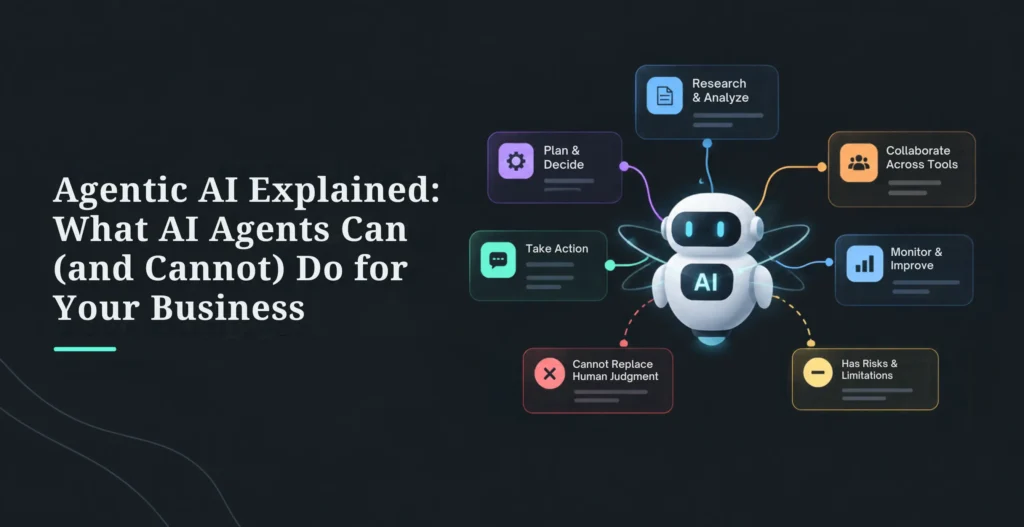
“Agentic AI” is the most hyped term in business technology right now, and also one of the most misunderstood. Vendors promise autonomous digital workers that run your business while you sleep. The reality in 2026 is more useful and more limited than that, and knowing the difference is what separates the businesses getting real value from the ones about to waste a budget.
Agentic AI refers to AI systems that can perceive context, plan across multiple steps, take actions through tools and APIs, and pursue a goal with some autonomy, going beyond a chatbot that just answers prompts. In 2026, that genuinely means AI agents can qualify and follow up on leads, resolve a majority of support tickets, reconcile transactions, reorder stock, and run multi-step workflows. But it also means they cannot replace human judgment on complex decisions, can’t be trusted on high-stakes actions without guardrails, and will quietly rack up cost and risk without governance. This guide covers both halves honestly.
Here’s the number that frames everything: Gartner predicts over 40% of agentic AI projects will be cancelled by 2027, not because the models aren’t capable, but because of governance gaps, unclear ROI, and runaway costs. And separately, research suggests around 88% of AI agents never make it from demo to production, though the ones that do return strong ROI. So the real question isn’t “can agentic AI work?” It’s “how do you end up in the group it works for?” That’s what the rest of this is about.
We build and govern agentic AI for exactly this reason. You can see the approach on our **[AI solutions page](https://www.krishaweb.com/ai-solutions-agency/)**, but this guide is written to help you decide, not to sell you an agent you don’t need.
## What Is Agentic AI?
Agentic AI is AI that acts, not just answers. A generative AI model responds to a prompt and stops. An agentic system takes a goal, breaks it into steps, carries them out using tools and integrations, checks its own results, and adjusts, with a degree of autonomy a chatbot doesn’t have.
The capabilities that define it: autonomous goal pursuit (it works toward an objective with limited hand-holding), multi-step planning and reasoning (it decomposes a goal and executes the pieces in order), tool use and API integration (it can search, run code, and read and write to your CRM, ERP, or database), memory (it holds context across steps and, ideally, across sessions), and self-correction (it can retry, validate, and improve rather than failing silently).
Crucially, agentic AI is a spectrum, not a switch. A mildly agentic system is an assistant that can search the web. A moderately agentic one is a coding agent that opens a pull request end to end. A highly agentic one is a long-running operator managing a sales pipeline with little supervision. Most businesses should start at the mild-to-moderate end; the further right you go, the more capable the agent and the more governance it demands. In 2026, real agents are shipping production code, running literature reviews, managing outbound campaigns, controlling browsers to complete tasks, handling support, and orchestrating multi-step processes, all genuinely, and all within bounds someone set.
## Agentic AI vs AI Agents vs Generative AI
The terminology is a mess because vendors use these words interchangeably. Here’s the clean distinction.
| **Term** | **What It Is** | **Example** |
|---|---|---|
| Generative AI | AI that produces content in response to prompts; it doesn’t act on its own | ChatGPT, Claude, Midjourney |
| AI agent | A specific software entity that takes actions autonomously to hit a goal | A sales agent that enriches a lead, scores it, emails it, and books a call |
| Agentic AI | The broader paradigm where one or more agents operate, and often coordinate, to run workflows | A multi-agent setup where sales, finance, and inventory agents coordinate to fulfill an order |
The simplest way to hold it: generative AI responds, AI agents act, and agentic AI is the environment in which agents act and collaborate. An AI agent is the actor; agentic AI is the system. In practice, most SMBs will deploy one or two focused agents, not a sprawling multi-agent system, and that’s the right place to start.
The other distinction that matters is autonomy level, because it determines both capability and risk. An assistive agent suggests, and a human approves everything (AI drafts the email, you send it). A semi-autonomous agent acts within set boundaries and escalates exceptions (it sends routine emails, flags the unusual ones). A fully autonomous agent runs independently within guardrails (it manages the pipeline and alerts on anomalies). Gartner’s explicit guidance in 2026: govern agents by autonomy level, because applying one-size-fits-all controls is itself a cause of failed deployments. Match the autonomy to the stakes; low-stakes work can run more autonomously, high-stakes work keeps a human in the loop.
## What AI Agents Can Do Today
Here are the use cases delivering real, measurable value for SMBs in 2026, drawn from the patterns that actually reach production.
### Sales and prospecting
An agent watches inbound leads, enriches each with company data (industry, size, tech stack, recent news), scores it against your ideal customer profile, drafts and sends personalized outreach referencing the prospect’s real context, tracks engagement, and books or schedules follow-up. It cuts manual lead handling substantially and, because it responds instantly, lifts conversion. Best for B2B teams with real lead volume.
### Customer support
An agent reads incoming inquiries, pulls the customer’s history, drafts a response from your knowledge base, updates the ticketing system, and escalates what it can’t resolve. In practice, well-built support agents now resolve a majority of routine inquiries end to end, handing only the genuinely complex cases to a human. Best for teams above a few hundred tickets a month.
### Accounting and finance
An agent reconciles transactions against bank feeds, chases overdue invoices, categorizes expenses by rule, and generates cash-flow snapshots on schedule, with a human reviewing the exceptions. This is one of the strongest SMB use cases because the work is repetitive and measurable, though it’s also one where you keep tight guardrails, since money is involved.
### Inventory and operations
An agent tracks stock across locations, generates purchase orders at reorder thresholds, chases vendor confirmations, and flags delivery delays. In a multi-agent setup, this can chain across functions, a sales agent quotes, a finance agent checks margin, an inventory agent confirms stock, without manual handoffs. Best for ecommerce, retail, and manufacturing with real SKU counts.
### Marketing
An agent handles content scheduling, email-sequence management, performance monitoring, and basic campaign adjustments based on engagement, with a human approving anything brand-facing. This is the lower-ROI end, because quality review claws back some of the time saved, so treat it as a strong assistant, not an autopilot.
Across these, the pattern is clear: agents excel at repetitive, high-volume, measurable, rule-bounded work where a wrong move is recoverable. That’s where to point them first.
## What AI Agents Cannot Do (Yet)
This is the half the hype skips, and it’s where the honesty that builds trust lives. AI agents in 2026 have real, hard limits.
They cannot replace human judgment on complex or high-stakes decisions, strategic calls, high-value negotiations, anything needing genuine empathy or nuanced context. They cannot reliably handle unpredictable edge cases without guardrails; real-world operations are exception-heavy, and an agent that performs beautifully in a demo often “completes the task while getting the answer completely wrong” when an API rate-limits or an input is malformed mid-workflow. They struggle with error compounding, in a long chain of steps, small errors accumulate rather than cancel out, which is why narrow, short workflows are far more reliable than sprawling autonomous ones. And they cannot run safely at scale without governance, security and risk are consistently cited as the top barrier to deploying agents, ahead of every technical factor.
The risks are equally real and worth naming plainly: security and privacy (an agent with broad access can be exploited through privilege compromise, scope creep, or prompt injection), cost (an unchecked agent running in a loop drives surprise inference bills), accountability (when multiple agents interact, assigning fault for a bad outcome gets genuinely hard), bias (autonomous decisions can amplify bias in the data), and data exfiltration (an agent touching many systems can leak sensitive data if poorly governed).
Here’s the sobering, well-sourced reality to hold onto: Gartner expects over 40% of agentic AI projects to be canceled by 2027, and separately, research suggests the large majority of agents never reach production at all, dying in the demo-to-production gap. The cause is almost never model capability. It’s governance immaturity, “agent washing” (rebranded chatbots sold as agents), integration surprises found late, and no cost caps or monitoring. The flip side is the encouraging part: the agents that do reach production, built with discipline, return strong ROI. The difference is entirely in how they’re built and governed, which is the next two sections.
## Cost and Pricing
Agentic AI cost spans a huge range depending on the agent’s sophistication, so treat these as vendor-reported 2026 planning ranges and get a scoped quote. The useful mental model: cost rises with autonomy and the number of systems the agent touches.
| **Agent Type** | **Rough Cost Range** |
|---|---|
| Simple reflex agent (rules, light memory) | ~350–3,500 |
| Goal-based agent (planning, tool routing) | ~6,000–10,000 |
| Learning / utility agent (feedback loops, fine-tuning) | ~8,000–13,000 |
| Hierarchical agent (planners + executors) | ~11,000–16,000 |
| Multi-agent collaborative system | ~14,000–21,000+ |
By business scale, a rough guide: a small business often spends ~7,000–15,000 per workflow, mid-market ~15,000–50,000, and a full autonomous enterprise agent 100,000–300,000+ with 6-12 months of development and ongoing operating costs of several thousand to $20,000+ a month. The cost also breaks down by component, model work, integration (often the biggest and most underestimated line), UI, testing, and, critically, governance (RBAC, audit, cost caps, monitoring), which is not optional and should be budgeted from the start.
A realistic mid-market example, a sales agent with CRM and email integration, an approval dashboard, and proper governance, lands around 40,000–45,000 to build plus roughly $4,000/month to run (maintenance plus inference), so on the order of $90,000 in year one. The watch-outs that inflate budgets: integration with legacy systems, data preparation, compliance for regulated industries, ongoing tuning, and the security work that the top-barrier status makes unavoidable. The honest headline: the agent is rarely the expensive part, the integration and governance around it are.
## Implementation Roadmap
The disciplined path to the minority of agents that succeed runs in four phases over roughly 6-12 months.
Evaluate (about a month). Identify the use case, assess data readiness, and evaluate the risk. The output is a quantified problem, a named internal champion, and a single locked use case. This phase is what prevents the most common failure, hype-driven selection with no real problem behind it.
Architecture (about a month). Design the agent, map every integration, define service-level objectives, and design the governance. The output is a clear agent design, an integration map, SLOs, and a governance plan. This is where you prevent the integration surprises that kill projects late.
Pilot (roughly two to three months). Build a Level 1 agent, one trigger, one flow, one output, test it on real data, and iterate. Keep it deliberately narrow; over-scoping with untested handoffs is a top failure mode. Prioritize a narrow, measurable use case like invoice processing or reporting automation.
Scale and govern (the rest of the year). Expand what provably works to more teams, with policies, monitoring, and compliance, and with RBAC, audit, and cost caps live from day one, not bolted on later. Scale only after the pilot has actually proven value.
The success factors underneath all four: start narrow and measurable, govern by autonomy level with human-oversight triggers, build governance in from day one, test on real production data, and expand only after proof. Teams that treat agents like production software (handling retries, partial failures, validation against a system of record, graceful degradation) ship; teams that treat them like demos don’t.
## Governance and Risk Mitigation
Governance isn’t bureaucracy here, it’s the single biggest predictor of whether an agentic project survives. The essentials: define agent boundaries by autonomy level with clear human-oversight triggers; implement role-based access control so an agent reaches only the systems and data it needs; set hard cost caps so a looping agent can’t run up a surprise bill; log every agent action for accountability and audit; monitor performance, errors, and anomalies in real time; and keep an incident runbook for when an agent fails or is compromised.
The risk-mitigation playbook maps to the risks named earlier: strict access controls and data minimization for security; regular bias audits and human-in-the-loop on consequential decisions; clear, written accountability for agent actions; cost monitoring with alerts; solid integration patterns with real error handling rather than fragile glue; and data-loss-prevention controls to stop exfiltration. The reason this matters so much is quantified, security and data concerns (data privacy, hallucination/accuracy, and identity controls each cited by large majorities of leaders) are the top blockers to scaling agents, outranking every technical limitation. The businesses that build governance in from day one are the ones whose agents are still running, and delivering ROI, a year later. The ones who rely on vendor claims and skip it are the 40% Gartner is warning about.
##### Additional Read
- [10 Business Workflows You Can Automate With AI Right Now](https://www.krishaweb.com/blog/business-workflows-automate-with-ai/)
- [Process Automation With AI: The Fastest ROI Most SMBs Are Missing](https://www.krishaweb.com/blog/ai-process-automation-fastest-roi/)
- [Custom AI Development vs Off-the-Shelf AI Tools: Which Does Your Business Need?](https://www.krishaweb.com/blog/custom-ai-development-vs-off-the-shelf/)
## When to Hire an Agentic AI Partner
DIY is reasonable for a simple, narrow, low-risk agent, a single workflow with clear rules and limited integration, if you have in-house AI expertise and no heavy compliance burden. Start there, build a Level 1 agent, prove it.
Bring in a partner when the workflow is complex or multi-step, when it touches regulated data or high-stakes actions (finance, customer data, core operations), when you lack in-house AI and integration expertise, when you need multi-agent coordination, or when you need real security and governance (RBAC, audit, cost caps, monitoring) from day one. The loud signals: integration keeps breaking, security and compliance are blocking you, or a DIY attempt already stalled in the demo-to-production gap, which is exactly where most do. A good partner brings genuine agentic experience (not a rebranded chatbot, “agent washing” is rampant, so vet for real architecture), integration depth with your systems, governance and security expertise, and a track record of agents that actually reach production. Given that most agents don’t, that last point is the one that matters most.
### Frequently Asked Questions
**What is agentic AI?**Agentic AI is AI that acts rather than just answers, systems that perceive context, plan across steps, take actions through tools and APIs, hold memory, and pursue a goal with some autonomy. Unlike a chatbot that responds to a single prompt, an agent decomposes a goal, executes the steps, checks its results, and adjusts. In 2026 agents handle lead follow-up, support resolution, transaction reconciliation, inventory reordering, and multi-step workflows, within boundaries a human sets.
**What’s the difference between agentic AI and AI agents?**An AI agent is a specific software entity that takes actions to achieve a goal, the actor. Agentic AI is the broader paradigm or environment in which one or more agents operate and sometimes coordinate, the system. Generative AI, by contrast, only responds to prompts without acting. In short: generative AI responds, agents act, and agentic AI is the environment they act within. Most SMBs start with one or two focused agents rather than a full multi-agent system.
**What can AI agents actually do for my business in 2026?**The highest-value SMB use cases are lead management (enrich, score, personalize outreach, book calls), customer support (resolve routine tickets end to end, escalate the hard ones), accounting (reconcile, chase invoices, categorize, report), inventory (monitor, reorder, chase vendors), and marketing (schedule, manage sequences, adjust campaigns). Agents do best on repetitive, high-volume, measurable, rule-bounded work where a mistake is recoverable, and need a human in the loop on anything high-stakes.
**What can’t AI agents do?**They can’t replace human judgment on complex or high-stakes decisions, can’t reliably handle unpredictable edge cases without guardrails, and struggle with long multi-step chains where small errors compound. They also can’t run safely at scale without governance, security and risk are the top barrier to deploying them. Treat agents as capable assistants for bounded work, not autonomous replacements for judgment, and keep humans on consequential decisions.
**How much does agentic AI development cost?**It ranges widely by sophistication: roughly 350–3,500 for a simple rule-based agent, 6,000–16,000 for planning or hierarchical agents, and 14,000–21,000+ for multi-agent systems. By scale, small businesses often spend 7,000–15,000 per workflow, mid-market 15,000–50,000, and enterprise 100,000–300,000+ for a full autonomous agent plus ongoing monthly costs. Integration and governance, not the model, usually drive the budget. Treat these as planning ranges and get a scoped quote.
**How do I implement agentic AI successfully?**Follow a four-phase path over 6-12 months: evaluate (lock one quantified use case and a champion), architecture (design the agent, map integrations, plan governance), pilot (build a narrow Level 1 agent, one trigger, one flow, one output, and test on real data), then scale and govern (expand what works with RBAC, audit, cost caps, and monitoring live from day one). Start narrow, govern by autonomy level, and scale only after the pilot proves value.
**Why do most agentic AI projects fail?**Gartner expects over 40% of agentic AI projects to be canceled by 2027, and most agents never reach production at all, but the cause is rarely model capability. It’s governance immaturity, unclear ROI, runaway costs, integration surprises found late, over-scoped pilots, and “agent washing” (rebranded chatbots sold as real agents). The projects that succeed treat agents like production software, start narrow, build governance in from day one, and scale only after proof.
**When should I hire an agentic AI development partner?**When the workflow is complex or multi-step, touches regulated data or high-stakes actions, needs multi-agent coordination, or requires real security and governance from day one, and when you lack in-house AI and integration expertise. Clear signals include repeated integration failures, security or compliance blockers, or a DIY attempt that stalled before production. Vet partners for genuine agentic architecture (not rebranded chatbots) and a track record of agents that actually reached production.
### Conclusion
Agentic AI is real, and in 2026 it genuinely does useful work, qualifying leads, resolving support tickets, reconciling finances, reordering stock, running multi-step workflows. But it works within limits: it handles bounded, measurable, recoverable tasks well, and it needs human judgment on the hard calls and governance on everything consequential. The hype oversells the autonomy; the reality rewards the disciplined.
The data is blunt, more than 40% of these projects will be canceled, and most agents never leave the demo, but not because the technology can’t deliver. They fail on governance, scope, and integration, every one of which is in your control. Start with one narrow, measurable use case. Govern by autonomy level. Build RBAC, audit, and cost caps in from day one. Scale only after a pilot proves value. Do that, and you land in the group agentic AI actually works for.
##### Ready to explore agentic AI without the hype?
[**Explore our AI Solutions**](https://www.krishaweb.com/ai-solutions-agency/) to see how we build and govern agentic AI with the discipline that gets agents into production.
[**Book a consultation**](https://www.krishaweb.com/contact-us/) to pressure-test a use case and get a scoped, honest estimate.
**[AI Strategy Consulting](https://www.krishaweb.com/ai-strategy-consulting/) · [AI Implementation & Integration](https://www.krishaweb.com/ai-implementation-integration/)**

###### Nirav Panchal
Lead – Custom DevelopmentLead of the Custom Development team at KrishaWeb, holds AWS certification and excels as a Team Leader. Renowned for his expertise in Laravel and React development. With expertise in cloud solutions, he leads with innovation and technical excellence.
 Interact With Me- [ ](https://twitter.com/iamNiravPanchal)
- [ ](https://www.linkedin.com/in/nirav-panchal-5b299385/)
- [ ](mailto:niravp@krishaweb.com)
---
_View the original post at: [https://www.krishaweb.com/blog/agentic-ai-explained-ai-agents-business/](https://www.krishaweb.com/blog/agentic-ai-explained-ai-agents-business/)_
_Served as markdown by [Third Audience](https://github.com/third-audience) v3.6.1_
_Generated: 2026-10-05 12:50:45 UTC_