---
title: "AI Chatbot vs AI Agent: What’s the Difference and Which Do You Need?"
url: "https://www.krishaweb.com/blog/ai-chatbot-vs-ai-agent-difference/"
date: "2026-10-06T12:47:53+00:00"
modified: "2026-10-06T12:48:43+00:00"
type: "Article"
resource: "https://www.krishaweb.com/blog/ai-chatbot-vs-ai-agent-difference/"
timestamp: "2026-10-06T12:48:43+00:00"
author:
name: "Nirav"
url: "https://www.krishaweb.com"
categories:
- "Web Development"
word_count: 3143
reading_time: "16 min read"
summary: "Here's the whole thing in one line: a chatbot answers, an AI agent acts. A chatbot responds to a question inside a conversation. An AI agent takes a goal, plans the steps, uses your tools and syste..."
description: "A chatbot answers, an AI agent acts. Compare AI chatbot vs AI agent on cost, use cases, and ROI, plus a simple test to choose the right one."
keywords: "AI chatbot vs AI agent, Web Development"
language: "en"
schema_type: "Article"
related_posts:
- title: "Agentic AI Explained: What AI Agents Can (and Cannot) Do for Your Business"
url: "https://www.krishaweb.com/blog/agentic-ai-explained-ai-agents-business/"
- title: "10 Business Workflows You Can Automate With AI Right Now"
url: "https://www.krishaweb.com/blog/business-workflows-automate-with-ai/"
- title: "Process Automation With AI: The Fastest ROI Most SMBs Are Missing"
url: "https://www.krishaweb.com/blog/ai-process-automation-fastest-roi/"
---
# AI Chatbot vs AI Agent: What’s the Difference and Which Do You Need?
_Published: Tuesday,October 6, 2026_
_Author: Nirav_
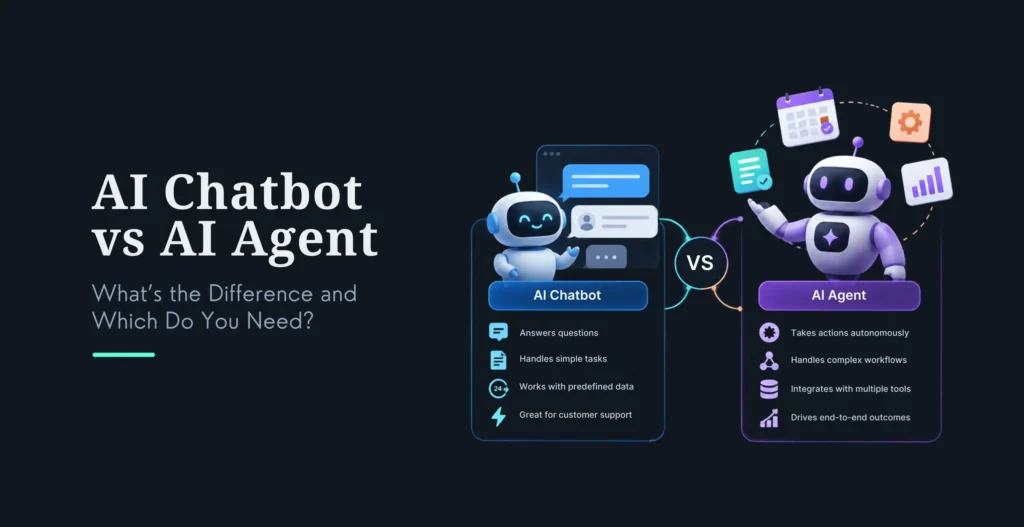
Here’s the whole thing in one line: a chatbot answers, an AI agent acts. A chatbot responds to a question inside a conversation. An AI agent takes a goal, plans the steps, uses your tools and systems, and actually completes the task, not just talks about it. Chatbots are reactive; they wait to be asked. Agents are proactive; they pursue an objective.
That one distinction decides which you need, and getting it wrong is expensive in both directions, overbuilding an agent for a job a chatbot handles, or deploying a cheap chatbot for work that genuinely needs an agent. In 2026, chatbots are the right call for high-volume, repetitive, answer-only work: FAQs, order status, lead capture, simple Q&A. Agents are the right call for multi-step work that touches your systems: qualifying and routing leads, processing invoices, running data pipelines, automating a business process end to end.
This guide gives you the real differences, honest 2026 costs and ROI (not the inflated numbers floating around), clear use cases for each, and a simple test to choose, including the hybrid pattern that most production deployments actually land on. One note on the numbers throughout: AI pricing and ROI figures vary widely by vendor and get quoted with false precision online, so I’ve used commonly cited ranges for US small and mid-sized businesses and flagged them as planning estimates. Verify against your own situation before budgeting.
When the answer is “build one,” that’s what we do, see our **[chatbot and AI agent development](https://www.krishaweb.com/ai-solutions-agency/)**, but this guide is written to help you decide, including when the answer is “you don’t need the expensive option.”
## The 30-Second Answer: Chatbot vs AI Agent
If you read nothing else, read this table. Cost figures are commonly cited planning ranges for US small and mid-sized businesses; enterprise and fully custom builds run higher.
| **Dimension** | **AI Chatbot** | **AI Agent** |
|---|---|---|
| Core job | Answers questions | Completes tasks |
| Mode | Reactive (waits for a prompt) | Proactive (pursues a goal) |
| How it decides | Matches patterns / follows a script or retrieves an answer | Reasons, plans, and adapts across steps |
| Acts on your systems? | No, lives in the conversation | Yes, uses tools, APIs, files, email |
| Scope | Single question, single answer | Multi-step workflow across systems |
| Memory | Usually per-session | Persistent across steps and sessions |
| Cost of a mistake | Low (a wrong answer) | Higher (a wrong action in a real system) |
| Typical build cost | ~2,000–15,000 | ~15,000–75,000 |
| Typical monthly run | ~50–400 | ~200–1,200 |
| Time to launch | ~2–10 weeks | ~8–24 weeks |
The simplest heuristic going around, and it’s a good one: if the work is “tell me,” you need a chatbot. If the work is “do it,” you need an agent. Another way engineers put it: the gap between the two isn’t the language model, it’s the wrapper around it, tools, memory, planning, and the ability to take real actions with real consequences.
## What Is an AI Chatbot?
An AI chatbot is a conversational program that responds to user questions, either from a scripted decision tree or, in more advanced versions, by retrieving and generating an answer with AI. Its defining trait: it lives inside the chat window. It can answer, guide, and hand you a link, but it cannot reach outside the conversation to do things, no calling your APIs, editing files, running code, or taking an action in another system.
That limitation isn’t a flaw; it’s the right tool for a specific job. Chatbots are excellent at high-volume, repetitive, low-stakes questions where the answer already exists somewhere: FAQs, store hours, return policy, order status, basic lead capture, simple product guidance, and content brainstorming. The common thread is that resolving the query needs an answer, not an action, and a wrong answer is cheap to catch and fix. For that work, a chatbot is faster to launch and far cheaper to run than an agent, and it does the job just as well.
Where chatbots fall short is the moment a query needs something done, not just said. They can’t complete a multi-step workflow, can’t act across systems, and (in their simpler forms) don’t learn or adapt without manual updates. Ask a chatbot to “process my refund” and the best it can do is tell you how; it can’t actually do it.
## What Is an AI Agent?
An AI agent is an autonomous system that takes a goal, breaks it into steps, reasons about context, uses tools and integrations, and executes the task, without being told what to do at each step. Where a chatbot responds, an agent resolves. The difference that matters most: an agent can take actions in your real systems. It can browse the web, call APIs, read and write to your CRM or ERP, manage files, send emails, book meetings, and chain several of those together to finish a job.
This is what makes agents worth their higher cost and complexity: they close the loop. Instead of answering “here’s how to process a refund,” an agent checks the order, validates eligibility, processes the refund in your payment system, emails the customer, and updates your CRM, the whole workflow, autonomously, escalating only what it can’t handle. That capability is why agents suit multi-step, multi-system work: lead qualification with enrichment, invoice processing, data pipelines, research workflows, and business-process automation.
But that power comes with real limits, and honest vendors say so. Agents still need human oversight on high-stakes decisions, need guardrails for unpredictable edge cases, accumulate errors across long chains, and, critically, can’t scale safely without governance (security, permissions, cost caps, audit trails). An agent’s mistakes cost more than a chatbot’s, because they happen in live systems, not just in the chat. A wrong chatbot answer wastes a minute; a wrong agent action can break a real record or move real money.
## The Key Differences That Actually Matter
Strip away the marketing and the real differences come down to five things.
Pattern-matching vs understanding. A chatbot sees your text and finds the closest scripted reply or knowledge-base article. An agent reasons about what you actually mean in context, intent, history, sentiment, and decides what to do about it.
Conversation vs action. This is the big one and the fastest way to tell a real agent from a rebranded chatbot: can it take an action in another system, or does it only talk? If “process the refund” ends with instructions rather than a processed refund, it’s a chatbot.
Amnesia vs memory. Most chatbots forget between sessions. Agents maintain memory across steps and sessions, which is what lets them handle work that spans time and multiple touchpoints.
Scripting vs reasoning. A chatbot follows a fixed path or retrieves the nearest document. An agent plans a route to a goal, evaluates results mid-task, and revises, which is why it can handle variation a script can’t.
Static vs learning. A simple chatbot only improves when someone manually updates it. An agent improves from interactions and outcomes over time.
A practical “agent-washing” test worth using in any vendor demo, since the market is full of chatbots sold as agents: ask it to complete a task that touches another system, change scope mid-task, and recover from an error. A real agent handles all three; a dressed-up chatbot stumbles.
## When a Chatbot Is the Right Choice
Choose a chatbot when the work is transactional, single-step, high-volume, and answer-only. The classic fits: answering FAQs and policy questions, order-status lookups, capturing leads from a form, store hours and simple product guidance, and brainstorming or drafting content. If more than half your incoming queries are standard, repetitive questions, a chatbot is the most cost-effective solution, full stop.
The reason is economics. A chatbot costs roughly 2,000–15,000 to build (or 0–5,000 on a SaaS platform) and 50–400 a month to run, and it can be live in two to ten weeks. Because its cost per interaction is tiny (a few cents to a dollar or so, versus $6 or more for a human), it pays back fast on sheer volume, often within weeks on support deflection alone. For the large share of conversations that are simple, that’s exactly the efficiency you want. Don’t overbuild: if a chatbot genuinely solves the problem, building an agent instead is wasted money and time.
## When You Actually Need an AI Agent
Reach for an agent when the work requires action, not just answers, and especially when it spans more than one system. The clearest signal, from the engineers who build these: does the AI need write access to your business systems? If it only needs to read and answer, a good chatbot with solid retrieval will do. If it needs to create, update, or delete records, you need an agent.
The use cases that justify an agent: lead qualification that enriches, scores, routes, and follows up across your CRM and email; invoice processing that extracts, matches, routes, and posts; data pipelines that fetch, clean, analyze, and distribute; research workflows that scrape, compare, and synthesize; and multi-step business-process automation across sales, finance, and operations. All of these share the traits a chatbot can’t meet: multiple steps, multiple systems, real actions, and a loop that needs closing without a human doing each handoff.
Agents cost more and take longer, roughly 15,000–75,000 to build and 200–1,200 a month to run, with an 8-to-24-week timeline and a realistic six-month horizon to full ROI. Their cost per task runs several times a chatbot’s, because each run makes more reasoning and tool calls. But that only matters against the right benchmark: an agent pays back when each run replaces a real human action (a task that would’ve cost $6 or more of someone’s time), not when it just answers a question. Point an agent at genuine multi-step work and the economics are strong; point it at FAQs and you’ve overpaid for capability you don’t use.
## Cost and ROI: The Honest Numbers
Online figures for this comparison are all over the map, with some sources quoting eye-popping “8x ROI” numbers from a single vendor. The ranges below are commonly cited planning ranges for US small and mid-sized business builds, not promises. Fully custom enterprise builds, voice agents, and agents that touch many systems cost considerably more, and published numbers vary widely by source, so treat them as a starting point and get a scoped quote.
| | **AI Chatbot** | **AI Agent** |
|---|---|---|
| Build cost | ~2,000–15,000 (custom); 0–5,000 (SaaS) | ~15,000–75,000 |
| Monthly run cost | ~50–400 | ~200–1,200 |
| Cost per resolved task (varies widely by pricing model) | ~0.02–0.08 | ~0.15–0.80 |
| Typical Year-1 ROI (vendor-reported) | ~100–250% | ~250–400% |
| Time to payback | Weeks (on volume) | ~6 months |
| Annual maintenance | Lower | Higher (monitoring, governance) |
Two honest points that matter more than any single number. First, agents cost several times more per task than chatbots, and they only clear that bar when each run replaces real human work, so the ROI case lives entirely in the use case, not the technology. Second, for genuinely simple, high-volume work, a chatbot often delivers better ROI than an agent precisely because its cost per task is a fraction of an agent’s, there’s nothing to gain from paying for autonomy you won’t use. The reverse is equally true: for complex, multi-system work, an agent’s higher cost is easily justified because it replaces whole chains of human effort a chatbot can’t touch. Match the tool to the job and the ROI follows; mismatch them and no amount of technology fixes it.
## Implementation Timeline
Chatbots are fast: a no-code build can go live in two to four weeks, a custom one in four to ten. The phases are straightforward, define requirements, prepare your content and knowledge base, build and integrate, test, deploy.
Agents take longer and demand more discipline, typically eight to twenty-four weeks, because the hard part isn’t the model, it’s the integration, permissions, and exception handling. A sound agent build runs in phases: a tight discovery (one locked, quantified use case), an architecture phase (agent design, integration map, governance), a narrow pilot (one trigger, one flow, one output, tested on real data), then a governed scale-up with monitoring, access controls, and cost caps live from day one. The timeline difference is really a reflection of the stakes: an agent acts in your live systems, so it needs the setup rigor of production software, not a demo.
##### Additional Read
- [Agentic AI Explained: What AI Agents Can (and Cannot) Do for Your Business](https://www.krishaweb.com/blog/agentic-ai-explained-ai-agents-business/)
- [10 Business Workflows You Can Automate With AI Right Now](https://www.krishaweb.com/blog/business-workflows-automate-with-ai/)
- [Process Automation With AI: The Fastest ROI Most SMBs Are Missing](https://www.krishaweb.com/blog/ai-process-automation-fastest-roi/)
## Which Do You Need? A Simple Test
Run your use case through five questions:
1. Is the work mostly answering simple, repetitive questions? → Chatbot.
2. Does resolving it need an answer, or an action? Answer → chatbot. Action → agent.
3. Does the AI need write access to your systems (create, update, delete records)? No → chatbot. Yes → agent.
4. Does the workflow span more than one system and multiple steps? No → chatbot. Yes → agent.
5. Is your budget and timeline tight, with simple needs? → Chatbot. Can you invest more for higher-value automation? → Agent.
| **Your situation** | **Right tool** |
|---|---|
| High-volume FAQs, order status, lead capture | Chatbot |
| Simple Q&A, content drafting, guidance | Chatbot |
| Lead qualification with enrichment and routing | AI agent |
| Invoice processing, data pipelines, research | AI agent |
| Multi-step process automation across systems | AI agent |
| A mix of simple and complex queries | Hybrid (both) |
The hybrid pattern wins most real deployments, and it’s worth planning for. A chatbot front end handles the simple, high-volume majority cheaply, while an agent backbone takes the complex minority that needs action, with the routing decision made automatically. You get the chatbot’s cost efficiency for the simple majority of conversations and the agent’s capability for the smaller share that is actually worth the spend. And yes, you can absolutely start with a chatbot, prove the ROI fast, then add agent capability as you validate the use cases, that “start simple, evolve toward agents” path is exactly what most businesses should do rather than over-committing on day one.
### Frequently Asked Questions
**What’s the difference between an AI chatbot and an AI agent?**A chatbot answers questions within a conversation; an AI agent plans, decides, and takes actions across your systems to complete a task. Chatbots are reactive (they wait for a prompt) and conversation-only, they can’t act outside the chat. Agents are proactive (they pursue a goal) and can use tools, call APIs, update records, send emails, and chain steps together. The simplest test: if the work is “tell me,” it’s a chatbot; if it’s “do it,” it’s an agent.
**When should I use a chatbot vs an AI agent?**Use a chatbot for high-volume, repetitive, answer-only work, FAQs, order status, lead capture, simple Q&A, where no system action is needed and a wrong answer is cheap. Use an agent when resolving the task requires an action, touches more than one system, needs write access to your records, or involves a multi-step workflow. A quick rule: if the AI only needs to read and answer, a chatbot works; if it needs to create, update, or delete records, you need an agent.
**How much does an AI chatbot cost vs an AI agent?**Based on commonly cited 2026 ranges for US small and mid-sized businesses: a chatbot costs roughly 2,000–15,000 to build (or 0–5,000 on SaaS) and 50–400 a month to run; an AI agent costs roughly 15,000–75,000 to build and 200–1,200 a month. Cost per task runs several times higher for agents because they make more reasoning and tool calls. Fully custom and enterprise builds cost more, and published figures vary widely, so get a scoped quote before budgeting.
**What’s the ROI difference between a chatbot and an AI agent?**The ranges vendors most often report: chatbots around 100–250% in year one, agents around 250–400%, though figures vary widely and inflated numbers are common online. The key isn’t the headline percentage, it’s fit. Chatbots deliver strong ROI on high-volume simple work because their per-task cost is tiny, so they pay back on volume. Agents deliver strong ROI only when each run replaces real human action in a multi-step workflow. Matched to the right use case, either can be an excellent investment; mismatched, neither is.
**How long does it take to implement each?**A chatbot typically goes live in two to ten weeks (two to four for no-code, four to ten for custom). An AI agent takes eight to twenty-four weeks, because the work is in integration, permissions, and exception handling, not the model. Agents need the rigor of production software, discovery, architecture, a narrow pilot, then a governed rollout, since they act in live systems. Plan a roughly six-month horizon to full agent ROI versus weeks for a chatbot.
**Can I start with a chatbot and upgrade to an AI agent later?**Yes, and for most businesses that’s the smart path. Start with a chatbot to handle high-volume simple queries, prove the ROI quickly, then add agent capability for the complex, multi-step work as you validate specific use cases. Technically, an agent is a chatbot plus three things, tool access, persistent memory, and a planning loop, so evolving from one to the other is a natural progression. Many production setups end up hybrid: chatbot for the simple majority, agent for the complex minority.
**Which is better for customer service, a chatbot or an AI agent?**It depends on your query mix, and the best answer is usually both. Use a chatbot to deflect the high-volume simple questions (hours, policies, order status) cheaply and instantly. Use an agent for complex cases that need account access, multi-system updates, or actually resolving an issue end to end rather than routing it. The hybrid model, chatbot for triage and simple queries, agent for complex escalations, is what most high-performing customer-service deployments use in 2026.
**How do I spot a fake AI agent (agent-washing)?**The market is full of chatbots rebranded as “agents,” so test three things in any demo. Ask it to complete a task that touches another system (not just answer), change the scope or add a condition mid-task, and recover from an error or missing information. A real agent takes the action, adapts to the change, and handles the failure gracefully. A dressed-up chatbot gives you a scripted answer, breaks when the path changes, or fails silently. If it can’t act in a real system, it’s a chatbot regardless of the label.
### Conclusion
The choice between an AI chatbot and an AI agent comes down to one question: do you need the AI to answer, or to act? Chatbots answer, cheaply, fast, and well, for high-volume, repetitive, low-stakes queries. Agents act, taking on multi-step, multi-system work that a chatbot can’t touch, for a higher but justified cost when each run replaces real human effort.
Don’t overthink it, and don’t overbuild. Match the tool to the job: a chatbot for the simple majority of interactions, an agent for the complex minority that genuinely needs autonomy, and a hybrid of both for most real deployments. Start simple, prove the value, and evolve toward agents as your use cases justify it. The businesses that get the best return aren’t the ones that buy the most advanced AI, they’re the ones that pick the right AI for each job.
##### Not sure which fits your specific use case?
**[Explore our Chatbot & AI Agent Development](https://www.krishaweb.com/ai-solutions-agency/)** to see how we match the right solution to the job, and build the hybrid setups that work best in production.
**[Book a consultation](https://www.krishaweb.com/contact-us/)** for a straight recommendation on chatbot vs agent for your use case, and a scoped estimate.
**[AI Solutions Agency](https://www.krishaweb.com/ai-solutions-agency/) · [AI Implementation & Integration](https://www.krishaweb.com/ai-implementation-integration/)**

###### Nirav Panchal
Lead – Custom DevelopmentLead of the Custom Development team at KrishaWeb, holds AWS certification and excels as a Team Leader. Renowned for his expertise in Laravel and React development. With expertise in cloud solutions, he leads with innovation and technical excellence.
 Interact With Me- [ ](https://twitter.com/iamNiravPanchal)
- [ ](https://www.linkedin.com/in/nirav-panchal-5b299385/)
- [ ](mailto:niravp@krishaweb.com)
---
_View the original post at: [https://www.krishaweb.com/blog/ai-chatbot-vs-ai-agent-difference/](https://www.krishaweb.com/blog/ai-chatbot-vs-ai-agent-difference/)_
_Served as markdown by [Third Audience](https://github.com/third-audience) v3.6.1_
_Generated: 2026-10-06 12:48:43 UTC_