---
title: "AI Code Security Audit: What It Covers and Why You Need One Before Launch"
url: "https://www.krishaweb.com/blog/ai-code-security-audit-guide/"
date: "2026-11-23T12:34:56+00:00"
modified: "2026-11-23T12:34:58+00:00"
type: "Article"
resource: "https://www.krishaweb.com/blog/ai-code-security-audit-guide/"
timestamp: "2026-11-23T12:34:58+00:00"
author:
name: "Nirav"
url: "https://www.krishaweb.com"
categories:
- "Web Development"
word_count: 3612
reading_time: "19 min read"
summary: "You built an app with Lovable, Bolt, v0, Cursor, or Replit, it works, and you're ready to launch. The problem is that "it works" and "it's safe to put real users and real data into" are different s..."
description: "You built an app with Lovable, Bolt, v0, Cursor, or Replit, it works, and you’re ready to launch. The problem is that “it works” and “..."
keywords: "Web Development"
language: "en"
schema_type: "Article"
related_posts:
- title: "White Label SaaS Development: How Agencies Build Recurring-Revenue Products for Their Clients"
url: "https://www.krishaweb.com/blog/white-label-saas-development/"
- title: "Why AI-Generated Apps Break at 80%, and How to Get Them to Launch"
url: "https://www.krishaweb.com/blog/why-ai-apps-break-at-80-percent/"
- title: "White Label Laravel Development for Agencies: Secure Custom Web Apps Under Your Brand"
url: "https://www.krishaweb.com/blog/white-label-laravel-development/"
---
# AI Code Security Audit: What It Covers and Why You Need One Before Launch
_Published: Monday,November 23, 2026_
_Author: Nirav_
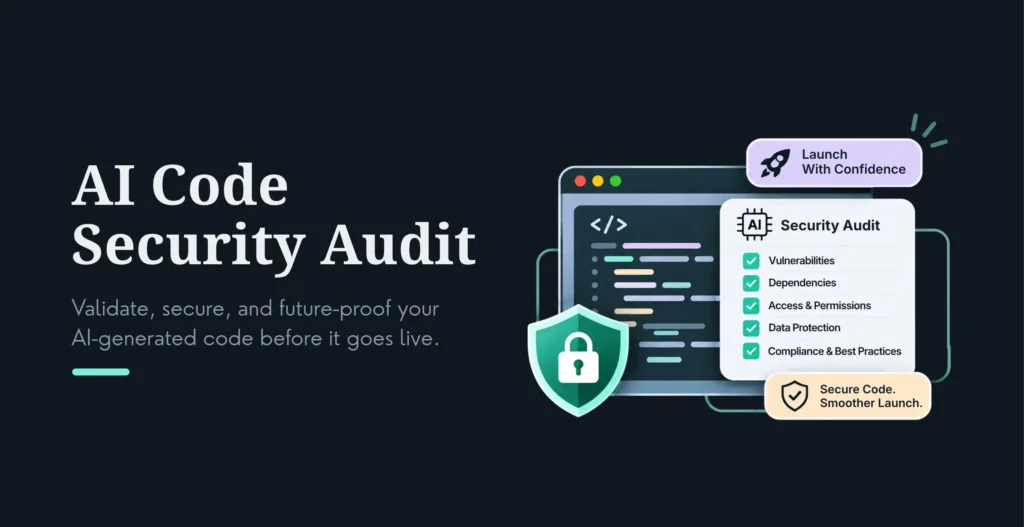
You built an app with Lovable, Bolt, v0, Cursor, or Replit, it works, and you’re ready to launch. The problem is that “it works” and “it’s safe to put real users and real data into” are different standards, and AI coding tools are very good at the first and routinely skip the second. An AI code security audit is how you find the gap before your users, or an attacker, do. This guide explains exactly what an audit covers, why it matters before launch, how it works, what it costs, and what it is not.
An AI code security audit is a structured review of AI-generated code, reading your source code, configuration, and infrastructure settings, to find the security problems the demo hid: exposed secrets, missing access controls, injection flaws, unsafe dependencies, and misconfigurations. It combines proven security-testing methods (secrets scanning, static analysis, dependency scanning, dynamic testing) with expert review, and it produces a prioritized list of findings with a fix order, not a pass/fail certificate and not a penetration test. It matters before launch because the data is unambiguous: Veracode’s 2025 GenAI Code Security Report tested 100+ large language models and found 45% of generated code introduced a known OWASP Top 10 vulnerability, with cross-site-scripting defenses failing in 86% of relevant cases, and its [2026 follow-up](https://www.veracode.com/resources/analyst-reports/2026-genai-code-security-report/) found that picture essentially unchanged, an average security pass rate of about 56%, even though nearly all the code compiled. (Both reports tested models without human review and on a limited set of vulnerability classes, so they measure how often flawed code is generated, not how often it reaches production.) A typical audit covers around eleven areas (secrets, static analysis, dependencies, authorization, headers/CORS, input validation, dynamic testing, error handling, deserialization, CI/CD gates, and compliance), runs in roughly five stages, and costs anywhere from under $100 for a quick automated review to tens of thousands of dollars for an enterprise engagement.
This is the pre-launch playbook for the founder or technical lead who needs to know whether their AI-built app is safe to ship: what an audit covers, why the timing matters, how it runs, what it finds, real costs and timelines, how to choose a provider, and what an audit can’t do. It’s exactly the work our **[AI code security audit service](https://www.krishaweb.com/ai-code-security-audit/)** performs. (If you want the deeper data on why AI code is insecure, our companion piece, **[is AI-generated code secure?](https://www.krishaweb.com/blog/is-ai-generated-code-secure/)**, goes into the research; this guide focuses on the audit itself.)
##### Key Highlights
- **What it is:** A structured review of AI-generated source code, config, and infrastructure that finds security problems and returns a prioritized fix list. It’s not a certificate and not a penetration test.- **Why before launch:** Veracode found 45% of AI-generated code introduces a known OWASP Top 10 vulnerability, with XSS defenses failing 86% of the time, and that picture hasn’t improved (a ~56% security pass rate in 2026) even though the code compiles.- **What it covers (≈11 areas):** secrets, static analysis (SAST), dependencies (SCA), authorization/access control, headers and CORS, input validation, dynamic testing (DAST), error handling, deserialization, CI/CD gates, and compliance evidence.- **How it works (5 stages):** inventory and architecture mapping → automated SAST scan → business-logic and auth testing by hand → dependency audit (catching hallucinated packages) → senior review of the money, identity, and data paths.- **What it finds:** the AI-specific failure cluster, exposed secrets, missing Row Level Security, client-side-only permission checks, XSS, injection, misconfigured CORS, and leaky error handling.- **Cost (vendor-reported ranges):** from under $100 for an automated written review, a few hundred to a few thousand dollars for a focused manual audit, and 15,000–80,000+ for comprehensive or enterprise engagements. Verify with a scoped quote.- **The one rule:** fix data-exposure findings first. A leak is the only vulnerability you can’t undo after launch, so authorization, secrets, and access rules come before everything else.
## What Is an AI Code Security Audit?
At its core, an audit is an independent, structured evaluation of code that was written or substantially generated by AI, focused on whether the product is actually safe and maintainable for real users. A good one reads the source code, the configuration, and the infrastructure settings, and reasons about them (it’s a reasoning-based source-code review, not just a scanner dump), combining the established security-testing disciplines, secrets detection, static analysis, dependency scanning, and dynamic testing, with expert, often AI-assisted, analysis to identify and explain the vulnerabilities. It works across any language or framework and on any web-facing application, which is why it fits apps built on Lovable, Bolt, v0, Cursor, or Replit regardless of what stack they generated.
Two clarifications matter up front, because they shape expectations. First, an audit is not a certificate. It doesn’t hand you a pass/fail stamp you can show a customer; it produces findings, each with evidence and a recommended fix order, so you know not just what’s wrong but what to fix first. Second, an audit is not a penetration test. A pentest is a live attack against your running application; an audit reads the code, config, and infrastructure to find the weaknesses before anyone attacks. The two are complementary, and if a customer contract or compliance requirement demands a pentest report, that’s a separate engagement with a security firm, but for a pre-launch AI-built app, the audit is almost always the right first step, because it finds the structural problems at their source rather than probing for symptoms from the outside.
## Why Do You Need an AI Code Security Audit Before Launch?
The case for auditing before launch rather than after an incident rests on measured, repeatable data, not fear. Veracode’s 2025 GenAI Code Security Report, which tested more than 100 large language models across 80 standardized coding tasks, found that 45% of the generated samples introduced a known OWASP Top 10 vulnerability, and that the failures clustered in predictable, dangerous places: cross-site-scripting defenses failed in 86% of relevant cases and log injection in 88%, while SQL injection and basic cryptography fared better (both passing over 80% of the time). Java was the worst-performing language, with roughly a 72% failure rate. Crucially, Veracode’s 2026 follow-up found this picture essentially flat, an average security pass rate of about 56%, meaning roughly 44% of tasks still produced a vulnerability, even as the models got better at everything else and the code compiled nearly every time. The capability curve rose; the security curve didn’t. Even the best-performing model topped out around a 68% pass rate in the 2026 report, so “we used a good model” is not a security strategy.
That’s the statistical backdrop, but the launch-specific urgency is simpler: compilation is not security, and the flaws AI leaves behind are exactly the ones that cause catastrophic, public failures the moment real users arrive. Exposed API keys, missing database access rules (Row Level Security left off), and client-side-only permission checks can expose an entire database to anyone who looks, and that exposure can’t be undone once real data is in the system and real users are hitting it. It is not hypothetical: a November 2026 investigation by Crissy Field and Handelsblatt, [covered by Startup Fortune](https://startupfortune.com/lovable-ai-apps-left-passport-and-payment-data-open-to-anyone/), found that 24,664 of the 34,545 Supabase-backed Lovable apps it scanned returned database records without any login (not all of it sensitive, but some included passport numbers, payment details and private chats). For the full path from a Lovable prototype to a safe launch, see our **[Lovable to production guide](https://www.krishaweb.com/blog/lovable-to-production/)**. An audit before launch catches these while they’re still cheap, private mistakes rather than public breaches. The honest threshold: a quick automated review is worth running on any AI-built app before you share it, and a full external audit becomes genuinely necessary the moment the app handles real users or sensitive data at any scale.
## What Does an AI Code Security Audit Cover? (The 11 Areas)
A thorough AI code security audit covers roughly eleven areas, running from cheap automated checks to expert manual review. Here’s the full scope, with what each area checks and how.
| **#** | **Area** | **What it checks** | **How** |
|---|---|---|---|
| 1 | Secrets | Exposed passwords, API keys, tokens, credentials, in code and git history | TruffleHog, Gitleaks, GitGuardian across full history |
| 2 | Static analysis (SAST) | Insecure code patterns without running the app, how data flows | Semgrep with OWASP Top 10 + security-audit rules |
| 3 | Dependencies (SCA) | Known CVEs in packages; AI-hallucinated or typo-squatted packages | Snyk, npm audit |
| 4 | Authorization | Can user A reach user B’s data? Is RLS on every table? | Manual testing; RLS review (e.g. Supabase) |
| 5 | Headers & CORS | Wildcard CORS, missing CSP / X-Frame-Options / HSTS | Config review |
| 6 | Input validation | Server-side validation on every field; string-interpolated SQL | Code review + manual testing |
| 7 | Dynamic testing (DAST) | Runtime flaws and access-control issues in the running app | OWASP ZAP against staging |
| 8 | Error handling | Stack traces, internal paths, or DB details leaking to users | Manual testing (deliberately breaking things) |
| 9 | Deserialization | Schema validation on parsed input; unsafe YAML loaders | Code review |
| 10 | CI/CD gates | Security gates active and un-bypassable; secrets scanning enforced | Config review + bypass logs |
| 11 | Compliance | SOC 2 / GDPR evidence; AI tools and model versions documented | Policy review; AI-SBOM / AIBOM |
Beyond this checklist, a strong audit also reasons about the things a tool can’t see on its own: how credentials and sensitive data are stored, accessed, and shared (including anything sent to third-party AI services); whether login flows, permission boundaries, and session handling actually restrict users to what they’re allowed; whether the framework’s built-in protections are used correctly or accidentally bypassed; whether security configuration fails safe during errors; and, for AI-powered products, whether prompts and trust boundaries are handled per OWASP’s LLM guidance. The two layers matter together: the automated checks catch the known-pattern issues cheaply and comprehensively, and the human reasoning catches the logic- and architecture-level problems that scanners miss. (This is the same coverage framework we detail in the companion security piece; here the emphasis is on it as a pre-launch service.)
## How Does an AI Code Security Audit Work? (5 Stages)
A well-run audit moves through five stages, deliberately front-loading the cheap, broad checks and reserving expensive expert attention for where it matters most.
Stage one, inventory and architecture mapping: the auditor catalogs what the AI actually wrote and where it runs, maps the entry points, and runs the build, tests, and checks from a clean clone, you can’t secure what you haven’t mapped.
Stage two, the SAST scan: static analysis passes over the source for insecure patterns (injection, unsafe deserialization, weak crypto), ideally as a blocking check rather than an advisory report.
Stage three, business-logic and auth testing by hand: this is where a human checks the things scanners can’t, authentication flows, authorization boundaries (can a user reach another’s data?), and input validation, and tests the app’s behavior against what it’s actually supposed to do.
Stage four, the dependency audit: scanning packages for known CVEs and, specifically, catching the AI-hallucinated or typo-squatted dependencies that are a distinctive AI risk.
Stage five, senior expert review: an experienced engineer reads the output and the source of the paths that handle money, identity, and personal data, the highest-consequence code, and verifies findings, sometimes using a second model from a different family to review the diff.
The sequencing is the point. Stages one through four are mostly automated and relatively cheap, and they catch the bulk of the known-pattern vulnerabilities. Stage three and stage five, the human stages, are where the audit earns its value, because the failures that actually sink companies (a broken authorization check, business logic that’s subtly wrong, an architecture-level flaw) are precisely the ones automated tools are blind to. An audit that’s only a scanner run will miss them; an audit that layers real expert review over the automated passes won’t.
## What Vulnerabilities Does an AI Code Security Audit Find?
The findings follow a recognizable, AI-specific pattern, which is what makes auditing these apps efficient. The injection and output flaws dominate: cross-site scripting is the single most common and most severe (AI defends against it only about 15% of the time), followed by log injection (~12% pass rate), while SQL injection is better handled (~83%) but still appears wherever the AI wrote raw queries. The access-and-secrets cluster is where data actually leaks: exposed secrets and API keys (Escape.tech’s October 2025 scan of 5,600 vibe-coded apps found more than 400 exposed secrets), missing Row Level Security (extremely common on Supabase-backed apps, which can expose every user’s data), and client-side-only permission checks that a user can simply bypass. And the configuration and handling flaws round it out: wildcard CORS, security headers missing, error handling that leaks stack traces and internal paths, unsafe deserialization, and CI/CD gates that can be bypassed.
The through-line across all of them is that each is invisible in a working demo and obvious to an audit, the app functions perfectly while quietly carrying the flaw. That’s exactly why the audit exists, and why it’s run before launch rather than after. And it’s why the fix order the audit produces matters as much as the findings themselves: data-exposure issues (authorization, secrets, access rules) are fixed first because a leak is irreversible, then the injection and configuration flaws, then everything else, so you’re closing the catastrophic risks before the cosmetic ones.
##### Additional Read
- [Why AI-Generated Apps Break at 80%, and How to Get Them to Launch](https://www.krishaweb.com/blog/why-ai-apps-break-at-80-percent/)
- [AI-Assisted Development: What It Is and When It Makes Sense for Your Business](https://www.krishaweb.com/blog/what-is-ai-assisted-development/)
- [How to Refactor AI-Generated Code Without Breaking Your Application](https://www.krishaweb.com/blog/refactor-ai-generated-code/)
## AI Code Security Audit Cost, Timeline, and How to Choose a Provider
Treat pricing as vendor-reported planning ranges that vary with codebase size, depth, and who reads the code, and scope a real quote. The market spans a wide spectrum. At the fast, cheap end, automated written reviews run from under $100 (a repo scan returning a severity-ranked PDF) up to a few hundred dollars for a specialist review of a small app’s secrets, RLS, auth, and OWASP Top 10, often turned around in 48 hours to a few days. A focused manual audit of a real codebase commonly runs a few thousand dollars (2,000–5,000) over one to two weeks, which is the right tier for most pre-launch startups. A comprehensive audit runs roughly 15,000–30,000 (2-3 weeks) and a larger or enterprise engagement with compliance mapping 30,000–80,000+ (3-6 weeks). A penetration test, if a contract requires one, is a separate add-on in the 15,000–40,000 range. The practical guidance: for an early-stage AI-built app, a right-sized audit focused on auth, secrets, database access rules, and injection paths in the low-four-figures is usually the correct starting point, step up to comprehensive only when you have real users, sensitive data, or a compliance requirement like SOC 2.
On choosing a provider, the markers of a good one are specific. Favor a partner who reviews engineering and security together (relevant for a pre-launch product holding personal data), who prices the review separately from any fix work (so you’re not upsold into a rebuild), who gives evidence for every finding plus the order to fix them, and who states scope, dates, reviewers, and re-checks in a written proposal. Senior-led, fixed-price engagements that cover access control, secrets, RLS, and the OWASP Top 10, and that offer a free first look at scope and likely findings, are a good sign; a partner who hands you a scanner report with no prioritization or human reasoning is not. The efficient process is to compare two or three providers in about a week, one short call each and one scorecard, and only add a dedicated security firm if a contract specifically demands a penetration-test report. If an audit surfaces problems too deep to patch, that’s rescue territory, our **[AI build rescue](https://www.krishaweb.com/blog/ai-build-rescue-vibe-coded-app-stops-working/)** guide covers that path, and our **[restructure AI code](https://www.krishaweb.com/restructure-ai-code/)** and **[AI prototype to production](https://www.krishaweb.com/ai-prototype-to-production/)** services cover the cleanup and the move to a launch-ready product.
### Frequently Asked Questions
**What is an AI code security audit?**It’s a structured, independent review of code that was written or substantially generated by AI, reading the source code, configuration, and infrastructure settings to find security problems. It combines proven security-testing methods, secrets detection, static analysis (SAST), dependency scanning (SCA), and dynamic testing (DAST), with expert, often AI-assisted, reasoning, and it produces a prioritized list of findings with a recommended fix order. It works on any language or framework and is designed for web-facing apps, including those built on Lovable, Bolt, v0, Cursor, or Replit. Critically, it’s a reasoning-based source-code review, not just a raw scanner dump.
**What does an AI code security audit cover?**Roughly eleven areas: secrets (exposed keys and credentials in code and git history), static analysis for insecure code patterns, dependency scanning for vulnerable and AI-hallucinated packages, authorization and access-control review (can one user reach another’s data; is Row Level Security on every table), CORS and security headers, server-side input validation, dynamic testing of the running app, error handling (no leaked stack traces or internal details), deserialization safety, CI/CD security gates, and compliance evidence (SOC 2 / GDPR documentation, an AI-SBOM). The best audits also reason about how sensitive data is stored and shared, whether framework protections are correctly used, and, for AI-powered products, prompt and trust-boundary handling.
**Why do I need an audit before launch?**Because the vulnerabilities are measured and common, and the worst ones are irreversible once you launch. Veracode found 45% of AI-generated code introduces a known OWASP Top 10 vulnerability, with cross-site-scripting defenses failing 86% of the time, and that the picture hasn’t improved (a ~56% security pass rate in 2026) even though the code compiles almost every time. The specific flaws AI leaves, exposed keys, missing database access rules, client-side-only permission checks, can expose your entire database the day real users arrive, and a data leak can’t be undone. An audit before launch catches these while they’re still private, cheap mistakes.
**How does an AI code security audit work?**In five stages. First, inventory and architecture mapping, cataloging what the AI wrote, where it runs, and the entry points, and building it from a clean clone. Second, a static-analysis (SAST) scan for insecure patterns. Third, business-logic and authentication testing by hand, the part scanners can’t do, checking auth flows, authorization boundaries, and input validation against what the app should actually do. Fourth, a dependency audit that catches known CVEs and AI-hallucinated packages. Fifth, senior expert review of the highest-consequence paths, money, identity, and personal data. The cheap automated stages catch known-pattern issues; the human stages catch the logic and architecture flaws that cause real breaches.
**What vulnerabilities does an audit usually find?**A recognizable AI-specific cluster. Cross-site scripting is the most common and severe (AI defends against it only ~15% of the time), followed by log injection; SQL injection is better handled (~83% pass) but still appears in raw queries. On the access side: exposed secrets, missing Row Level Security (very common on Supabase apps, exposing all user data), and client-side-only permission checks a user can bypass. Plus configuration flaws, wildcard CORS, missing security headers, error handling that leaks internal details, unsafe deserialization, and bypassable CI/CD gates. Each is invisible in a working demo and obvious to an audit.
**How much does an AI code security audit cost?**Vendor-reported ranges: from under $100 for an automated written review (48-hour turnaround), a few hundred dollars for a specialist review of a small app, 2,000–5,000 for a focused manual audit (1-2 weeks, the right tier for most pre-launch startups), 15,000–30,000 for a comprehensive audit (2-3 weeks), and 30,000–80,000+ for an enterprise engagement with compliance mapping (3-6 weeks). A penetration test, if a contract requires one, is a separate 15,000–40,000 add-on. The driver is codebase size, depth, and whether a senior human reads the code. For an early-stage AI app, a right-sized low-four-figure audit focused on auth, secrets, access rules, and injection is usually correct.
**How long does an audit take?**From 48 hours to about six weeks, depending on scope. An automated written review returns in ~48 hours; a specialist small-app audit in 48 hours to a few days; a fixed-price agency audit in about a week; a focused audit in 1-2 weeks; a comprehensive audit in 2-3 weeks; an enterprise audit with compliance mapping in 3-6 weeks; a penetration-test add-on adds 1-3 weeks. The fastest tiers lean heavily on automation; the longer ones include substantial senior manual review, which is where the audit catches the logic and authorization flaws that automated scans miss, so faster isn’t automatically better for a high-stakes launch.
**What’s the difference between an audit and a penetration test?**An audit reads your source code, configuration, and infrastructure to find weaknesses at their source, and returns a prioritized list of findings with a fix order. A penetration test attacks your running application from the outside to see what an attacker could exploit. They’re complementary, but for a pre-launch AI-built app the audit is almost always the right first step, because it finds the structural problems (a missing access check, an exposed secret) directly in the code rather than inferring them from external probing. Add a penetration test, from a dedicated security firm, when a customer contract or compliance standard specifically requires a pentest report.
**Is an audit a certificate or a guarantee?**No. An AI code security audit is not a certificate and doesn’t produce a pass/fail stamp, it produces findings, each with evidence and a recommended fix order, so you know what’s wrong and what to fix first. It’s also not a guarantee that your app is perfectly secure; no review can promise that. What it does is dramatically reduce your risk by finding the known, common, high-impact vulnerabilities, especially the irreversible data-exposure ones, before you launch, and give you a clear, prioritized path to fixing them. Pair it with ongoing practices (CI security gates, dependency monitoring, and human review of new AI-generated code) to keep the risk down after launch.
### Conclusion: Make the AI Code Security Audit Your Last Step Before Launch
An AI-built app that works in a demo tells you almost nothing about whether it’s safe to launch, and the data makes that concrete: in Veracode’s tests, roughly 45% of AI-generated code introduced a known vulnerability, the code compiled nearly every time while failing security about as often as it passes, and the specific flaws AI leaves behind are the ones that expose entire databases the moment real users arrive. An AI code security audit is how you find those flaws before your users or an attacker do, by reading the code, config, and infrastructure across the eleven areas where AI apps break, and handing you a prioritized list of what to fix.
The playbook is straightforward. Run at least a quick automated review on any AI-built app before you share it, and a full audit before you launch anything handling real users or sensitive data. Expect it to cover secrets, static analysis, dependencies, authorization, headers, input validation, dynamic testing, error handling, deserialization, CI/CD, and compliance, and to layer senior human review over the automated scans. Fix the data-exposure findings first, because a leak is the one mistake you can’t take back. And remember what the audit is and isn’t: not a certificate, not a penetration test, but the single most effective way to turn an AI-built prototype into something you can safely put in front of real users. Launch secure. Find the risks first, and fix them in the right order.
**Shipping an AI-built app and need to know it’s safe to launch?**
**[Explore our AI Code Security Audit service](https://www.krishaweb.com/ai-code-security-audit/)** to see how we audit AI-generated code across all eleven areas, data-exposure risks first, with evidence for every finding and a clear fix order (not just a scanner report).
**[Book a consultation](https://www.krishaweb.com/contact-us/)** and send us the repo, we’ll scope the audit and show you exactly where you’re exposed before you launch.

###### Nirav Panchal
Lead – Custom DevelopmentLead of the Custom Development team at KrishaWeb, holds AWS certification and excels as a Team Leader. Renowned for his expertise in Laravel and React development. With expertise in cloud solutions, he leads with innovation and technical excellence.
 Interact With Me- [ ](https://twitter.com/iamNiravPanchal)
- [ ](https://www.linkedin.com/in/nirav-panchal-5b299385/)
- [ ](mailto:niravp@krishaweb.com)
---
_View the original post at: [https://www.krishaweb.com/blog/ai-code-security-audit-guide/](https://www.krishaweb.com/blog/ai-code-security-audit-guide/)_
_Served as markdown by [Third Audience](https://github.com/third-audience) v3.6.1_
_Generated: 2026-11-23 12:34:58 UTC_