---
title: "AI-Powered Customer Portals for Manufacturers: What They Are and What They Return"
url: "https://www.krishaweb.com/blog/ai-customer-portal-manufacturing/"
date: "2026-08-10T12:39:41+00:00"
modified: "2026-08-10T12:39:43+00:00"
type: "Article"
resource: "https://www.krishaweb.com/blog/ai-customer-portal-manufacturing/"
timestamp: "2026-08-10T12:39:43+00:00"
author:
name: "Parth"
url: "https://www.krishaweb.com/"
categories:
- "Web Development"
word_count: 2333
reading_time: "12 min read"
summary: "Your buyers don't want to call your sales rep to check order status. They haven't for a while. What changed in 2026 is that their patience for manufacturers who still require that call has run out."
description: "Your buyers don’t want to call your sales rep to check order status. They haven’t for a while. What changed in 2026 is that their patience for ma..."
keywords: "Web Development"
language: "en"
schema_type: "Article"
related_posts:
- title: "Manufacturing Workflow Automation: 8 Processes Worth Automating"
url: "https://www.krishaweb.com/blog/manufacturing-workflow-automation/"
- title: "AI Use Cases for Manufacturing Companies: Where ROI Happens First"
url: "https://www.krishaweb.com/blog/ai-use-cases-manufacturing/"
- title: "30 Best WordPress Security Plugins for Your Website"
url: "https://www.krishaweb.com/blog/best-wordpress-security-plugins/"
---
# AI-Powered Customer Portals for Manufacturers: What They Are and What They Return
_Published: Monday,August 10, 2026_
_Author: Parth_
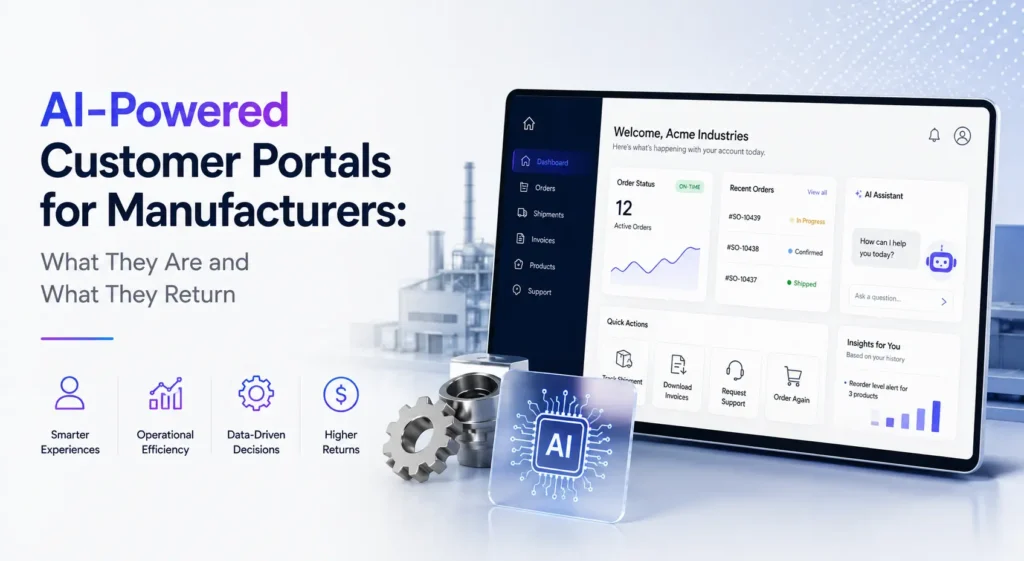
Your buyers don’t want to call your sales rep to check order status. They haven’t for a while. What changed in 2026 is that their patience for manufacturers who still require that call has run out.
67% of B2B buyers now prefer self-service portals over interacting with sales representatives for routine reorders and account inquiries *(****Source:***[ *Creatuity*](https://www.creatuity.com/insights/ai-in-b2b-commerce-statistics-2026/)*)*. 72% expect self-service access to account and order information as a baseline capability, not a differentiator *(****Source:***[ *Manufacturing Lead Generation*](https://manufacturingleadgeneration.com/customer-portal-self-service-tools-manufacturers/)*)*. And 75% say they would switch to a supplier offering a better online buying experience. That last number is the one that should matter most to a manufacturing Sales or Digital lead reading this article.
A customer portal is not a luxury for manufacturers with large digital budgets anymore. It is the table stakes for keeping accounts that have decided convenience is part of what they are buying from you.
## What most manufacturers’ customer experience actually looks like
Walk through a typical B2B order cycle at a mid-market manufacturer without a portal, and you find the same friction points in almost every version of it.
A buyer at a production facility needs to reorder fasteners, coatings, or components they have ordered before. They email a sales contact or call customer service. The sales contact checks stock availability, gets a price confirmation from someone else, and responds sometime the following business day. The buyer places the order. Three days later they call back to ask where it is. Customer service checks with warehouse. Shipping confirms a date. The buyer updates their production schedule accordingly.
Every step in that sequence is manual. Every manual step is time someone on your team is spending on a task that adds no value to either party. The sales rep who spent 40 minutes processing a repeat order for an existing account did not spend those 40 minutes developing a new account or deepening a strategic relationship.
This is the problem an AI-powered customer portal solves, and it solves it completely. The buyer logs into the portal, sees their order history and current inventory availability in real time, places the reorder in three clicks, receives an automated confirmation with a shipping date, and gets a notification when the order ships. Nobody on your team touched it. The buyer is happier. Your sales rep is free to work on something that requires judgment.
## What an AI layer actually adds on top of a basic portal
A self-service portal without AI is better than no portal. It handles the transactional friction. An AI layer on top of that handles the intelligence layer: learning from buying patterns, surfacing relevant information at the right moment, and reducing the cognitive load on the buyer during the order process.
Automated order processing with AI reduces order-to-fulfillment cycle times by 40 to 60% *(****Source:***[ *Creatuity*](https://www.creatuity.com/insights/ai-in-b2b-commerce-statistics-2026/)*)*. That compression happens because the AI handles validation, inventory checking, and routing simultaneously rather than sequentially, and flags exceptions rather than routing everything through a human review queue.
AI-powered search understands intent rather than requiring exact part numbers or keyword matches. For manufacturers with complex product catalogs, this matters significantly. A buyer who types “stainless hex bolts for outdoor marine applications” in an AI-enabled search gets relevant results filtered by material, thread type, and coating. A buyer in the same portal without AI-powered search types a partial part number and gets 400 results that require manual filtering. One of those experiences generates a completed order. The other generates a phone call to customer service.
B2B companies with AI-powered search report 25% higher average order values because better product discovery and cross-sell surface compatible products and accessories the buyer would not have found through manual browsing.
AI-driven dynamic pricing improves margins by 5 to 10% on average for B2B manufacturers by applying contracted pricing, volume tiers, and promotional rules automatically rather than requiring a sales rep to manually calculate and confirm pricing for each order.
And AI chatbots within the portal handle 60 to 70% of routine customer inquiries without human intervention, including order status, shipping queries, invoice questions, and product compatibility checks, reducing support costs by 30% *(****Source:***[ *Creatuity*](https://www.creatuity.com/insights/ai-in-b2b-commerce-statistics-2026/)*)*.
***Want to understand what a customer portal connected to your ERP and product catalog would look like for your manufacturing operation?***[ *Talk to our team*](https://www.krishaweb.com/contact-us/)*. We build custom manufacturing portals with AI layers, ERP integration, and account-specific pricing. No off-the-shelf templates.*
## The features that actually drive adoption
A customer portal that buyers do not use is infrastructure spend with no return. The features that drive adoption in manufacturing B2B are not about complexity. They are about whether the portal gives buyers something they genuinely cannot get as fast any other way.
Real-time order status with production-level visibility is the highest-adoption feature consistently. Buyers who can see where their order is in the production queue, not just whether it has shipped, get the information they actually need for production planning without calling anyone.
Account-specific pricing and contract terms displayed accurately in the portal removes the most common reason buyers abandon self-service and call a sales rep instead. If the price shown in the portal does not match the contracted price, every order requires a manual confirmation call. The portal has to be connected to the ERP’s pricing engine, not displaying a generic price list.
Reorder in three clicks from order history is the feature that drives repeat purchase frequency. Buyers on regular replenishment cycles who can reorder from their purchase history without re-entering specifications or quantities reorder more consistently and earlier in their inventory cycle.
Invoice management and online payment. 71% of B2B buyers are Millennials or Gen Z. They do not want to receive PDF invoices by email and process manual bank transfers. A portal that handles invoice visibility and payment in one place reduces accounts receivable cycle time and reduces the administrative overhead of finance managing invoice follow-up.
Multi-user access with role-based permissions matters for manufacturing accounts where multiple people place orders: procurement staff, plant managers, maintenance coordinators, and finance teams all have different access needs. A portal that cannot differentiate these roles forces the manufacturer to either share single login credentials or limit portal access to one user type.
## The connection to the broader manufacturing digital stack
A customer portal does not work in isolation. Its value is directly proportional to how accurately it reflects what is actually happening inside the manufacturing operation.
Real-time inventory availability requires a live connection to the ERP. Accurate delivery date commitments require a connection to production scheduling. Account-specific pricing requires a connection to the pricing engine. If the portal is pulling data from a nightly export rather than a live feed, the information it shows buyers is already stale by the time they see it, and a buyer who places an order based on stale availability data and then receives a backorder notification has a worse experience than if they had called.
This is why the technical architecture of the portal matters as much as the feature set. A portal built on top of live ERP integration is a different product from a portal with a batch-sync data layer, and the buyer experience reflects that difference immediately.
For manufacturers who have already invested in[ **workflow automation**](https://www.krishaweb.com/blog/manufacturing-workflow-automation/) within their production and fulfillment operations, a customer portal that connects to those systems extends that automation to the customer-facing layer. Orders placed through the portal trigger the same automated fulfillment workflows as orders processed internally. The result is that a customer placing their own order through the portal gets the same accuracy, speed, and communication as an order processed by the sales team.
## The ROI case for a manufacturing Sales or Digital lead
The business case for a customer portal in manufacturing runs across four dimensions, and each one compounds the others.
**Support cost reduction.** When buyers can answer their own questions about order status, pricing, and invoices, the volume of inbound support contacts drops significantly. AI chatbots handling 60 to 70% of routine inquiries without human intervention translates directly to customer service headcount efficiency or reallocation toward higher-value interactions.
**Sales rep productivity.** A sales team spending 40 to 60% of their time on order processing, status inquiries, and quoting for repeat orders is not a sales team. It is a customer service team with a sales title. A portal that handles routine account management frees that capacity for new account development, strategic relationship work, and large deal support, the activities that drive revenue growth rather than revenue maintenance.
**Revenue per account.** B2B companies using AI for personalization see a 15 to 20% increase in revenue per customer. The mechanism is what you would expect: buyers who can see their account history, get relevant product recommendations, and access a streamlined reorder experience buy more frequently and at higher average values. Digital Commerce 360’s research shows B2B companies using self-service portals see an average 15% increase in order value compared to orders placed through traditional channels.
**Account retention.** Buyers who have embedded your portal into their purchasing workflow have a switching cost that buyers who order by phone or email do not. The operational dependency created by a portal that a buyer uses daily to run their own procurement is a retention mechanism that a good relationship manager cannot easily replicate on its own.
The ROI payback period for a B2B customer portal is 6 to 12 months when the implementation is connected to live ERP data and includes the AI layer for search, recommendations, and routine inquiry handling.
***Have a specific ERP system or product catalog complexity you are working with and want to understand what integration actually involves?***[ *Schedule a technical conversation*](https://api.leadconnectorhq.com/widget/bookings/book-a-call-with-parth-krishaweb) *with our team. We build custom manufacturing portals on top of SAP, Oracle, Microsoft Dynamics, and a range of mid-market ERP systems.*
##### Additional Read
- [Manufacturing Workflow Automation: 8 Processes Worth Automating](https://www.krishaweb.com/blog/manufacturing-workflow-automation/)
- [AI Use Cases for Manufacturing Companies: Where ROI Happens First](https://www.krishaweb.com/blog/ai-use-cases-manufacturing/)
- [How USA Manufacturers Choose Digital Transformation Partners](https://www.krishaweb.com/blog/manufacturing-digital-transformation-partner/)
### Frequently Asked Questions
**What is an AI-powered customer portal for manufacturers?**A secure, self-service web application that allows B2B buyers to place orders, check order status, access account-specific pricing, manage invoices, and communicate with the manufacturer without requiring intervention from a sales or customer service team. The AI layer adds intelligent search, automated order validation, predictive reorder recommendations, and a chatbot that handles routine inquiries. It is connected to the manufacturer’s ERP system in real time so the information buyers see reflects actual inventory, pricing, and production status.
**How is an AI customer portal different from a regular customer portal?**A standard customer portal handles transactions: order placement, status checking, invoice access. An AI-powered portal adds intelligence: search that understands intent rather than requiring exact part numbers, product recommendations based on purchase history and compatibility, automated pricing that applies contracted rates and volume tiers without manual calculation, and a chatbot that resolves routine inquiries without human involvement. The practical difference shows up in order value (25% higher average order value from AI-powered search), support cost (30% reduction from AI chatbot handling), and adoption rate.
**What ERP systems can a manufacturing customer portal integrate with?**The integration approach depends on the ERP system’s API and data model. SAP, Oracle NetSuite, Microsoft Dynamics 365, Epicor, SYSPRO, and Infor all support API-level integration for real-time inventory, pricing, and order data. Older or heavily customized ERP systems may require middleware layers or custom API development. The most important technical requirement is that the portal pulls live data rather than batch-synchronized exports, which determines whether the inventory and pricing information buyers see is accurate at the moment of the order.
**How long does it take to build and deploy a manufacturing customer portal?**A focused initial deployment covering order history, real-time status, reorder functionality, account-specific pricing, and invoice access typically takes 12 to 20 weeks from architecture and ERP integration design to go-live. The timeline is driven primarily by ERP integration complexity and the scope of the AI features included. Adding an AI chatbot trained on product catalog and order data adds four to six weeks. Adding complex product configurators or visual search adds more. Starting with a pilot group of accounts rather than a full customer base reduces go-live risk and allows the portal to be refined based on real buyer behavior before broad rollout.
**Will buyers actually use a self-service portal, or will they continue calling?**Adoption depends almost entirely on whether the portal gives buyers something they cannot get as fast another way. If the portal shows accurate real-time inventory and a buyer can reorder in three clicks with confidence that the price and availability are correct, they use it. If the portal shows prices that do not match their contract or availability that is 24 hours stale, they call instead. The design principle for manufacturing portal adoption: every piece of information in the portal must be more accurate and more current than what a buyer would get by calling. If that is true, buyers migrate to self-service naturally. If it is not, the portal becomes a secondary channel that nobody trusts.
### Conclusion
The manufacturers gaining ground on their competition in B2B sales right now are not necessarily the ones with the best product or the lowest price. In a lot of cases they are the ones whose buyers can log in, see what they need, and place an order without touching a phone. That experience, once a buyer has it, becomes the expectation they apply to every other supplier relationship they manage.
A customer portal built on live ERP data, with AI handling search, recommendations, pricing, and routine inquiry, is not a website feature. It is a channel. And for manufacturers whose sales growth is limited by how many accounts a finite sales team can actively manage, it is the channel that removes that constraint.
If your manufacturing operation is ready to build that channel, the right conversation to have first is about your ERP system, your product catalog complexity, your customer segmentation, and your current support cost per account. That conversation is what shapes the architecture before anyone writes a line of code.
[**Book a Free AI Website and CRO Audit with KrishaWeb**](https://api.leadconnectorhq.com/widget/bookings/book-a-call-with-parth-krishaweb)
Our[ **AI solutions team**](https://www.krishaweb.com/ai-solutions-agency/) builds manufacturing customer portals from the ERP integration layer through the AI features that drive adoption and retention.

###### Parth Pandya
Founder & CEOFounder & CEO of KrishaWeb, leads an Enterprise Web Agency. With contributions to WordPress and organization of WordCamps, he pioneers innovation and community engagement in the digital realm.
 Interact With Me- [ ](https://twitter.com/imparthpandya)
- [ ](https://www.linkedin.com/in/parthjpandya/)
- [ ](mailto:parth@krishaweb.com)
---
_View the original post at: [https://www.krishaweb.com/blog/ai-customer-portal-manufacturing/](https://www.krishaweb.com/blog/ai-customer-portal-manufacturing/)_
_Served as markdown by [Third Audience](https://github.com/third-audience) v3.6.1_
_Generated: 2026-08-10 12:39:44 UTC_