---
title: "AI Readiness Assessment: How to Budget for Your First AI Initiative"
url: "https://www.krishaweb.com/blog/ai-readiness-assessment-budget/"
date: "2026-07-29T12:46:01+00:00"
modified: "2026-07-29T12:46:03+00:00"
type: "Article"
resource: "https://www.krishaweb.com/blog/ai-readiness-assessment-budget/"
timestamp: "2026-07-29T12:46:03+00:00"
author:
name: "Parth"
url: "https://www.krishaweb.com/"
categories:
- "Web Development"
word_count: 2345
reading_time: "12 min read"
summary: "Here is the number every first-time AI buyer should see before writing a budget: 70% of enterprise AI projects never reach production, and failed projects cost an average of $2.4 million. Worse, or..."
description: "Here is the number every first-time AI buyer should see before writing a budget: 70% of enterprise AI projects never reach production, and failed projects co..."
keywords: "Web Development"
language: "en"
schema_type: "Article"
related_posts:
- title: "The Cost of Integrating AI into Existing Enterprise Systems (2026 Guide)"
url: "https://www.krishaweb.com/blog/cost-of-integrating-ai-into-enterprise-systems/"
- title: "Healthcare Portal Development Cost in 2026: The Complete Budget Guide"
url: "https://www.krishaweb.com/blog/healthcare-portal-development-cost/"
- title: "10 Signs Your Agency Needs a White Label Web Design Partner"
url: "https://www.krishaweb.com/blog/signs-agency-needs-white-label-partner/"
---
# AI Readiness Assessment: How to Budget for Your First AI Initiative
_Published: Wednesday,July 29, 2026_
_Author: Parth_
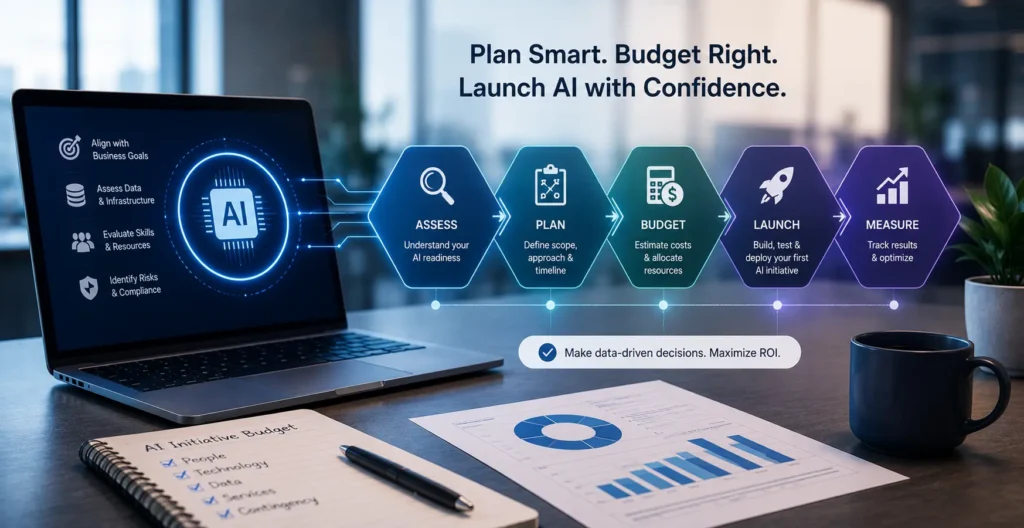
Here is the number every first-time AI buyer should see before writing a budget: 70% of enterprise AI projects never reach production, and failed projects cost an average of $2.4 million. Worse, organizations that skip a readiness assessment and jump straight in spend 2.3 times more budget and take 40% longer to reach production than those that assess first.
Read that again, because it reframes the whole budgeting question. The reason first AI projects blow their budget is rarely the technology. It is that the organization budgeted for a project it was not ready to run, then paid for the gaps mid-build at full price. The single most expensive thing you can do with your first AI initiative is fund it before you know what it will actually require.
That is what an AI readiness assessment fixes, and this guide shows you how to use one to build a budget you can defend. Not a vague “AI is the future” pitch, but a practical framework that connects each readiness dimension to a real cost line, so you fund the right project at the right number. This is written for the CEO or head of innovation about to commit budget for the first time.
## What an AI readiness assessment actually is (and why it’s a budgeting tool)
An AI readiness assessment scores how prepared your organization is to deliver an AI project, across a handful of dimensions, before you commit budget. It answers one question: are you ready to ship, or do you need to fix gaps first?
Most people treat it as a technical audit. That’s a mistake. Its real value is financial. Every gap it surfaces is a cost you would otherwise discover mid-project, when it’s most expensive to fix. As one framework puts it, an infrastructure gap found at the assessment stage costs a fraction of the same gap discovered at sprint six. The assessment converts unknown future costs into known upfront ones, which is the entire point of a budget.
So think of readiness not as a report card but as a budgeting instrument. A low score is not a verdict, it’s a plan, and it tells you exactly where your first dollars need to go before the build even starts.
## The five dimensions to assess (and what each one costs to fix)
Readiness assessments in 2026 converge on roughly five dimensions. Here they are, with the budget implication of each, because that’s the part the CEO actually needs.
### 1. Data
This is where most projects break first. AI needs data that is accurate, accessible, and governed, and in most companies valuable data sits trapped in PDFs, spreadsheets, and legacy systems. If yours does, budget for data preparation, the extraction, cleaning, and consolidation work, before any AI development. This is the most commonly underestimated line, and skipping it is the top reason first projects fail.
### 2. Infrastructure
Can your systems actually run and connect to AI? Running workloads without the right cloud or compute access constrains your options, and many companies underestimate the migration lift. Budget line: any cloud or integration work needed to connect the AI to your existing stack.
### 3. Talent
Do you have people who can build, run, and maintain this? If not, you either hire (slow and expensive) or partner with an agency (faster, lower upfront cost). Budget line: internal hires or external delivery, plus training so your team can actually use what gets built.
### 4. Process
Are your workflows defined enough to insert AI into them, and is there a named owner accountable for the outcome? Without clear ownership, AI outputs sit unused, and the budget gets quietly reallocated. Budget line: usually low in dollars, high in consequence, this is mostly about assigning an owner before you build, not after.
### 5. Strategy
Does the use case map to a specific, measurable business outcome with an executive who owns it? “Improve efficiency” is not a use case. ” Cut contract-review time from four hours to under 45 minutes”. Budget line: The discipline here doesn’t cost money; it saves it by stopping you from funding a vague experiment.
The quotable summary worth remembering: Your readiness score in each dimension is really a preview of your budget in that dimension. Score low on data, and data prep is your biggest line. Score low on talent, and delivery is too. The assessment tells you where the money goes before you spend it.
**The table below makes that connection concrete.**
### Readiness dimension: what your score means for your budget
| **Dimension** | **What “ready” looks like** | **What “not ready” looks like** | **Budget impact if not ready** |
|---|---|---|---|
| **Data** | Clean, accessible, governed data for your use case | Data trapped in PDFs, spreadsheets, and legacy systems | Highest hidden cost. Data prep can rival the build cost when badly fragmented |
| **Infrastructure** | Cloud and systems ready to run and connect to AI | On-prem or siloed systems with no clear integration path | Cloud migration and integration work added before development |
| **Talent** | People who can build, run, and maintain AI in-house | No AI skills on the team | Cost of hiring (slow) or partnering with an agency (faster), plus staff training |
| **Process** | Defined workflows with a named, accountable owner | Vague workflows, no one owns the outcome | Low in dollars, high in risk. Unowned projects get quietly defunded |
| **Strategy** | Use case tied to a specific, measurable outcome | “Improve efficiency” with no metric or executive sponsor | Saves money by preventing you from funding a vague experiment |
The pattern the table makes obvious: your weakest dimension is usually your biggest budget line. Read your scores as a preview of where the money goes, then fund those gaps deliberately instead of discovering them at sprint six.
## The KrishaWeb Ready-to-Budget method
Here’s how we turn a readiness assessment into an actual number, in four steps. We call it the Ready-to-Budget method because a score alone doesn’t fund anything; a plan does.
First, pick one use case, not a transformation. The biggest budgeting mistake first-timers make is trying to assess AI readiness across sales, operations, and service all at once. Don’t. Assess readiness for your single highest-value use case, because a focused first project typically needs 40% fewer dependencies and delivers ROI in three to four months. One narrow project you can fund and finish beats a grand plan you can’t.
Second, score that one use case across the five dimensions. Be honest, since a generous score just moves the cost from the budget to the surprise column later.
Third, translate each weak dimension into a cost line. A low data score becomes a data-prep line. A low talent score becomes a hire-or-partner line. Now you have a real budget built from real gaps, not a guess.
Fourth, add the build and the run. On top of the readiness-gap costs, add the actual AI development and the ongoing costs, because AI is never a one-time spend. This is where our related guides help: for a smaller first project, our[ **AI automation cost for mid-sized businesses**](https://www.krishaweb.com/blog/ai-automation-cost-mid-sized-business/) breaks down the numbers, and for deeper system work, the[ **cost** ](https://www.krishaweb.com/blog/cost-of-integrating-ai/)**[of ](https://www.krishaweb.com/blog/cost-of-integrating-ai/)**[**integrating AI**](https://www.krishaweb.com/blog/cost-of-integrating-ai/) covers build, run, and total cost of ownership.
Run those four steps, and you walk into your board meeting with a number built from evidence, not optimism. That is a budget that survives scrutiny.
### How much should you budget for a first AI project?
The honest answer depends on your readiness, which is the whole point of assessing it first. But here are realistic anchors for a first initiative in 2026.
A focused first project, one workflow, on reasonably ready systems, commonly runs a build in the low-to-mid five figures, plus ongoing usage and maintenance. If your data or infrastructure needs significant preparation, add that before development, it can rival the build cost itself when data is badly fragmented. And always budget for the run, not just the build: hosted AI models charge per use, so ongoing cost is a permanent line, not a one-time item.
A defensible first budget has three layers, and first-timers usually only plan for the middle one.
#### The three layers of a first AI budget
| **Budget layer** | **What it covers** | **When first-timers miss it** |
|---|---|---|
| **Readiness-gap costs** | Data prep, infrastructure, talent, fixing the gaps above | Discovered mid-project at full price |
| **Build** | The actual AI development for one use case | Usually the only thing they budget for |
| **Run (12 months)** | Ongoing usage, monitoring, and maintenance | Forgotten, then arrives as a surprise in month four |
The rule of thumb: readiness-gap costs, plus build, plus twelve months of run. Leave any of the three out, and your real number arrives as a surprise. Budget all three and you’ve built the number correctly.
One more piece of protection: set cost visibility from day one. The organizations that stay on budget aren’t the ones that spend the least, they’re the ones that can see their AI spend in real time and catch it climbing before it becomes a problem.
#### What to check before you commit a single dollar
Before the budget is approved, confirm these. They’re the difference between a first project that ships and one that joins the 70% that don’t.
You have one specific, measurable use case, not a theme. A named executive owns the outcome and is accountable for it. Your data for that use case is accessible, or you’ve budgeted to make it so. You’ve decided to build, buy, or partner for delivery. You have a way to measure success (a real metric, not “executive enthusiasm after a demo”). And you have a plan to monitor cost. If any of those is missing, fix it before funding, not after, because every one of them is cheaper to solve now than at sprint six.
***Choosing the right delivery partner is part of this too, and it deserves its own scrutiny, our guide on***[ ***how to choose an AI development agency***](https://www.krishaweb.com/blog/how-to-choose-ai-development-agency/) ***covers exactly what to look for.***
### Start With a Free AI Readiness Assessment
You don’t have to build this framework alone, and you shouldn’t guess at the number. The fastest way to a defensible first AI budget is to assess readiness with people who’ve done it before.
That’s exactly what our free[ **AI Readiness Assessment**](https://www.krishaweb.com/ai-readiness-assessment/) is. In a 30-minute call, our AI team helps you pick your highest-value first use case, honestly score your readiness across the five dimensions, flag the data and infrastructure costs that catch first-timers, and give you a realistic budget range you can take to your board. No pitch, no obligation, just a clear-eyed number and a plan.
Whether your organization scores high or low, the next step is the same: a baseline you can act on.
[**Book your free AI Readiness Assessment**.](https://www.krishaweb.com/contact-us/)
### Frequently Asked Questions
**What is an AI readiness assessment?**An AI readiness assessment is a structured evaluation of how prepared your organization is to deliver an AI project, scored across dimensions like data, infrastructure, talent, process, and strategy, before you commit budget. It answers whether you’re ready to build now or need to fix gaps first. Its real value is financial: every gap it surfaces is a cost you’d otherwise hit mid-project, when it’s far more expensive to fix. Think of it less as a report card and more as a budgeting tool that converts unknown future costs into known upfront ones.
**How do I budget for my first AI project?**Build the budget from your readiness assessment in four steps: pick one high-value use case rather than a broad transformation, score it honestly across the five readiness dimensions, translate each weak dimension into a cost line (low data score becomes a data-prep line, low talent score becomes a hire-or-partner line), then add the AI build cost and twelve months of ongoing run cost on top. This produces a defensible number built from real gaps instead of optimism. A focused first project typically runs low-to-mid five figures for the build, plus data preparation if your data is fragmented, plus recurring usage costs.
**Why do most first AI projects fail or go over budget?**Around 70% of enterprise AI projects never reach production, and it’s rarely a technology problem. Organizations budget for a project they aren’t ready to run, then pay for the gaps mid-build at full price. Companies that skip a readiness assessment spend about 2.3 times more and take 40% longer to reach production, and failed projects average $2.4 million. The most common root cause is poor data readiness, valuable data trapped in PDFs, spreadsheets, and legacy systems that needs preparation before any AI can use it. Assessing readiness first turns those expensive surprises into planned budget lines.
**How much does a first AI initiative cost in 2026?**It depends on your readiness, which is why assessing first matters. A focused first project on reasonably prepared systems commonly runs a build in the low-to-mid five figures, plus ongoing usage and maintenance costs. If your data or infrastructure needs significant preparation, budget that separately before development, as it can approach the build cost when data is badly fragmented. Always budget for the run as well as the build, since hosted AI models charge per use and create a permanent cost line. The defensible formula is readiness-gap costs, plus build, plus twelve months of run.
**Should my first AI project be one use case or a broad rollout?**One use case, always. The most common first-project mistake is trying to assess and fund AI readiness across sales, operations, and service simultaneously, which creates analysis paralysis and unrealistic budgets. A single focused use case typically needs 40% fewer dependencies and can deliver ROI in three to four months. Pick your highest-value, most self-contained process, prove it, then expand using what you learned and the savings you generated. Your first success should fund and de-risk your second project, not bet the whole budget at once.
**What should I have in place before funding an AI project?**Six things: one specific, measurable use case (not a vague theme), a named executive who owns the outcome, accessible data for that use case or a budget to prepare it, a build-buy-or-partner decision for delivery, a real success metric beyond demo enthusiasm, and a plan to monitor ongoing cost. If any of these is missing, fix it before approving the budget rather than after, since each is far cheaper to solve at the assessment stage than mid-project. This checklist is essentially what separates the projects that ship from the 70% that stall.

###### Parth Pandya
Founder & CEOFounder & CEO of KrishaWeb, leads an Enterprise Web Agency. With contributions to WordPress and organization of WordCamps, he pioneers innovation and community engagement in the digital realm.
 Interact With Me-
-
- [ ](mailto:)
---
_View the original post at: [https://www.krishaweb.com/blog/ai-readiness-assessment-budget/](https://www.krishaweb.com/blog/ai-readiness-assessment-budget/)_
_Served as markdown by [Third Audience](https://github.com/third-audience) v3.6.1_
_Generated: 2026-07-29 12:46:03 UTC_