---
title: "How to Know if Your Business Is Ready for AI (A Readiness Guide)"
url: "https://www.krishaweb.com/blog/ai-readiness-assessment-guide/"
date: "2026-09-23T12:31:56+00:00"
modified: "2026-09-23T12:31:58+00:00"
type: "Article"
resource: "https://www.krishaweb.com/blog/ai-readiness-assessment-guide/"
timestamp: "2026-09-23T12:31:58+00:00"
author:
name: "Parth"
url: "https://www.krishaweb.com/"
categories:
- "Web Development"
word_count: 3330
reading_time: "17 min read"
summary: "Almost every company is using AI in some form now, and almost none of them can scale it. That gap is the whole problem this guide solves."
description: "Almost every company is using AI in some form now, and almost none of them can scale it. That gap is the whole problem this guide solves. Here’s the di..."
keywords: "Web Development"
language: "en"
schema_type: "Article"
related_posts:
- title: "What Businesses Actually Get From an AI Solutions Partner (Beyond the Hype)"
url: "https://www.krishaweb.com/blog/ai-solutions-company-deliverables/"
- title: "Top Vibe Coding Agencies in 2026: Companies Building Production-Ready Software"
url: "https://www.krishaweb.com/blog/top-vibe-coding-agencies/"
- title: "White Label NDA, IP Assignment & Code Ownership: What Every Agency Must Get in Writing"
url: "https://www.krishaweb.com/blog/white-label-nda-ip-code-ownership/"
---
# How to Know if Your Business Is Ready for AI (A Readiness Guide)
_Published: Wednesday,September 23, 2026_
_Author: Parth_
Almost every company is using AI in some form now, and almost none of them can scale it. That gap is the whole problem this guide solves.
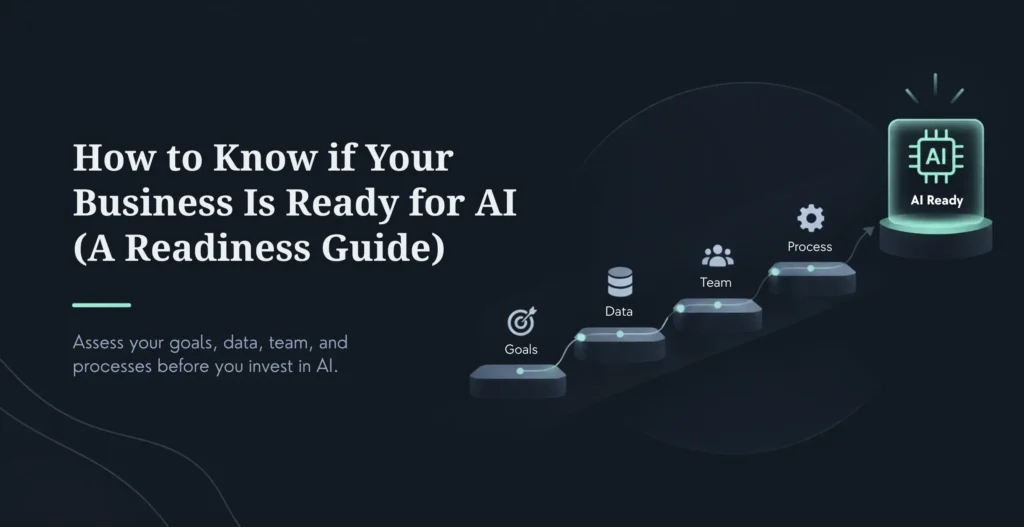
Here’s the direct answer. To know if your business is ready for AI, assess six dimensions: data (is it clean, accessible, and fit for the use case), infrastructure (can your systems actually integrate AI), talent (do you have or can you reach AI expertise), governance (are compliance and ethical guidelines in place), process (are workflows redesigned around AI, not layered on top), and ownership (is there a named person accountable for the outcome). Score yourself across those six, and your weakest dimensions tell you exactly what to fix before you spend a rupee or a dollar on AI tools.
The stakes are real and measurable. Gartner predicts that through 2026, organizations will abandon 60% of AI projects that aren’t supported by AI-ready data, and that’s not a distant risk: S&P Global found 42% of companies abandoned most of their AI initiatives in 2025, up from 17% the year before. Meanwhile 88% of companies use AI but only about 7% have scaled it. Readiness, not ambition, is the bottleneck.
This guide gives you the whole toolkit: what AI readiness means, the six dimensions, a 40-question self-assessment with scoring, a 90-day roadmap if you’re not ready yet, and honest guidance on when to bring in a professional. If you’d rather have it done for you, KrishaWeb’s **[AI Readiness Assessment](https://www.krishaweb.com/ai-readiness-assessment/)** is the fast, practical version of everything below.
## What Is AI Readiness?
AI readiness is your organization’s actual capacity to adopt and scale AI successfully, not whether you’ve bought the tools, but whether the foundations underneath them can hold. It spans six pillars: data, infrastructure, talent, governance, process, and ownership. A business can be enthusiastic about AI and completely unready, which is exactly how most failed projects begin.
It helps to separate readiness from strategy, because they’re often confused and they answer different questions:
| | **AI Readiness** | **AI Strategy** |
|---|---|---|
| The question it answers | Can we build this without it collapsing? | What should we build, and why? |
| What it examines | Data, infrastructure, talent, governance | Use cases, sequencing, expected ROI |
| What it produces | Readiness score, gap assessment, roadmap | Prioritized use cases, ROI model, budget |
| When it happens | Before any AI spend | After readiness is confirmed |
As one way to put it: strategy decides what to build and why, readiness decides whether you can build any of it without the project collapsing the moment it leaves the sandbox. Do them in that order. A brilliant strategy built on unready foundations is just a more expensive way to fail.
The reason this matters so much comes down to a single recurring villain: data. Gartner’s own survey found 63% of organizations either lack the data management practices to support AI or aren’t sure they have them. When AI projects die, they usually die of a data problem, not a model problem, which is precisely why readiness assessment is the cheapest insurance you can buy before the invoice arrives.
## Why AI Readiness Matters
The case for assessing readiness first is made entirely by the failure data, and it’s stark.
More than 80% of AI projects fail, roughly twice the failure rate of comparable IT projects (RAND). MIT’s 2025 research found about 95% of generative-AI pilots produced no measurable return on the P&L. BCG found 74% of companies get no tangible value from AI. And only around 7% of enterprises say their data is completely ready for AI (Cloudera/HBR). Read together, these numbers all point at the same conclusion: the failures are organizational, not technical. The model almost never is the problem.
Skipping readiness is what turns that risk into reality. Without it you get wasted investment (spending on tools before data, infrastructure, or people are ready), failed deployments that work in a demo and collapse in production, shadow AI spreading with no governance, compliance exposure, employee resistance from no change management, and, maybe worst for the business case, no measurable ROI because nobody set a baseline before building.
The flip side is the encouraging part, and it’s why assessment pays for itself. Readiness predicts durability: Gartner found 45% of organizations with high AI maturity keep their AI projects running for at least three years, versus just 20% for low-maturity ones. An assessment is essentially a pre-mortem, it shows you how the project would die so you can decide not to let it, before you’ve spent the money.
## The Six Dimensions of AI Readiness
Here’s what each dimension actually examines, the questions to ask, and the red flags that say you’re not there yet.
### Data readiness
The most important dimension, because it’s where most projects die. Ask: is the data clean, labeled, and accessible without major extraction work? Has someone reviewed its quality against this specific use case? Are pipelines in place to keep a model fed as new data arrives? Red flags: data needs major restructuring, no quality review has happened, and there’s no plan to keep it current.
### Infrastructure readiness
Can your systems actually carry AI? Ask: does your infrastructure support the compute this needs? Do you have tooling to deploy, version, and monitor models in production? Can the AI connect to the enterprise systems it must talk to? Red flags: legacy systems that can’t integrate, no deployment tooling, and no monitoring capability.
### Talent and skills readiness
Someone has to build it and keep it alive. Ask: does the team include at least one person with hands-on AI deployment experience? Is there a clear plan for who maintains the model after go-live? Is there a workforce-literacy plan so users understand how their work changes? Red flags: no AI experience on the team, no maintenance owner, no literacy plan.
### Governance readiness
The dimension that keeps you out of trouble. Ask: have the regulatory and compliance requirements been identified? Is there a documented process for handling errors or unexpected outputs? Are there ethical guidelines and a published use policy, plus an inventory of the shadow AI already in use? Red flags: no compliance review, no error-handling process, no guidelines.
### Process readiness
AI amplifies whatever workflow you point it at, including a bad one. Ask: is the workflow documented, with a measured baseline (time, cost, error rate)? Have workflows been redesigned around AI rather than layered on top of old ones? Is there a change-management plan? Red flags: undocumented workflows, AI bolted onto outdated processes, no change management.
### Ownership and strategy readiness
Projects without an owner drift and die. Ask: is there a dedicated business-side owner accountable for the outcome? Has leadership agreed on a definition of success before the build starts? Is there a funded roadmap covering the next 12 to 36 months? Red flags: no owner, no agreed success metric, no roadmap or budget.
A pattern runs through all six: readiness is mostly organizational, not technical. Five of the six dimensions are about people, process, and decisions, not algorithms. That’s why enthusiastic, well-funded companies still fail, and why an honest look at these six is worth more than any tool demo.
## The 40-Question AI Readiness Checklist
Score each question yes (1 point) or no (0). Total out of 40, then read your result in the scoring section that follows. Be honest, an inflated score here just moves the failure to a more expensive stage later.
### Data readiness (7)
1. Do you have a specific AI use case with a documented business problem behind it?
2. Is the data you need accessible without major extraction or restructuring?
3. Has someone formally reviewed data quality against this specific use case?
4. Are data pipelines in place to keep the model updated as new data arrives?
5. Is your data clean, labeled, and accessible to the teams that need it?
6. Do you know where your data lives, who owns it, and what condition it’s in?
7. Are access approvals and permitted uses for that data confirmed?
### Infrastructure readiness (7)
1. Does your infrastructure support the compute this type of AI requires?
2. Do you have tooling to deploy, version, and monitor models in production?
3. Can the AI connect to the existing systems it needs to interact with?
4. Are your systems modern enough to integrate with AI tools?
5. Can your systems support AI with scalability in mind?
6. Can the system perform its task without unintended access or actions?
7. Do you have a defined security boundary for the AI system?
### Talent and skills readiness (6)
1. Does your team include at least one person with hands-on AI deployment experience?
2. Is there a clear plan for who maintains the model after go-live?
3. Do you have in-house AI expertise, or reliable access to external specialists?
4. Do employees understand how AI will change their work, not just that it’s coming?
5. Do you have a workforce AI-literacy plan?
6. Can your people operate the system, challenge its outputs, and own the release decision?
### Governance readiness (6)
1. Have the regulatory and compliance requirements for this use case been identified?
2. Is there a documented process for handling errors or unexpected outputs?
3. Are there ethical guidelines governing responsible AI use?
4. Do you have a published AI use policy?
5. Do you have an inventory of the AI tools already in use (shadow AI)?
6. Are there clear data-privacy and security guidelines for AI use?
### Process readiness (7)
1. Is the workflow understood and documented (steps, sample cases, current records)?
2. Have workflows been redesigned around AI rather than layered under it?
3. Is there a change-management plan for AI adoption?
4. Is exception handling documented for the workflow?
5. Have you measured the baseline (hours, elapsed time, error rate, fully loaded cost)?
6. Is the problem defined well enough to test an improvement (outcomes, acceptance criteria)?
7. Are you prepared to adjust processes to fit AI, rather than forcing AI to fit old systems?
### Ownership and strategy readiness (7)
1. Has leadership agreed on a definition of success before the build begins?
2. Is there a dedicated business-side owner accountable for the outcome?
3. Is there a funded AI roadmap covering the next 12 to 36 months?
4. Is there a named budget owner for AI initiatives?
5. Is there a pilot charter with a measurement baseline?
6. Do you have a use-case shortlist ranked by ROI?
7. Is leadership genuinely aligned and committed to supporting adoption?
##### Want this checklist in a form you can score?
Download the free White Label Partner Scorecard, run it on your finalists, then book a partnership call.
[Download the Free Scorecard](https://www.krishaweb.com/contact-us/) [Book a Partnership Call](https://api.leadconnectorhq.com/widget/bookings/book-a-call-with-parth-krishaweb)
## Scoring and the Maturity Model
Add up your points and find your band. The bands map to a five-level maturity model, so you can see both where you are and what “next” looks like.
| **Score** | **Readiness Level** | **What It Means** | **What to Do Next** |
|---|---|---|---|
| 0–15 | Pre-readiness (Exploring) | Foundations aren’t there yet | Data cleanup, infrastructure, talent, before any AI spend |
| 16–25 | Partial readiness (Planning/Implementing) | Pilots viable, production needs real planning | Run low-risk pilots, close gaps in parallel |
| 26–35 | Strong readiness (Scaling) | Ready for production AI with governance | Move to strategy and implementation |
| 36–40 | AI-ready (Realizing) | Ready to scale with confidence | Fast-track deployment, expand use cases |
The maturity ladder underneath those bands runs Exploring (little AI understanding, focus on education), Planning (strategy defined, focus on data and infrastructure), Implementing (active pilots, focus on scaling and governance), Scaling (multiple systems in production with measurable ROI, focus on optimization), and Realizing (AI embedded in core operations, focus on innovation). Note the thresholds vary slightly between published frameworks, so treat the bands as directional, the value is in identifying your two weakest dimensions, not in the decimal precision of the total.
To use your result well: don’t chase the total, chase the low dimensions. A company scoring 29 with a governance score of 3/6 doesn’t need to “improve its readiness” in the abstract, it needs an error-handling process and compliance review, specifically. Fix the weakest one or two, re-score, and move.
Worked example. A mid-market company scores data 5/7, infrastructure 6/7, talent 4/6, governance 3/6, process 5/7, ownership 6/7, total 29/40, strong readiness. The total looks healthy, but governance at 3 is the real story. Their next steps aren’t “get more ready,” they’re precise: build an error-handling process, redesign the top workflow around AI rather than under it, and name a maintenance owner. That’s what a score is for, turning a vague worry into a short, specific to-do list.
## What to Do If You’re Not Ready: A 90-Day Roadmap
If you landed in pre- or partial readiness, that’s useful information, not a verdict. Most gaps are fixable in a quarter of focused work. Here’s the arc.
### Days 1–30, Foundation
Get the basics in order. Audit your data sources, clean and label what matters, and set quality standards. Assess your infrastructure for integration gaps and plan the upgrades. Map your AI skills and decide whether you’ll train or hire. You should end the month with a data-quality report, an infrastructure gap analysis, and a talent plan.
### Days 31–60, Enablement
Build the guardrails and the buy-in. Stand up a light governance framework: a committee, ethical guidelines, a compliance checklist. Document and then redesign your priority workflows around AI rather than bolting it on. And invest in AI literacy, train people, address the fears honestly, and create a few internal champions. You should end with a governance charter, redesigned workflows, and literacy materials.
### Days 61–90, Pilot Preparation
Get ready to actually build. Prioritize use cases by impact and feasibility and pick two or three for pilots. Write a pilot charter with scope, owners, timeline, and success metrics. And critically, measure the baseline (time, cost, error rate) for each target process before any AI touches it, because you can’t prove ROI against a baseline you never captured. You should end with ranked use cases, a pilot charter, and baseline metrics.
Then re-run the 40-question assessment. If you’ve crossed into the mid-20s, you’re ready to move to strategy and build. If not, keep going on the weakest dimensions, or bring in help, which is the next question.
## When to Get a Professional Assessment
Self-assessment is genuinely useful and, for many businesses, enough. Here’s how to tell which camp you’re in.
DIY is usually fine if you’re a smaller business with straightforward workflows, you scored comfortably (mid-20s or above), you’re focused on a single use case, and you have at least one AI-experienced person in-house to sanity-check the answers.
Bring in a professional if you’re mid-market or larger, scored low across several dimensions, are weighing multiple use cases across different functions, operate in a regulated industry (healthcare, finance, legal) where compliance expertise is non-negotiable, or simply have no in-house AI expertise to lean on. The bigger and more regulated you are, the more a structured outside assessment earns its cost, mostly by catching the expensive gaps a self-assessment glosses over.
The honest trade-off: DIY is free and fast but tends to miss complex, cross-functional, and compliance gaps, precisely the ones that sink larger deployments. A professional assessment costs money but brings an outside eye, benchmarking, and accountability. Match the tool to your size and risk.
##### Additional Read
- [What Businesses Actually Get From an AI Solutions Partner (Beyond the Hype)](https://www.krishaweb.com/blog/ai-solutions-company-deliverables/)
- [Top Vibe Coding Agencies in 2026: Companies Building Production-Ready Software](https://www.krishaweb.com/blog/top-vibe-coding-agencies/)
- [How to Choose a White Label Development Partner: The 15-Point Agency Due-Diligence Checklist](https://www.krishaweb.com/blog/how-to-choose-a-white-label-partner/)
## Cost and Deliverables
Pricing for professional AI readiness assessments spans an enormous range, from free self-service tools to half-a-million-dollar strategy-firm engagements, so treat the figures below as broad, vendor-reported 2026 ranges and get a scoped quote before assuming any of them fit you. Price mostly tracks data and organizational complexity, not brand: a strong boutique can outperform a big name at a fraction of the cost.
| **Tier** | **Typical Cost** | **Scope** | **What You Get** |
|---|---|---|---|
| Free self-assessment | $0 | 1–2 hours | A score, a maturity stage, a benchmark |
| SMB fixed-fee | ~$2,000–$25,000 | 1–2 weeks | Gap assessment, initial roadmap |
| Independent / mid-market | ~$15,000–$75,000 | 2–4 weeks | Full gap assessment, prioritized roadmap |
| Enterprise practitioner | ~$40,000–$120,000 | 4–8 weeks | Buildable roadmap for large, complex orgs |
| Big Four / strategy firm | ~$100,000–$500,000+ | Multi-week | Board-level report, multi-year program |
Whatever the tier, a genuinely useful assessment should deliver more than a number. Look for a maturity report with a dimension-by-dimension breakdown backed by evidence and prioritized gaps; a workflow audit mapping your repeatable processes with AI applicability scored; an opportunity map of use cases ranked by ROI (impact times feasibility); a requirement specification for the top use cases (inputs, outputs, minimum accuracy, integrations, data and security constraints); a value case with a measured baseline, a quantified target, and stated assumptions; and an enablement roadmap with actions, owners, and dates. If a quote doesn’t include most of these, the price is high for what’s being delivered. For more on treating the assessment as a budgeting tool rather than a checkbox, see our guide to the **[AI readiness assessment as a budgeting tool](https://www.krishaweb.com/blog/ai-readiness-assessment-budget/)**.
### Frequently Asked Questions
**What is an AI readiness assessment?**It’s a structured evaluation, usually two to four weeks for a professional engagement, of your organization’s ability to deploy and durably run AI. It scores you across dimensions like data, infrastructure, talent, governance, process, and ownership, and produces a written roadmap. In plain terms, it tells you where AI will actually help and what you need to fix first, before you spend on tools.
**How do I know if my business is ready for AI?**Check three things above all: is your data clean and accessible, have your workflows been redesigned around the tool rather than layered under it, and did you define a success metric before development started. If any of those three is missing, you’re not ready yet. The 40-question checklist in this guide turns that instinct into a score you can act on.
**What does an AI readiness assessment cover?**Six dimensions: data (clean, accessible, fit for the use case), infrastructure (systems that can integrate and scale AI), talent (in-house expertise or access to specialists, plus a maintenance plan), governance (compliance, ethical guidelines, error handling), process (workflows documented and redesigned around AI), and ownership (a named accountable owner, an agreed success definition, and a funded roadmap).
**How much does an AI readiness assessment cost?**It ranges enormously: free for self-assessment tools, roughly $2,000–$25,000 for SMB fixed-fee engagements, about $15,000–$75,000 for independent mid-market work (often the sweet spot), $40,000–$120,000 for enterprise, and $100,000–$500,000+ for Big Four or strategy firms. Cost tracks data and organizational complexity more than brand, so verify scope against price before committing.
**What’s the difference between AI readiness and AI strategy?**Strategy decides what to build and why, the use cases, the sequence, the expected return. Readiness decides whether you can build any of it without the project collapsing in production. Readiness comes first: a strong strategy on unready foundations just fails more expensively. Do the readiness assessment before you invest in strategy or tools.
**When should I get a professional assessment instead of doing it myself?**Bring in a professional if you’re mid-market or larger, scored low across several dimensions, are weighing multiple use cases, operate in a regulated industry, or have no in-house AI expertise. DIY is fine for smaller businesses with a single use case, a solid self-assessment score, and someone AI-experienced to check the answers.
**What counts as a good AI readiness score?**On the 40-point checklist here, 26 or above signals strong readiness, you can move to production AI with proper governance, and 36-40 means you’re ready to scale with confidence. 16-25 means pilots are viable but production needs planning, and below 16 means foundational work comes first. Focus less on the exact total and more on your two weakest dimensions.
**How do I improve my AI readiness score?**Target your lowest-scoring dimensions first rather than working on everything at once. The common fixes: clean and label your data, modernize systems that can’t integrate, train or hire for the skills gap, stand up governance (guidelines, compliance, error handling), redesign workflows around AI, and name an accountable owner with a funded roadmap. Then re-score after about 90 days of focused work.
### Conclusion
AI readiness isn’t about the tools. It’s about six foundations, data, infrastructure, talent, governance, process, and ownership, that decide whether the AI you build survives contact with the real world. The failure statistics are brutal precisely because most companies skip this step and discover the gaps after they’ve spent the money, not before.
Use the 40-question checklist to score yourself honestly. Land at 26 or above and you’re ready to move to strategy and build. Land below it and the 90-day roadmap gives you a clear, affordable path to get there, before you invest in tools you’re not yet set up to use.
#### Ready to find out where you stand?
Score yourself now with the 40-question checklist above, it’s free, and it’ll tell you your weakest dimensions in twenty minutes.
Or have it done properly: book an **[AI Readiness Assessment](https://www.krishaweb.com/ai-readiness-assessment/)** with KrishaWeb for a full maturity report, workflow audit, opportunity map, and 90-day roadmap tailored to your business.
**[AI Readiness Assessment as a Budgeting Tool](https://www.krishaweb.com/blog/ai-readiness-assessment-budget/) · [AI Solutions Agency](https://www.krishaweb.com/ai-solutions-agency/)**

###### Parth Pandya
Founder & CEOFounder & CEO of KrishaWeb, leads an Enterprise Web Agency. With contributions to WordPress and organization of WordCamps, he pioneers innovation and community engagement in the digital realm.
 Interact With Me- [ ](https://twitter.com/imparthpandya)
- [ ](https://www.linkedin.com/in/parthjpandya/)
- [ ](mailto:parth@krishaweb.com)
---
_View the original post at: [https://www.krishaweb.com/blog/ai-readiness-assessment-guide/](https://www.krishaweb.com/blog/ai-readiness-assessment-guide/)_
_Served as markdown by [Third Audience](https://github.com/third-audience) v3.6.1_
_Generated: 2026-09-23 12:31:59 UTC_