---
title: "AI Strategy Before AI Tools: Why Most AI Projects Fail Without It"
url: "https://www.krishaweb.com/blog/ai-strategy-before-ai-tools/"
date: "2026-09-28T12:46:58+00:00"
modified: "2026-09-28T12:46:59+00:00"
type: "Article"
resource: "https://www.krishaweb.com/blog/ai-strategy-before-ai-tools/"
timestamp: "2026-09-28T12:46:59+00:00"
author:
name: "Parth"
url: "https://www.krishaweb.com/"
categories:
- "Web Development"
word_count: 3313
reading_time: "17 min read"
summary: "Here's the number that should reframe how you think about AI spending: more than 80% of AI projects fail, roughly twice the failure rate of conventional IT projects. And almost none of those failur..."
description: "Over 80% of AI projects fail, and the cause is almost always scoping and governance, not technology. Here's why AI strategy must come before AI tools, and wh..."
keywords: "AI strategy consulting, Web Development"
language: "en"
schema_type: "Article"
related_posts:
- title: "How to Know if Your Business Is Ready for AI (A Readiness Guide)"
url: "https://www.krishaweb.com/blog/ai-readiness-assessment-guide/"
- title: "What Businesses Actually Get From an AI Solutions Partner (Beyond the Hype)"
url: "https://www.krishaweb.com/blog/ai-solutions-company-deliverables/"
- title: "Top Vibe Coding Agencies in 2026: Companies Building Production-Ready Software"
url: "https://www.krishaweb.com/blog/top-vibe-coding-agencies/"
---
# AI Strategy Before AI Tools: Why Most AI Projects Fail Without It
_Published: Monday,September 28, 2026_
_Author: Parth_
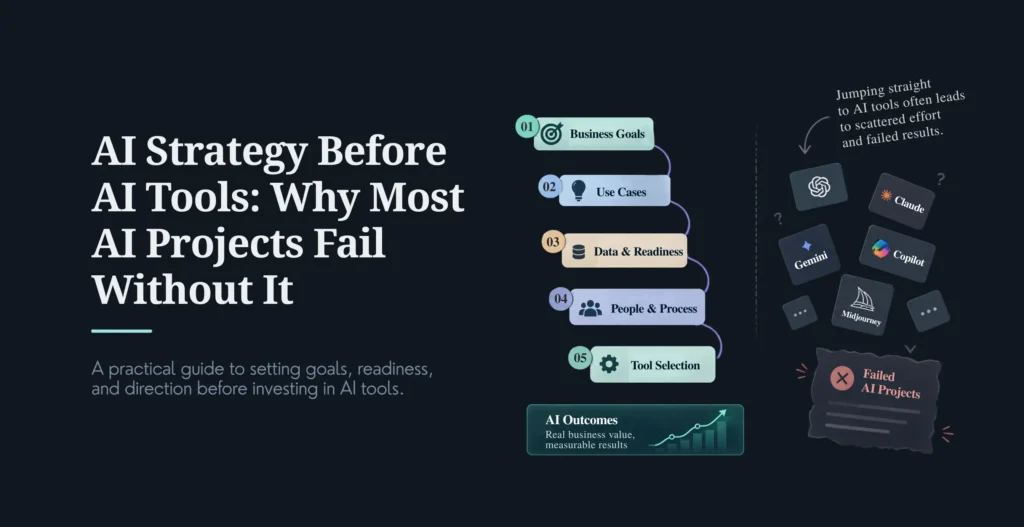
Here’s the number that should reframe how you think about AI spending: more than 80% of AI projects fail, roughly twice the failure rate of conventional IT projects. And almost none of those failures are the technology’s fault.
The models work. The algorithms work. What breaks is everything around them, the scoping, the data foundation, the governance, and the discipline to define what success even looks like before the build starts. RAND Corporation’s 2025 root-cause study of dozens of enterprise AI efforts found the failure drivers are overwhelmingly organizational, not technical. That’s the whole case for putting strategy before tools: you can’t buy your way past a scoping problem with a better model.
This guide lays out what the failure data actually says, why AI projects really collapse (RAND’s five root causes), the difference between AI strategy and AI implementation, what strategy consulting delivers and costs, and how to tell whether you need it. It’s written for the business owner, CTO, or operations leader who’s about to invest in AI and wants to be in the minority that gets a return.
One honest note before the numbers: the famous failure stats (80%, 95%, 42%) measure different things over different windows, so I’ll be precise about what each one means rather than stacking them. The strategy-first approach we describe is exactly how we run **[AI strategy consulting at KrishaWeb](https://www.krishaweb.com/ai-strategy-consulting/)**, business outcome first, tool selection last.
## The AI Project Failure Rate: What the Data Actually Says
The failure numbers are real, well-sourced, and consistent in their shape, even though each measures something slightly different. Read carefully, they all point at the same conclusion.
RAND Corporation, in a 2025 meta-analysis of documented enterprise AI projects, found more than 80% failed to produce real outcomes, about twice the failure rate of non-AI IT projects. MIT’s Project NANDA found roughly 95% of generative-AI pilots delivered no measurable return on the P&L. S&P Global reported 42% of companies abandoned most of their AI initiatives in 2025, up sharply from 17% the year before. And Gartner predicts that through 2026, organizations will abandon 60% of AI projects specifically unsupported by AI-ready data.
Those figures aren’t interchangeable, one counts projects, one counts pilots, one counts abandonment in a single year, and the Gartner figure applies only to data-starved projects. But with their caveats restored, they agree on a shape: adoption is near-universal, most pilots never reach production, and only about one organization in twenty reports value at scale. That consistency across five research bodies using different methods is what makes this a systemic problem, not a measurement quirk.
The single most important finding, the one that should change how you budget, is where the failures come from. When RAND and others traced root causes, the failures were overwhelmingly organizational. As one analysis of enterprise implementations put it, only around a quarter of failures were caused by model performance, data quality as a pure tech issue, or integration complexity. The rest, the clear majority, were structural: success was never defined, the process wasn’t ready, and the people who had to change how they worked were never brought along. The quotable version: AI projects don’t fail in the lab, they fail in the org chart.
## Why AI Projects Fail: RAND’s Five Root Causes
RAND’s James Ryseff interviewed experienced data scientists and ML engineers and distilled the failures into five root causes. What’s striking is that every one of them is settled before a single model is chosen. Here they are, with what each looks like and how strategy prevents it.
1. The wrong problem (misaligned purpose). Leaders and technical teams never actually agree on what problem the AI is meant to solve, so the model gets optimized for the wrong metric or built for a workflow that doesn’t exist. It looks like “build a chatbot to improve customer service” with no definition of which problems to solve or how improvement will be measured. Strategy prevents it by defining the problem, and the success metric, before any tool enters the conversation.
2. No data foundation. The organization lacks the data to train an effective model, and the quality, access, and governance gaps only surface mid-project, after money’s been spent. This is the failure Gartner’s 60% prediction is about. Strategy prevents it with a readiness and data audit up front, so you find out before the build, not during it. (This is exactly what a proper **[AI readiness assessment](https://www.krishaweb.com/ai-readiness-assessment/)** is for.)
3. Technology over outcome. Teams chase the flashiest tools instead of solving a real problem, the model becomes the goal instead of the business result. It sounds like “we need to use LLMs” with no definition of what business problem they’ll solve. Strategy prevents it by putting business outcomes first and technology second, always in that order.
4. Inadequate infrastructure. There’s no reliable way to manage data and push models into production, so a pilot that works in a sandbox collapses under real volume and legacy-system reality. Strategy prevents it by assessing infrastructure and planning for production (MLOps, monitoring, integration) as part of the plan, not as a mid-project surprise.
5. The wrong fit. AI gets pointed at problems it genuinely can’t solve well, overly ambitious or poorly scoped work that needs human judgment it can’t provide. Strategy prevents it by honestly identifying which problems suit AI and which don’t, and saying so before the budget is committed.
Running through all five is a sixth theme the research keeps surfacing: a governance vacuum, where nobody owned the decision, success was never defined, and no evidence trail existed to justify stopping a failing project. The lesson for 2026 is blunt: AI failure is organizational, not technical, and the fix is governance and scope discipline, not more model spend. That’s not an argument for spending less on AI. It’s an argument for spending on the right things first.
## AI Strategy vs. AI Implementation
These two get conflated constantly, and the confusion is expensive, because doing them in the wrong order is how the failures above happen. They’re different work answering different questions.
| | **AI Strategy** | **AI Implementation** |
|---|---|---|
| The question | What to build, and why | How to build and deploy it |
| What it decides | Which use cases, which capabilities, which vendors | How to integrate, manage change, measure outcomes |
| What it produces | Use-case prioritization, roadmap, governance, business cases | Working systems, integrations, change management, monitoring |
| Typical duration | Weeks | Months |
| Typical cost | Tens of thousands (mid-market) | Hundreds of thousands and up (multi-use-case rollout) |
| When | Before any AI spend | After strategy is confirmed |
Put simply: strategy outlines what the organization aims to achieve and why, and sets the framework for readiness, operating model, and governance. Implementation is how you bring that to life. Strategy is the destination, implementation is the journey, and without a defined destination you wander, expensively.
The reason order matters isn’t philosophical, it’s in the failure data. The most common single cause of failure is that success was never defined before the project started. That’s a strategy failure, and no amount of implementation skill fixes it after the fact. Skipping strategy means risking the whole implementation budget, the tens or hundreds of thousands, on a project that may have been aimed at the wrong target from day one. Strategy is cheap insurance against an expensive mistake.
A note on the ROI claims you’ll see around this: some vendors advertise that strategy consulting “raises success rates from 20% to 60-96%.” Treat precise conversion figures like that skeptically, they come from consultancies’ own benchmarks, not independent research. What’s well-supported is the direction: defining success, scoping tightly, and building governance before you build the model measurably improves the odds, because it directly addresses RAND’s documented failure causes. You don’t need an inflated stat to justify strategy; the failure data does it on its own.
## What Is AI Strategy Consulting?
AI strategy consulting is advisory work that helps an organization decide where AI actually creates value, prioritize the use cases, build a roadmap, set up governance, and lead the change. The consultant is the architect, not necessarily the builder, the role is to make sure you build the right thing before anyone builds the thing.
In practice it does five things: decides where AI creates value (high-impact use cases tied to real business priorities), prioritizes use cases (scored by value, feasibility, data readiness, effort, risk, and adoption complexity), builds a sequenced roadmap (quick wins, then foundational work, then strategic bets), sets up governance (policies, approvals, evaluation, monitoring, accountability), and leads the change (executive alignment and a clean handoff to implementation).
Just as important is what it isn’t. It’s not tool selection, the question is business outcomes, not which LLM to use. It’s not implementation, it defines what to build, it doesn’t build it. And it’s not technology consulting dressed up, it’s business-first, technology-second. If a “strategy” engagement opens with a recommended platform before it understands your problem, that’s not strategy, that’s a sales process.
## The AI Strategy Consulting Process: Five Phases
A structured strategy engagement typically runs four to twelve weeks and moves through five phases. Here’s what actually happens in each.
**Phase 1, Discovery and readiness (1-2 weeks).** Consultants interview executives and process owners, inventory current AI initiatives, review data and systems, and identify the blockers across governance, talent, and architecture. You come out with a readiness report and a clear-eyed picture of your current state and constraints.
**Phase 2, Use-case workshops (1-2 weeks).** Cross-functional teams translate business problems into candidate use cases, typically 8 to 15, and define the workflows, users, data, integrations, risks, and potential KPIs for each. The output is a comprehensive map of where AI might help, with the requirements and risks attached.
**Phase 3, Prioritization and business cases (1-2 weeks).** Each candidate is scored on value, feasibility, data readiness, effort, risk, and adoption complexity, and the strongest are modeled into real business cases with ROI. You come out with a ranked shortlist, usually a top three to five, each with a quantified value case and a baseline.
**Phase 4, Roadmap and governance design (1-2 weeks).** Consultants sequence the work (quick wins, foundational, strategic) and design the governance to run it: policies, approvals, evaluation, monitoring, accountability. The output is a phased roadmap (often 12 to 36 months) with governance and success metrics built in.
**Phase 5, Executive alignment and handoff (about 1 week).** Leadership confirms the investment gates, owners, KPIs, and sourcing decisions, and the engagement transitions cleanly into engineering and change management. You come out with a board-defensible presentation, a 90-day action plan, and named owners, so strategy actually becomes execution instead of a document on a shelf.
## What You Actually Get: Deliverables
A strategy engagement should hand you concrete artifacts, not a vision statement. The core set:
A phased AI roadmap with milestones, a recommended technology direction, rough cost and effort estimates, and defined success metrics. A prioritized use-case shortlist (top three to five) ranked on the scoring criteria above. Business cases quantifying the value of each (cost savings, revenue lift, risk reduction) with ROI models. A governance framework covering policies, approvals, evaluation, monitoring, and accountability. Success metrics, real KPIs with baselines and targets. And a 90-day action plan to move from strategy into implementation.
Depending on scope you may also get an AI readiness report, workflow maps with AI integration points, per-use-case data requirements and gap analysis, risk assessments with mitigation, a vendor and model shortlist, high-level solution architecture, and a board-ready executive presentation with the investment ask. The test of a good engagement: every deliverable should help you either decide what to build or defend that decision to your board. Anything that does neither is filler.
## Cost and ROI
Strategy consulting is priced by scope, and the range is wide, so treat these as vendor-reported 2026 planning ranges and get a scoped quote before budgeting.
| **Engagement** | **Typical Duration** | **Typical Range** |
|---|---|---|
| Executive briefing | 2–4 weeks | ~15K–40K |
| AI strategy roadmap | 4–12 weeks | ~40K–200K (mid-market often 40K–120K) |
| Readiness assessment | 2–4 weeks | ~8K–100K by firm size |
| Pilot implementation | 6–12 weeks | ~80K–300K |
| Multi-use-case rollout | 6–12 months | ~300K–2M+ |
Smaller and phased engagements exist too, some boutiques structure discovery, a small pilot, and a roadmap in stages for a lower total. The right tier depends on your size, complexity, and how many use cases you’re weighing.
On ROI, here’s the honest framing. Strong vendor case studies report 15-45% efficiency gains from well-scoped engagements, and Deloitte found 74% of organizations say their advanced AI initiatives meet or exceed ROI expectations when properly implemented with expert guidance. Those are real signals, but the more defensible ROI argument is simpler and doesn’t rely on any single vendor’s number: strategy consulting is a small fraction of the implementation budget it protects. If a strategy engagement costs a fraction of a build, and the build has an 80% baseline failure rate driven by exactly the scoping and governance gaps strategy addresses, then strategy pays for itself by moving even one project from the failure column to the success column. The math isn’t “strategy delivers X% ROI,” it’s “strategy is cheap relative to the six-figure mistake it prevents.”
## When to Hire an AI Strategy Consultant
Not everyone needs one, so here’s an honest read on both sides.
You can likely go DIY if you’re a smaller business with a single, well-understood use case, you have genuine AI-strategy experience in-house, and the budget for a formal engagement is hard to justify against the scope.
Bring in a consultant if you’re mid-market or enterprise weighing multiple use cases (8 to 15 candidates that need prioritizing), you lack in-house AI strategy expertise, you operate in a regulated industry where governance and compliance are non-negotiable, or, tellingly, you’ve already had AI projects fail and need to understand why before spending again.
There are also clear symptoms that you need strategy help regardless of size: leadership can’t agree on what success looks like, the conversation is technology-first (“we need LLMs”) rather than problem-first, you’re running multiple pilots with no P&L return, you have no governance framework, or you genuinely don’t know whether your data is ready. Any two of those together is a strong signal that the next dollar should go to strategy, not tools.
## How to Choose an AI Strategy Consultant
When you’re comparing consultants, these are the things that separate a real strategist from a rebranded tool vendor.
Look for genuine industry experience with case studies and references, a strategy-first approach (business outcomes before technology, and a refusal to recommend a platform before understanding your problem), a structured methodology with concrete phases and deliverables, real governance expertise, a demonstrable ROI track record, transparent pricing and honest timelines, a clean implementation-handoff plan, and cultural fit with how your business actually works.
The questions that surface all of it fast: What have you done in my industry, and can I speak to those clients? What’s your process, and what exactly are the deliverables? How do you score and prioritize use cases? What governance framework do you provide? What’s your pricing and what drives it? And how do you hand off to implementation? The red flags mirror these, a technology-first pitch, no governance discussion, vague deliverables, no ROI evidence, overpromising on time or cost, and no plan for the handoff. A consultant who leads with your problem and is specific about deliverables is a different animal from one who leads with a product.
##### Additional Read
- [How to Know if Your Business Is Ready for AI (A Readiness Guide)](https://www.krishaweb.com/blog/ai-readiness-assessment-guide/)
- [What Businesses Actually Get From an AI Solutions Partner (Beyond the Hype)](https://www.krishaweb.com/blog/ai-solutions-company-deliverables/)
- [Top Vibe Coding Agencies in 2026: Companies Building Production-Ready Software](https://www.krishaweb.com/blog/top-vibe-coding-agencies/)
### Frequently Asked Questions
**Why do 80% of AI projects fail?**Because of organizational and process issues, not technology. RAND’s 2025 root-cause research found the failures come from misaligned purpose (success never clearly defined), weak data foundations, poor integration into real workflows, chasing technology over business outcomes, and fading executive sponsorship, with a governance vacuum running through all of them. The models generally work; the scoping, governance, and change management around them are what’s missing. That’s why strategy, which addresses exactly these causes, matters before tools.
**What is AI strategy consulting?**It’s advisory work that helps you decide where AI creates value, prioritize use cases, build a roadmap, set up governance, and lead the change, the architect role, not the builder. Deliverables typically include a phased roadmap, a prioritized use-case shortlist with business cases and ROI models, a governance framework, success metrics, and a 90-day action plan. It’s business-first and technology-second, deliberately the opposite of tool-led AI adoption.
**What’s the difference between AI strategy and AI implementation?**Strategy defines what to build and why: which use cases, which capabilities, which vendors, plus the governance and success metrics. Implementation is how you execute that in production: building, integrating, managing change, and measuring outcomes. Strategy takes weeks and costs tens of thousands; implementation takes months and costs far more. Strategy must come first, because the most common cause of AI failure, undefined success, is a strategy problem no implementation skill can fix later.
**How much does AI strategy consulting cost?**It varies widely by scope: roughly 15K-40K for a short executive briefing, 40K-200K for a full strategy roadmap (mid-market often 40K-120K), and into the hundreds of thousands or more once you move into implementation and rollout. Phased engagements at boutiques can lower the entry cost. Treat published figures as planning ranges and get a scoped quote, since price tracks complexity and the number of use cases more than anything.
**What’s the ROI of AI strategy consulting?**The most defensible way to see it: strategy is a small fraction of the implementation budget it protects, and it directly addresses the scoping and governance failures behind the 80% failure rate, so it pays for itself by keeping even one project out of the failure column. Vendor case studies report 15-45% efficiency gains from well-scoped work, and Deloitte found 74% of organizations meet or exceed AI ROI expectations with expert guidance. Be cautious with precise “success rate” jumps advertised by consultancies, the direction is well-supported, the exact figures are self-reported.
**When should I hire an AI strategy consultant?**When you’re mid-market or enterprise weighing multiple use cases, lack in-house AI strategy expertise, operate in a regulated industry, or have already had AI projects fail. Also when the symptoms are present: leadership can’t define success, the thinking is technology-first, pilots aren’t returning value, there’s no governance, or data readiness is unknown. A smaller business with one clear use case and in-house expertise can often proceed without one.
**How long does AI strategy consulting take?**A full strategy roadmap engagement typically runs 4 to 12 weeks across five phases: discovery, use-case workshops, prioritization and business cases, roadmap and governance design, and executive alignment. Shorter executive briefings run 2 to 4 weeks. The variable is rarely analysis time, it’s how quickly the consultant can get access to stakeholders, data, and systems to do the work properly.
**Can I do AI strategy myself?**Yes, if you’re a smaller business with a single, well-understood use case and genuine AI-strategy experience in-house. For mid-market and enterprise, multiple use cases, no in-house expertise, or regulated industries, professional strategy consulting is worth it, precisely because it addresses the organizational failure causes behind the 80% rate that a busy internal team without AI experience tends to miss. The bigger the spend at stake, the more strategy earns its cost.
### Conclusion
More than 80% of AI projects fail, and the evidence from RAND, MIT, and others is consistent: they fail on scoping, data, governance, and undefined success, not on technology. That’s the entire case for strategy before tools. You cannot out-model a scoping problem, and buying a better AI tool for an undefined problem just fails faster and more expensively.
AI strategy consulting exists to make sure you build the right thing before you build anything, defining what to build and why, prioritizing by real business value, and putting governance in place, so your implementation budget goes toward a project that can actually succeed. Against an 80% baseline failure rate driven by exactly the gaps strategy closes, that’s not an extra cost. It’s the cheapest insurance you can buy.
If you’d rather start with the strategy than the sales pitch:
**[Explore our AI Strategy & Consulting services](https://www.krishaweb.com/ai-strategy-consulting/)** to see how we define what to build and why, before any tool investment.
**[Book a consultation](https://api.leadconnectorhq.com/widget/bookings/book-a-call-with-parth-krishaweb)** to talk through your situation and get a scoped estimate for your AI strategy roadmap.
**[AI Readiness Assessment](https://www.krishaweb.com/ai-readiness-assessment/) · [AI Solutions Agency](https://www.krishaweb.com/ai-solutions-agency/)**

###### Parth Pandya
Founder & CEOFounder & CEO of KrishaWeb, leads an Enterprise Web Agency. With contributions to WordPress and organization of WordCamps, he pioneers innovation and community engagement in the digital realm.
 Interact With Me- [ ](https://twitter.com/imparthpandya)
- [ ](https://www.linkedin.com/in/parthjpandya/)
- [ ](mailto:parth@krishaweb.com)
---
_View the original post at: [https://www.krishaweb.com/blog/ai-strategy-before-ai-tools/](https://www.krishaweb.com/blog/ai-strategy-before-ai-tools/)_
_Served as markdown by [Third Audience](https://github.com/third-audience) v3.6.1_
_Generated: 2026-09-28 12:46:59 UTC_