---
title: "AI Use Cases for Manufacturing Companies: Where ROI Happens First"
url: "https://www.krishaweb.com/blog/ai-use-cases-manufacturing/"
date: "2026-08-06T12:49:49+00:00"
modified: "2026-08-06T12:49:51+00:00"
type: "Article"
resource: "https://www.krishaweb.com/blog/ai-use-cases-manufacturing/"
timestamp: "2026-08-06T12:49:51+00:00"
author:
name: "Parth"
url: "https://www.krishaweb.com/"
categories:
- "Web Development"
word_count: 2809
reading_time: "15 min read"
summary: "Every Operations Director who has sat through an AI vendor pitch has heard the same thing. Transformative. Intelligent. Future-ready. And somewhere in there, a mention of McKinsey research showing ..."
description: "The manufacturing AI use cases that deliver ROI first in 2026: predictive maintenance, quality inspection, real payback timelines, and where to start."
keywords: "ai use cases manufacturing, Web Development"
language: "en"
schema_type: "Article"
related_posts:
- title: "How USA Manufacturers Choose Digital Transformation Partners"
url: "https://www.krishaweb.com/blog/manufacturing-digital-transformation-partner/"
- title: "AI Chatbots for US eCommerce: Cost, Compliance, and ROI in 2026"
url: "https://www.krishaweb.com/blog/ai-chatbot-us-ecommerce-cost-roi/"
- title: "The Cost of Integrating AI in 2026: Build, Run, and Total Cost of Ownership"
url: "https://www.krishaweb.com/blog/cost-of-integrating-ai/"
---
# AI Use Cases for Manufacturing Companies: Where ROI Happens First
_Published: Thursday,August 6, 2026_
_Author: Parth_
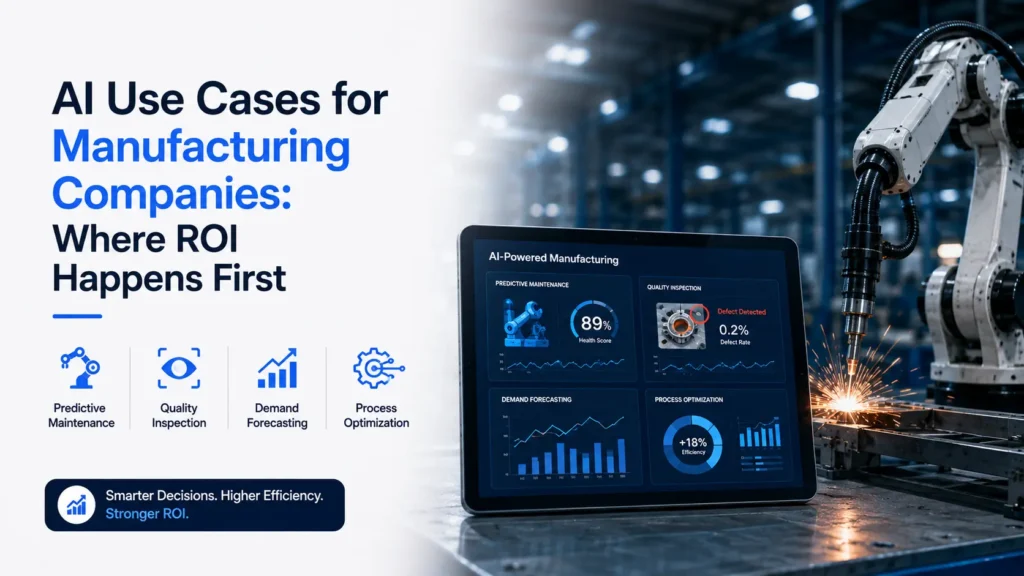
Every Operations Director who has sat through an AI vendor pitch has heard the same thing. Transformative. Intelligent. Future-ready. And somewhere in there, a mention of McKinsey research showing that AI could unlock hundreds of billions in value for manufacturing.
What those pitches rarely show is where the ROI actually materializes first, in which specific operations, on which timeline, and with what data infrastructure underneath it. That is the conversation manufacturing operations leaders actually need to have before they decide where to point their AI budget.
This article skips the theory. The use cases below are the ones with documented ROI in production deployments, not pilot programs, not proofs of concept, not projections. The numbers come from real manufacturers who have moved past experimentation.
## Why manufacturing gets AI ROI faster than most industries
Factory operations produce continuous, structured data. Every machine has sensors. Every production run has a record. Every quality check generates a data point. The raw material that AI needs to deliver value, clean and abundant data, is something manufacturers have been accumulating for years, often without knowing what to do with it.
That is the fundamental reason AI delivers faster payback in manufacturing than in most other sectors. Manufacturers report an average 200% ROI on AI investments overall *(****Source:***[ *The Thinking Company*](https://thinking.inc/en/industry-service/manufacturing-ai-use-cases/)*)*. The highest-return individual use cases go significantly above that: predictive maintenance at 250 to 300% ROI, robotics and automation at 275 to 300%, quality inspection at 250%, and supply chain optimization at 220 to 250% *(****Source:***[ *iFactory*](https://ifactoryapp.com/blog/ai-in-manufacturing-real-world-use-cases-2026)*)*. These are not aspirational benchmarks. They are outcomes from deployments that are operating right now.
The critical discipline is sequencing. Not every use case delivers ROI at the same speed. The payback period for quality control AI runs 6 to 12 months. Predictive maintenance pays back in 12 to 18 months. Demand forecasting takes 18 to 24 months to reach payback *(****Source:***[ *AI Assembly Lines*](https://aiassemblylines.com/post/ai-roi-manufacturing-5-function-benchmark)*)*. Operations leaders who present finance with a single blended payback number for a multi-function AI program underestimate by six to twelve months and lose board confidence when reality does not match the projection. Sequence by function, set expectations by function, and the program holds up under scrutiny.
## Use Case 1: Predictive Maintenance
This is where most manufacturers should start, and the data for why is strong enough that it should not require much convincing.
Unplanned downtime is one of the most expensive line items in any manufacturing operation. When a machine fails unexpectedly, the cost is not just the repair. It is the disrupted production schedule, the expedited parts, the overtime, the missed shipments, and the downstream effects on customer relationships and on-time delivery rates. The traditional response to this problem is either reactive maintenance (fix it when it breaks) or calendar-based preventive maintenance (replace parts on a schedule regardless of their actual condition). Both are expensive in different ways.
AI-powered predictive maintenance changes the model. Sensors on motors, bearings, compressors, and spindles feed continuous data to an AI model that identifies anomalies and degradation patterns, typically four to eight weeks before failure occurs. The result is that maintenance happens at the right time: before failure, but not unnecessarily early. McKinsey’s research documents that AI-driven predictive maintenance reduces unplanned downtime by 20 to 40% and lowers maintenance costs by 25 to 40% in production deployments *(****Source:***[ *Exotica IT Solutions*](https://ai.exoticaitsolutions.com/blog/ai-for-manufacturing-operations-predictive-maintenance-quality-control-demand-forecasting/)*)*.
The Continental AG deployment is the most cited real-world example. They rolled out predictive maintenance across tire manufacturing plants, monitoring 12,000 sensors across four facilities and processing 800 million data points daily. Unplanned downtime fell 37% in the first year. Annual savings exceeded EUR 8 million *(****Source:***[ *The Thinking Company*](https://thinking.inc/en/industry-service/manufacturing-ai-use-cases/)*)*.
For manufacturers evaluating this use case, the data infrastructure requirement is more accessible than most expect. Two to three years of sensor data, combined with maintenance logs that document what failed, when it failed, and what the sensor readings were in the hours and days before failure, is typically sufficient to train a first predictive maintenance model. Many manufacturers have this data already. The question is whether it has been structured and stored in a way that an AI model can use.
Deloitte’s research documents a 10:1 ROI within two years of implementing AI-driven predictive maintenance *(****Source:***[ *iFactory*](https://ifactoryapp.com/blog/ai-in-manufacturing-real-world-use-cases-2026)*)*. At a 12 to 18 month payback and 95% of implementations achieving positive ROI *(****Source:***[ *AI Assembly Lines*](https://aiassemblylines.com/post/ai-roi-benchmarks-by-industry-2026-enterprise)*)*, this is the most defensible starting point for any manufacturer building an AI business case.
## Use Case 2: Computer Vision Quality Inspection
Quality inspection is the second use case with both the strongest ROI evidence and the clearest path from pilot to production.
Manual visual inspection has a fundamental limitation that has nothing to do with the skill or attention of the inspectors. Human inspectors miss 15 to 30% of defects during routine checks, particularly in high-volume, repetitive inspection tasks where fatigue is inevitable *(****Source:***[ *iFactory*](https://ifactoryapp.com/blog/ai-in-manufacturing-real-world-use-cases-2026)*)*. The defects that escape the line show up as warranty claims, customer returns, scrap at the customer’s facility, and in regulated industries, compliance failures.
AI computer vision systems do not have that limitation. In production deployments, AI visual inspection achieves 99.8% accuracy detecting defects as small as 0.1mm, operating continuously at line speed without fatigue *(****Source:***[ *iFactory*](https://ifactoryapp.com/blog/ai-in-manufacturing-real-world-use-cases-2026)*)*. Gartner’s 2025 manufacturing benchmarks document defect-detection accuracy exceeding 98% in AI inspection systems, against 80 to 85% for manual inspection. Mature deployments show a 90%-plus reduction in defects escaping the production line *(****Source:***[ *AI Assembly Lines*](https://aiassemblylines.com/post/ai-roi-benchmarks-by-industry-2026-enterprise)*)*.
Forrester’s three-year analysis across manufacturing quality control deployments documents 374% average ROI with a 7 to 8 month payback period *(****Source:***[ *AI Assembly Lines*](https://aiassemblylines.com/post/ai-roi-benchmarks-by-industry-2026-enterprise)*)*. For a high-volume manufacturer with significant scrap, rework, and warranty costs, that payback timeline is compelling enough to justify the business case without extensive modeling.
The practical implementation path starts with a focused deployment on a single production line, one product type, one inspection station. The model trains on images of known-good and known-defective parts. It reaches production-ready accuracy faster when the defect types are well-documented and the image library is large. Most manufacturers who have been doing manual inspection for years have this library already, in physical samples and in inspection records, though it may require effort to digitize and label it.
The organizational dimension worth addressing explicitly: quality inspectors who hear that AI is being deployed to their line have legitimate questions about what that means for their roles. The manufacturers who get adoption right are the ones who involve inspectors in the training process (they are the domain experts on what defective looks like), position the AI as a tool that flags for their judgment rather than replaces it, and redirect their capacity toward higher-value inspection tasks that benefit from human expertise.
***Trying to build the business case for AI quality inspection or predictive maintenance with your operations team?***[ *Talk to our team*](https://www.krishaweb.com/contact-us/) *about what an AI readiness assessment covers for a manufacturing environment, and what data you need to have in place before deployment makes sense.*
## Use Case 3: AI Demand Forecasting and Production Scheduling
Demand forecasting AI does not get the attention of predictive maintenance or computer vision, but the ROI data is strong and the disruption context of 2025 to 2026 has made it more urgent.
Static historical forecasting does not handle supply chain volatility well. When demand patterns shift suddenly, as they did repeatedly during the tariff volatility and supply chain disruptions of 2025, manufacturers relying on historical averages overproduced or underproduced in ways that created inventory problems and customer service failures. Manufacturers with AI-adjusted forecasting adapted faster because the model updated in response to leading indicators rather than waiting for the historical baseline to shift.
McKinsey’s research documents that AI-driven forecasting reduces forecast errors by 20 to 50%, translating into up to 65% reduction in lost sales and 5 to 10% lower warehousing costs *(****Source:***[ *AI Assembly Lines*](https://aiassemblylines.com/post/ai-use-cases-manufacturing-distribution)*)*. In one documented supply chain deployment, AI demand forecasting improved accuracy by 27% over three years, directly reducing overstock, stockouts, and carrying costs *(****Source:***[ *Exotica IT Solutions*](https://ai.exoticaitsolutions.com/blog/ai-for-manufacturing-operations-predictive-maintenance-quality-control-demand-forecasting/)*)*.
The data requirement for demand forecasting AI is lower than most operations leaders expect. Two to three years of clean historical demand data, a record of major anomalies or promotions that affected demand, and basic supplier lead time data. Most mid-market manufacturers have this in their ERP or WMS already. The barrier is usually not data availability but data quality and accessibility.
AI production scheduling is closely related and often deployed alongside demand forecasting. Rather than running static weekly or monthly production plans, AI scheduling tools dynamically adjust production sequences in response to changes in demand, supply disruptions, machine availability, and workforce capacity. The result is higher OEE (Overall Equipment Effectiveness) and shorter lead times with the same physical assets.
## Use Case 4: Energy Optimization
This one is often overlooked in manufacturing AI conversations because it is not as visually compelling as a computer vision quality system or as operationally urgent as predictive maintenance. But the financial case is straightforward for any facility with significant energy consumption, and the data infrastructure is often already in place.
AI energy management systems analyze production schedules, machine utilization patterns, and energy pricing to optimize when energy-intensive operations run, reducing consumption during peak pricing windows and shifting load to off-peak periods. For manufacturers in energy-intensive sectors, pharma, food processing, metals, chemicals, the cost savings from AI energy optimization can be substantial without any change to the production process itself.
The case for starting here is strongest when energy is a major operating cost and when the organization wants a lower-complexity first AI deployment to build internal confidence before tackling predictive maintenance or quality inspection.
## Use Case 5: AI-Powered Customer and Supplier Portals
The AI use cases above are all operations-facing. This one faces outward, and it is increasingly relevant for manufacturers managing complex customer relationships or large supplier networks.
An AI-powered customer portal lets customers check order status, configure products, submit service requests, and access documentation without calling into a sales or customer service team. For manufacturers with high transaction volumes and complex product configurations, the operational savings from self-service are meaningful. More importantly, customers who can get real-time visibility into their orders, delivery schedules, and account history without waiting for a sales rep to pull the information are customers who experience a meaningfully better relationship.
Our[ **AI solutions**](https://www.krishaweb.com/ai-solutions/) team builds these systems for manufacturers who want to extend AI capability to the customer-facing layer of their operation, connected to ERP and production data so the information customers see reflects what is actually happening on the floor.
The same logic applies to supplier portals. AI-assisted supplier communications, automated purchase order processing, and real-time inventory visibility across the supply network reduce the manual coordination overhead that consumes procurement and supply chain team capacity.
## Where to start: the sequencing framework
Most Operations Directors evaluating this list will want to know where to put the first dollar. Here is the honest framework.
Start with the use case where the data already exists and the problem is already costing you measurably. For most manufacturers, that is predictive maintenance or quality inspection. Both have documented payback periods under 18 months, both have strong enough ROI evidence to build a board-level business case, and both have a relatively clear data infrastructure requirement.
If your maintenance data is incomplete or your sensor coverage is limited, quality inspection is often the faster path to a first deployment because it requires images and defect records rather than continuous sensor data. If your scrap and rework costs are modest relative to your downtime costs, predictive maintenance is the better starting point.
Demand forecasting and scheduling optimization are the right second-phase investments once the first application is delivering documented results and the organization has built the operational confidence and data discipline that make the second deployment go faster.
Energy optimization slots in wherever energy costs make the business case most compelling for your specific facility.
The point is to pick one, deploy it well, measure it rigorously, and use the documented results to fund the next one. The manufacturers with broad AI adoption did not start broad. They started focused and let the compounding results build the program.
For a broader look at how to evaluate and select the right partner for this work, the guide on[ **how USA** ](https://www.krishaweb.com/blog/manufacturing-digital-transformation-partner/)**[manufacturers ](https://www.krishaweb.com/blog/manufacturing-digital-transformation-partner/)**[**choose digital transformation partners**](https://www.krishaweb.com/blog/manufacturing-digital-transformation-partner/) covers the criteria and red flags in detail.
***Know which use case you want to pursue but not sure whether your data and infrastructure are ready to support it?*** *A free AI Readiness Assessment gives you an honest picture of your current data maturity, the use cases that are viable with that foundation, and what needs to be in place before deployment makes sense.*[ ***Book the assessment***](https://www.krishaweb.com/contact-us/)*.*
##### Additional Read
- [How USA Manufacturers Choose Digital Transformation Partners](https://www.krishaweb.com/blog/manufacturing-digital-transformation-partner/)
- [AI Chatbots for US eCommerce: Cost, Compliance, and ROI in 2026](https://www.krishaweb.com/blog/ai-chatbot-us-ecommerce-cost-roi/)
- [The Cost of Integrating AI in 2026: Build, Run, and Total Cost of Ownership](https://www.krishaweb.com/blog/cost-of-integrating-ai/)
### Frequently Asked Questions
**Which AI use case has the fastest ROI for manufacturers?**Quality control AI delivers the fastest payback, with Forrester’s three-year analysis documenting 374% average ROI and a 7 to 8 month payback period across manufacturing quality control deployments. Predictive maintenance delivers stronger total ROI over a 24-month horizon (250 to 300%), but the payback period is longer at 12 to 18 months. For manufacturers whose primary pain is defect rates, scrap, rework, and warranty costs, quality inspection is the faster path to documented results.
**How much data does a manufacturer need to start an AI program?**Less than most operations leaders expect. For predictive maintenance, two to three years of sensor data combined with maintenance logs that correlate sensor readings to failure events is typically sufficient for a first model. For quality inspection, a library of labeled images showing known-good and known-defective parts is the primary requirement. For demand forecasting, two to three years of clean historical demand data from the ERP or WMS. The barrier for most manufacturers is not the volume of data but its quality, accessibility, and structure.
**Can small and mid-size manufacturers implement AI, or is this only for large operations?**Mid-market manufacturers are deploying all of the use cases covered here. The data infrastructure required is not enterprise-scale. A single production line running a focused AI quality inspection deployment, or a focused predictive maintenance program on the three or four machines whose failure has the highest operational impact, is a viable entry point for a manufacturer at $50 million in revenue as much as for one at $500 million. The key is starting focused rather than trying to deploy broadly across the facility in the first program.
**What is the difference between predictive maintenance and preventive maintenance?**Preventive maintenance replaces parts and performs service on a calendar schedule regardless of the actual condition of the components. Predictive maintenance uses sensor data and AI to identify when a component is showing degradation patterns that indicate it is likely to fail within a specific window, allowing maintenance to happen at the right time: before failure, but not unnecessarily early. The result is lower total maintenance cost (because good parts are not replaced unnecessarily), and lower downtime cost (because failures are prevented rather than responded to).
**How long does it take to deploy AI for manufacturing quality inspection?**A focused deployment on a single production line, one product type, one inspection station, typically takes eight to sixteen weeks from data preparation to production operation. The timeline depends on the size and quality of the training image library, the complexity of the defect types being detected, and the integration requirements with existing production systems. Broader deployments across multiple lines or multiple products take longer, but the model performance typically improves faster on subsequent lines because the training data from the first deployment can be leveraged.
### Conclusion
The sequencing question is where most manufacturing AI programs either succeed or stall. Not which use case to pursue, most Operations Directors already have a shortlist. But whether to start with one focused deployment and let the results fund the next one, or to scope a broad multi-function program from the start and hope the board stays patient through 18 months of deployment before seeing returns.
The evidence from manufacturers who have done this well is consistent. Start with the single most expensive operational problem. Predictive maintenance if unplanned downtime is your biggest cost. Quality inspection if scrap, rework, and warranty claims are. Run a 90-day deployment with a specific success metric. Document the result. That documented result is both the proof point for internal confidence and the funding justification for the next application.
The manufacturers who tried to go broad first are still explaining why the program hasn’t delivered yet.
If you are at the point of deciding where to start and want a clear-eyed assessment of which use case your facility’s current data and infrastructure can actually support, that is exactly what an AI Readiness Assessment covers. No platform pitch, no technology recommendation before the assessment is done.
[**Book a Free AI Readiness Assessment with KrishaWeb**](https://www.krishaweb.com/contact-us/)
Our[ **AI consulting team**](https://www.krishaweb.com/ai-strategy-consulting/) runs the assessment, scopes the deployment, and stays through implementation to the point where results are documented and the next use case is ready to scope.
*ROI figures and benchmark data cited are drawn from third-party research and industry studies published in 2025 and 2026. Manufacturing AI outcomes vary by facility, implementation quality, data infrastructure, and operational context. All figures are for planning and benchmarking purposes.*

###### Parth Pandya
Founder & CEOFounder & CEO of KrishaWeb, leads an Enterprise Web Agency. With contributions to WordPress and organization of WordCamps, he pioneers innovation and community engagement in the digital realm.
 Interact With Me- [ ](https://twitter.com/imparthpandya)
- [ ](https://www.linkedin.com/in/parthjpandya/)
- [ ](mailto:parth@krishaweb.com)
---
_View the original post at: [https://www.krishaweb.com/blog/ai-use-cases-manufacturing/](https://www.krishaweb.com/blog/ai-use-cases-manufacturing/)_
_Served as markdown by [Third Audience](https://github.com/third-audience) v3.6.1_
_Generated: 2026-08-06 12:49:51 UTC_