---
title: "12 Best Nonprofit Website Designs in 2026 [Global Examples]"
url: "https://www.krishaweb.com/blog/best-nonprofit-website-designs/"
date: "2026-04-30T12:55:44+00:00"
modified: "2026-04-30T12:58:11+00:00"
author:
name: "Nisarg"
categories:
- "Web Design"
word_count: 2529
reading_time: "13 min read"
summary: "A nonprofit website has to accomplish something that commercial websites do not: ask visitors to give money, time, or support for a cause rather than in exchange for a product. That means trust mus..."
description: "12 of the best nonprofit website designs in 2026, with design lessons on what makes each one effective at building donor trust and driving conversions."
keywords: "best nonprofit website designs, Web Design"
language: "en"
schema_type: "Article"
related_posts:
- title: "13 Best Hotel Website Designs You Will Love in 2026"
url: "https://www.krishaweb.com/blog/best-hotel-website-designs/"
- title: "14 Best Insurance Website Designs 2026 [Examples and Best Practices]"
url: "https://www.krishaweb.com/blog/best-insurance-website-designs/"
- title: "22 Best Restaurant Website Design Examples in 2026"
url: "https://www.krishaweb.com/blog/best-restaurant-website-design-examples/"
---
# 12 Best Nonprofit Website Designs in 2026 [Global Examples]
_Published: Thursday,April 30, 2026_
_Author: Nisarg_
![12 Best Nonprofit Website Designs in 2026 [Global Examples]](https://d1hdtc0tbqeghx.cloudfront.net/wp-content/uploads/2023/10/30123034/image-8.jpeg)
A nonprofit website has to accomplish something that commercial websites do not: ask visitors to give money, time, or support for a cause rather than in exchange for a product. That means trust must be established faster, emotional connection must be deeper, and the path from interest to action must be shorter than on almost any other category of website.
At KrishaWeb, we have built websites for nonprofits, NGOs, and mission-driven organizations. The nonprofit websites that generate the most donations and volunteer sign-ups share one characteristic: they make the visitor feel that their specific action will produce a specific outcome for a specific person or community.
***KrishaWeb has designed and built nonprofit websites since 2008. The pattern that holds across every high-performing example: design decisions made in service of the visitor’s actual goal, not the agency’s portfolio.***
## 12 Best Nonprofit Website Designs in 2026
### 1. Charity: Water
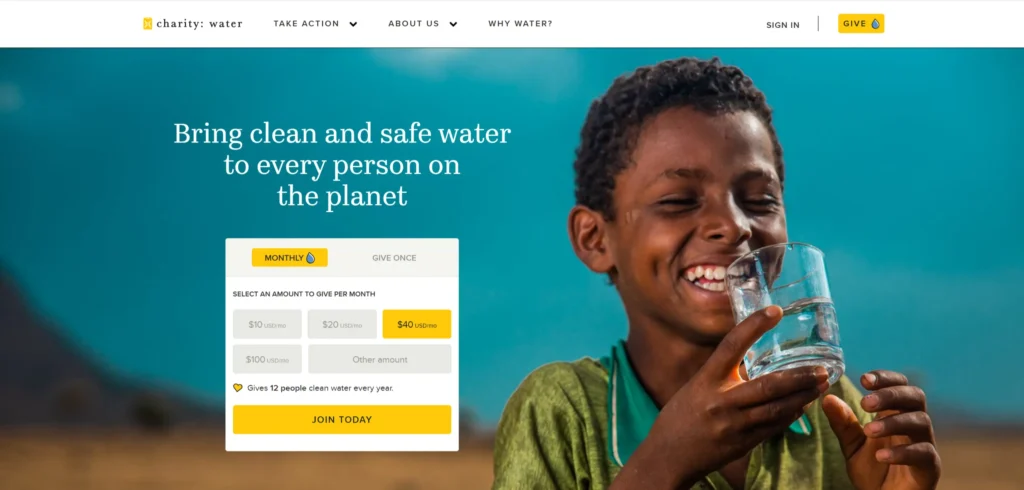[**Charity: Water**](https://www.charitywater.org/) is the most widely cited example of nonprofit web design done at a high standard. The website communicates the organization’s 100% model (all public donations go directly to projects) with specific project photography, GPS coordinates of completed wells, and donor-tracking technology that shows exactly what happened with a specific donation. The visual design is confident and modern, treating the mission with ambition rather than austerity.
***Design lesson:*** *Donation attribution, showing donors exactly what happened with their money specifically and verifiably, is the most powerful trust and retention mechanism a nonprofit website can deploy. Charity: Water’s ability to show a donor the GPS coordinates of the well their money built is the reason their retention rate is exceptional.*
### 2. Doctors Without Borders
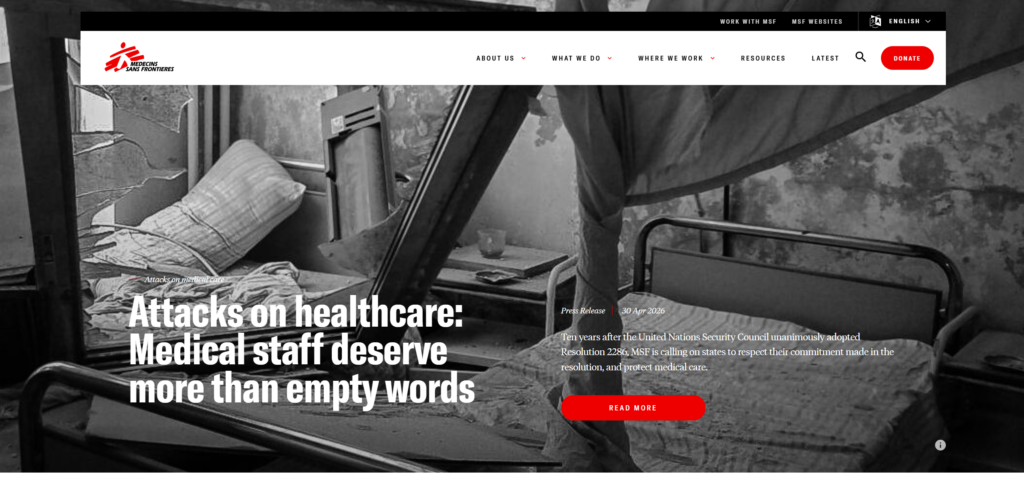[**MSF’s website**](https://www.msf.org/) communicates the urgency and scale of their operations without exploiting the suffering of the people they serve. Photography is humanising rather than traumatising. The crisis response section is updated regularly and the impact data is specific and current. The donation journey is simple and the recurring giving option is prominently featured.
***Design lesson:*** *Nonprofit photography that shows dignity and agency alongside need is more effective at building long-term donor relationships than photography that focuses solely on suffering. Donors respond better to evidence of impact than to evidence of crisis alone.*
### 3. World Wildlife Fund
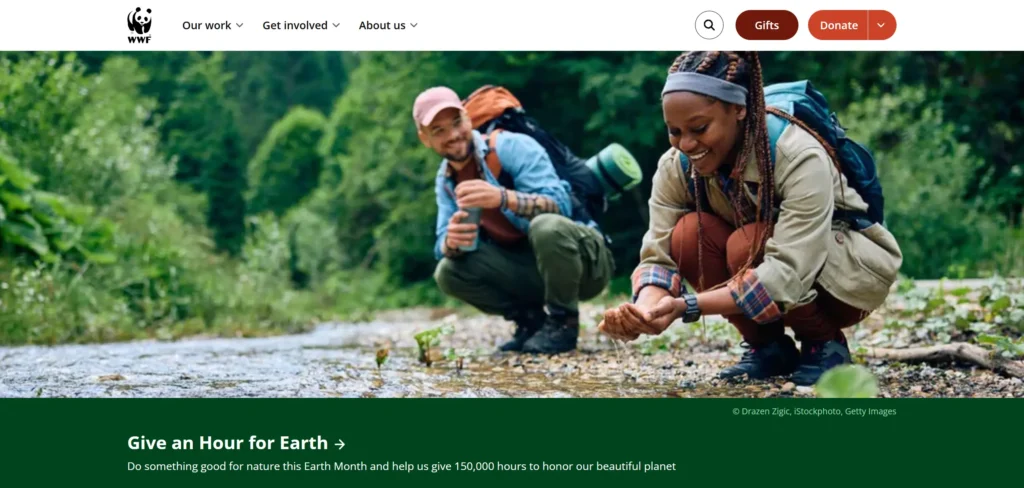[**WWF’s website**](https://www.worldwildlife.org/) communicates conservation urgency through specific, species-level and habitat-level impact data rather than abstract statistics. The symbolic adoption model (adopt a snow leopard, receive updates about its conservation) creates a personal connection between donor and cause. The content strategy balances urgency with hope, which sustains long-term donor engagement more effectively than urgency alone.
***Design lesson:*** *The symbolic adoption model, where a donor is connected to a specific animal, species, or community they are supporting, creates the personal relationship that sustains monthly giving over years. Abstract cause descriptions do not create this relationship.*
### 4. UNICEF
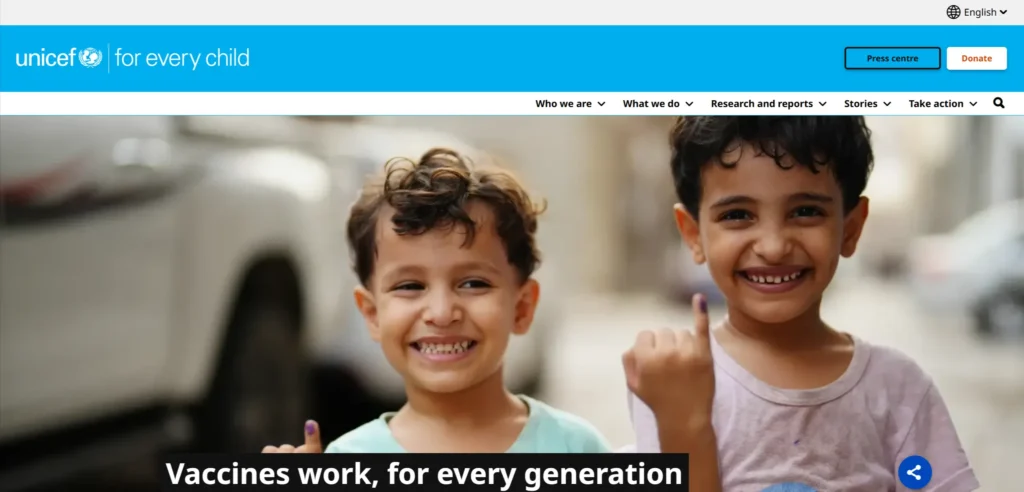[**UNICEF’s website**](https://www.unicef.org/) manages global complexity (dozens of countries, multiple crisis types, hundreds of programs) through intelligent navigation and consistent impact framing. The donate journey is well-designed and the monthly giving option is prominently featured. Photography is genuinely impactful without exploitation. The transparency reporting is detailed and accessible.
***Design lesson:*** *For large international nonprofits with complex programme portfolios, the website navigation architecture must be designed for multiple visitor types simultaneously: major donors researching program effectiveness, emergency donors responding to a specific crisis, and general visitors trying to understand the organization’s work.*
### 5. Habitat for Humanity
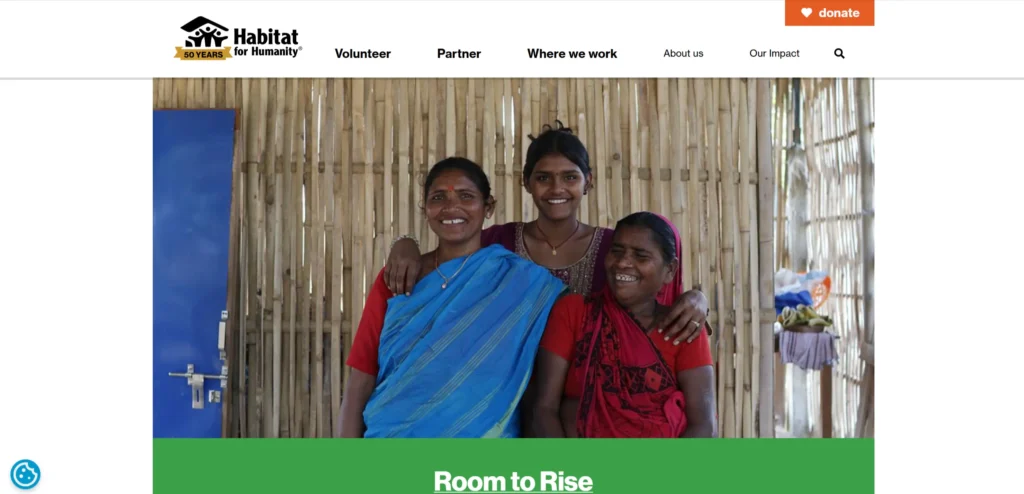[**Habitat for Humanity’s website**](https://www.habitat.org/) communicates both the tangible nature of their work, building homes, and the transformative impact of stable housing on families and communities. The volunteer section is well-developed and makes the contribution pathway clear. The local affiliate structure is handled through a location finder that routes visitors to their local chapter.
***Design lesson:*** *Volunteer pathway design is as important as donation pathway design for nonprofits that rely on volunteer labor. A visitor who wants to give time rather than money should be routed to a simple, clear volunteer application as quickly as a donor is routed to a donate button.*
### 6. Red Cross
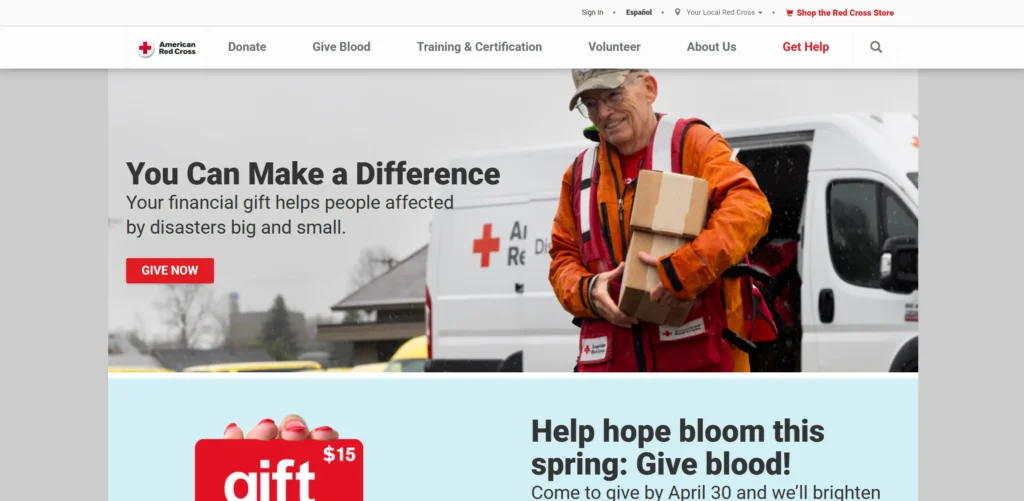[**The Red Cross website**](https://www.redcross.org/) manages the full complexity of a disaster-response, health-training, and international humanitarian organisation. Emergency response sections are updated in real time during disaster events. The blood donation scheduler is a separate digital product embedded cleanly. The training and certification section is comprehensive and bookable online.
***Design lesson:*** *During disaster events, a nonprofit website becomes a real-time communications platform. The CMS and content workflow that supports rapid publishing of crisis-specific information, donation landing pages, and resource guides is a design requirement, not a communications afterthought.*
### 7. Khan Academy
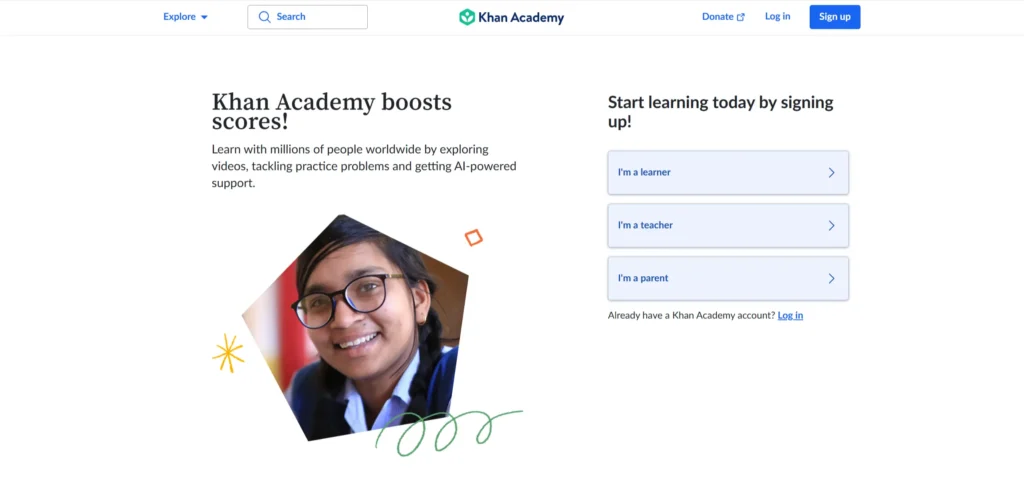[**Khan Academy**](https://www.khanacademy.org/) operates as a nonprofit education platform and the website communicates the mission (free education for everyone) through the product itself rather than through traditional nonprofit storytelling. The donation ask is present but not dominant. The focus is on the learner experience, which is the most compelling argument for the mission. Impact data is presented in terms of learners reached rather than dollars raised.
***Design lesson:*** *For nonprofits whose mission is delivered through a digital product, the quality and accessibility of the product is the most compelling case for donation. Donating to a product experience you have personally benefited from has a conversion rate that no fundraising copy can match.*
### 8. The Nature Conservancy
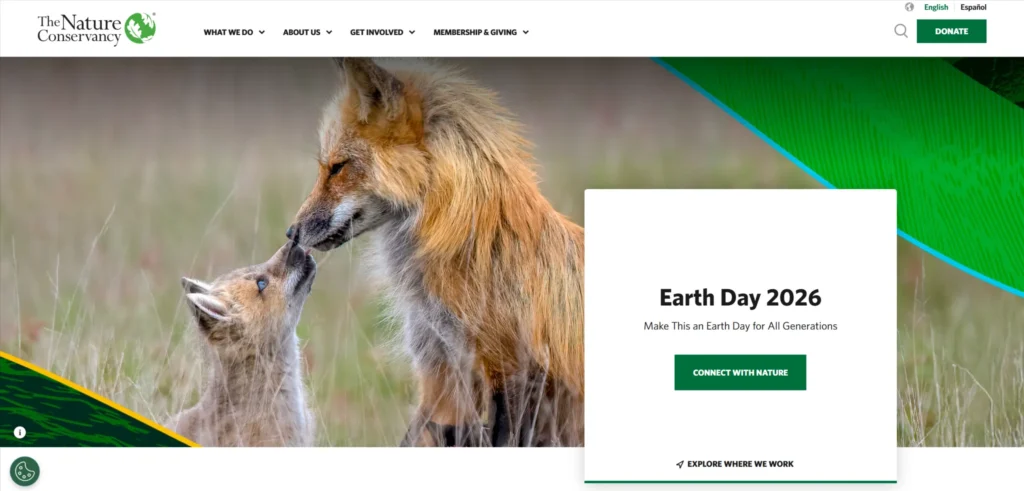[**TNC’s website**](https://www.nature.org/) communicates conservation impact through photography and specific place-based stories that create emotional connection to the landscapes and species they protect. The science content is genuinely substantive rather than simplified, which attracts major donors and institutional partners who want evidence of program rigor. The membership model is clearly presented alongside one-time giving.
***Design lesson:*** *Detailed science and programme methodology content on a nonprofit website attracts a specific and valuable donor segment: major donors and institutional funders who require evidence of programme rigour before making significant commitments.*
### 9. Save the Children
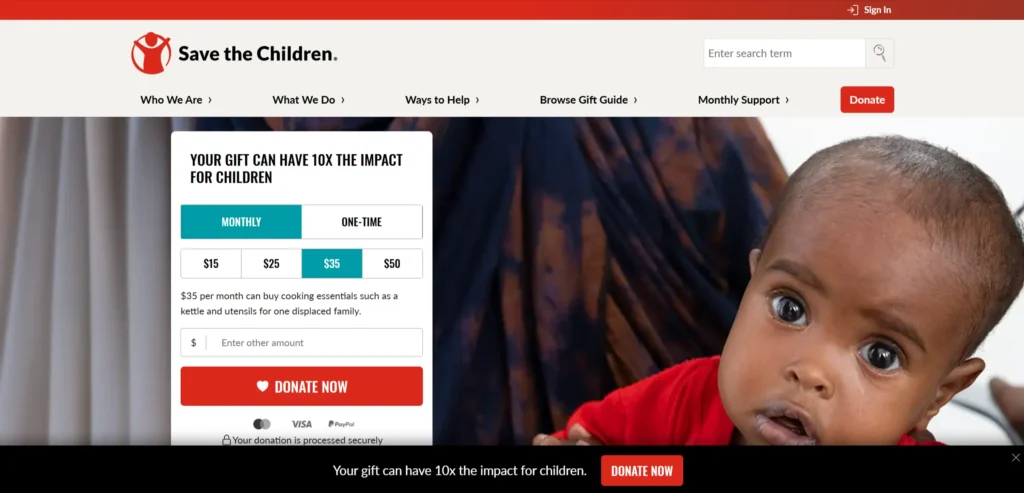[**Save the Children’s website**](https://www.savethechildren.org/) handles emergency response and long-term development programmes in a navigation structure that serves both the emotional emergency donor and the long-term supporter who wants to understand the organisation’s development approach. The child sponsorship model is prominently featured and the sponsorship journey is visually compelling and emotionally specific.
***Design lesson:*** *Child sponsorship programmes on nonprofit websites convert at high rates when the sponsorship journey shows a specific child with a specific story rather than a representative profile. The more specific and real the person, the stronger the conversion.*
### 10. Amnesty International
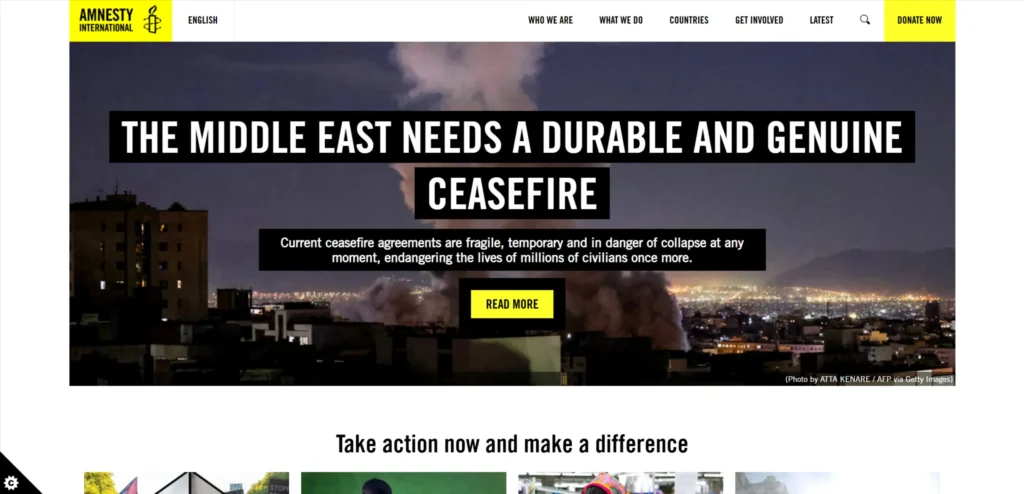[**Amnesty International’s website**](https://www.amnesty.org/) handles a mission that requires communicating both urgency and evidence. The human rights documentation is accessible and credible. The campaign and petition section drives engagement with specific, time-sensitive actions. The distinction between donation, membership, and campaign action is clear and visitors are routed to the appropriate action based on the content they have engaged with.
***Design lesson:*** *Nonprofits with advocacy and action components need the website to support multiple engagement types (donate, sign, share, volunteer) with each pathway as clear and friction-free as the others.*
### 11. GiveDirectly
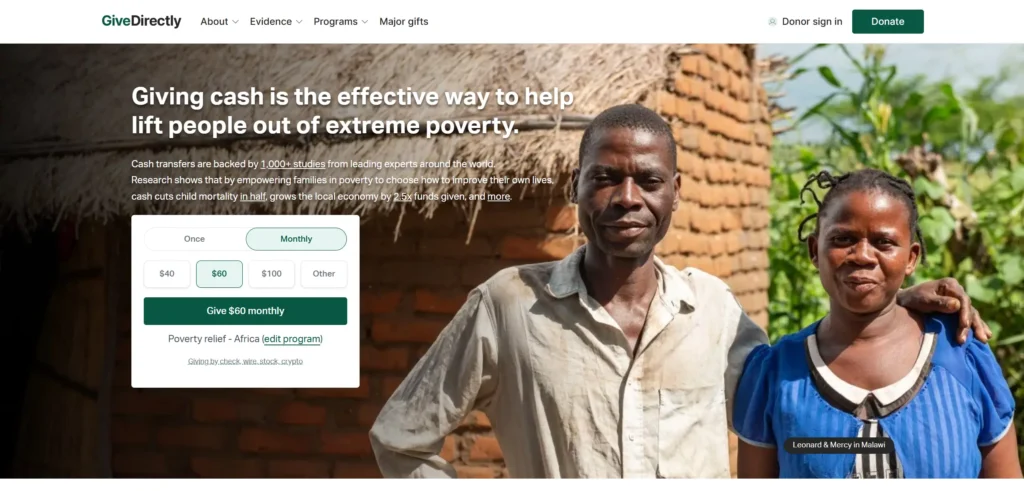[**GiveDirectly’s website**](https://www.amnesty.org/) communicates radical transparency: their model is to transfer cash directly to people in extreme poverty with no intermediary. The website makes the case for this approach with evidence, impact data, and rigorous independent evaluation citations. The donate journey is simple and the fraction of each donation that reaches recipients is stated clearly.
***Design lesson:*** *Nonprofits with high-transparency models should lead with the transparency data rather than burying it in an annual report page. Visitors who care about donation efficiency make their giving decisions based on overhead ratios and programme effectiveness, and displaying this prominently attracts this donor segment.*
### 12. Feeding America
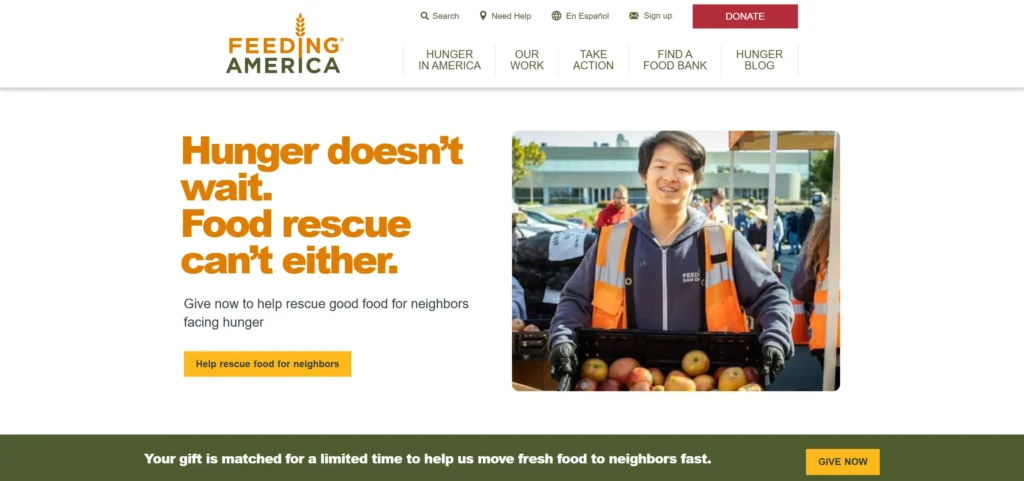[**Feeding America’s website**](https://www.feedingamerica.org/) communicates the tangible nature of hunger relief through specific claims (how many meals a dollar provides, how many people are food insecure in the visitor’s state) that make the donation feel concrete rather than abstract. The food bank locator serves visitors who need help as well as those who want to give. The corporate partnership section is well-developed.
***Design lesson:*** *Quantifying the impact of a specific donation amount (‘your $10 provides 90 meals’) makes the giving decision feel concrete and purposeful in a way that abstract impact claims cannot. Nonprofit websites that make this calculation visible on the donate page consistently outperform those that do not.*
## What These Nonprofit Website Designs Have in Common
Looking across all 12 examples, these patterns appear consistently in the ones that work best commercially, not just aesthetically.
- Specific, verifiable impact data rather than abstract statistics or vague claims
- Photography that communicates dignity and agency alongside need
- Monthly giving and recurring donation options prominently featured
- Donation impact quantified in specific, tangible terms per dollar or per pound
- Multiple engagement pathways — donate, volunteer, advocate, share — each as friction-free as the others
## 5 Design Elements Every Nonprofit Website Needs
Whether you are building from scratch or redesigning an existing site, these five elements consistently separate high-performing examples from functional but forgettable ones.
#### 1. Specific, tangible donation impact quantified per dollar or pound
Specific, tangible donation impact quantified per dollar or pound. State the impact clearly on the donate page: ‘$10 provides 90 meals’ converts at higher rates than ‘help us fight hunger.’ The more concrete the number, the lower the donor’s decision threshold.
#### 2. A clear recurring giving option with the monthly impact quantified prominently. Monthly donors have substantially higher lifetime value than one-time givers. Feature this on the first donate screen, not a secondary step.
A clear recurring giving option with the monthly impact quantified prominently
#### 3. Photography that communicates dignity and specific human stories rather than generic need imagery. Donors respond better to evidence of impact than to evidence of suffering alone.
Photography that communicates dignity and specific human stories rather than generic need imagery
#### 4. Multiple engagement pathways with each action
Multiple engagement pathways, with donate, volunteer, sign, and share each as easy to find as the others. A visitor who cannot donate right now may be willing to sign a petition or share a campaign. Each pathway kept open increases lifetime engagement.
#### 5. Transparency data and overhead ratios, program effectiveness data, and independent evaluation citations should be accessible without requiring download of an annual report. Donors who care about donation efficiency make decisions based on this data.
Transparency content — overhead ratios, program effectiveness data, independent evaluation citations — accessible without requiring download of an annual report
## AI Implementation for Nonprofit Websites in 2026
Most nonprofit website articles cover design examples. Almost none address AI implementation, which is where the commercial gap is opening in 2026. The nonprofit websites that implement these features in the next 12 months will have a measurable advantage over those that do not.
### 1. AI-Powered Donor Personalization
Returning donors and long-term supporters should not see the same homepage as first-time visitors. AI personalization that recognises returning donors and surfaces content relevant to their previous giving history, campaigns they have supported, and areas of the mission they have engaged with creates the personal relationship that drives long-term retention. Salesforce Nonprofit and Raiser’s Edge both include AI personalization capabilities that connect to website content systems.
### 2. AI Chat for Donor Support and Program Inquiries
Potential major donors, legacy giving enquirers, and corporate partnership contacts often have specific questions that generic website content does not answer. An AI chat assistant trained on the organization’s program documentation, impact reports, and giving options can provide immediate, accurate responses to these high-value inquiries at any hour, and can route complex questions to the appropriate team member with full context from the conversation.
### 3. Intelligent Campaign and Crisis Response Publishing
During disaster or crisis events, nonprofit websites need to publish emergency donation pages, crisis updates, and resource guides faster than standard editorial workflows allow. AI-assisted content generation tools that can produce first-draft crisis updates, donation landing page copy, and resource summaries based on a brief from the communications team significantly reduce the time between crisis event and live appeal, which matters directly for fundraising outcomes.
### 4. AI-Powered Donor Retention Email Sequences
The most expensive moment in a nonprofit’s donor relationship is acquisition. Retaining donors through their second and third gift costs a fraction of acquiring a replacement. AI-powered email sequences that personalize the thank-you journey, impact reporting, and next-gift asks based on each donor’s giving history, engagement with previous campaigns, and demographic characteristics consistently outperform broadcast newsletters on retention rates.
***KrishaWeb builds AI-integrated nonprofit websites on WordPress and other platforms. If your current site is not using these features, our team can assess what to implement first based on your specific conversion goals.***
##### Additional Read
- [13 Best Hotel Website Designs You Will Love in 2026](https://www.krishaweb.com/blog/best-hotel-website-designs/)
- [14 Best Insurance Website Designs 2026 [Examples and Best Practices]](https://www.krishaweb.com/blog/best-insurance-website-designs/)
- [14 Best Fashion Website Designs: Inspiring Examples for 2026](https://www.krishaweb.com/blog/best-fashion-website-designs/)
### Frequently Asked Questions
**What makes a good nonprofit website design?**A good nonprofit website creates emotional connection and communicates specific impact fast enough to convert visitors who arrived with intention but could easily leave without acting. The key elements are specific, verifiable impact data, photography that communicates dignity alongside need, a donation process that takes under two minutes, and a recurring giving option that quantifies the monthly impact.
**How should nonprofits display donation impact?**Donation impact should be quantified in specific, tangible terms per donation amount: ‘your $25 provides clean water for one person for one year’ rather than ‘help us end the water crisis.’ The more specific and concrete the impact claim, the more effectively it converts visitors who are deciding whether to give.
**Why is monthly giving important for nonprofit websites?**Monthly giving retention rates are substantially higher than one-time donor retention rates. A donor who gives monthly for three years contributes far more lifetime value than a one-time donor of similar amount. The monthly giving option should be prominently featured, and the monthly impact should be quantified as specifically as the one-time gift impact.
**How should a nonprofit website handle emergency and crisis fundraising?**Crisis fundraising pages need to be published within hours of a crisis event, not days. The CMS and editorial workflow should support rapid publishing of emergency appeals with minimal technical barriers. The design system should include pre-built emergency appeal page templates that can be activated quickly with crisis-specific content.
**How can AI improve a nonprofit website?**AI can personalize the homepage and donation journey for returning donors, provide immediate responses to major donor and corporate partnership enquiries, assist with rapid crisis content publishing, and optimize donor retention email sequences based on individual giving history and engagement patterns.
### Conclusion
The 12 nonprofit website designs on this list span different scales, budgets, and markets. What they share is not production budget or agency pedigree. It is a commitment to treating the website as a genuine commercial and brand tool rather than a digital brochure.
The design elements that matter most in this category are not complex or expensive to implement. Strong photography, a clear path to the primary conversion action, social proof specific enough to be credible, and mobile performance that matches desktop quality. These are achievable at almost any budget with the right priorities and the right **[web design service](https://www.krishaweb.com/web-design/)**.
If your current nonprofit website is not doing these things, [**talk to KrishaWeb’s web design team**](https://www.krishaweb.com/contact-us/) about what a focused redesign would look like for your specific goals.
***Ready to improve your website? KrishaWeb designs and develops conversion-focused websites since 2008. Tell us your goals and we will tell you the right approach.***
***Disclaimer:** This article is intended for informational and inspirational purposes only. The website examples featured are owned by their respective organizations. KrishaWeb has no affiliation with any of the websites referenced unless otherwise stated. All observations, statistics, and design notes reflect research current as of April 2026 and may change over time.*

###### Nisarg Pandya
Project ManagerExperienced Project Manager and Scrum Master at KrishaWeb, delivers expertise in Scrum methodologies, Laravel, React.js, UX design, and project management, ensuring efficient project delivery and agile implementation.
 Interact With Me-
-
- [ ](mailto:)
---
_View the original post at: [https://www.krishaweb.com/blog/best-nonprofit-website-designs/](https://www.krishaweb.com/blog/best-nonprofit-website-designs/)_
_Served as markdown by [Third Audience](https://github.com/third-audience) v3.5.3_
_Generated: 2026-04-30 12:58:12 UTC_