---
title: "Best Web Development Agencies for USA SMEs: How to Choose the Right Partner in 2026"
url: "https://www.krishaweb.com/blog/best-web-development-agency-usa/"
date: "2026-07-01T12:50:32+00:00"
modified: "2026-07-01T12:51:30+00:00"
type: "Article"
resource: "https://www.krishaweb.com/blog/best-web-development-agency-usa/"
timestamp: "2026-07-01T12:51:30+00:00"
author:
name: "Nirav"
url: "https://www.krishaweb.com"
categories:
- "Web Development"
word_count: 2816
reading_time: "15 min read"
summary: "If you are a US business owner searching for the best web development agency, here is the uncomfortable truth. There is no single best agency. There is only the best agency for your business, your ..."
description: "How US SMEs choose a web development agency in 2026: the criteria, red flags, real costs, and why one accountable partner beats five freelancers."
keywords: "best web development agency usa, Web Development"
language: "en"
schema_type: "Article"
related_posts:
- title: "How AI Is Transforming Web Development: What Business Owners Need to Know in 2026"
url: "https://www.krishaweb.com/blog/how-ai-is-transforming-web-development/"
- title: "How to Choose the Right Laravel Development Company for Your Project [Checklist + Red Flags]"
url: "https://www.krishaweb.com/blog/how-to-choose-laravel-development-company/"
- title: "AI Webflow Development in 2026: How Designers Are Building Smarter"
url: "https://www.krishaweb.com/blog/ai-webflow-development/"
---
# Best Web Development Agencies for USA SMEs: How to Choose the Right Partner in 2026
_Published: Wednesday,July 1, 2026_
_Author: Nirav_
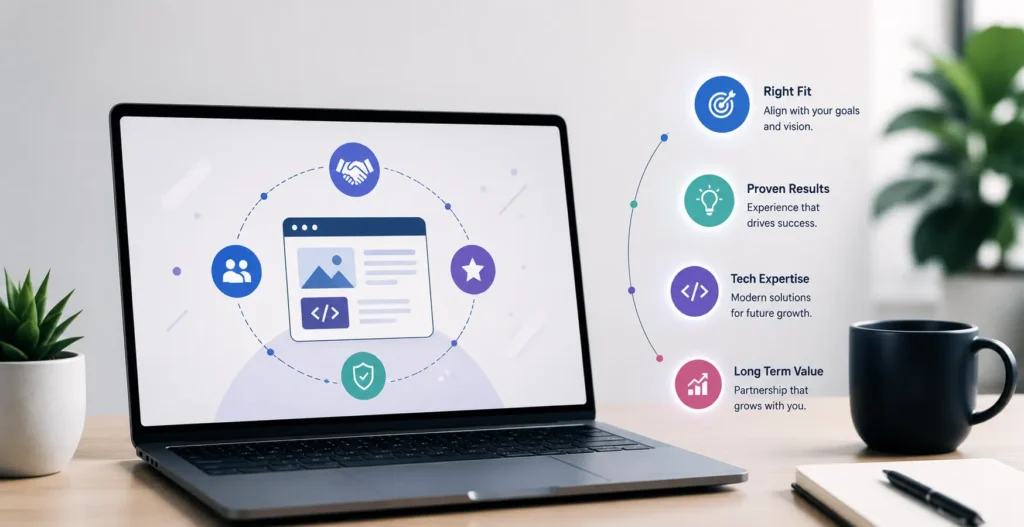
If you are a US business owner searching for the[ **best web development agency**](https://www.krishaweb.com/), here is the uncomfortable truth. There is no single best agency. There is only the best agency for your business, your budget, and where you are trying to go. A firm that is perfect for a funded SaaS startup can be completely wrong for a growing service business, and vice versa.
So this guide does something more useful than handing you a ranked list you cannot verify. It shows you how to choose. The criteria that actually separate a strong partner from a flashy one, the red flags worth walking away from, what a real project costs in 2026, and the one question that has become non-negotiable this year.
Because the stakes are higher than they used to be. The Standish Group found that roughly two-thirds of larger technology projects end in partial or total failure. Your website is not a side project. It is your sales engine, your first impression, and increasingly the thing an AI assistant reads before a customer ever clicks. Choosing the right partner matters more than it ever has.
## Why SMEs are consolidating to one partner in 2026
Here is the shift driving this decision right now. For years, small and mid-size businesses stitched their web presence together from parts. A freelancer for the design. Another for development. Someone else for SEO. A fourth person for the occasional fix.
That model is quietly falling apart in 2026, and for a simple reason. Every handoff between vendors is a gap where things break, deadlines slip, and nobody is accountable. When the site goes down and the developer blames the host and the host blames the theme and the theme was picked by a freelancer who has moved on, you are the one holding it.
Businesses get better results from one accountable team than from coordinating several freelancers, because a single partner eliminates the handoff gaps that cause the delays and quality problems. That is the real reason SMEs are consolidating. Not to save money, though it often does. To have one number to call when something matters and one team that owns the outcome instead of a slice of it.
***“So the first decision is not which agency. It is whether you want one partner who owns the whole thing or a pile of vendors you have to manage yourself.”***
## Agency vs freelancer vs in-house: which fits you
Before you shortlist anyone, get clear on what kind of help your project actually needs.
A freelancer is right for a small, well-defined job. A few pages, a specific fix, a short piece of work with a clear brief. Cheaper and quick to start. The risk is that there is no backup if they vanish, no one reviewing the work, and no one to call after launch.
An agency is right when the project needs strategy, more than one skill set, ongoing accountability, and the bandwidth to handle complexity. You pay more than a single freelancer, but you get a team that owns the result end to end, and that keeps working after the site goes live. For most SMEs whose website actually drives revenue, this is the right call.
An in-house hire makes sense only when you have enough continuous web work to justify a full salary plus overhead. Most SMEs do not, which is exactly why the agency model exists.
If your website is central to how you get customers, you are almost certainly in agency territory. The rest of this guide assumes that is where you are.
## The types of agencies you will run into
Once you have decided an agency is the right call, you will find they are not all the same animal. Knowing the categories saves you a lot of wasted calls, because each type is built for a different kind of buyer.
### Boutique studios
Small teams, often three to ten people, usually strong on design and craft. Great for a business that wants a polished, custom site and values a close working relationship. The trade-off is bandwidth. A boutique can go deep, but it can only take on so much at once, and it may not cover everything you need under one roof.
### Platform specialists
Agencies that do one thing: Shopify-only, Webflow-only, WordPress-only. If your project is squarely on their platform, their depth is hard to beat. The risk is that a specialist tends to recommend their platform for everything, even when it is not the right fit, because it is the only tool they carry.
### Freelance collectives and marketplaces
A loose group of freelancers coordinated by a middle layer, or a platform that matches you with vetted individuals. Often cheaper. But you are back to the handoff problem this guide opened with, since accountability is split across people who do not really work as one team.
### Enterprise firms
Large agencies built for Fortune 500 budgets and timelines. Deep process, heavy governance, premium pricing. For most SMEs, this is overkill, and you will pay for a layer of account managers and formality your project does not need.
### Full-service partners
Agencies that handle design, development, SEO, and increasingly AI, all under one roof, with a single team accountable for the outcome. This is the category built for the SME that is consolidating vendors and wants one number to call. The strong ones combine the craft of a boutique with the range and staying power a boutique cannot offer alone.
## A shortlist of US web development agencies worth knowing in 2026
To make this concrete, here are agencies that consistently show up on US small and mid-size business shortlists, grouped by what each one is actually best at. Use this as a starting point, then run each candidate through the criteria in the next section.
#### KrishaWeb
Best for SMEs consolidating vendors into one accountable full-service partner. Design, development, SEO, and AI implementation under one roof, running since 2008 with named account managers in the US. The fit for a business that is tired of juggling freelancers and wants one team that owns the whole outcome, from the build through AI features and AI search visibility.
#### Americaneagle.com
Best for enterprise-scale, high-traffic platforms. Deep experience with large systems and heavy integrations. Strong if you are a big organization with a big budget, likely more process and cost than a typical SME needs.
#### WebDevStudios
Best for WordPress-heavy builds. A well-regarded WordPress specialist for scalable, API-integrated sites. A solid pick if you are certain WordPress is your platform, and you do not need much beyond it.
#### Agency Jet
Best for local service businesses. Conversion-focused sites with strong local SEO and transparent pricing. A good fit for contractors, clinics, and consultancies competing for nearby customers.
#### Mainstreethost
Best for SMBs wanting web plus marketing. WordPress and eCommerce builds bundled with integrated SEO and paid media. Well-rounded for a business that wants growth marketing alongside the site.
#### Coalition Technologies
Best for eCommerce and SEO-led builds. Strong track record on Shopify and WordPress eCommerce with performance and search baked in. Worth a look if online sales are the whole point of your site.
#### Goji Labs
Best for startups and product-style web apps. Twelve-plus years building on WordPress, Webflow, React, and Node for growth-stage companies. A fit if your site is closer to a software product than a marketing site.
## The criteria that actually matter
Most agency-selection guides hand you a 30-point checklist. That is too much, and most of it is noise. A handful of criteria do the real work.
### They ask hard questions before they talk solutions
The best agencies want to understand your goals, your customers, your funnel, and what your sales team hears every day, before they say a word about design. If a team jumps straight to mockups without asking why, they are building you a brochure, not a business asset. A good test: ask a slightly complex question about your project and watch how they respond. Strong teams slow down and challenge your assumptions. Weak ones just nod and agree with everything.
### They are full-service, so nothing falls through the cracks
Design, development, and at least foundational SEO under one roof. A beautiful site that cannot be found is not doing its job. This is the consolidation advantage in practice: one team responsible for how it looks, how it is built, and whether anyone can find it.
### They are transparent about price and process
A defined workflow (discovery, design, development, QA, launch, and ongoing support) and a clear, itemized quote. Vague scope with hourly billing leaves your costs uncapped. Insist on a fixed price or a capped budget.
### They stick around after launch
A website is not finished at launch. It needs maintenance, security updates, and a point of contact when something breaks. If an agency does not talk about post-launch support, they are not thinking about your total cost of ownership.
### They are fluent in the tools that matter now
Which brings us to the criterion that changed the game this year.
## The new non-negotiable: AI capability
A year ago, AI was not part of this decision. In 2026, it is, and it is quietly the criterion that separates agencies that are current from agencies that are coasting.
AI has changed what a small team can deliver. It speeds up the routine parts of a build, which should show up in your timeline and your quote. It has also changed what your website can do. The agencies worth hiring can build AI into your product where it earns its place: a support chatbot that actually knows your services, intelligent search, content and lead workflows that run themselves, and personalization that lifts conversions.
There is a second, quieter reason AI capability matters. Customers now discover businesses through AI answer engines like ChatGPT, Gemini, and Google’s AI Overviews, and those systems read your site before a human ever clicks. An agency that understands how to make your site visible and citable in AI search is protecting a channel that did not exist two years ago and is growing fast.
So add this to your questions. Ask any agency how they use AI in their process and whether they can build AI features into your site. A confident, specific answer marks a current team. A blank look marks one that is about to fall behind and will take your website with it. If AI implementation is on your roadmap at all, it belongs in the very first conversation.
## What it costs in 2026
So you can spot a quote that is too cheap or needlessly high, here are the real US numbers.
For most SMEs, a **professional website lands between $2,500 and $15,000**, with **custom, integration-heavy, or eCommerce builds running $15,000 to $30,000** and up. Simple brochure sites sit at the low end. Sites that carry real business logic sit at the top.
Across all project sizes, Clutch’s 2026 data puts the average agency project at around $66,500 over roughly nine months, but that number is pulled up by large enterprise and SaaS builds. As an SME, you are usually well below it.
The cost most owners forget is maintenance. **Budget $3,600 to $24,000 a year depending on complexity for hosting, security, updates, and support**. If an agency does not raise this, they are quoting you a build, not the true cost of owning a website.
One warning on price. Two honest agencies can quote the same project at very different numbers, and both can be fair for what each delivers. A cheap quote often means a template, junior developers, or corners cut on testing and security. Compare scope, not just the bottom line.
## The red flags worth walking away from
Slow down if you see any of these.
They jump to mockups without asking about your business. They quote a big project with a vague scope and hourly billing. The senior person in the sales call disappears after you sign, replaced by juniors you never met. They will not put post-launch support in writing. They cannot explain how they use AI or dismiss it entirely. A price dramatically below market with no explanation. No clarity on who owns the code and the site when the project ends.
Any one of these is a conversation. Several together is your answer.
## A simple shortlist process you can run yourself
You do not need to be technical to hire well. Run this.
Write down what you actually need: the goal of the site, your rough budget, and who owns it after launch. Shortlist three agencies whose portfolios show real work for businesses like yours, not just enterprise logos. Get on a discovery call with each and ask a slightly hard question about your project, then watch who slows down and thinks versus who just agrees. Ask each one how they handle AI, post-launch support, and code ownership. Get itemized, fixed or capped quotes. Then pick the team that asked you the best questions, not the one with the prettiest deck.
The right partner thinks beyond the build. They ask sharper questions, they document everything, they ship with data, and they stay after launch.
##### Additional Read
- [7 Ways AI Is Changing How SMBs Generate Leads Online](https://www.krishaweb.com/blog/ai-lead-generation-smb-website/)
- [AI Website Redesign ROI: What SMBs in SaaS and Professional Services Actually Get](https://www.krishaweb.com/blog/ai-website-redesign-roi-smb/)
- [How to Build an AI-Powered Web App in 2026: A Practical Guide for Founders and CTOs](https://www.krishaweb.com/blog/ai-powered-web-app-development/)
### Where KrishaWeb fits
We built KrishaWeb to be the one accountable partner this guide describes. Since 2008, we have delivered web design, development, and digital strategy for businesses across the US and 45 countries, with named account managers in the US so you always have one number to call.
We are a full-service agency, so your [**design**](https://www.krishaweb.com/web-design/), [**development**](https://www.krishaweb.com/web-development/), [**SEO**](https://www.krishaweb.com/seo/), and AI all sit with one team that owns the outcome. And[ **AI implementation**](https://www.krishaweb.com/ai-implementation-integration/) is part of how we work now, not a bolt-on, from AI features inside your site to making your business visible in AI search.
If you are consolidating vendors and want a single partner who owns the whole thing, tell us what you are building.[ **Schedule a call**](https://api.leadconnectorhq.com/widget/bookings/book-a-call-with-parth-krishaweb) to talk it through, or[ **contact us**](https://www.krishaweb.com/contact-us/) with your project.
### Frequently Asked Questions
**How much does a web development agency cost in the USA in 2026?**For most US SMEs, a professional website costs between $2,500 and $15,000, with custom, eCommerce, or integration-heavy builds running $15,000 to $30,000 and up. Across all sizes, Clutch’s 2026 data puts the average agency project at around $66,500 over roughly nine months, though that figure is pulled up by large enterprise builds, so SMEs usually sit well below it. Budget an additional $3,600 to $24,000 a year for maintenance, hosting, and support, which is the cost most owners forget.
**Should I hire a web development agency or a freelancer?**Hire a freelancer for small, well-defined jobs with a clear brief. Hire an agency when your project needs strategy, more than one skill set, ongoing accountability, and someone who stays after launch. The main advantage of an agency is a single accountable team that owns the whole outcome, which removes the handoff gaps between multiple freelancers that cause most delays and quality problems. If your website actually drives revenue, an agency is usually the better fit.
**Why are small businesses consolidating to one agency in 2026?**Because every handoff between separate vendors is a gap where things break and nobody is accountable. When a business uses a freelancer for design, another for development, and someone else for SEO, no single person owns the result. Consolidating to one full-service partner gives the business one point of contact and one team responsible for the whole outcome, which produces fewer delays and better quality than coordinating several freelancers.
**What should I look for in a web development agency?**Look for an agency that asks hard questions about your business before proposing solutions, offers full-service capability (design, development, and SEO under one roof), is transparent about price and process with a clear itemized quote, provides post-launch support in writing, and is fluent in AI, both building AI features and making your site visible in AI search. The best test is a discovery call: strong agencies slow down and challenge your assumptions, while weak ones just agree with everything.
**Does my agency need AI capability in 2026?**Yes, for two reasons. First, AI has changed what your website can do, from chatbots that know your services to personalization that lifts conversions, and a current agency can build these where they add value. Second, customers now discover businesses through AI answer engines like ChatGPT and Google’s AI Overviews, which read your site before a human clicks on it. An agency that understands AI search protects a fast-growing discovery channel. Ask any agency how they use AI, and treat a vague answer as a warning sign.
**How long does it take to build a website with an agency?**A standard 5 to 10 page site usually takes 4 to 8 weeks from kickoff to launch. eCommerce builds with product setup and payment integration typically take 8 to 16 weeks. Complex web applications run longer. The most common cause of delay is almost always on the client side: late content, photos, or feedback. AI-assisted development has sped up the build itself, but your timeline still depends heavily on how quickly you review and approve work.

###### Nirav Panchal
Lead – Custom DevelopmentLead of the Custom Development team at KrishaWeb, holds AWS certification and excels as a Team Leader. Renowned for his expertise in Laravel and React development. With expertise in cloud solutions, he leads with innovation and technical excellence.
 Interact With Me-
-
- [ ](mailto:)
---
_View the original post at: [https://www.krishaweb.com/blog/best-web-development-agency-usa/](https://www.krishaweb.com/blog/best-web-development-agency-usa/)_
_Served as markdown by [Third Audience](https://github.com/third-audience) v3.6.1_
_Generated: 2026-07-01 12:51:30 UTC_