---
title: "The Cost of Integrating AI into Existing Enterprise Systems (2026 Guide)"
url: "https://www.krishaweb.com/blog/cost-of-integrating-ai-into-enterprise-systems/"
date: "2026-07-28T12:39:01+00:00"
modified: "2026-07-28T12:39:03+00:00"
type: "Article"
resource: "https://www.krishaweb.com/blog/cost-of-integrating-ai-into-enterprise-systems/"
timestamp: "2026-07-28T12:39:03+00:00"
author:
name: "Parth"
url: "https://www.krishaweb.com/"
categories:
- "Web Development"
word_count: 2066
reading_time: "11 min read"
summary: "If you lead IT or integration at an enterprise, you already know the mandate for 2026: add AI to the systems you have, without a rip-and-replace. Nobody wants to tear out a working ERP or CRM. They..."
description: "What AI integration into existing enterprise systems really costs in 2026: real numbers by scope, hidden costs, and how to budget without overruns."
keywords: "cost integrating ai enterprise systems, Web Development"
language: "en"
schema_type: "Article"
related_posts:
- title: "Healthcare Portal Development Cost in 2026: The Complete Budget Guide"
url: "https://www.krishaweb.com/blog/healthcare-portal-development-cost/"
- title: "10 Signs Your Agency Needs a White Label Web Design Partner"
url: "https://www.krishaweb.com/blog/signs-agency-needs-white-label-partner/"
- title: "Laravel/Node.js vs .NET for Healthcare Applications: Security, Compliance & Cost"
url: "https://www.krishaweb.com/blog/laravel-vs-net-healthcare-application/"
---
# The Cost of Integrating AI into Existing Enterprise Systems (2026 Guide)
_Published: Tuesday,July 28, 2026_
_Author: Parth_
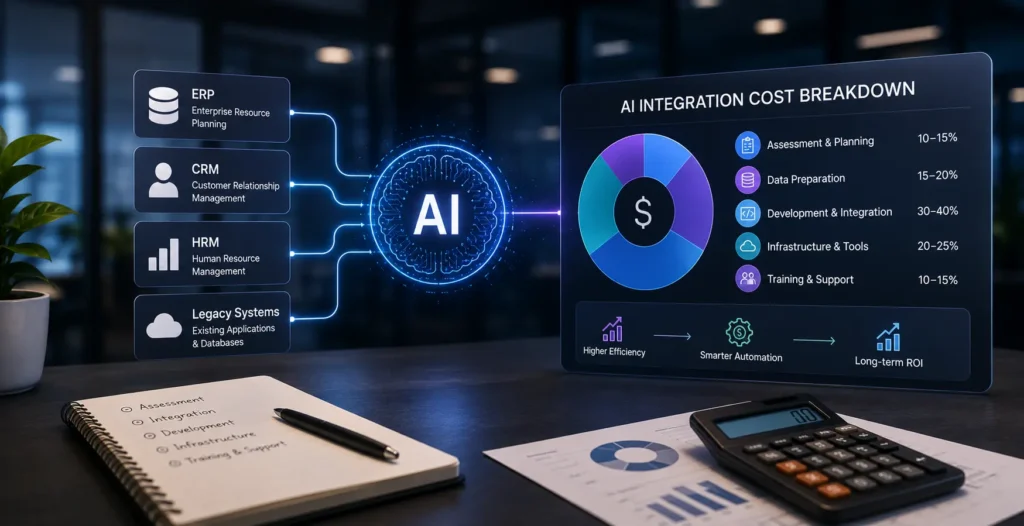
If you lead IT or integration at an enterprise, you already know the mandate for 2026: add AI to the systems you have, without a rip-and-replace. Nobody wants to tear out a working ERP or CRM. They want AI inside it. So the question on your desk is not “should we do AI,” it is “what will it actually cost to integrate AI into the stack we already run?”
Here is the honest headline, and it is the thing most vendors bury. The AI model is the cheap part. The integration is where the money goes. Across enterprise deployments in 2026, integration engineering and testing alone account for 40 to 60% of total build cost. The model you are excited about is a fraction of the invoice. The connections to your ERP, CRM, and data warehouse are the invoice.
This guide breaks down what that integration really costs in 2026, the specific hidden costs that blow up enterprise AI budgets, and how to scope it so you can defend the number to your board. Real figures, current as of mid-2026, no hand-waving.
## The honest range, and why it is so wide
Integrating AI into existing enterprise systems in 2026 runs anywhere from about $30,000 for a single, simple AI feature on one modern platform to $2 million and beyond for an enterprise-scale, multi-system AI platform. That range is almost uselessly wide until you break it by scope, so here is where real projects land.
Adding AI to a single, API-ready system (one CRM, ERP, or CMS with modern APIs) typically runs $20,000 to $45,000. Connecting AI across multiple systems (ERP plus CRM plus analytics plus custom apps), where you need API orchestration and data synchronization, runs meaningfully higher. A typical US mid-market multi-system integration, three to six systems with production monitoring and role-based access, lands in a twelve-to-twenty-week build at mid-six figures. Full enterprise-wide integration across ERP, CRM, data warehouse, and operational platforms, with multi-agent orchestration, observability, security audits, and human-in-the-loop checkpoints, runs a 24-to-52-week program and well into seven figures.
Why the enormous spread? Because the cost is driven almost entirely by your existing systems, not the AI. A modern cloud API-ready stack integrates fast and cheap. A legacy on-premise, poorly documented stack does not. That single variable moves the number more than any other.
## Where the money actually goes
For budgeting, it helps to see the real cost breakdown, because it is not where most people expect.
The AI model itself is often the smallest line. Using a hosted API model (OpenAI, Anthropic, Google) costs far less than most enterprises assume, and API prices have dropped to roughly a tenth of their 2023 launch pricing. If you were scared off by model costs a year or two ago, the math has changed dramatically.
Integration engineering is the big one, 40 to 60% of the total build. This is the middleware, the API work, the data mapping between systems, the authentication and access controls, and the regression testing across your existing workflows to make sure the AI does not break something that already works.
Data preparation is the other giant and the most underestimated. AI runs on your data, and in most enterprises that data is fragmented across departments and legacy systems. Cleaning, normalizing, and consolidating it, often building a data warehouse or pipelines to feed the AI, can add 25 to 35% to the project budget on its own.
Then infrastructure (cloud compute, which runs from a few hundred dollars a month for light workloads to $80,000+ a month at an intensive scale); UI work to embed AI into the tools your people already use; and governance and security, which in regulated sectors is a fixed cost multiplier, not an afterthought.
The pattern to take to your board: you are not buying an AI model. You are buying the integration, the data work, and the operations around it. The model is almost a rounding error by comparison.
## The hidden costs that blow up enterprise AI budgets
This is the section that protects your budget, because these are the costs that surprise teams who scoped only the model build.
### Legacy system integration
If your target systems lack modern APIs, you are into custom middleware, code refactoring, and data migration. This is consistently the most expensive integration factor, and it adds $30,000 to $200,000 and 3 to 8 months to the timeline, a figure that routinely shocks teams who budgeted for the AI and forgot the plumbing.
### Ongoing maintenance
Ongoing maintenance, which 81% of organizations fail to budget for adequately. AI is not a one-time capital cost. Models drift as real-world data diverges from training data, so they need monitoring and retraining. Annual maintenance runs 15 to 25% of the initial build cost, every year, as a permanent operating line. Projects that treat go-live as the budget endpoint routinely overspend in year two.
### Usage costs that scale with adoption
Hosted model inference is billed per use, so the more your people use the AI, the higher the bill. Successful teams set cost attribution and alerts from day one, because Deloitte’s 2026 research found that the speed of seeing AI spend, not the size of it, separates the organizations that pull ahead from the ones that get burned.
### Change management is underbudgeted by 40 to 60% in most RFPs
Deloitte’s survey of 3,235 senior leaders named the AI skills gap the single biggest barrier to enterprise AI integration. Your people need to understand the system, know when to trust it and when to escalate, and adapt their workflows. Skip this and adoption fails, which means the whole investment fails.
The rule of thumb: the sticker price of the build is a fraction of the true cost. Budget for the full lifecycle, or plan to be surprised in year two.
## What drives your number up or down
Two enterprises scoping the same AI capability can get quotes that differ 3x to 5x. These are the inputs that decide where you land and the ones to get specific about before any RFP.
Number of systems integrated. Each system you connect adds roughly $5,000 to $20,000. A four-system project is far cheaper than a fourteen-system one, so scope tightly.
System readiness. Modern cloud platforms with open APIs integrate quickly. Legacy on-premise systems need middleware and extraction layers, driving cost up sharply. This is the single biggest lever.
Data maturity. Clean, well-governed master data moves fast. Fragmented, inconsistent data means a large data-preparation bill before anything works, often that 25 to 35% adder.
Model strategy. Using an API model is cheapest, fine-tuning costs more, and training a custom or private model on your own data costs the most (full customization can exceed $50,000 just for the model, before integration). Most enterprises should start with API models and only fine-tune where accuracy or data sensitivity genuinely demands it.
Compliance burden. Healthcare, finance, and insurance carry access controls, audit logging, and legal review that add roughly 15 to 20% before a single workflow goes live.
##### Additional Read
- [AI Automation Cost for Mid-Sized Businesses: A 2026 Budget Guide](https://www.krishaweb.com/blog/ai-automation-cost-mid-sized-business/)
- [AI Agency vs In-House: Full Cost Breakdown (2026)](https://www.krishaweb.com/blog/ai-agency-vs-in-house-cost/)
- [White Label vs Subcontracting vs Hiring: The Real Cost Comparison for Agencies](https://www.krishaweb.com/blog/white-label-vs-subcontracting-vs-hiring-agency/)
## How to budget it without the overruns
The enterprises that succeed with AI integration do not scope one giant program. They phase it, and the data strongly favors this approach.
Start with one high-value use case on your most AI-ready system. Customer support automation pays back fastest (6 to 12 months), workflow automation next (12 to 18 months), and analytics systems longer (12 to 24 months). Predictive maintenance and computer-vision QA pay back fastest of all in industrial settings; IBM research shows AI predictive maintenance can cut unplanned downtime by 47%, so a single avoided line stoppage can cover the whole build.
Run it, prove the ROI, then scale. This phased path lets you validate return before committing an enterprise-wide budget, and it means your first success funds and de-risks the next phase. It is the difference between the organizations capturing measurable value and the 95% of enterprise AI pilots that, per MIT’s 2026 research, delivered no measurable P&L impact, almost always because they were scoped and governed poorly, not because the technology failed.
For a defensible board number, insist on cost attribution at the workload level from day one, so you can trace spend to outcomes. The enterprises that can do this optimize effectively. The ones flying blind overspend without knowing what they are getting back.
***If you are budgeting a smaller or single-department effort rather than a full enterprise program, our guide to***[ ***AI automation cost for mid-sized businesses***](https://www.krishaweb.com/blog/ai-automation-cost-mid-sized-business/) ***breaks down the numbers at that scale.***
### Frequently Asked Questions
**How much does it cost to integrate AI into existing enterprise systems in 2026?**It ranges from about $30,000 for a single simple AI feature on one modern system to $2 million or more for an enterprise-scale, multi-system AI platform. Adding AI to one API-ready system typically runs $20,000 to $45,000, while a mid-market multi-system integration lands in the mid-six figures over 12 to 20 weeks, and a full enterprise-wide program runs into seven figures over 24 to 52 weeks. The biggest cost driver is not the AI model but the integration with your existing systems, which alone accounts for 40 to 60% of total build cost.
**Why is AI integration so expensive when AI models are getting cheaper?**Because the model is the cheap part. API model prices have dropped to roughly a tenth of their 2023 levels, but the cost of AI integration lives in connecting it to your existing systems: middleware, API work, data mapping, authentication, and regression testing across current workflows account for 40 to 60% of the build. Data preparation adds another 25 to 35%, since enterprise data is usually fragmented across legacy systems and must be cleaned and consolidated first. You are not paying for the AI, you are paying for the integration, data work, and operations around it.
**What are the hidden costs of enterprise AI integration?**The main ones are legacy system integration (custom middleware and data migration adding $30,000 to $200,000 and 3 to 8 months when systems lack modern APIs), ongoing maintenance (15 to 25% of build cost every year, which 81% of organizations fail to budget adequately), usage costs that scale with adoption, and change management (underbudgeted by 40 to 60% in most RFPs). AI is a permanent operating line, not a one-time capital cost, and projects that treat go-live as the budget endpoint routinely overspend in year two.
**How long does it take to integrate AI into existing systems?**A focused single-department deployment typically takes 6 to 12 months from scoping to production. Enterprise-wide integration across multiple systems, teams, and compliance controls generally takes 12 to 24 months. Legacy systems without modern APIs add 3 to 8 months on their own. Timelines depend heavily on how many systems you connect and how AI-ready they are: modern cloud platforms with open APIs integrate far faster than legacy on-premise systems that need custom middleware. A proof-of-concept is quicker but does not reliably predict the production timeline.
**Should we build AI in-house or outsource the integration?**It depends on your existing talent. In-house builds give you control but carry full talent cost (AI engineers, data scientists, and ML specialists average $120,000 to $160,000 a year in the US), plus recruitment and ramp time, and Deloitte named the AI skills gap the biggest barrier to enterprise AI integration. Outsourcing is usually faster and lower in upfront cost, especially for organizations without existing AI engineering and MLOps talent. Many enterprises use a hybrid model, internal ownership with external delivery, which distributes risk but requires disciplined coordination.
**How do we avoid AI budget overruns?**Phase the work instead of committing to one giant program. Start with a single high-value use case on your most AI-ready system, prove the ROI, then scale, so your first success funds and de-risks the next phase. Insist on cost attribution at the workload level from day one so you can trace spend to outcomes, since Deloitte found that visibility into AI spend, not its size, separates the winners. Budget for the full lifecycle including maintenance and usage, scope the number of integrated systems tightly, and address data quality early, since it is the most underestimated cost.
#### Scope Your AI Integration With a Free Assessment
The hardest part of budgeting AI integration is knowing what your specific systems will actually require, and where the hidden costs hide in your particular stack. That is exactly what we help enterprise IT and integration leaders figure out before an RFP or a board request.
Start with a free[ **AI Readiness Assessment**](https://www.krishaweb.com/ai-readiness-assessment/), a 30-minute call with our AI team. We will look at your existing systems, identify your highest-ROI first integration, flag the legacy and data-preparation costs that others miss, and give you a defensible cost baseline you can take to your board. No pitch, no obligation.
Book your[ **free AI readiness assessment call**](https://api.leadconnectorhq.com/widget/bookings/book-a-call-with-parth-krishaweb).

###### Parth Pandya
Founder & CEOFounder & CEO of KrishaWeb, leads an Enterprise Web Agency. With contributions to WordPress and organization of WordCamps, he pioneers innovation and community engagement in the digital realm.
 Interact With Me-
-
- [ ](mailto:)
---
_View the original post at: [https://www.krishaweb.com/blog/cost-of-integrating-ai-into-enterprise-systems/](https://www.krishaweb.com/blog/cost-of-integrating-ai-into-enterprise-systems/)_
_Served as markdown by [Third Audience](https://github.com/third-audience) v3.6.1_
_Generated: 2026-07-28 12:39:03 UTC_