---
title: "Healthcare Portal Development Cost in 2026: The Complete Budget Guide"
url: "https://www.krishaweb.com/blog/healthcare-portal-development-cost/"
date: "2026-07-27T13:02:05+00:00"
modified: "2026-07-27T13:02:08+00:00"
type: "Article"
resource: "https://www.krishaweb.com/blog/healthcare-portal-development-cost/"
timestamp: "2026-07-27T13:02:08+00:00"
author:
name: "Nirav"
url: "https://www.krishaweb.com"
categories:
- "Web Development"
word_count: 2398
reading_time: "12 min read"
summary: "A healthcare portal costs between $60,000 and $300,000 to build in 2026, takes 3 to 18+ months, and, critically, incurs an additional 15 to 25% of the build price each year to run and maintain. Tha..."
description: "A healthcare portal costs between $60,000 and $300,000 to build in 2026, takes 3 to 18+ months, and, critically, incurs an additional 15 to 25% of the build ..."
keywords: "Web Development"
language: "en"
schema_type: "Article"
related_posts:
- title: "10 Signs Your Agency Needs a White Label Web Design Partner"
url: "https://www.krishaweb.com/blog/signs-agency-needs-white-label-partner/"
- title: "Laravel/Node.js vs .NET for Healthcare Applications: Security, Compliance & Cost"
url: "https://www.krishaweb.com/blog/laravel-vs-net-healthcare-application/"
- title: "Best Website Development Agencies for Healthcare Organizations: Secure & Compliant"
url: "https://www.krishaweb.com/blog/healthcare-website-development-agency/"
---
# Healthcare Portal Development Cost in 2026: The Complete Budget Guide
_Published: Monday,July 27, 2026_
_Author: Nirav_
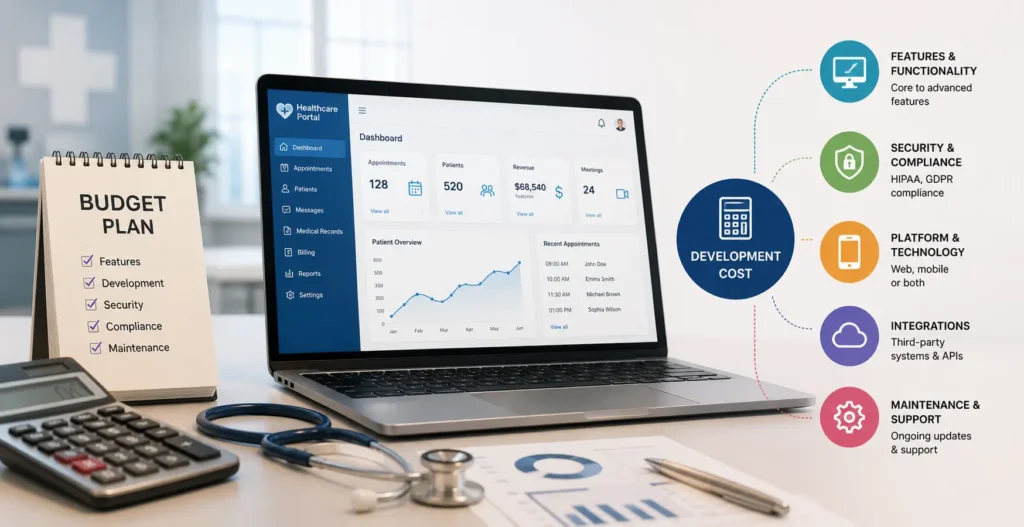
A **healthcare portal costs between $60,000 and $300,000 to build in 2026**, takes 3 to 18+ months, and, critically, incurs **an additional 15 to 25% of the build price each year** to run and maintain. That last number is the one most cost guides skip, and it is the one that separates a portal that delivers real return from one that becomes a budget drain.
If you are the person who has to justify this spend, you have probably found the same thing everywhere: cost ranges so wide they are useless, and no help understanding whether the investment actually pays off. So this guide does more than list numbers. It breaks down the true cost by portal type and complexity, shows exactly what HIPAA and EHR integration add, models the real 3-to-5-year total cost of ownership, and gives you the ROI case to take to your board.
One note upfront: this is practical budgeting guidance, not legal advice. For your specific HIPAA and interoperability obligations, confirm with a compliance professional. What we can give you is a clear picture of what actually gets built and what it costs.
## Healthcare portal development cost overview
Here is where real projects land in 2026, by complexity tier.
| **Complexity tier** | **Cost range** | **Timeline** | **Best for** |
|---|---|---|---|
| Basic patient portal | $60,000-$100,000 | 3-6 months | Appointment booking, secure messaging, record viewing |
| Mid-level portal | $100,000-$200,000 | 6-12 months | EHR integration, billing, telehealth, multiple user roles |
| Enterprise portal | $200,000-$300,000+ | 12-18+ months | Multi-EHR, bidirectional data, advanced compliance, high volume |
The single biggest cost driver is not the visible features. It is what happens behind the screen: how deeply the portal integrates with your existing systems and how much compliance architecture it carries. Two portals that look identical to a patient can differ by six figures based on what they connect to and how they protect data.
### Cost by portal type
Not all healthcare portals are the same, and the type you need shapes the price.
| **Portal type** | **Who it serves** | **Relative cost** | **Why** |
|---|---|---|---|
| Patient portal | Patients | Lower to mid | Record access, scheduling, messaging, bill pay |
| Provider/clinician portal | Doctors, nurses, staff | Higher | Information-dense dashboards, clinical workflows, write-back to EHR |
| Admin portal | Operations, billing | Mid | Reporting, user management, billing operations |
Patient portals generally cost less than provider portals, because clinician-facing tools need denser interfaces, deeper workflow integration, and often the ability to write data back into the EHR, which is far more complex than simply displaying it. Many organizations need more than one of these, which is why enterprise builds reach the top of the range.
## Key features and what they cost
Features drive the bill. Here is what the main ones add, based on 2026 pricing.
Authentication and identity verification run $8,000 to $20,000, covering multi-factor login, patient identity proofing, and caregiver proxy access. EHR data display (rendering labs, medications, and conditions from FHIR or HL7 sources) runs $8,000 to $50,000. Secure HIPAA-compliant messaging runs $8,000 to $20,000. Appointment scheduling with real-time availability runs $8,000 to $25,000. Telehealth video adds high cost due to HIPAA-compliant video infrastructure. Billing and payment integration adds more still.
The pattern to plan around: a portal is priced by capability, not page count. Decide which features genuinely drive value for your patients and defer the rest to a later phase. That single discipline is the biggest lever you have on the build cost.
### HIPAA and compliance costs, broken down by requirement
This is the section most cost guides gloss over and the one that surprises budget owners most. Compliance is not a single line item. It is several layers, and skipping any of them creates legal exposure.
HIPAA compliance itself adds 15 to 25% to the total build cost when planned from the start, covering encryption at rest and in transit, role-based access controls, and immutable audit logging. The crucial warning: retrofitting HIPAA after the fact costs 30 to 50% more than building it in from day one and introduces clinical risk. Compliance is an architecture decision, not a feature you bolt on before launch.
Beyond HIPAA itself, budget for these distinct layers. HIPAA security audits and penetration testing run $15,000 to $60,000 per cycle. SOC 2 Type II audits run $20,000 to $50,000 per year. The 21st Century Cures Act and CMS interoperability rules now mandate SMART on FHIR (HL7 FHIR R4) support with active enforcement, which shapes your integration requirements. And Section 1557 of the Affordable Care Act requires WCAG 2.1 AA accessibility and multilingual support; non-compliance there is its own legal exposure. State privacy laws add another layer depending on where your patients are.
The takeaway: in healthcare, compliance is a real and recurring cost category, not a checkbox. A quote that does not itemize it has hidden it, and hidden compliance cost is the number one reason healthcare builds blow past budget.
### EHR integration costs (the line most quotes bury)
If your portal connects to an EHR, and most do, this is where budgets quietly balloon.
A single EHR integration typically costs $15,000 to $50,000 for a straightforward read-only FHIR connection, and $50,000 to $150,000 for deeper or bidirectional integration, taking two to six months of engineering after sandbox access is granted. Sandbox access alone adds four to eight weeks before work even begins.
The cost varies sharply by EHR and by depth:
| **EHR platform** | **Integration cost** | **Note** |
|---|---|---|
| Epic | Higher ($18K-$80K) | App Orchard certification adds time and cost |
| Cerner (Oracle Health) | Similar to Epic | Own certification program |
| athenahealth | Lower ($10K-$48K) | Cloud-native, API-first, streamlined |
Two things drive the number most. Read-only versus bidirectional: writing data back to the EHR costs 40 to 60% more than reading from it, because every write needs clinical validation and safe failure handling. Number of EHRs: supporting three or more typically costs 2 to 3x a single integration. Ongoing budget: $3,000 to $15,000 per interface per year just to keep each integration running as vendors update their APIs.
Practical advice that saves real money: start with the one EHR most of your users are on, use FHIR wherever possible (it is more portable across platforms), and phase write-back into a later stage. We handle exactly this kind of work in our[ **EHR integration services**](https://www.krishaweb.com/contact-us/).
## Post-launch cost modeling: the 3-5 year total cost of ownership
Here is the gap almost no competitor fills and the one a budget owner needs most. The build price is not the cost of the portal. The cost of ownership over three to five years is.
Plan for these recurring costs every year after launch. Maintenance and updates run 15 to 25% of the build cost annually. HIPAA-compliant hosting costs two to three times regular hosting, because it needs audit logs, encryption at rest, and signed BAAs. Security audits and penetration testing recur at $15,000 to $60,000 per cycle, plus SOC 2 at $20,000 to $50,000 a year. EHR interface maintenance runs $3,000 to $15,000 per integration per year. And feature updates and iteration continue as patient expectations and regulations evolve.
Put it together with a realistic example. A $150,000 mid-level portal build, with hosting, maintenance, security audits, and two EHR interfaces, can carry $50,000 to $90,000 a year in ongoing costs. Over five years, the total cost of ownership can reach $400,000 to $600,000, well more than double the build price. This is the number to budget and defend, not the build quote alone. Budget owners who plan in TCO terms avoid the year-two surprise that derails so many healthcare technology projects.
## The ROI: how to justify the investment
Cost is only half the decision. Here is the business case because a healthcare portal is not an expense; it is an efficiency and retention engine.
A well-built portal reduces call volume by letting patients book, message, view records, and pay online instead of tying up your front desk. It improves patient retention; over 60% of patients now expect digital access to records and appointments before they will even choose a provider, so organizations without a mature portal are losing patients to those that have one. It improves billing efficiency and reduces no-shows through automated reminders. And it frees clinical and administrative staff from routine requests to focus on care.
The framing for your board: a portal that deflects even a fraction of routine calls and reduces no-shows pays back its ownership cost through recovered staff time and retained patients. The organizations that invested two years ago are already capturing that return. The cost of not building one is measured in lost appointments and patients who chose a more digitally accessible competitor.
## Build vs. buy vs. configure: the real decision
Before you budget a custom build, understand your three options, because these are the actual choices a budget owner faces, and few guides address them.
Configure an EHR-native portal (like Epic MyChart) if you run that EHR and your needs are standard. It is the fastest and often cheapest path, but you are limited to what the platform offers, and your branding and experience are constrained.
Buy a SaaS patient portal platform if you want faster deployment and predictable subscription costs. Off-the-shelf enterprise licensing runs $50,000 to $300,000 a year plus $25,000 to $150,000 in implementation, and you trade customization for speed.
Build custom when you need a specific patient experience, deep multi-system integration, your own branding, full data control, or capabilities the platforms do not offer. It costs more upfront, but you own it outright, and it fits your workflows exactly.
The honest answer for most organizations: match the choice to your situation, not to what a vendor is selling. If a standard portal on your existing EHR meets your needs, configure it. If you need something the platforms cannot deliver? Build it. A good partner will tell you honestly which one fits, even when it means a smaller project.
##### Additional Read
- [Why Healthcare Organizations Choose Laravel for Secure Patient Portals](https://www.krishaweb.com/blog/laravel-healthcare-patient-portal/)
- [Best Website Development Agencies for Healthcare Organizations: Secure & Compliant](https://www.krishaweb.com/blog/healthcare-website-development-agency/)
- [Laravel/Node.js vs .NET for Healthcare Applications: Security, Compliance & Cost](https://www.krishaweb.com/blog/laravel-vs-net-healthcare-application/)
- [Laravel + AI in 2026: How to Build Intelligent Backends the Right Way](https://www.krishaweb.com/blog/laravel-ai-integration/)
### How to reduce healthcare portal development cost
Practical levers that lower the number without cutting compliance corners.
Start with an MVP that proves value, then expand, rather than building everything at once. Build HIPAA compliance in from day one to avoid the 30 to 50% retrofit penalty. Integrate one EHR first and use FHIR for portability. Defer bidirectional write-back and non-essential features to phase two. Choose a healthcare-specialist development partner over a general agency, since specialists build compliance in by default and avoid the expensive mistakes generalists make. And budget for the full TCO upfront so you are never forced into rushed, costly decisions later.
### Frequently Asked Questions
**How much does it cost to build a healthcare portal?**Most healthcare portals land between $60,000 and $300,000 in 2026, and where you fall comes down to how complex yours needs to be. A basic patient portal, think scheduling, secure messaging, and letting patients view their records, usually runs $60,000 to $100,000. Add EHR integration, billing, and telehealth, and you are into mid-level territory, roughly $100,000 to $200,000. Enterprise builds with multiple EHRs and heavier compliance start around $200,000 and climb from there. Expect the work to take anywhere from 3 to 18 months. And here is the part organizations forget: once it is live, plan on 15 to 25% of the build cost every year for maintenance, hosting, and security.
**What is the average cost of a HIPAA-compliant patient portal?**Figure on $100,000 to $300,000 for a HIPAA-compliant patient portal. Compliance itself adds 15 to 25% to the base build, and that money buys real things: encryption in transit and at rest, role-based access, and audit logging you cannot fake. The important part is timing. Build compliance in from day one and it costs that 15 to 25%. Try to bolt it on later and you pay 30 to 50% more, plus you introduce clinical risk. On top of the build, there are recurring compliance costs to plan for, security audits and penetration testing run $15,000 to $60,000 each cycle, and a SOC 2 Type II audit adds $20,000 to $50,000 a year.
**How much does EHR integration add to portal costs?**It depends heavily on how deep the connection goes. A simple read-only FHIR link, where your portal pulls data from the EHR but never writes back, runs $15,000 to $50,000. Full bidirectional integration, where the portal writes clinical data back, is a different animal: $50,000 to $150,000, and two to six months of engineering once you have sandbox access. The EHR matters too. Epic tends to cost the most because of its App Orchard certification, while athenahealth is usually cheaper thanks to its cloud-native APIs. Two rules of thumb worth knowing: writing data back costs 40 to 60% more than just reading it, and connecting three or more EHRs runs 2 to 3 times a single one. Then budget $3,000 to $15,000 per interface each year to keep it running.
**How long does it take to build a healthcare portal?**A basic patient portal takes 3 to 6 months, a mid-level portal with EHR integration and telehealth takes 6 to 12 months, and an enterprise portal takes 12 to 18+ months. EHR integration alone adds two to six months of engineering after sandbox access, and sandbox access itself takes four to eight weeks before work begins. Compliance reviews and integration complexity are the biggest timeline factors, so teams that scope EHR integration as a short sprint consistently miss launch dates.
**What is the total cost of ownership for a healthcare portal over 5 years?**Total cost of ownership typically reaches two to three times the build price over five years. A $150,000 mid-level portal can carry $50,000 to $90,000 a year in ongoing costs, hosting (2 to 3x normal due to HIPAA requirements), maintenance (15 to 25% of build), security audits and SOC 2, and EHR interface maintenance ($3,000 to $15,000 per interface). Over five years, that build can total $400,000 to $600,000. Budget owners should plan in TCO terms rather than build cost alone, since ongoing costs, not the build, determine whether the portal pays off.
**Should we build a custom portal or use an EHR-native one like MyChart?**It depends on your needs. Configure an EHR-native portal like Epic MyChart if you run that EHR and your requirements are standard; it is fastest and often cheapest but limited to what the platform offers. Buy a SaaS portal for predictable subscription cost and faster deployment, trading customization for speed. Build custom when you need a specific patient experience, deep integration, your own branding, or capabilities the platforms lack. Most organizations should match the choice to their situation: Configure if a standard portal meets your needs; build if it does not.
### Get an Accurate Cost Estimate for Your Healthcare Portal
Every cost guide gives you ranges. The number that matters is the one for your systems, your EHR, your compliance requirements, and your patients, and that takes a real conversation.
KrishaWeb builds HIPAA-conscious healthcare portals with EHR integration and compliance handled as standard, not bolted on after the fact. We will help you scope the right build, model the true 3-to-5-year cost, and tell you honestly whether to configure, buy, or build.
[**Contact us**](https://www.krishaweb.com/contact-us/) **for a personalized cost estimate.**
[**Healthcare Software Development**](https://www.krishaweb.com/healthcare-it-solutions/) |[ **Web Application Development**](https://www.krishaweb.com/web-application-development/)
*This article is practical budgeting guidance and not legal or compliance advice. Confirm your specific HIPAA, interoperability, and accessibility obligations with a qualified compliance professional.*

###### Nirav Panchal
Lead – Custom DevelopmentLead of the Custom Development team at KrishaWeb, holds AWS certification and excels as a Team Leader. Renowned for his expertise in Laravel and React development. With expertise in cloud solutions, he leads with innovation and technical excellence.
 Interact With Me-
-
- [ ](mailto:)
---
_View the original post at: [https://www.krishaweb.com/blog/healthcare-portal-development-cost/](https://www.krishaweb.com/blog/healthcare-portal-development-cost/)_
_Served as markdown by [Third Audience](https://github.com/third-audience) v3.6.1_
_Generated: 2026-07-27 13:02:08 UTC_