---
title: "How to Hire a WordPress Developer: Agency vs Freelancer"
url: "https://www.krishaweb.com/blog/hire-wordpress-developer-agency/"
date: "2026-03-10T09:19:08+00:00"
modified: "2026-06-18T11:21:39+00:00"
author:
name: "Girish"
categories:
- "Web Development"
word_count: 2985
reading_time: "15 min read"
summary: "A decision framework for hiring WordPress developers that covers cost, AI-readiness, and project fit so you pick the right option the first time."
description: "Freelancer or agency? Get real cost data, AI-readiness vetting questions, and a decision framework for hiring WordPress developers that fits your project and..."
keywords: "Hire WordPress Developer, Web Development"
language: "en"
schema_type: "Article"
related_posts:
- title: "Laravel Development Services in 2026: What’s Included, What It Costs, and What AI Changes"
url: "https://www.krishaweb.com/blog/laravel-development-services-cost/"
- title: "Healthcare Website Development 2026: HIPAA Compliance Guide"
url: "https://www.krishaweb.com/blog/healthcare-website-development-compliance-guide/"
- title: "How to Build an AI-Powered Web App in 2026: A Practical Guide for Founders and CTOs"
url: "https://www.krishaweb.com/blog/ai-powered-web-app-development/"
---
# How to Hire a WordPress Developer: Agency vs Freelancer
_Published: Tuesday,March 10, 2026_
_Author: Girish_
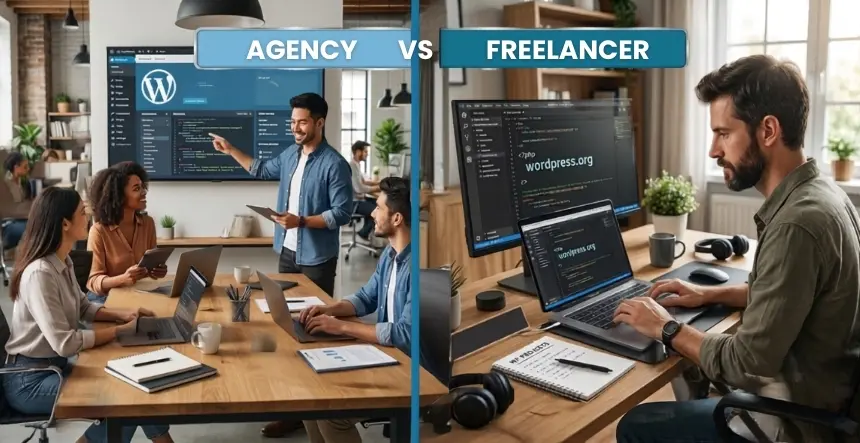
A decision framework for hiring WordPress developers that covers cost, AI-readiness, and project fit so you pick the right option the first time.
If you have already tried to figure this out, you know how fast the process breaks down. You post a job, receive 40 applications, have no real way to evaluate them, get a few wildly different quotes, and end up either hiring someone on gut feel or stalling the project entirely.
That is not a vetting problem. It is a framing problem. Most hiring guides for WordPress developers answer the wrong question. They tell you how much things cost without telling you which type of hire is right for your project in the first place.
This guide answers the right question first.
## The Decision That Matters Before Any Rate Discussion
There are three ways to hire WordPress development help: a freelancer, an agency, or an in-house developer. Each is the right answer for a different type of project. Getting this wrong costs more than overpaying on the hourly rate.
Here is the honest breakdown.
**Freelancers** are the right choice when you have a defined, bounded task: building a specific feature, fixing a bug, setting up a theme, or completing a project with a clear scope and endpoint. They are typically 20 to 40% cheaper than agency rates on equivalent hourly work.
What the rate does not reflect: a freelancer is one person. If they get sick, take another project, or go quiet, your project stalls. You are also the project manager. You coordinate timelines, review work, and handle the communication overhead that an agency absorbs internally.
**Agencies** are the right choice when your project requires multiple disciplines at once: design, development, QA, performance optimization, and project management running in parallel. You pay a premium, but that premium buys you accountability, a team, and the structural protection of a contract with a company rather than an individual.
The hidden math that most founders miss: If a freelancer charges $50/hour and takes 120 hours on a project that an agency completes in 60 hours with a $90/hour blended rate, the agency is cheaper. Parallelizing workstreams with a team can cut delivery time significantly, which affects your real cost more than the hourly rate comparison suggests.
**In-house developers** make sense when you have ongoing, continuous work that justifies a salary. If you are updating and building on your WordPress site every week, the math shifts in favor of an employee over time. But for most SMBs, in-house makes sense only when the volume of work consistently exceeds what a retainer arrangement with an agency can handle.
| **Hiring Model** | **Best For** | **Typical Cost** | **Main Risk** |
|---|---|---|---|
| Freelancer | Defined tasks, bounded scope | $20–$100/hr | Availability, single point of failure |
| Agency | Multi-discipline projects, accountability | $75–$200/hr blended | Higher rate, requires clear brief |
| In-house | Continuous, high-volume ongoing work | $57K–$96K/year + benefits | Overhead, management cost |
| Offshore team/agency | Budget-sensitive projects with coordination capacity | $25–$60/hr | Time zone gaps, communication overhead |
***(Sources:*** [*Codeable*](https://www.codeable.io/blog/how-much-do-wordpress-developers-make)*,* [*Flexiple*](https://flexiple.com/cost-to-hire/wordpress))
## What WordPress Development Actually Costs in 202
The honest rate range is $20 to $250 per hour, depending on who you hire and where they are based. That range is useless without context, so here is the breakdown that actually helps you budget.
### By Experience Level
- **Entry-level developers (0 to 2 years)**: $20 to $50 per hour. Fine for theme setup, plugin installation, basic content updates, and simple site builds. Not the right choice for custom development, performance work, or anything requiring PHP depth.
- **Mid-level developers (3 to 5 years)**: $50 to $90 per hour. Can handle most standard WordPress builds, custom theme work, plugin customization, and moderate integrations. The most common sweet spot for SMB projects.
- **Senior developers (5+ years):** $90 to $200 per hour. Appropriate for complex custom functionality, headless WordPress, performance-critical builds, REST API integrations, and AI feature implementation.
Specialized agency developers in the US: $100 to $250 per hour.
**By Location**
- North America (US/Canada): $50 to $150+ per hour for freelancers; $100 to $250 for agencies.
- Western Europe (UK, Germany): $40 to $100 per hour.
- Eastern Europe (Poland, Ukraine, Romania): $30 to $70 per hour, often comparable quality to Western counterparts at significantly lower rates.
- India and Southeast Asia: $15 to $50 per hour. The quality range here is wider, so vetting matters more. The cost savings are real, but the coordination investment is also real.
**By Project Type**
| **Project Type** | **Typical Range** | **Notes** |
|---|---|---|
| Basic site setup with theme | $500–$3,000 | Entry to mid-level freelancer |
| Custom WordPress website | $5,000–$25,000 | Mid to senior; agency preferred |
| WooCommerce store | $8,000–$50,000+ | Depends on catalog size and integrations |
| WordPress + AI feature integration | $15,000–$80,000+ | Requires senior dev with API and AI experience |
| Enterprise WordPress / headless | $50,000–$200,000+ | Agency or dedicated team is required |
| Monthly maintenance retainer | $500–$3,000/month | Depends on site complexity |
**One cost many founders underestimate:** scope creep and content delays routinely add 20 to 60% to the final project cost. If copy, images, and design decisions are not ready when development starts, you are paying a developer to wait.
## The AI-Readiness Factor: Why This Matters in 2026
WordPress development in 2026 is not the same project it was in 2020. Any CMO or founder evaluating a WordPress hire needs to ask one question the original hiring guides do not cover: Can this developer build or integrate AI features?
The demand for **AI-enhanced WordPress sites** is accelerating. This includes AI chatbots connected to CMS content, personalization layers that adjust content based on visitor behavior, predictive lead capture, AI-powered site search, and automated content workflows. These are not experimental features. They are increasingly baseline expectations for competitive SaaS and professional services websites.
A WordPress developer who can only work within the theme and plugin ecosystem is a different hire from one who understands REST API integration, headless architecture, and connecting third-party AI services to a WordPress backend.
When evaluating any WordPress developer or agency for a project that includes AI features, ask these specific questions:
- Have you integrated any AI tools, APIs, or services into a WordPress site before? What specifically?
- How do you handle WordPress as a headless CMS with a separate frontend consuming the REST API?
- What is your experience connecting third-party services (OpenAI, custom models, CRM data) to WordPress?
- How do you approach performance optimization for a WordPress site with AI features that add a JavaScript payload?
A developer who cannot answer these concretely is not the right hire for an AI-integrated build, regardless of their general WordPress capability.
## Agency vs Freelancer: The Full Pros and Cons
### Freelancer
**Pros:**
- Lower hourly rate, typically 20 to 40% less than agency equivalent
- Direct communication with the person doing the work
- More flexible for short-term or single-task engagements
- Can start faster — typically 3 to 5 business days after agreement
- Better for tight budgets on a bounded scope
**Cons:**
- Single point of failure: illness, other clients, or disengagement stalls your project
- You manage the project, the timeline, and the communication overhead
- Quality ranges widely, especially on budget platforms like Fiverr and Upwork, where vetting is your responsibility
- AI and headless expertise is harder to find in the freelance market than through specialist agencies
- No design, QA, or project management included unless separately contracted
### Agency
**Pros:**
- Team structure means no single point of failure
- Project management included one contact who coordinates design, development, QA, and delivery
- Accountability via contract with a company, not an individual
- Better suited for AI integration, performance engineering, and multi-disciplinary projects
- Typically faster on complex projects because workstreams run in parallel
- Ongoing retainer and support are more reliable
**Cons:**
- Higher hourly or project rate
- Less direct access to the developer doing the work
- Agency kickoff typically takes one to two weeks, versus a few days for a freelancer
- Quality varies significantly between agencies—portfolio and case study review is essential
## How to Vet a WordPress Developer: The Questions That Actually Matter
Most founder vetting processes fail because they focus on the wrong signals. A portfolio is necessary but not sufficient. Here is the vetting framework that separates capable developers from good-looking profiles.
### For Freelancers
Ask for a GitHub link or code samples, not just a portfolio of finished sites. Finished sites are design outcomes. Code samples reveal how someone actually works.
Give them a small paid test task aligned to your actual project: if you need custom plugin work, have them solve a specific small problem. If you need performance optimization, ask them to review your Lighthouse report and tell you what they would fix first and why.
Ask how they handle scope changes. The answer reveals whether they have project management maturity or whether they will simply say yes to everything until the project is late and over budget.
### For Agencies
Review case studies for projects that match your vertical and complexity. An agency with strong eCommerce case studies and no professional services clients may not understand your conversion priorities.
Ask specifically who will be on your project: the team lead, the developer, and the QA person. Agencies sometimes sell with senior talent and deliver with junior talent. Get names and LinkedIn profiles.
Ask for a technical discovery process before any design or development starts. An agency that is willing to start design in week one without a discovery phase is not going to scope your project accurately.
Ask how they handle AI feature integration. This is the question most agencies in the WordPress space cannot answer well yet. The ones who can are worth paying a premium for.
### The Red Flags Across Both
- Quote provided without asking about your existing tech stack, CMS structure, or content volume
- No clear process for handling content readiness before development starts
- Cannot explain how they would handle a URL structure change and SEO redirect mapping
- Vague answer to “what happens if we need to change scope in week six.”
- No clear post-launch support plan
##### Additional Read
- [Enterprise WordPress Optimization: Scale Performance, Security & CRO in 2026](https://www.krishaweb.com/blog/enterprise-wordpress-optimization/)
- [WordPress vs Webflow vs Custom Build: Which Converts Better in 2026?](https://www.krishaweb.com/blog/wordpress-vs-webflow-vs-custom-build/)
- [25 Proven WordPress Website Examples for 2026 Inspiration](https://www.krishaweb.com/blog/best-wordpress-website-examples/)
## A Real Project: Professional Services Firm WordPress Rebuild (Anonymized)
A professional services firm with 12 employees and a 5-year-old WordPress site needed a full rebuild. Their primary issues: a 4.9-second mobile load time, no integration between their website and their CRM, an outdated content structure that made updating the site painful, and no AI feature layer despite their competitors having chatbots and personalized lead capture.
They received three quotes. A freelancer quoted $8,500 and 10 weeks. A generalist agency quoted $22,000 and 14 weeks. KrishaWeb quoted $31,000 and 16 weeks, including a discovery phase, headless CMS implementation, CRM integration, and an AI chatbot connected to their service knowledge base.
They went with the higher quote. The reasons: the discovery phase meant the spec was defined before development started (which had burned them before); the AI chatbot was a requirement, not an afterthought; and the post-launch retainer was included in the contract structure.
**Results at 90 days post-launch:**
| **Metric** | **Before** | **After** |
|---|---|---|
| Mobile load time | 4.9 seconds | 1.8 seconds |
| Lead form completions/month | 14 | 31 |
| AI chatbot pre-sales queries handled | N/A | 67% resolved without human |
| CRM data quality (contacts enriched) | Manual, inconsistent | Automated on every form submission |
| Marketing team content update time | 45 min average | 8 min average (headless CMS) |
The lead generation improvement alone, from 14 to 31 qualified inquiries per month, covered the rebuild cost within four months at their average project value.
## Talk to KrishaWeb About Your WordPress Project
If you are evaluating a **WordPress development** hire and want a scoped estimate for your specific project before committing to a vendor, whether it is a new build, a rebuild, a performance fix, or an AI feature integration, that is the conversation we are set up to have.
KrishaWeb has been delivering WordPress development for global clients since 2008. Our team combines deep WordPress development expertise with **[AI implementation capability](https://www.krishaweb.com/ai-implementation-integration/)**, which matters if your build requires more than a theme and a few plugins.
No commitment required on the first call. We will assess your project, provide a realistic scope, and tell you honestly whether a freelancer, an agency, or another approach is right for what you are building.
**[**[**Book a 30 min call with our WordPress development team.**](https://api.leadconnectorhq.com/widget/bookings/book-a-call-with-parth-krishaweb)**]**
Questions before booking? Email us at info@krishaweb.com
### About KrishaWeb
KrishaWeb is a design, development, and AI solutions company that has been building digital products for global clients since 2008. Our [**WordPress Development Services**](https://www.krishaweb.com/wordpress-development/) cover everything from custom theme and plugin development to headless WordPress implementations and enterprise-grade builds.
For projects that require AI features alongside WordPress development, our [**AI Consulting**](https://www.krishaweb.com/ai-strategy-consulting/) and [**AI Development**](https://www.krishaweb.com/ai-implementation-integration/) practice handles the integration work that connects AI tools to your WordPress backend, CMS content, and CRM data. We have worked with SaaS companies, professional services firms, and enterprise clients who need a development team that understands both the platform and the GTM strategy behind the build.
If you want to understand [**why clients choose KrishaWeb**](https://www.krishaweb.com/about-us/) for WordPress projects specifically, the answer starts with a discovery process that gets the scope right before development begins.
### Frequently Asked Questions
**Should I hire a freelancer or an agency for my WordPress project?**It depends on what the project actually involves. Freelancers are the right choice for bounded, defined tasks: a specific feature, a bug fix, a theme setup, or a project with a clear scope and endpoint. They cost 20 to 40% less than agency rates on equivalent hourly work and can start faster. The tradeoff is that you manage the project and absorb the risk if their availability changes.
Agencies are the right choice when the project requires multiple disciplines running simultaneously: design, development, QA, and project management at the same time. You pay more per hour, but a team working in parallel often delivers faster and more reliably than a single freelancer working sequentially. For AI-integrated builds, headless WordPress, or anything with CRM and third-party integrations, an agency with the right specialization is almost always the lower-risk choice, even at a higher rate.
**How much does it cost to hire a WordPress developer in 2025?**The real range is $20 to $250 per hour, depending on experience and location. Whether you are hiring a freelancer or an agency team, entry-level developers typically charge $20 to $50 per hour and are well-suited for basic tasks. Mid-level developers run $50 to $90 per hour and handle most standard builds. Senior developers’ and agency rates run $90 to $200 per hour. For full projects, a custom WordPress site from a qualified agency runs $5,000 to $25,000. WooCommerce builds run $8,000 to $50,000, depending on catalog complexity. WordPress builds with AI integration start around $15,000 and scale significantly based on what the AI layer connects to and does.
**What is the best way to vet a WordPress developer before hiring?**For freelancers: ask for a GitHub link or code samples rather than just a portfolio of finished sites. Give them a small paid test task aligned to your actual project. Ask how they handle scope changes mid-project. For agencies: review case studies for projects that match your vertical and complexity. Ask specifically who will be on your project team, not just who presents in the pitch call. Ask for a technical discovery process before design starts, and ask how they handle AI feature integration if that is relevant to your build. The red flag across both is a quote that arrives without questions about your existing tech stack, content volume, or CMS structure.
**What is a WordPress development agency, and why would I use one over a freelancer?**A WordPress development agency is a company that delivers WordPress projects through a structured team rather than a single developer. You typically get a project manager, one or more developers, a designer, and QA capabilities working on your project simultaneously. The primary advantages are accountability (you have a contract with a company), team resilience (no single point of failure), and the ability to parallelize work that a solo developer would need to complete sequentially. The primary disadvantage is cost: agencies charge a blended rate that reflects their overhead and management structure, typically 30 to 50% higher than equivalent freelance rates. For complex projects, that premium is usually justified by faster delivery and fewer mid-project problems.
**Can I outsource my WordPress development to a team in India or Eastern Europe to save money?**Yes, and many successful businesses do. Developer rates in India range from $15 to $50 per hour, and Eastern European developers run $30 to $70 per hour, compared to $75 to $200 for US-based agencies. The quality range in offshore markets is wider, which means vetting matters more. The considerations that affect real cost beyond the headline rate: time zone overlap and how many working hours per day align with your team; communication quality and whether technical explanations translate accurately; and project management capacity on your side to compensate for the coordination overhead that local agencies absorb internally. Currency fluctuations can also shift monthly costs by 5 to 10%. For a well-scoped project with clear requirements and a competent offshore agency, the cost savings are real. For a project where requirements will evolve and real-time collaboration matters, the coordination overhead often closes the gap.
**Does my WordPress project need AI integration, and what does that add to the cost?**For SaaS and professional services websites specifically, AI integration is increasingly a competitive expectation rather than a luxury feature. The most common AI features on WordPress sites in 2025 are AI chatbots connected to your content or knowledge base, personalization layers that adjust page content based on visitor behavior or ICP signals, AI-powered site search, and lead capture tools that use behavioral signals to trigger specific CTAs. Adding a basic AI chatbot connected to your WordPress knowledge base adds roughly $3,000 to $8,000 to a standard build. Deep AI integration with live CRM data, personalization, and custom model training adds $15,000 to $50,000 or more, depending on complexity. The key vetting question: ask any agency or developer you are considering whether they have built AI features into WordPress before, and ask for a specific example.
**What should a WordPress development retainer cost for ongoing maintenance and support?**Monthly maintenance retainers for WordPress sites typically run $500 to $3,000 per month, depending on site complexity, update frequency, and what is included. Basic retainers covering security updates, plugin updates, backups, and minor content changes run $500 to $1,000 per month. Retainers that include performance monitoring, CRO testing, feature development hours, and priority support run $1,500 to $3,000 per month. The question worth asking before agreeing to a retainer is what specifically is included, how hours are tracked, and what happens to unused hours in a given month. Retainers are worth the investment for sites where downtime or security incidents have a material business impact, which describes most SaaS and professional services sites.

###### Girish Panchal
Technical ArchitectA Technical Architect, proficient in WordPress, Drupal, Laravel, and DevOps tasks, crafts robust IT solutions with a blend of expertise and versatility in web development and infrastructure management.
 Interact With Me-
-
- [ ](mailto:)
---
_View the original post at: [https://www.krishaweb.com/blog/hire-wordpress-developer-agency/](https://www.krishaweb.com/blog/hire-wordpress-developer-agency/)_
_Served as markdown by [Third Audience](https://github.com/third-audience) v3.5.3_
_Generated: 2026-06-18 11:21:39 UTC_