---
title: "How to Evaluate a Web Development Agency Before Signing a Contract"
url: "https://www.krishaweb.com/blog/how-to-evaluate-web-development-agency/"
date: "2026-07-02T12:23:30+00:00"
modified: "2026-07-02T12:23:31+00:00"
type: "Article"
resource: "https://www.krishaweb.com/blog/how-to-evaluate-web-development-agency/"
timestamp: "2026-07-02T12:23:31+00:00"
author:
name: "Parth"
url: "https://www.krishaweb.com/"
categories:
- "Web Development"
word_count: 2059
reading_time: "11 min read"
summary: "The story is almost always the same. The proposal looked sharp. The portfolio screenshots were impressive. The price was competitive. So you signed, paid the deposit, and waited. Then the first del..."
description: "The story is almost always the same. The proposal looked sharp. The portfolio screenshots were impressive. The price was competitive. So you signed, paid the..."
keywords: "Web Development"
language: "en"
schema_type: "Article"
related_posts:
- title: "Best Web Development Agencies for USA SMEs: How to Choose the Right Partner in 2026"
url: "https://www.krishaweb.com/blog/best-web-development-agency-usa/"
- title: "How AI Is Transforming Web Development: What Business Owners Need to Know in 2026"
url: "https://www.krishaweb.com/blog/how-ai-is-transforming-web-development/"
- title: "How to Choose the Right Laravel Development Company for Your Project [Checklist + Red Flags]"
url: "https://www.krishaweb.com/blog/how-to-choose-laravel-development-company/"
---
# How to Evaluate a Web Development Agency Before Signing a Contract
_Published: Thursday,July 2, 2026_
_Author: Parth_
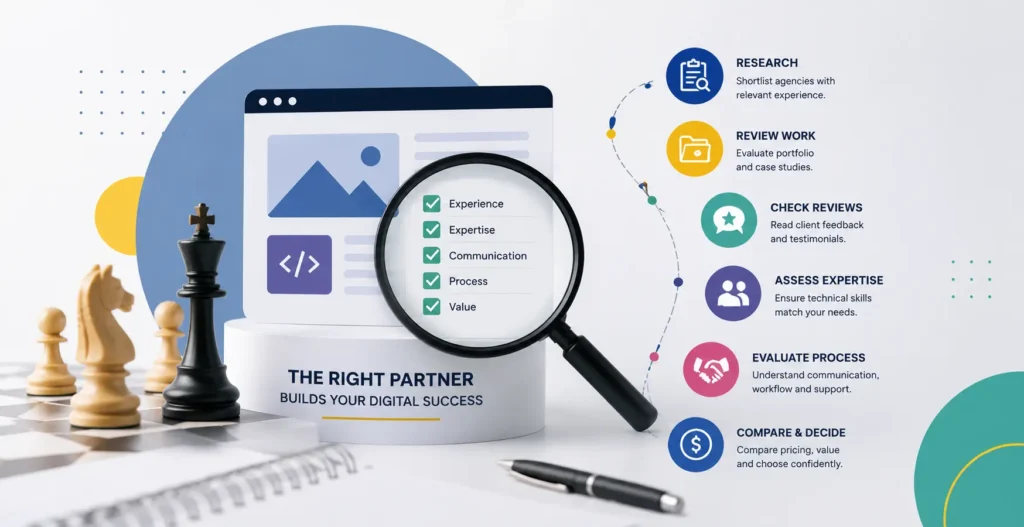
The story is almost always the same. The proposal looked sharp. The portfolio screenshots were impressive. The price was competitive. So you signed, paid the deposit, and waited. Then the first deliverable arrived weeks late and looked nothing like the brief, built by people you never met, on a platform you do not control.
If you have lived that once, you do not want to live it again. And the reason it happened is rarely bad luck. It is that the evaluation stopped at the proposal, which is the one thing every agency, good or bad, can make look great.
This is a repeatable framework for the part that actually protects you: how to evaluate an agency after they have impressed you and before you sign anything. How to verify their work is real, check references the right way, test them with a small paid project, and read the contract for the clauses that decide who wins if things go wrong. Run this on every agency you consider, and you stop choosing on polish and start choosing on evidence.
If you have not built your shortlist yet, start with our guide on[ **how to choose the right web development agency**](https://www.krishaweb.com/blog/best-web-development-agency-usa/), then come back here to vet the finalists.
## Step 1: Verify the portfolio is real
A portfolio is the easiest thing in this whole process to fake, so treat screenshots as a starting point, not proof.
Ask for live URLs, not images. A real agency hands you working links to sites they built. If you only get screenshots and “concepts,” that is your first warning sign. Open the live sites, click around, test them on your phone, and run one or two through a free speed test. A portfolio full of beautiful mockups with no live, functioning sites behind them tells you what they can design, not what they can ship.
Then look past the looks. A gorgeous site that never produced a result for the client is decoration, not capability. Ask what each project was meant to achieve and whether it did. The agencies worth hiring talk about outcomes, not just aesthetics.
## Step 2: Find out who actually does the work
This is the question that exposes the most common bait-and-switch in the industry. Many agencies sell you on senior talent during the pitch, then hand your project to junior staff or subcontractors the moment you sign.
Ask directly, and specifically. Who will be my day-to-day contact? Who is actually writing the code and making the technical decisions? Will any of this be outsourced, and if so, to whom? Using a distributed or hybrid team is not wrong on its own, plenty of great agencies do it, but you deserve to know before you sign, because accountability depends on it.
The follow-up matters just as much. Ask to speak with the people who will actually build your project, not only the account manager who is selling it. An agency that keeps the real team hidden until the ink is dry is telling you something.
## Step 3: Check references the right way
Most buyers skip references. The ones who do get the clearest signal in the entire process, if they ask the right questions.
Every agency will offer you their two happiest clients. Ask for three. The third is usually less rehearsed and tells you far more. Then, once you are past the pleasantries, ask the questions that actually surface the truth:
“Were the people on your project the same ones from the sales pitch?” This catches the bait-and-switch directly. “What did you wish you had known before signing?” This is the golden question, and the pause before the answer is often the answer. “Would you hire them again, and for what kind of project?” This gives you a recommendation with nuance. And critically: “How responsive were they 90 days after launch?” Because many agencies vanish once the final payment clears, and the launch is the easy part. You want the one that is still there when something breaks in month three.
If a reference gets vague or dodges the question about the team, the project probably went badly and they are being polite. Listen for what they will not say.
## Step 4: Run a small paid pilot
If you are deciding between two strong finalists and cannot separate them, this is the best money you will spend in the whole process.
Pay for one small, well-defined piece of work before you commit to the full project. A single page, a contained feature, a focused task. It reveals everything the sales process hides: the real code quality, how they communicate when they hit a snag, whether they actually meet a deadline, and what it feels like to receive their work. Learning an agency is wrong for you on a small paid task is far cheaper than learning it halfway through a six-figure build. Strong agencies welcome this, because they are confident. An agency that refuses a reasonable paid trial is answering the question for you.
## Step 5: Read the contract for the clauses that protect you
This is the step burned buyers care about most and the one that separates a real commitment from a hopeful email. A one-page summary is not a contract. Here is what a real one must spell out.
#### IP and code ownership.
The single most important clause. It must state plainly that all deliverables and source code transfer to you at final payment. Anything vaguer than that should trigger a rewrite request, and if they push back, walk. If the agency keeps the code, the accounts, or the login credentials, you do not own a website; you are renting one.
#### A detailed scope of work.
Not “build a website,” but an itemized list of exactly what is included: pages, features, integrations, rounds of revision. Vague scope is how change orders and budget overruns are born.
#### A change-order process.
The contract should define what counts as a revision versus a new request and set a threshold above which extra work needs written sign-off. This is what stops every small change from becoming a billing dispute.
#### A payment schedule tied to milestones.
A deposit is normal. One hundred percent upfront is not. Payment should be staged against delivered work, which keeps both sides honest.
#### A warranty and post-launch support.
A professional agency includes a defined warranty, usually 30 to 90 days, covering bugs from the build and then offers ongoing support as a clear separate retainer with defined response times. An agency that never mentions post-launch support before you ask is often gone when you need them.
#### A termination clause.
What happens, and who owns what, if the engagement ends early. Read this before you sign, not when you are already in trouble.
## The red flags that should stop you
Any single one of these is worth a hard pause. Several together is your answer.
A detailed proposal within a day of first contact, with no discovery call and no questions about your business: that proposal was a template with your name pasted in. A portfolio of screenshots with no live URLs. A demand for full payment upfront. No written contract, or vagueness about who owns the code. Guaranteed search rankings, which nobody can honestly promise and Google itself warns against. Slow or messy communication during the sales process, which is the most reliable preview of how they will communicate once you are a client. And a price dramatically below market, which usually hides template work, junior developers, or corners cut on testing that resurface as upcharges later.
### The evaluation, in one pass
Put together, the framework is simple to run on every finalist. Verify the portfolio with live URLs and outcomes. Confirm who actually does the work. Call three references and ask the uncomfortable questions. Run one small paid pilot. Then read the contract for IP transfer, detailed scope, change orders, milestone payments, warranty, and termination.
The agency that wins should not be the one with the flashiest deck. It should be the one that asked you the sharpest questions, gave you live proof, passed the pilot, and put every promise in writing. Polish wins pitches. Evidence protects budgets.
##### Additional Read
- [7 Ways AI Is Changing How SMBs Generate Leads Online](https://www.krishaweb.com/blog/ai-lead-generation-smb-website/)
- [AI Website Redesign ROI: What SMBs in SaaS and Professional Services Actually Get](https://www.krishaweb.com/blog/ai-website-redesign-roi-smb/)
- [Best Web Development Agencies for USA SMEs: How to Choose the Right Partner in 2026](https://www.krishaweb.com/blog/best-web-development-agency-usa/)
### How KrishaWeb Handles This
We are comfortable being evaluated this way, because we are built for it. Live URLs for our work, not just screenshots. The people who build your project are the people you talk to. References who will take your call. A small paid pilot whenever you want to test us before committing. And a contract that transfers full code and IP ownership to you at final payment, with a clear scope, a defined warranty, and post-launch support in writing.
If you have been burned before and want a partner who passes this framework rather than dodges it, put us through it. Tell us what you are building.[ **Schedule a call**](https://api.leadconnectorhq.com/widget/bookings/book-a-call-with-parth-krishaweb) to talk it through, or[ **contact us**](https://www.krishaweb.com/contact-us/) about your project.
### Frequently Asked Questions
**How do I evaluate a web development agency before hiring?**Evaluate in five steps after the proposal impresses you. First, verify the portfolio with live URLs, not just screenshots, and look for real outcomes. Second, confirm who actually does the work, since many agencies pitch senior staff then hand the project to juniors. Third, call three references and ask whether the pitch team did the work, what they wished they had known, and how responsive the agency was 90 days after launch. Fourth, run a small paid pilot to test quality and communication. Fifth, read the contract for IP ownership, scope, change orders, payment milestones, warranty, and termination. Choose on evidence, not polish.
**What should be in a web development contract?**A real contract includes a detailed scope of work with itemized deliverables, a payment schedule tied to milestones (never 100% upfront), a clear intellectual property clause transferring all code and assets to you at final payment, a change-order process defining revisions versus new requests, a defined warranty period (typically 30 to 90 days) for build-related bugs, post-launch support terms, and a termination clause. A one-page email summary is not a contract. The IP and code-ownership clause is the most important, if it is vague, request a rewrite before signing.
**Who should own the code and website after the project?**You should own everything: the source code, design files, the CMS account, the domain, and any third-party accounts created during the project. The contract must state clearly that ownership transfers to you on final payment as work-for-hire. If the agency retains the code or holds the login credentials, you do not own your website, you are effectively renting it from them. This is the single biggest contract red flag, and vague ownership language should trigger a rewrite request.
**What are the biggest red flags when choosing a web development agency?**The most common are a detailed proposal sent within a day with no discovery call (a template with your name inserted), a portfolio of screenshots with no live URLs, a demand for 100% payment upfront, no written contract, vagueness about code ownership, guaranteed search rankings (which no one can honestly promise), slow or unclear communication during the sales process, and pricing far below market that hides template work or cut corners. One red flag warrants a pause; several together is your answer to walk away.
**Should I ask a web development agency for references?**Yes, and it is one of the most revealing steps most buyers skip. Ask for three references rather than accepting the two happiest clients an agency offers, since the third is usually more candid. Ask whether the sales-pitch team actually did the work, what they wished they had known before signing, whether they would hire the agency again, and how responsive the agency was 90 days after launch. A reference who gets vague about the team or dodges the “what went wrong” question is signaling a problem politely.
**Is it worth paying for a small test project before hiring an agency?**Yes, especially when choosing between two strong finalists. A small paid pilot, one page or a contained feature, reveals what a sales call cannot: real code quality, communication under pressure, and whether they meet deadlines. It is far cheaper to discover an agency is wrong for you on a small task than midway through a large build. Confident agencies welcome a reasonable paid trial. One that refuses is telling you something worth hearing before you commit a full budget.

###### Parth Pandya
Founder & CEOFounder & CEO of KrishaWeb, leads an Enterprise Web Agency. With contributions to WordPress and organization of WordCamps, he pioneers innovation and community engagement in the digital realm.
 Interact With Me-
-
- [ ](mailto:)
---
_View the original post at: [https://www.krishaweb.com/blog/how-to-evaluate-web-development-agency/](https://www.krishaweb.com/blog/how-to-evaluate-web-development-agency/)_
_Served as markdown by [Third Audience](https://github.com/third-audience) v3.6.1_
_Generated: 2026-07-02 12:23:32 UTC_