---
title: "How to Build a Multi-Tenant SaaS with Laravel: A Product Manager's Step-by-Step Guide"
url: "https://www.krishaweb.com/blog/laravel-multi-tenant-saas/"
date: "2026-06-22T13:06:20+00:00"
modified: "2026-06-22T13:06:22+00:00"
author:
name: "Nirav"
url: "https://www.krishaweb.com"
categories:
- "Web Development"
word_count: 2432
reading_time: "13 min read"
summary: "If you are a product manager scoping a SaaS build, multi-tenancy is the architecture decision that will quietly shape your product for years, and it gets made in the first week of engineering, ofte..."
description: "If you are a product manager scoping a SaaS build, multi-tenancy is the architecture decision that will quietly shape your product for years, and it gets mad..."
keywords: "Web Development"
language: "en"
schema_type: "Article"
related_posts:
- title: "IT Staff Augmentation vs Outsourcing in 2026: Which One Your Team Actually Need"
url: "https://www.krishaweb.com/blog/it-staff-augmentation-vs-outsourcing/"
- title: "SaaS Website Development in 2026: Cost and Tech Stack"
url: "https://www.krishaweb.com/blog/saas-website-development-guide/"
- title: "Laravel Development Services in 2026: What’s Included, What It Costs, and What AI Changes"
url: "https://www.krishaweb.com/blog/laravel-development-services-cost/"
---
# How to Build a Multi-Tenant SaaS with Laravel: A Product Manager's Step-by-Step Guide
_Published: Monday,June 22, 2026_
_Author: Nirav_
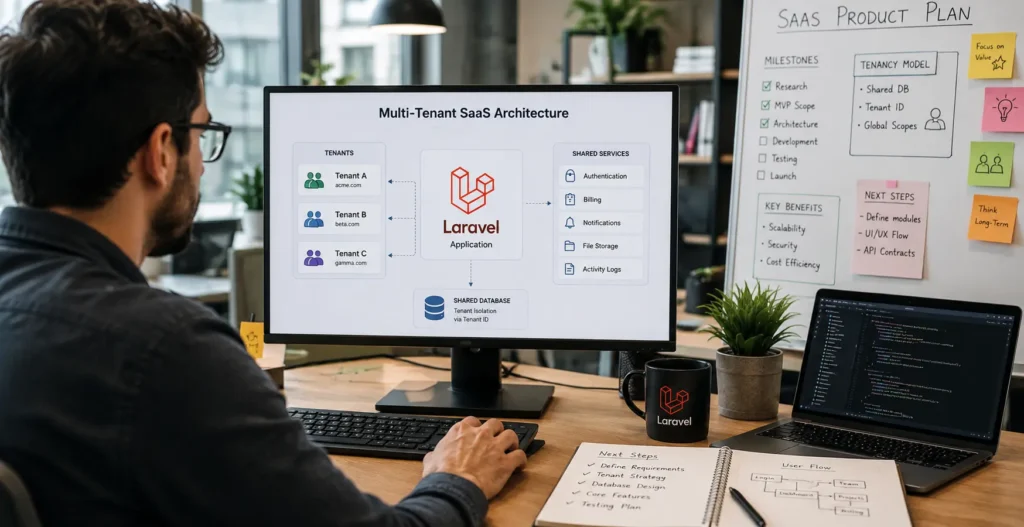
If you are a product manager scoping a SaaS build, multi-tenancy is the architecture decision that will quietly shape your product for years, and it gets made in the first week of engineering, often without you in the room.
That is a problem. Because the choice your team makes about how tenants are isolated affects your costs, your ability to land enterprise clients, your compliance story, and how painful it will be to scale two years from now, get it wrong, and the fix will be a rewrite, not a patch.
You do not need to write the code. But you do need to understand the decisions well enough to scope the project, brief your engineering team or your agency, and push back when something does not add up. This guide walks through building a multi-tenant SaaS with Laravel the way a PM needs to understand it: the decisions, the sequence, the costs, and the traps, without drowning in code you will never write.
## What multi-tenancy actually means, in plain terms
Multi-tenancy is the architecture that makes SaaS possible. One application, one codebase, one deployment, serving hundreds or thousands of customers, where each customer (a “tenant”) sees only their own data and feels like the product was built just for them.
Your customers never think about this. They log in, they see their data, and it works. Everything that makes that happen invisibly is multi-tenancy. And it is also, when done wrong, the single most common cause of catastrophic SaaS data leaks: the wrong query returns another tenant’s data, a background job processes the wrong customer’s records, or a report crosses a boundary it should never have crossed.
Laravel is one of the strongest frameworks available for building this, which is why so many funded and bootstrapped SaaS products run on it. The ecosystem for multi-tenancy is mature, battle-tested, and production-proven in 2026.
## The one decision everything else depends on: your isolation model
Before a single feature gets built, your team has to answer one question: how is each tenant’s data kept separate? There are three answers, and this is the decision you most need to understand because it drives cost, complexity, security, and scale.
### Option 1: Shared database (one database, tenant_id on every row)
All tenants live in the same database. Every table has a “tenant_id” column, and every query is scoped to the right tenant. Tenant A is tenant_id 1, Tenant B is tenant_id 2, and the application makes sure they never see each other’s rows.
This is the cheapest and fastest to build. It is the right starting point for most SaaS products, especially at the MVP stage. The risk is that data isolation depends entirely on the application getting every single query right. One unscoped query and a customer sees data that is not theirs. Good engineering practice and Laravel’s tooling manage this risk well, but it is a real risk that lives in the code.
### Option 2: Separate database per tenant
Each tenant gets their own database. Complete physical separation. Tenant A’s data physically cannot appear in Tenant B’s results because they are in different databases entirely.
This is the strongest isolation and the most operational overhead. More databases to manage, migrate, back up, and monitor. It is what enterprise clients and regulated industries often demand, because “our data is in its own database” is a much easier compliance story than “our data is separated by a column.”
### Option 3: Schema-per-tenant (the middle path)
Each tenant gets their own schema within a shared database (using PostgreSQL schemas or equivalent). Stronger isolation than shared tables, less operational overhead than fully separate databases. A reasonable middle ground for enterprise-facing products that do not need full physical separation.
**What a PM needs to take from this:** start with the shared database model unless you have a specific reason not to. It is faster and cheaper to build and easier to manage early. Move high-value or enterprise tenants to dedicated databases later, as they need it. Most successful SaaS products evolve gradually rather than committing to maximum isolation on day one. The hybrid approach, shared by most tenants, dedicated databases for enterprise clients who pay for it, is increasingly the 2026 standard.
## The build, step by step (what your team will actually do)
Here is the sequence a Laravel multi-tenant build follows. You are not writing this. You are tracking it, so you know what “done” looks like at each stage and can spot when a step is being skipped.
### Step 1: Choose the tenancy package
Your team should not build tenancy from scratch. In 2026, the production standard is the stance/tenancy package. It handles the hard infrastructure: automatically switching database connections per tenant, tenant provisioning, custom domain mapping, and tenant-aware caching and queues. It supports both single-database and multi-database tenancy, so it works with whichever isolation model you choose. Spatie’s multi-tenancy package is the other production-proven option. If your team proposes building tenancy logic by hand, ask why. There is rarely a good reason in 2026.
### Step 2: Set up the central (landlord) database
There is always a central database that sits above all tenants. It stores the tenant registry (who your tenants are), domain mapping (which URL belongs to which tenant), and, critically, your billing data. A firm design rule from production systems: billing always lives in the central database, never in tenant databases. If a tenant’s database is ever deleted, you do not want their billing history going with it.
### Step 3: Build tenant identification
When a request comes in, the application has to figure out which tenant it belongs to before doing anything else. Usually this is by subdomain (tenant-a.yourapp.com) or custom domain (app.tenant-a.com). This resolution happens on every single request, and everything downstream depends on it being right.
### Step 4: Scope everything to the tenant
This is where multi-tenancy succeeds or fails and where a good team earns their fee. It is not enough to scope the database queries. The whole system has to be tenant-aware: background jobs that run without a logged-in user, CSV exports generated in the background, file storage paths, cache keys, and emails. Teams that “solve” tenancy only in the database layer get caught later when a queued job runs without tenant context and processes the wrong customer’s data. The lifecycle has to be designed end to end. When you brief an agency or evaluate a proposal, this is the thing to probe: how do you handle tenant isolation in jobs, exports, caching, and file storage, not just queries?
### Step 5: Add subscription billing
SaaS needs recurring billing, and Laravel handles this through Cashier, which integrates with Stripe and Paddle. Subscription plans, upgrades, downgrades, trials, and failed-payment handling. This connects to your central database, where the billing data lives.
### Step 6: Per-tenant roles and permissions
Each tenant needs their own users with their own permission levels. An admin in Tenant A should have no relationship to Tenant B. Laravel’s permission ecosystem handles per-tenant roles cleanly.
### Step 7: Test data isolation specifically
Normal testing checks that features work. Multi-tenant testing has an additional, non-negotiable job: proving that tenants cannot see each other’s data under any circumstance. This deserves its own dedicated test coverage. The cost of skipping it is the kind of data leak that ends SaaS companies.
## What this costs and how long it takes
For a product manager budgeting the project, rough guidance is based on what these builds actually take.
A multi-tenant SaaS MVP on Laravel, with shared-database tenancy, subscription billing, per-tenant authentication, and a core feature set, typically runs a meaningful custom [**Web Application Development**](https://www.krishaweb.com/web-application-development/) project measured in months, not weeks. The multi-tenancy infrastructure itself is a portion of that, with the rest being your actual product features.
The biggest cost variable is the isolation model. Shared-database tenancy is the most economical to build and run. Multi-database tenancy costs more in both development and ongoing infrastructure because every tenant database needs to be provisioned, migrated, backed up, and monitored. This is why starting shared and upgrading enterprise tenants later is usually the most cost-effective path: you do not pay for maximum isolation until a customer is paying you for it.
The hidden cost to plan for is the tenant-aware infrastructure beyond the database, the jobs, exports, caching, and storage from Step 4. Teams that scope only the database layer underestimate the project, then discover the rest in month two. A team experienced in [**Laravel development**](https://www.krishaweb.com/laravel-development/) scopes all of it upfront.
## Where AI fits into a multi-tenant SaaS in 2026
This is the part that did not exist in multi-tenant guides a year ago, and it changes what your SaaS can offer.
Laravel 13 shipped with Prism, a first-party package for integrating AI models (OpenAI, Anthropic, and Google Gemini) into Laravel applications. For a multi-tenant SaaS, this opens up per-tenant AI features: an AI assistant trained on each tenant’s own data, intelligent search scoped to a single tenant’s content, automated content generation, and predictive features based on a tenant’s usage patterns.
The multi-tenancy angle matters here. AI features in a multi-tenant SaaS have to respect the same tenant boundaries as everything else. An AI assistant for Tenant A must never surface insights from Tenant B’s data. The same isolation discipline that governs your database queries governs your AI features. Done right, per-tenant AI becomes a genuine competitive differentiator, the kind of feature that moves a prospect from interested to signed. Done wrong, it becomes the most embarrassing possible data leak. This is where [**AI implementation**](https://www.krishaweb.com/ai-implementation-integration/) experience and multi-tenancy experience have to come together, because the failure mode is worse than a normal AI bug.
## The mistakes that cost the most
A few traps worth knowing, because they are expensive to fix after launch.
Committing to maximum isolation too early. Building separate databases per tenant from day one, before you have a single enterprise client who needs it, adds cost and operational burden you do not yet need. Start shared, evolve as you grow.
Solving tenancy only in the database. The data leaks come from the parts teams forget: background jobs, exports, cache keys, file paths. End-to-end tenant awareness is the standard, not query scoping alone.
Putting billing in tenant databases. Billing belongs in the central database. Always. This one is a design rule, not a preference.
Skipping isolation testing. The test that proves Tenant A cannot see Tenant B’s data is the most important test in a multi-tenant application. It is also the one most often skipped under deadline pressure.
Building tenancy by hand. The packages exist, they are mature, and they are battle-tested by thousands of production SaaS platforms. Custom tenancy infrastructure is a maintenance burden with no upside for the vast majority of products.
### Frequently Asked Questions
**What is the best architecture for a multi-tenant Laravel SaaS?**For most products, start with a shared database where every row carries a tenant_id and every query is scoped to the right tenant. It is the fastest and most cost-effective to build and manage. Move to separate databases per tenant for enterprise clients who need stronger isolation for compliance or performance reasons. This hybrid approach, shared for most, dedicated for enterprise, is the common 2026 standard. The right choice depends on your isolation requirements, expected tenant count, and compliance obligations.
**Which package should I use for multi-tenancy in Laravel?**The stance/tenancy package is the production standard in 2026. It is the most feature-complete and actively maintained option, used by thousands of SaaS platforms, and it supports both single-database and multi-database tenancy. Spatie’s multi-tenancy package is the other production-proven choice. You should not build tenancy infrastructure from scratch unless you have unusual requirements and senior engineering capacity to maintain the abstraction.
**How long does it take to build a multi-tenant SaaS with Laravel?**A multi-tenant SaaS MVP with shared-database tenancy, subscription billing, and authentication is a custom project measured in months. The multi-tenancy infrastructure is one portion; your actual product features make up the rest. The isolation model affects the timeline: shared-database is faster to build, multi-database adds time and ongoing operational work. A team experienced in Laravel multi-tenancy scopes the full lifecycle, including tenant-aware jobs and storage, upfront rather than discovering it mid-build.
**Can I add AI features to a multi-tenant SaaS?**Yes. Laravel 13’s Prism package makes it possible to build per-tenant AI features: an AI assistant scoped to each tenant’s own data, intelligent search, content generation, and predictive analytics. The critical requirement is that AI features respect the same tenant boundaries as the rest of the application. An AI feature that crosses tenant boundaries is a serious data leak, so AI in a multi-tenant SaaS requires both AI implementation experience and multi-tenancy discipline together.
**What is the biggest risk in building a multi-tenant SaaS?**Data leakage between tenants. The most damaging bugs are not features that break, they are tenants seeing each other’s data. These usually come from the parts of the system teams forget to make tenant-aware: background jobs, exports, cache keys, and file storage, rather than the database queries themselves. Dedicated isolation testing and an end-to-end tenant-aware design are the defenses, and both should be in scope from the start.
**Should we build this in-house or hire an agency?**It depends on whether your team has built multi-tenant architecture before. A standard web application is within most Laravel teams’ reach. Multi-tenancy introduces a different class of challenge: dynamic database switching, tenant-scoped everything, and isolation testing where mistakes are expensive. If your team has not built it before, the architecture mistakes made early become costly rewrites later. An agency experienced in multi-tenant Laravel SaaS scopes it correctly from the start, which is usually cheaper than learning on your own production system.
#### Build Your Multi-Tenant SaaS with KrishaWeb
KrishaWeb has been building Laravel applications since version 4 and multi-tenant SaaS platforms for clients across 42 countries. We scope the full tenant lifecycle upfront, the database model, the tenant-aware jobs and storage, the billing architecture, and the isolation testing, so the expensive mistakes get avoided before they are written into your codebase.
If you are scoping a multi-tenant SaaS and want a realistic assessment of the architecture, the timeline, and the cost, that is the conversation worth having before development starts.
***Tell us what you are building, and we will map the architecture, timeline, and cost with you.*** [***Schedule a call***](https://api.leadconnectorhq.com/widget/bookings/book-a-call-with-parth-krishaweb) ***or*** [***contact us***](https://www.krishaweb.com/contact-us/) ***to get started.***
***Sources:***
1. [*Tenancy for Laravel*](http://tenancyforlaravel.com) *(stancl/tenancy) official documentation 2026*
2. [*Kokil*](http://kokil.com.np/blog/building-multi-tenant-saas-applications-in-laravel)*, Building Multi-Tenant SaaS Applications in Laravel 2026, June 2026*
3. [*LaraCopilot*](http://laracopilot.com/blog/laravel-multi-tenancy-saas-guide)*, Laravel Multi-Tenancy SaaS Guide 2026, April 2026*
4. [*RivuletIQ*](http://rivuletiq.com/how-to-build-a-multi-tenant-saas-application-with-laravel)*, How to Build a Multi-Tenant SaaS Application with Laravel, March 2026*
5. [*Spatie*](http://spatie.be)*, laravel-multitenancy package documentation 2026*
6. [*OneUptime*](http://oneuptime.com)*, How to Implement Multi-tenancy in Laravel, February 2026*
###### Nirav Panchal
Lead – Custom DevelopmentLead of the Custom Development team at KrishaWeb, holds AWS certification and excels as a Team Leader. Renowned for his expertise in Laravel and React development. With expertise in cloud solutions, he leads with innovation and technical excellence.
 Interact With Me-
-
- [ ](mailto:)
---
_View the original post at: [https://www.krishaweb.com/blog/laravel-multi-tenant-saas/](https://www.krishaweb.com/blog/laravel-multi-tenant-saas/)_
_Served as markdown by [Third Audience](https://github.com/third-audience) v3.5.3_
_Generated: 2026-06-22 13:06:22 UTC_