---
title: "How USA Manufacturers Choose Digital Transformation Partners"
url: "https://www.krishaweb.com/blog/manufacturing-digital-transformation-partner/"
date: "2026-08-05T12:52:22+00:00"
modified: "2026-08-07T10:22:43+00:00"
type: "Article"
resource: "https://www.krishaweb.com/blog/manufacturing-digital-transformation-partner/"
timestamp: "2026-08-07T10:22:43+00:00"
author:
name: "Parth"
url: "https://www.krishaweb.com/"
categories:
- "Web Development"
word_count: 2724
reading_time: "14 min read"
summary: "Something shifted in 2025 that changed the digital transformation conversation for US manufacturers. It wasn't a new technology or a new consulting framework. It was geography."
description: "How US manufacturers choose digital transformation partners in 2026: partner vs vendor, the evaluation criteria, and the red flags to watch for."
keywords: "manufacturing digital transformation partner, Web Development"
language: "en"
schema_type: "Article"
related_posts:
- title: "AI Use Cases for Manufacturing Companies: Where ROI Happens First"
url: "https://www.krishaweb.com/blog/ai-use-cases-manufacturing/"
- title: "AI Chatbots for US eCommerce: Cost, Compliance, and ROI in 2026"
url: "https://www.krishaweb.com/blog/ai-chatbot-us-ecommerce-cost-roi/"
- title: "The Cost of Integrating AI in 2026: Build, Run, and Total Cost of Ownership"
url: "https://www.krishaweb.com/blog/cost-of-integrating-ai/"
---
# How USA Manufacturers Choose Digital Transformation Partners
_Published: Wednesday,August 5, 2026_
_Author: Parth_
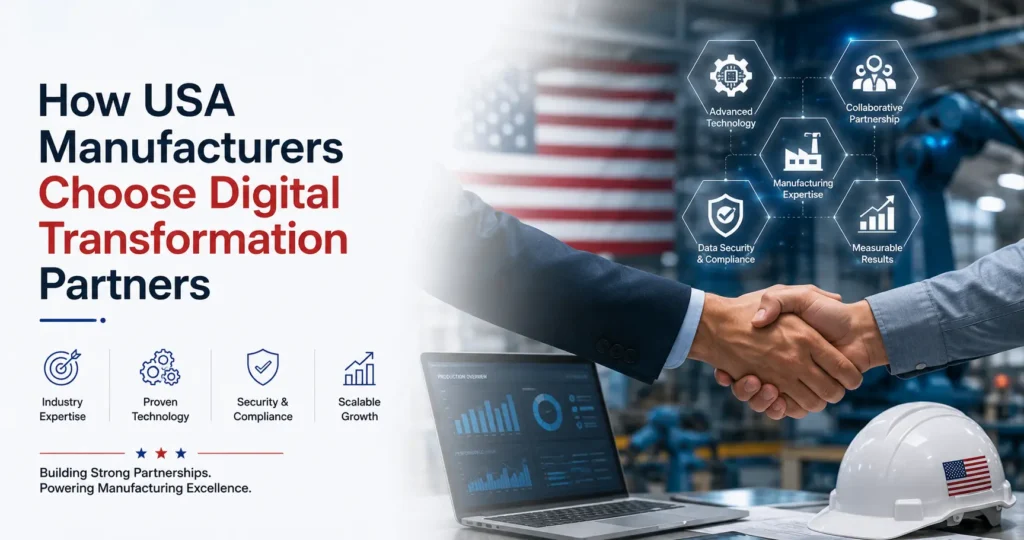
Something shifted in 2025 that changed the digital transformation conversation for US manufacturers. It wasn’t a new technology or a new consulting framework. It was geography.
Reshoring accelerated. The CHIPS Act, the IRA, 2025 tariffs, and the ongoing decoupling from China pushed semiconductors, EV batteries, automotive, defense, and pharma back toward domestic production. US manufacturing construction spending more than doubled between 2020 and 2024, hitting $223 billion annualized *(****Source:***[ *iFactory*](https://ifactoryapp.com/greenfield-consulting/reshoring-manufacturing-new-us-factory-investment-guide)*)*. New plants are coming online. Capacity is expanding. And suddenly, manufacturers who spent the past decade optimizing supply chains for global efficiency are operating in a fundamentally different environment: one where domestic labor scarcity, new facility complexity, and the need for AI-enabled operations have collided at the same moment.
That is the context in which US manufacturers are choosing digital transformation partners right now. Not from a position of comfortable incremental improvement, but from a position where the operating model is changing and the technology decisions made in the next 12 to 18 months will determine competitive position for years after that.
The partner decision in this environment is not a software procurement question. It is a strategy and capability question. Who actually understands manufacturing operations, not just technology? Who can connect the data from the factory floor to the decisions being made in supply chain, finance, and sales? Who will still be working with you when the first implementation hits a wall, as every real transformation eventually does?
## Why the vendor-versus-partner distinction actually matters
Most digital transformation conversations in manufacturing start with a technology category: ERP modernization, IoT connectivity, AI-powered quality control, predictive maintenance, digital twins. The first call is with a vendor who sells software in that category. That vendor has a strong story for why their platform is the answer.
The problem is not that vendors are dishonest. It is that they are optimizing for the sale of their platform, not for the outcome your plant actually needs. A vendor who sells predictive maintenance software will lead you toward predictive maintenance. A true partner starts with the operational problem and works backward to the right technology, which may or may not be the thing they were expecting to sell.
McKinsey’s State of AI 2025 found that AI adoption has gone mainstream, but only about one-third of companies have begun scaling AI programs *(****Source:***[ *DataForest*](https://dataforest.ai/blog/how-to-choose-an-end-to-end-digital-transformation-partner)*)*. The manufacturers who are scaling are the ones who chose partners rather than vendors for the implementation. Partners who could handle data readiness, workflow redesign, change management, and governance alongside the technical build, not just the installation of software.
The distinction shows up most clearly when things go wrong, and something always goes wrong in a real transformation. A vendor whose contract covers software implementation has limited obligation when the integration with your existing ERP takes twice as long as estimated. A partner who scoped the engagement correctly in the first place, who flagged the integration risk, and who has a shared interest in the outcome behaves completely differently in that moment.
## What US manufacturers are actually evaluating in 2026
The criteria have shifted from three years ago. In 2023, manufacturers were primarily asking about technology capability and implementation track record. In 2026, the evaluation is more specific, because the failures of earlier transformations have made Ops and Digital leads clearer about what they need.
### Manufacturing domain knowledge, not just technology expertise
A partner who understands technology but has never worked on a factory floor will design solutions that make sense on paper and create friction in practice. The person who builds your AI-powered quality inspection system needs to understand what a line supervisor actually does with the output, what the shift structure looks like, and what happens when the system flags an issue at 2am when the engineering team is not on site.
This is the criterion most manufacturers underweight in early partner evaluations and regret most during implementation. Ask any candidate to describe a manufacturing transformation they have been part of, specifically. Not a case study about a client in manufacturing, but a specific plant, a specific operational problem, and what actually happened during rollout. The level of operational specificity in the answer tells you whether they have done this before.
### Data readiness and integration experience with legacy systems
The data situation in most US manufacturing facilities is not clean. There are PLCs running on proprietary communication protocols. There are ERP systems that have been customized over 15 years and have data models that the original implementation team no longer fully understands. There are quality records in spreadsheets and maintenance logs that exist on paper.
A digital transformation partner who arrives with a modern data platform and an assumption that clean, structured data will be available is going to hit a wall in the first month. The partners who succeed in manufacturing environments have done the unglamorous work of integrating with Siemens S7 PLCs, extracting data from legacy ERP systems through custom middleware, and building the data pipelines that make everything else possible. Ask specifically about their industrial data integration experience before any conversation about AI or analytics.
### AI readiness assessment before technology recommendation
One of the red flags in a digital transformation partner pitch is a technology recommendation that arrives before an AI readiness assessment. If a partner is telling you in the first meeting that you need a specific AI platform, they have not had the conversation needed to know what you need.
An honest[ **AI readiness assessment**](https://www.krishaweb.com/ai-readiness-assessment/) covers the current state of operational data and its reliability, the processes that are actually candidates for AI augmentation versus the ones that are not, the organizational readiness of the teams who will use whatever gets built, and the infrastructure required to support it. Forvis Mazars’s 2026 manufacturing modernization report highlights that data, technology, and AI top the priority list for manufacturers, but specifically notes that manufacturers need to either upskill workers or provide reskilling that blends operational roles with digital skill sets *(****Source:***[ *Forvis Mazars*](https://www.forvismazars.us/forsights/2026/02/manufacturing-modernization-four-trends-to-watch-in-2026)*)*. A partner who addresses that organizational dimension alongside the technical one understands what manufacturing transformation actually involves.
### Proof of ROI, not just proof of implementation
Implementation is the easy claim. Every partner has a list of clients for whom they deployed technology. What is harder to find and more important to evaluate is proof that the technology produced measurable operating improvements: reduced downtime, improved yield, shorter lead times, lower defect rates, reduced energy consumption.
Ask for references from manufacturing clients. Ask those references not whether the implementation succeeded, but whether the operational metrics moved and by how much. Ask what happened six months after go-live, when the partner had moved on to the next engagement. Ask whether the internal team could own and extend the system after handoff or whether ongoing dependency on the partner was created.
***Not sure where your manufacturing operation sits on the digital readiness spectrum before evaluating partners?***[ *Talk to our team*](https://api.leadconnectorhq.com/widget/bookings/book-a-call-with-parth-krishaweb) *about what an AI readiness assessment would cover for your specific facility and operational context. No commitment, no proposal until you’re ready.*
## The reshoring context and why it changes the partner conversation
Manufacturers who are setting up new domestic facilities or expanding existing ones are in a different position from manufacturers optimizing a mature operation. They have a window to get the data architecture right from the start, rather than retrofitting digital capability onto a legacy foundation.
That window is valuable and shorter than it looks. The decisions made when a new facility is designed, what sensors get installed, how the network is architected, which ERP system gets deployed, how quality data gets captured, determine what is possible with AI and analytics for the next decade. A manufacturer who designs a greenfield facility without thinking about the data infrastructure is making that infrastructure three to five times more expensive to retrofit later.
The partner who is worth engaging for a reshoring or new facility project is one who brings that systems perspective to the facility design conversation, not one who shows up after the facility is built to discuss what analytics can be applied to whatever data happens to be available. That sequencing matters enormously and it is not how most technology vendor conversations are initiated.
For manufacturers who are expanding existing facilities or integrating reshored production into an existing footprint, the integration complexity is different. How does the new domestic facility connect to the existing ERP and supply chain systems? How does quality data flow between facilities? These are integration questions as much as technology questions, and they require a partner who has navigated facility-to-facility data integration before.
## Red flags that should stop the evaluation
The partner evaluation in manufacturing has specific failure patterns worth naming.
A technology-first pitch before an operational conversation is the clearest one. If the first conversation with a potential partner is a product demo rather than a discussion of your operational challenges, they are not interested in your problem. They are interested in selling their platform.
No manufacturing references is the second. “We work across many industries including manufacturing” is not manufacturing experience. References from plant managers and operations leads at manufacturing facilities are the minimum. References from IT or digital teams at manufacturing companies, without operational references alongside them, means the partner has been in the conference room, not the plant.
Unrealistic timelines are the third. Manufacturing digital transformations involve operational stakeholders who have production responsibilities that cannot pause for technology projects, integration with systems that are not always well-documented, and change management across frontline workers who have legitimate concerns about what automation means for their roles. A partner who quotes a three-month timeline for an end-to-end transformation has either never done this before or is underscoping the work.
Proprietary lock-in as a business model is worth flagging too. Some partners build solutions on proprietary platforms that make the manufacturer dependent on them for every future change. The right model builds on open, extensible architectures that the manufacturer’s internal team or any future partner can maintain and extend. Ask specifically whether the implementation creates technical dependency after handoff.
And no discussion of change management is always worth noting. A Manufacturing Leadership Council survey from early 2025 found that almost a quarter of manufacturers intend to deploy physical AI within two years *(****Source:***[ *Supply Chain Digital*](https://supplychaindigital.com/news/deloitte-reshoring-ai-2026-us-supply-chains)*)*. The technology is the easier part. The harder part is frontline workforce adoption: the shift supervisor who needs to trust what the algorithm says, the maintenance technician who needs to understand what predictive maintenance output means for their daily workflow. A partner who does not address this is solving for deployment, not for adoption. Those are different problems.
***Evaluating digital transformation partners and want to understand how KrishaWeb approaches manufacturing engagements?***[ *Schedule a conversation*](https://api.leadconnectorhq.com/widget/bookings/book-a-call-with-parth-krishaweb) *with our team. We will walk you through how we scope manufacturing digital transformation projects and what the assessment process looks like before any technology recommendation is made.*
## How to structure a partner evaluation
Given the stakes, the partner evaluation deserves more rigor than most manufacturers apply to it.
Start with a clear problem statement before talking to any partner. What operational metric are you trying to move? What is the current state and the target state? What is the business value of closing that gap? What data do you already have, and what data are you missing? A manufacturer who can answer these questions before the first partner conversation will get significantly better proposals and have a meaningful basis for comparison.
In the partner evaluation itself, ask to speak with the specific team members who would work on your project, not just the sales lead or the partner principal. The person presenting the proposal and the person building the solution are often different people. Ask the technical lead about their experience with your specific systems and industrial protocols. Ask the project manager how they handle scope changes and integration delays. Ask for a reference from a manufacturing project where something went wrong and how they handled it.
Finally, run a paid discovery or scoping engagement before committing to a full project. A genuine partner will welcome the opportunity to do a structured assessment of your current state and develop a real scope before either party commits to a full engagement. A partner who resists this or wants to jump straight to a full contract is optimizing for their sales process rather than your outcome.
##### Additional Read
- [24 Best Corporate Website Examples to Inspire You in 2026](https://www.krishaweb.com/blog/best-corporate-website-examples/)
- [AI Chatbots for US eCommerce: Cost, Compliance, and ROI in 2026](https://www.krishaweb.com/blog/ai-chatbot-us-ecommerce-cost-roi/)
- [AI Readiness Assessment: How to Budget for Your First AI Initiative](https://www.krishaweb.com/blog/ai-readiness-assessment-budget/)
### Frequently Asked Questions
**What makes a digital transformation partner right for manufacturing specifically?**The combination of manufacturing domain knowledge and technology capability. A technology partner who has not worked on factory floors will design solutions that create friction in practice, however technically sound they are. Ask for specific references from plant managers, ask what industrial data protocols they have integrated with, and ask what happened six months after go-live on their last manufacturing engagement. The specificity of those answers tells you whether they have actually done this before.
**How is manufacturing digital transformation different from other industries?**The data environment is more complex. Legacy systems, proprietary industrial protocols, operational technology that was never designed for connectivity, and the physical constraints of the factory floor all create integration challenges that do not exist in office-based digital transformation. The change management dimension is also more demanding. Frontline manufacturing workers have direct, legitimate concerns about automation, and a transformation that ignores that dimension will achieve deployment without adoption.
**What AI applications are US manufacturers prioritizing in 2026?**Predictive maintenance, AI-powered quality inspection, production scheduling optimization, and supply chain demand sensing are the highest-adoption categories. Physical AI, including more autonomous robotics, is the next deployment wave, with the Manufacturing Leadership Council finding that nearly a quarter of manufacturers plan physical AI deployment within two years. The manufacturers deploying these effectively started with a data readiness assessment rather than a technology selection.
**How long does a manufacturing digital transformation typically take?**A focused AI quality inspection deployment on a single production line can be operational in three to six months. An end-to-end plant digitization covering data infrastructure, ERP integration, predictive maintenance, and analytics takes 12 to 24 months for a facility of meaningful scale. Any partner quoting a complete transformation in less than six months for anything beyond a narrow scope should be asked to explain the assumptions behind that timeline.
**What does a manufacturing AI readiness assessment cover?**The current state of operational data including what exists, where it lives, how reliable it is, and how accessible it is. Which processes are actual candidates for AI augmentation versus simpler automation or process improvement. The organizational readiness of the teams who will use the output. And the infrastructure investment required before AI deployment is viable. The output is a clear picture of where your facility sits today and a sequenced roadmap for getting to the state where AI delivers measurable value.
### Conclusion
The partner decision for a US manufacturer pursuing digital transformation in 2026 is consequential in a way it wasn’t five years ago. The reshoring context, the AI deployment window, and the competitive pressure from manufacturers who are getting this right are all real. Getting the partner selection wrong doesn’t just cost money. It delays the transformation by the time it takes to recognize the mistake, exit the relationship, and restart with the right partner.
The criteria in this article are designed to make that partner decision more rigorous and more specific: manufacturing domain knowledge, data integration experience with legacy systems, an AI readiness assessment before any technology recommendation, and proof of operational ROI from manufacturing references.
KrishaWeb works with US manufacturers on digital transformation engagements scoped to operational outcomes, not technology installations. Our[ **web design**](https://www.krishaweb.com/web-design/) and[ **development services**](https://www.krishaweb.com/web-development/) include the digital infrastructure layer supporting plant-level data capture and operational dashboards. Our[ **AI consulting team**](https://www.krishaweb.com/ai-strategy-consulting/) helps manufacturers assess AI readiness, design the data architecture, and deploy AI applications connected to real operational systems.
A free[ **AI Readiness Assessment**](https://www.krishaweb.com/ai-readiness-assessment/) is the right starting point if you want to understand where your facility sits before committing to a transformation program. We will give you an honest picture of your current data maturity, the applications that are viable with that foundation, and what needs to be in place before anything more ambitious makes sense.
[**Book a Free AI Readiness Assessment with KrishaWeb**](https://www.krishaweb.com/contact-us/)
*Statistics and market data cited are drawn from publicly available research published in 2025 and 2026. Manufacturing transformation timelines and outcomes vary significantly by facility scale, existing infrastructure, and implementation approach. All figures are for planning purposes.*

###### Parth Pandya
Founder & CEOFounder & CEO of KrishaWeb, leads an Enterprise Web Agency. With contributions to WordPress and organization of WordCamps, he pioneers innovation and community engagement in the digital realm.
 Interact With Me- [ ](https://twitter.com/imparthpandya)
- [ ](https://www.linkedin.com/in/parthjpandya/)
- [ ](mailto:parth@krishaweb.com)
---
_View the original post at: [https://www.krishaweb.com/blog/manufacturing-digital-transformation-partner/](https://www.krishaweb.com/blog/manufacturing-digital-transformation-partner/)_
_Served as markdown by [Third Audience](https://github.com/third-audience) v3.6.1_
_Generated: 2026-08-07 10:22:43 UTC_