---
title: "Manufacturing Workflow Automation: 8 Processes Worth Automating"
url: "https://www.krishaweb.com/blog/manufacturing-workflow-automation/"
date: "2026-08-07T14:15:38+00:00"
modified: "2026-08-07T14:15:40+00:00"
type: "Article"
resource: "https://www.krishaweb.com/blog/manufacturing-workflow-automation/"
timestamp: "2026-08-07T14:15:40+00:00"
author:
name: "Parth"
url: "https://www.krishaweb.com/"
categories:
- "Web Development"
word_count: 2613
reading_time: "14 min read"
summary: "US manufacturing is short 800,000 workers right now. That number is projected to reach 2.1 million unfilled positions by 2030. No hiring strategy closes that gap. Automation is not an option on the..."
description: "The 8 manufacturing workflows with the strongest automation ROI in 2026: payback timelines, labor context, and where to put automation budget first."
keywords: "manufacturing workflow automation, Web Development"
language: "en"
schema_type: "Article"
related_posts:
- title: "30 Best WordPress Security Plugins for Your Website"
url: "https://www.krishaweb.com/blog/best-wordpress-security-plugins/"
- title: "AI Use Cases for Manufacturing Companies: Where ROI Happens First"
url: "https://www.krishaweb.com/blog/ai-use-cases-manufacturing/"
- title: "How USA Manufacturers Choose Digital Transformation Partners"
url: "https://www.krishaweb.com/blog/manufacturing-digital-transformation-partner/"
---
# Manufacturing Workflow Automation: 8 Processes Worth Automating
_Published: Friday,August 7, 2026_
_Author: Parth_
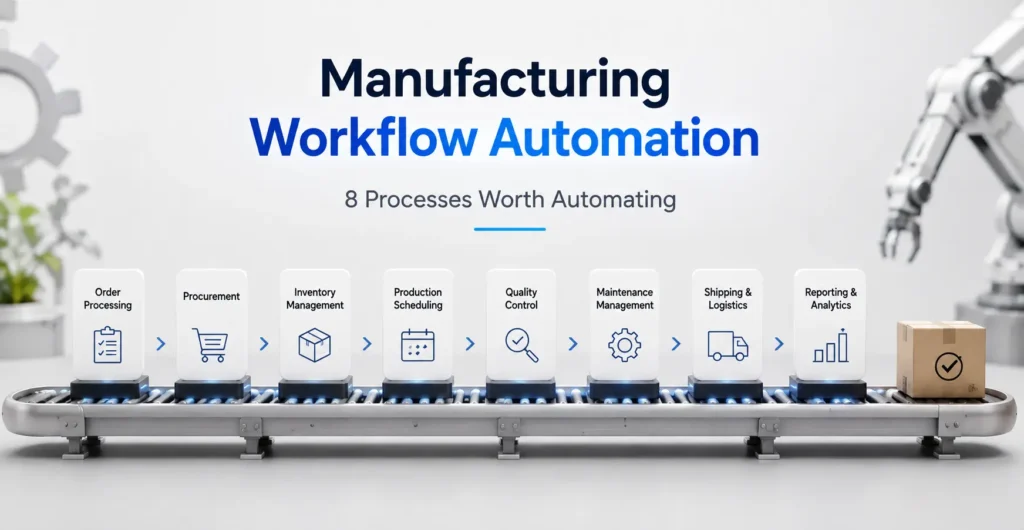
US manufacturing is short 800,000 workers right now. That number is projected to reach 2.1 million unfilled positions by 2030. No hiring strategy closes that gap. Automation is not an option on the table for plant and operations managers in 2026. For most facilities, it is the only lever that makes the production math work.
The problem is not appetite. Deloitte’s 2025 survey found that 92% of manufacturers believe smart manufacturing will be the main driver for competitiveness over the next three years, and 98% are exploring AI and automation in some form. The problem is execution. Only 20% say they are fully prepared to deploy at scale. A January 2026 study of 300 manufacturing professionals found that seven in ten have automated 50% or less of their core operations. Only 40% have automated exception handling.
That gap between ambition and execution usually comes down to not knowing where to start. This article answers that question with eight processes, in order of ROI certainty, and the specific data behind each. *(****Source:***[ *Oxmaint*](https://mail.oxmaint.com/industries/manufacturing-plant/roi-manufacturing-plant-automation-investment-analysis-2026)*,*[ *Phantasma Global*](https://www.phantasma.global/blogs/ai-and-automation-use-cases-in-manufacturing)*)*
## The principle before the list
A common mistake in manufacturing automation is calculating ROI using only the robot or software cost divided by the displaced worker’s salary. That approach underestimates true labor cost by 30 to 60% and ignores quality, safety, and throughput gains entirely. The full labor cost of a frontline manufacturing worker includes wages, benefits, payroll taxes, turnover cost (25 to 150% of annual salary per departure), training, and management overhead. When you run the real number, automation ROI cases that look marginal at face value become obvious.
Small and mid-size manufacturers that implement workflow automation recover their full investment cost within an average of seven weeks according to Forrester’s 2025 Manufacturing Automation ROI Report *(****Source:***[ *Cflow*](https://www.cflowapps.com/workflow-automation-statistics/)*)*. That is not a 12-month ROI case. That is a seven-week payback. The processes below are the ones that drive those numbers.
## 1. Production Scheduling and Capacity Planning
Static weekly production plans are a response to a world where demand was predictable and supply chains were stable. Neither is true anymore. Tariff volatility in 2025, reshoring complexity, and customer lead time expectations that compress year over year have made manual scheduling a source of margin leakage rather than operational control.
Automated production scheduling connects customer order data, machine availability, material stock levels, and labor capacity into a system that updates plans dynamically rather than weekly. The result is higher OEE on the same physical assets, shorter customer lead times without additional capacity, and faster response to disruptions when they happen.
McKinsey’s 2025 Operations Excellence Report documents 12 to 18% productivity improvements in year two after workflow automation is implemented, as coordination overhead shifts to value-added work *(****Source:***[ *Cflow*](https://www.cflowapps.com/workflow-automation-statistics/)*)*. For a plant manager running three shifts with a thin planning team, the relief from manual schedule management alone justifies the investment.
The data prerequisite: production scheduling automation depends on clean, connected data from your ERP, MES, and shop floor systems. If those systems are not talking to each other, automated scheduling produces outputs that are accurate in the system and disconnected from reality on the floor. The data integration comes before the automation layer.
## 2. Inventory Replenishment and Material Reordering
According to the APICS 2025 Inventory Management Report, 47% of delays in production among small manufacturers are as a result of shortages that could have been anticipated from production schedules and the state of inventory. However, just because they are predictable does not mean that they are preventable if reorder points are checked infrequently and by hand.
Replenishment systems that are automated are geared to supervise the levels of inventory at all times, and cross-check it against the schedule of production and points of order. The order at which an order is raised automatically. Systems such as this, which are very advanced, make the use of artificial intelligence in demand forecasting methods, allowing the companies to elevate the quality of service as they are receiving more accurate predictions when it is necessary to make an order.
75% of manufacturing companies have invested in supply chain automation to improve tracking *(****Source:***[ *Cflow*](https://www.cflowapps.com/workflow-automation-statistics/)*)*. For facilities still managing reorder triggers on spreadsheets or relying on material handlers to flag shortages verbally, the improvement in on-time delivery from even basic automated replenishment is immediate.
## 3. Quality Control and Non-Conformance Management
Manual quality recording is slow and creates the lag between a process going out of control and the corrective action reaching the floor. By the time a quality inspector logs a non-conformance, walks it to the supervisor, and the supervisor decides what to do, the defective output has continued for another shift.
Automated quality workflow connects inspection data directly to the production system. When a measurement falls outside specification, the system flags it, routes it to the correct team, tracks the root cause investigation, and closes the loop on corrective action without the manual handoff chain. The result is faster response and a complete, auditable record that supports ISO certification and customer quality system requirements.
For facilities using AI-powered computer vision inspection, the workflow automation layer on top of the detection system is what converts a flagged defect into a corrective action without human coordination. The detection is the AI application. The routing, tracking, and escalation are the workflow automation. Both matter, and they work together. For more on the AI quality inspection layer specifically, the article on[ **AI use cases for manufacturing**](https://www.krishaweb.com/blog/ai-use-cases-manufacturing/) covers the ROI data from production deployments.
## 4. Maintenance Work Order Management
The gap between a machine showing a problem and a maintenance technician reaching it is where unplanned downtime compounds. In facilities running manual maintenance workflows, that gap involves a phone call or a radio, a paper work order, a parts check that may or may not reflect actual stock, and a scheduling process that competes with production priorities in real time.
Automated maintenance workflow integrates with CMMS (Computerized Maintenance Management System) to route work orders automatically to the right technician based on skill set, location, and current workload. Parts availability is checked against inventory in real time. Completion is confirmed digitally, which updates the asset maintenance record without manual entry.
When combined with predictive maintenance AI, the workflow automation layer handles the scheduling and routing after the AI has identified that a component is showing degradation. The AI identifies the when. The workflow automation handles the what happens next. AI-driven predictive maintenance achieves up to 50% reductions in unplanned downtime when combined with the workflow layer that acts on its outputs *(****Source:***[ *Cflow*](https://www.cflowapps.com/workflow-automation-statistics/)*)*.
***Not sure which of these processes your current systems can support without additional data infrastructure?***[ *Talk to our team*](https://www.krishaweb.com/contact-us/) *before you scope an automation project. We can walk you through what a data readiness assessment covers for a manufacturing environment and where the typical gaps are.*
## 5. Purchase Order and Procurement Approval Workflows
Procurement in most manufacturing facilities has a bottleneck that has nothing to do with the purchasing team’s capability. It has to do with approval chains. A purchase order for a critical spare part sits in someone’s email inbox waiting for approval while a machine is down or a production schedule is at risk.
Automated procurement workflows route purchase requests based on value thresholds and commodity type, send approvals to the right person’s mobile device with one-tap response, and escalate automatically when approval timelines are missed. The result is that routine purchases complete in hours rather than days, and exception handling is triggered by rule rather than by whoever happens to notice the delay.
For job shops and contract manufacturers where material procurement is in the critical path of every project, the on-time delivery improvement from faster procurement alone makes the automation case. For high-volume manufacturers with large indirect procurement spend, the reduction in maverick buying and process exceptions produces meaningful cost savings alongside the speed improvement.
## 6. Compliance and Certification Document Control
ISO certification, equipment calibration schedules, employee training certification tracking, environmental compliance reporting, and customer-required quality system documentation all share the same characteristic: they have recurring schedules, renewal deadlines, and audit requirements that create constant low-level administrative burden.
Most facilities manage this in a combination of spreadsheets, calendar reminders, and tribal knowledge about who is responsible for what. That combination works until someone leaves, a deadline is missed during a busy production period, or an auditor asks for evidence of a process that was managed informally.
Automated compliance workflow sends notifications 30 to 60 days before calibration or certification expiration, routes corrective action when deadlines are missed, and maintains the documentation trail that makes audit preparation a data pull rather than a document search. For manufacturers pursuing or maintaining ISO 9001, IATF 16949, AS9100, or FDA quality system requirements, this workflow automation directly reduces the labor cost of compliance maintenance.
## 7. Customer Order Management and Status Communication
The manual coordination between a customer service team, production planning, and shipping to answer the question “where is my order” is one of the most labor-intensive workflows in a manufacturing operation, and one of the most dissatisfying for customers who are waiting for the answer.
Automated order management connects customer order records to production scheduling and shipping systems, sending proactive status updates when orders reach production milestones, when shipping is confirmed, and when exceptions occur. Customers get accurate information without a phone call, and your customer service team spends time on actual problems rather than answering status inquiries that the system could answer automatically.
For manufacturers building out customer-facing digital infrastructure, an AI-powered customer portal extends this further: real-time order visibility, self-service configuration, and account management without manual coordination. Our[ **AI solutions team**](https://www.krishaweb.com/ai-solutions/) builds these connected systems for manufacturers who want automation that reaches from internal operations to the customer relationship.
## 8. Onboarding and Training Workflow for Production Staff
This one gets less attention than shop floor automation, but the labor context of 2026 makes it urgent. When turnover rates for production staff run at 30 to 40% annually in many facilities, and filling a vacant position costs 25 to 150% of the employee’s annual salary, the time from hire to productive output is a direct financial variable.
Manual onboarding relies on available supervisors to walk new staff through safety procedures, equipment operation, quality standards, and facility processes. When the floor is busy, as it usually is when new hires start, onboarding gets compressed or delegated to whoever is available. The result is variability in what new staff know, higher early-tenure error rates, and higher early-tenure turnover because employees who feel unsupported in their first weeks leave faster.
Automated training workflows deliver standardized onboarding content in a consistent sequence, track completion, and flag when a team member is behind schedule. Certification requirements, safety training, and equipment qualification can be managed automatically rather than relying on a supervisor to track each new hire’s progress manually. McKinsey data shows that workers who use automation tools are more satisfied, more engaged, and more confident in their output, and early-stage engagement directly correlates with tenure *(****Source:***[ *Cflow*](https://www.cflowapps.com/workflow-automation-statistics/)*)*.
***Have a specific process from this list in mind and want to understand the implementation complexity for your environment?***[ *Schedule a consultation*](https://api.leadconnectorhq.com/widget/bookings/book-a-call-with-parth-krishaweb)*, and we’ll give you an honest read on what the data infrastructure requirements look like and what a realistic timeline and cost look like for your facility size and ERP system.*
##### Additional Read
- [AI Use Cases for Manufacturing Companies: Where ROI Happens First](https://www.krishaweb.com/blog/ai-use-cases-manufacturing/)
- [How USA Manufacturers Choose Digital Transformation Partners](https://www.krishaweb.com/blog/manufacturing-digital-transformation-partner/)
- [The Cost of Integrating AI in 2026: Build, Run, and Total Cost of Ownership](https://www.krishaweb.com/blog/cost-of-integrating-ai/)
## Where automation stalls and why
The statistic from the January 2026 study worth sitting with: 78% of manufacturers have automated less than half of their critical data transfers. Automation tends to stall at system boundaries, where workflows cross between ERP, MES, CMMS, and shop floor systems *(****Source:***[ *Oxmaint*](https://mail.oxmaint.com/industries/manufacturing-plant/roi-manufacturing-plant-automation-investment-analysis-2026)*)*.
This is the real barrier for most plant and operations managers, and it is not a process question. It is a data integration question. An automated procurement workflow that cannot read inventory data from the ERP in real time produces purchase orders that are disconnected from what is actually in the warehouse. An automated maintenance workflow that cannot pull machine status from the MES routes technicians to machines that are not actually the priority.
The sequencing that works is: data foundation first, then workflow automation on top of it. Organizations that try to automate workflows before the data integration is in place spend more and get less because the automation operates on incomplete information.
### Frequently Asked Questions
**Which manufacturing workflow is worth automating first?**Production scheduling and maintenance work order management have the broadest impact and the most direct connection to the two most expensive manufacturing problems: downtime and on-time delivery failure. For facilities where quality and compliance audit costs are the dominant pain, compliance document control and non-conformance management deliver faster visible improvement. The right starting point is whichever process is costing you the most measurably right now, not whichever sounds most technologically interesting.
**How much does manufacturing workflow automation cost?**Cost varies significantly by scope and existing system complexity. Basic workflow automation for a single process, like procurement approval routing or compliance document tracking, typically runs $15,000 to $40,000 including integration work. Multi-process automation programs across production scheduling, quality, and maintenance run $60,000 to $150,000 and above depending on ERP integration complexity. Forrester’s 2025 data shows a seven-week average payback for small and mid-size manufacturers, which means the cost question is better framed as an ROI question than a budget question.
**Can manufacturing workflow automation work with an existing ERP system?**Yes, and in most cases it should. The most impactful manufacturing workflow automation connects to rather than replaces the ERP. The integration work required depends on which ERP system you run, how heavily it has been customized, and whether clean APIs or middleware are available for the data exchange the automation requires. This integration assessment is the most important step before scoping any automation project.
**What is the difference between workflow automation and robotic process automation (RPA) in manufacturing?**Workflow automation manages the routing, sequencing, approval, and tracking of business processes: who does what, in what order, with what escalation rules. Robotic process automation (RPA) automates the repetitive digital tasks that a human would otherwise perform manually: copying data between systems, filling out forms, generating standard reports. Most effective manufacturing automation programs use both, with workflow automation managing the process logic and RPA handling the data transfer tasks that the workflow depends on.
**Do production workers resist automation?**Resistance is real when automation is presented as a replacement rather than a tool. The facilities with the best adoption track record introduce automation with explicit communication about what the system handles and what the employee’s role becomes, involve the workers who will use the system in the design and testing phase, and redirect the time freed by automation toward higher-value activities rather than leaving workers uncertain about what their job is now. McKinsey’s data consistently shows that workers who use automation tools report higher job satisfaction and engagement, not lower.
### Conclusion
There is a version of this conversation that happens in every manufacturing facility eventually. The labor shortage reaches a point where the cost of not automating exceeds the cost of doing it, and the question shifts from “should we” to “where do we start without wasting the budget on something we can’t support.”
The eight processes above are the answer to that question. They are the ones where the ROI data is documented, the implementation path is established, and the data infrastructure requirement is achievable for most mid-market manufacturers without a multi-year data transformation program as the prerequisite.
Start with one. Measure it. Use the result to fund the second.
If you want to understand which of the eight your current data and systems can support without additional infrastructure work, that is what an AI Readiness Assessment covers. It is the starting point before any automation project scope is built.
[**Book a Free AI Readiness Assessment with KrishaWeb**](https://api.leadconnectorhq.com/widget/bookings/book-a-call-with-parth-krishaweb)
*Benchmark data cited are drawn from third-party research and industry studies published in 2025 and 2026. Automation ROI varies by facility, implementation quality, and operational context. All figures are for planning purposes.*

###### Parth Pandya
Founder & CEOFounder & CEO of KrishaWeb, leads an Enterprise Web Agency. With contributions to WordPress and organization of WordCamps, he pioneers innovation and community engagement in the digital realm.
 Interact With Me- [ ](https://twitter.com/imparthpandya)
- [ ](https://www.linkedin.com/in/parthjpandya/)
- [ ](mailto:parth@krishaweb.com)
---
_View the original post at: [https://www.krishaweb.com/blog/manufacturing-workflow-automation/](https://www.krishaweb.com/blog/manufacturing-workflow-automation/)_
_Served as markdown by [Third Audience](https://github.com/third-audience) v3.6.1_
_Generated: 2026-08-07 14:15:40 UTC_