---
title: "React vs Vue vs Angular in 2026: Frontend Framework Decision Guide"
url: "https://www.krishaweb.com/blog/react-vs-vue-vs-angular/"
date: "2026-06-23T13:28:46+00:00"
modified: "2026-06-23T14:35:06+00:00"
author:
name: "Nirav"
url: "https://www.krishaweb.com"
categories:
- "Web Development"
word_count: 1883
reading_time: "10 min read"
summary: "React, Vue, and Angular are the three frameworks your developers will name when you ask what to build your web application's frontend on. They do the same fundamental job: building the interactive ..."
description: "React vs Vue vs Angular in 2026 for CTOs and founders: hiring, cost, performance, and which framework handles AI features best."
keywords: "react vs vue vs angular, Web Development"
language: "en"
schema_type: "Article"
related_posts:
- title: "How to Build a Multi-Tenant SaaS with Laravel: A Product Manager’s Step-by-Step Guide"
url: "https://www.krishaweb.com/blog/laravel-multi-tenant-saas/"
- title: "IT Staff Augmentation vs Outsourcing in 2026: Which One Your Team Actually Need"
url: "https://www.krishaweb.com/blog/it-staff-augmentation-vs-outsourcing/"
- title: "SaaS Website Development in 2026: Cost and Tech Stack"
url: "https://www.krishaweb.com/blog/saas-website-development-guide/"
---
# React vs Vue vs Angular in 2026: Frontend Framework Decision Guide
_Published: Tuesday,June 23, 2026_
_Author: Nirav_
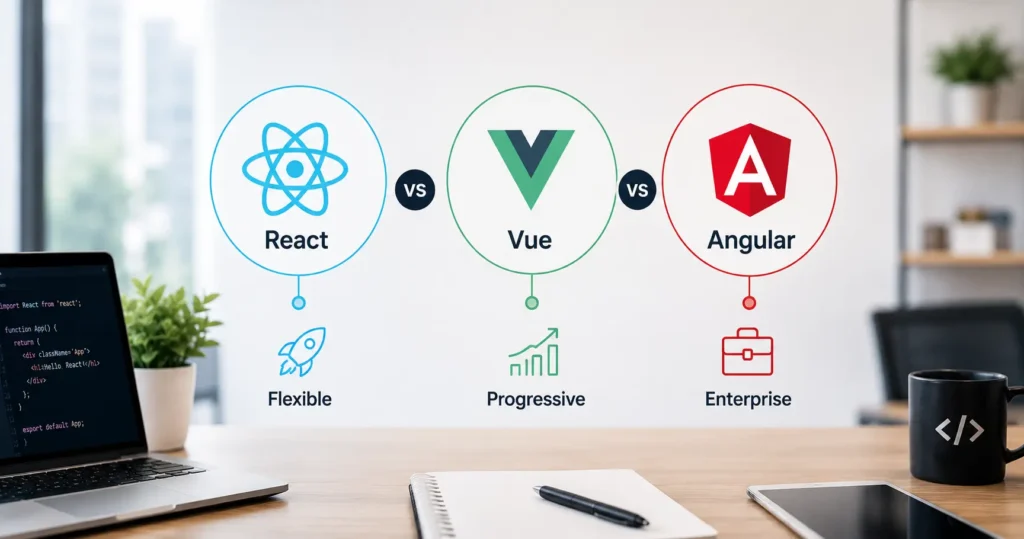
**React, Vue, and Angular** are the three frameworks your developers will name when you ask what to build your web application’s frontend on. They do the same fundamental job: building the interactive part of a website or app. They do it differently enough that the choice will shape your hiring, your costs, and your ability to ship AI features for years.
This is a decision guide for the person making the call, the CTO or founder signing off on the build, not the developer writing the code. No code samples. No jargon left unexplained. Just what each framework is good at, what each costs you in hiring and maintenance, and which one handles AI features best in 2026, which is the factor that did not matter a year ago and matters a great deal now.
Here is the short version up front. React has the largest talent pool and the strongest AI tooling, which makes it the safest default for most new products. Angular is built for large enterprise applications with strict structure. Vue is the fastest to build with and the best fit for lean teams. The rest of this guide is how to know which one is right for your situation.
## What these 3 frameworks actually are
All three are JavaScript frameworks, the pre-built toolkits developers use to build the interactive front end of a web application. The difference is how much structure each one imposes.
- **React** was built by Meta and released in 2013. It gives developers building blocks and lets them assemble everything their own way. Maximum flexibility. It powers Facebook, Instagram, Netflix, Airbnb, and most SaaS products launched in the last five years. It is the most popular of the three by a wide margin.
- **Angular** was built by Google and released in 2016. It gives developers a complete, opinionated package with strict rules about how code is organized. Less flexibility, more consistency. Google built it for large, complex internal applications, and you see it most in banking, healthcare, government, and enterprise tools.
- **Vue** was built by a former Google engineer and released in 2014. It sits between the two: easier to learn than both, with sensible defaults you can still rearrange. It is popular with startups and lean teams and is especially strong in the Laravel and PHP community.
A useful way to picture it: React is a kitchen with great appliances where you choose the layout. Angular is a fully designed kitchen where everything has a fixed place. Vue comes with a sensible layout you can rearrange without a fight.
## The numbers that matter for a business decision
| | **React** | **Angular** | **Vue** |
|---|---|---|---|
| Developer usage (Stack Overflow 2025) | 44.7% | 18.2% | 17.6% |
| Usage (State of JS 2025) | 69.9% | 22.1% | 44.8% |
| Active job listings worldwide (2026) | 150,000+ | 60,000+ | 35,000 |
| USA salary range | $95K to $130K | $90K to $120K | $85K to $115K |
| Developers who want to keep using it | 62.2% | 44.7% | 50.9% |
| Backed by | Meta | Google | Community |
**Sources:** Stack Overflow Developer Survey 2025, State of JavaScript 2025
**What this means for you.** React has the biggest talent pool by far, so hiring is faster and replacing someone who leaves is easier. Angular has a smaller, more specialized pool of developers used to enterprise environments; hiring takes longer, but they arrive ready for complex builds. Vue has the smallest pool in North America and Europe, though it is much stronger in Asia. The salary differences are real but modest, around $10K to $15K a year between React and Vue at comparable levels.
The developer satisfaction numbers are quietly important. 62.2% of React developers want to keep using React; only 44.7% of Angular developers say the same. That gap tells you Angular developers are more often using it because their employer requires it, which can make retention harder.
## Performance: the honest version
For the vast majority of business applications, all three are fast enough. The performance differences are measured in milliseconds your users will never notice. Do not choose a framework based on a benchmark chart.
Where performance starts to matter is at scale. Angular handles very large applications well because its rigid structure keeps a big codebase organized. React handles scale well with good architecture decisions. Vue can scale but needs more deliberate planning. For real-time features like live dashboards or chat, React with Next.js has the most mature ecosystem. Choose based on what you are building and who maintains it, not a speed test.
## AI integration: the factor that changed everything this year
A year ago this section did not exist. In 2026, it is one of the most important parts of the decision, because the framework you choose affects how easily your team can build AI features into your product.
The Vercel AI SDK hit version 6 in 2026 with over 20 million monthly downloads, and where it works best splits the three frameworks apart.
- **React** has the strongest AI tooling by a clear margin. The Vercel AI SDK is React-first. Streaming chat interfaces, live AI-generated content, and real-time AI search are all noticeably easier to build on React and Next.js. Most AI coding assistants also work best with React because there is more React code in their training data. If AI features are on your roadmap for the next year or two, React gives your team the shortest path to production.
- **Vue** can do everything React can with AI, but with more manual work. The Vercel AI SDK supports Vue, but many AI-specific interface patterns need custom building where React has a ready-made component. A capable team gets there; it just takes longer.
- **Angular** has the least developed AI tooling of the three. It connects to any AI API through standard calls, but there is no Angular-first AI SDK. Enterprise teams building AI on Angular write more from scratch. It works, it costs more developer time.
The takeaway for a CTO: if [**AI Solutions and Implementation**](https://www.krishaweb.com/ai-solutions-agency/) is part of your product plan, React is the lowest-friction choice. The ecosystem was built with AI in mind, and that lead is widening, not closing.
## Maintenance cost: the number nobody asks about upfront
Everyone asks what it costs to build. The cost that determines whether the project was a good investment is what it costs to maintain for three to five years.
- **React’s** flexibility is a double-edged sword. Different developers make different choices, and a React codebase built by several people over two years can become a patchwork without strong standards. The ecosystem also moves fast, so dependencies sometimes get abandoned and need replacing.
- **Angular** costs more upfront and less later. The strict structure means every Angular project looks roughly the same, so new developers get productive faster, and the upgrade path between versions is well-documented. For long-lived applications, Angular’s maintenance cost is often the lowest of the three.
- **Vue** is the cheapest to build initially. Its long-term maintenance cost depends heavily on team discipline, because it gives you fewer guardrails than Angular.
## Which one should you choose?
| **Your situation** | **Best choice** | **Why** |
|---|---|---|
| Customer-facing SaaS product | React | Biggest ecosystem, best AI tooling, easiest hiring |
| Complex enterprise internal tool | Angular | Built for structure, enterprise talent knows it |
| Startup MVP, tight budget | Vue | Fastest to build, lowest learning curve |
| AI features on the roadmap | React | Vercel AI SDK, React-first AI ecosystem |
| Team already knows one of them | What they know | Switching costs more than any framework difference |
| Long-term project, 5+ years | Angular or React | Corporate backing reduces long-term risk |
| Laravel/PHP backend | Vue | Vue and Laravel were made for each other |
| Headless eCommerce frontend | React | Next.js and Shopify Hydrogen lead this space |
If your team already knows one of these well, use it. The cost of switching or retraining exceeds any advantage one framework holds over another. If you are starting fresh and building something that needs to scale, React is the safest bet in 2026: largest hiring pool, most mature AI ecosystem, and the most available solutions when your team hits a problem. If you are building an enterprise internal platform where many developers work on one codebase for years, Angular was built for exactly that. And if you are a lean team shipping fast, especially on a Laravel backend, Vue gets you there with the least friction.
Whichever you choose, the framework is one decision inside a larger [**web development**](https://www.krishaweb.com/web-development/) project, and the right partner builds it so the choice still makes sense three years from now.
##### Additional Read
- [Frontend Performance for Enterprise Websites: React, Core Web Vitals, and Real UX Impact](https://www.krishaweb.com/blog/enterprise-frontend-performance/)
- [Laravel vs ReactJS: Choosing the Best Web Framework in 2026](https://www.krishaweb.com/blog/laravel-vs-react/)
- [ReactJS vs Vue.js: Which Frontend Framework is Best for Your Project?](https://www.krishaweb.com/blog/reactjs-vs-vuejs-frontend-framework-comparison/)
### Frequently Asked Questions
**Is React better than Vue and Angular?**React is not universally better, but it is the safest default for most new products in 2026 because it has the largest talent pool, the strongest AI tooling, and the biggest ecosystem of solutions. Angular is better for large enterprise applications that need strict structure. Vue is better for lean teams that need to build fast. The best choice depends on your team, your timeline, and whether AI features are on your roadmap, not on which framework is technically superior.
**Which framework is easiest to hire for?**React, by a wide margin. There are over 150,000 active React job listings worldwide in 2026 compared to roughly 60,000 for Angular and 35,000 for Vue. A larger pool means faster hiring and easier replacement when someone leaves. Vue has a smaller pool in North America and Europe but is much stronger in Asian markets.
**Which framework is best for AI features?**React. The Vercel AI SDK is React-first, streaming AI interfaces are easier to build on React and Next.js, and most AI coding assistants work best with React. Vue can do the same work with more manual effort, and Angular has the least developed AI tooling of the three. If AI is on your product roadmap, React gives your team the shortest path to production.
**Can I switch frameworks later?**Technically yes, but it is effectively a rebuild, not a migration. Switching from one framework to another means rewriting the entire frontend, typically costing 60 to 80% of the original build. This is why the choice matters at the start. It is far cheaper to spend an extra week deciding than to switch 18 months in.
**Which framework should a startup use?**For a startup that needs to ship fast on a limited budget, Vue is often the best fit because it has the lowest learning curve and the fastest build speed, especially with a Laravel backend. If the product is likely to scale significantly or AI features are planned, React is the safer long-term choice despite a slightly steeper start. Avoid Angular for early-stage startups unless the team already knows it well; its structure pays off at an enterprise scale, not at MVP stage.
**How much does it cost to build with each framework?**The framework choice affects cost less than scope, and team experience do. React and Vue MVPs are comparable, typically 8 to 16 weeks with an experienced team. Angular tends to run longer, 12 to 20 weeks, because of higher upfront structure, though that investment lowers maintenance cost later. The bigger cost driver over five years is maintenance, where Angular’s consistency and React’s ecosystem both have advantages over a poorly maintained Vue codebase.
#### Build It With KrishaWeb
KrishaWeb has shipped production applications on React, Angular, and Vue for clients across 42 countries. We also build AI features into web applications using the Vercel AI SDK and custom LLM integrations. When you bring us a project, the framework recommendation is based on your team, your timeline, and your roadmap, not on which one we happen to prefer.
If you are at the point where the framework decision needs making, tell us what you are building, and we will recommend what fits. [**Schedule a call**](https://api.leadconnectorhq.com/widget/bookings/book-a-call-with-parth-krishaweb) to talk it through, or [**contact us**](https://www.krishaweb.com/contact-us/) with your project details.

###### Nirav Panchal
Lead – Custom DevelopmentLead of the Custom Development team at KrishaWeb, holds AWS certification and excels as a Team Leader. Renowned for his expertise in Laravel and React development. With expertise in cloud solutions, he leads with innovation and technical excellence.
 Interact With Me-
-
- [ ](mailto:)
---
_View the original post at: [https://www.krishaweb.com/blog/react-vs-vue-vs-angular/](https://www.krishaweb.com/blog/react-vs-vue-vs-angular/)_
_Served as markdown by [Third Audience](https://github.com/third-audience) v3.5.3_
_Generated: 2026-06-23 14:35:06 UTC_