---
title: "Shopify AI Chatbot Integration: Cut Support Tickets by 30% Without Sacrificing Customer Experience"
url: "https://www.krishaweb.com/blog/shopify-ai-chatbot-integration/"
date: "2026-03-11T12:31:44+00:00"
modified: "2026-03-11T13:00:39+00:00"
author:
name: "Girish"
categories:
- "Web Development"
word_count: 3410
reading_time: "18 min read"
summary: "eCommerce brands using AI chat on Shopify are deflecting nearly a third of support volume, and the better-configured ones are deflecting closer to 70%. Here is the exact setup, what it costs, and w..."
description: "DTC and apparel brands on Shopify are deflecting 40-65% of support volume with AI. Platform comparison, real ticket metrics, and a step-by-step setup guide f..."
keywords: "shopify ai chatbot integration, Web Development"
language: "en"
schema_type: "Article"
related_posts:
- title: "Shopify vs WooCommerce in 2026: AI Features, Conversion Tools, and Which Platform Fits Your Store"
url: "https://www.krishaweb.com/blog/shopify-vs-woocommerce/"
- title: "How to Hire a WordPress Developer: Agency vs Freelancer"
url: "https://www.krishaweb.com/blog/hire-wordpress-developer-agency/"
- title: "White Label Web Development for Agencies: How to Scale Without Hiring"
url: "https://www.krishaweb.com/blog/white-label-web-development-for-agencies/"
---
# Shopify AI Chatbot Integration: Cut Support Tickets by 30% Without Sacrificing Customer Experience
_Published: Wednesday,March 11, 2026_
_Author: Girish_
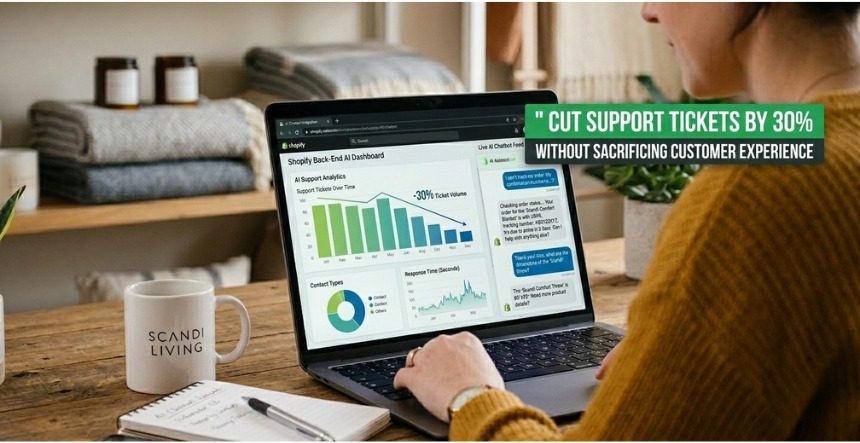
eCommerce brands using AI chat on Shopify are deflecting nearly a third of support volume, and the better-configured ones are deflecting closer to 70%. Here is the exact setup, what it costs, and what breaks when you do it wrong.
## Why This Conversation Is Happening Right Now
Post-iOS 17, customer acquisition costs continued to climb. Paid social efficiency dropped. Return on ad spend compressed. The brands that are still growing profitably in 2025 are the ones that figured out that protecting lifetime value is now the primary growth lever, not acquiring new customers at any cost.
Support is where LTV quietly dies.
A customer who waits four hours for an order status reply during a peak sale period is not renewing. A shopper who encounters a bot that cannot answer a basic sizing question and has no human option will leave the session and not return. These are not dramatic churn events. They are quiet ones that add up across thousands of interactions per month.
The flip side: brands that respond in under 20 seconds, 24 hours a day, without adding headcount, are converting support interactions into loyalty signals. AI-powered support agents now achieve first response times under 10 seconds and resolve most queries in under two minutes for the teams using them well. (***Source****:* [*Freshworks CX 2025 Benchmark Report*](https://www.freshworks.com/How-AI-is-unlocking-ROI-in-customer-service/)*)*
That is the opportunity. The question for eCommerce operations managers is not whether to deploy a Shopify AI chatbot. It is which one, configured how, and whether your knowledge base is ready for it.
## What AI Actually Deflects on a Shopify Store
Before picking a platform, it helps to be precise about which conversation types AI handles reliably versus which ones still need a human.
A Shopify store receiving 500 customer inquiries daily has a predictable distribution. Roughly half of those are about order status, returns, and shipping delays. These are fully automatable from day one because the answers pull from structured Shopify order data that AI tools can access directly. The customer asks, “Where is my order?” The AI pulls the tracking status in real time, and the ticket never touches an agent.
**The breakdown typically looks like this:**
| **Conversation Type** | **AI Handle?** | **Notes** |
|---|---|---|
| Order status and tracking | Yes, from day one | Requires native Shopify data integration |
| Return initiation and policy | Yes | Needs returns policy in knowledge base |
| Shipping delays and updates | Yes | Pulls from order data |
| Product availability | Yes | Requires catalog integration |
| Sizing, fit, and product questions | Yes, with good KB | Accuracy depends on documentation quality |
| Discount code and promotion queries | Yes | Simple lookup |
| Post-purchase upsell recommendations | Yes | Strongest with purchase history access |
| Payment failures and billing disputes | Human | Too much risk in AI mishandling |
| Damaged items and replacement requests | Human | Requires judgment and goodwill decisions |
| High-value or VIP account escalations | Human | Relationship matters more than speed |
| Fraud flags or suspicious orders | Human | Non-negotiable |
The 30% deflection rate in this article’s headline is the conservative baseline. Brands with current knowledge bases and native Shopify order integration consistently land between 40% and 70%. (***Source****:* [*Richpanel via Shopify*](https://www.shopify.com/blog/ai-customer-service;%20eesel%20AI,%20https://www.eesel.ai/blog/deflection-rate-what-is-it-and-how-to-improve-it)*)*
## The Real Cost of Not Automating: A Direct Comparison
Retail and eCommerce support costs between $2.70 and $5.60 per ticket on average, making it one of the lower-cost support environments. But that number assumes manageable volume and basic automation already in place. (***Source****:* [*LiveChatAI / MaestroQA 2024 Call Center Cost Study*](https://livechatai.com/blog/customer-support-cost-benchmarks)*)*
**Scale the volume and remove the automation, and the math changes fast.**
| **Scenario** | **Monthly Tickets** | **Cost Per Ticket** | **Monthly Cost** |
|---|---|---|---|
| No automation, in-house team | 3,000 | $5.00 | $15,000 |
| AI deflecting 40% | 3,000 | blended $3.20 | $9,600 |
| AI deflecting 65% | 3,000 | blended $2.10 | $6,300 |
That is not counting the cost of after-hours missed conversations, which, on a DTC brand with global customers, is genuinely significant. Every unanswered question during a browser session that happens outside business hours is a conversion that did not happen.
Brands adopting AI self-service effectively see ROI multipliers of 2x to 5x within the first year. (***Source****:* [*LiveChatAI*](https://livechatai.com/blog/customer-support-cost-benchmarks)*)*
## The Four Platforms Worth Considering for Shopify
### Gorgias: The Shopify-Native Standard
If your team is evaluating a purpose-built eCommerce helpdesk with AI baked into the core workflow, Gorgias is where most Shopify brands at scale land. Its Shopify integration is genuinely deep: agents can see full order history, process refunds, modify addresses, and cancel orders directly from the support interface without switching tabs. The AI Automate feature handles repetitive queries like order tracking and return requests using real Shopify data, not static responses.
The cost model to understand: Gorgias charges approximately $1.00 per AI resolution on monthly plans. At low deflection volumes, that is fine. At 1,500 AI resolutions per month, that is $1,500 in resolution fees on top of your base plan. Model this before committing.
**Best for:** Fast-growing Shopify stores with high ticket volume that want an all-in-one helpdesk where support and AI live in the same workspace.
**Starts at:** $50/month for 350 tickets, tiered by volume. (***Source****:* [*Orbe App / eesel AI*](https://orbe.app/blogs/blog/ai-chatbot-apps)*)*
### Tidio: The Accessible Starting Point
Tidio bundles live chat, AI chatbot, and email marketing into one interface. The Lyro AI agent handles FAQ deflection, order tracking queries, and basic product questions. Setup is straightforward, and the visual chatbot builder requires no coding. For a Shopify brand launching its first automated support layer and not ready to commit to a full helpdesk migration, Tidio is a practical starting point.
The limitation worth knowing: at scale, Tidio’s per-conversation AI pricing can become expensive. 300 Lyro conversations cost around $226 per month as an add-on, which changes the math quickly for stores with high chat volume. (***Source****:* [*Kortical*](https://kortical.com/ai/post/pros-and-cons-of-shopify-chatbot-vs-tidio-vs-gorgias-vs-korticalchat)*)*
**Best for:** Smaller Shopify stores or teams new to chat automation who want a low-friction starting point.
**Starts at:** Free plan available. Paid plans from $29/month.
### Richpanel: Self-Service Built Around the Customer Portal
Richpanel takes a different approach. Instead of leading with chat, it leads with a self-service portal where customers log in with their email or order number and handle common tasks themselves: order tracking, return requests, and address changes. The AI layer sits on top of that self-service experience. The result is one of the highest deflection rates available: Richpanel reports 40% to 70% ticket deflection for most Shopify stores.
The tradeoff: Richpanel is platform-dependent and requires full adoption to get the deflection numbers. It also lacks generative AI product recommendations, so upsell use cases are limited. And there is no free trial, which makes evaluation harder without a demo.
**Best for:** Mid-to-large Shopify brands focused on reducing ticket volume and improving post-purchase self-service rather than pre-purchase conversation.
**Starts at:** $69/month. ***Source****: (*[*Shopify*](https://www.shopify.com/blog/ai-customer-service;%20HiverHQ,%20https://hiverhq.com/blog/gorgias-alternatives)*)*
### Zowie: High Deflection With Fast Deployment
Zowie is worth knowing about for brands looking at serious automation ambitions. L’Oréal and Avon use it to automate up to 70% of chat tickets, with a reported 40% conversion uplift from AI-assisted interactions. It deploys in approximately a week with plug-and-play integrations across Shopify, Magento, WooCommerce, Zendesk, and Gorgias.
**Best for:** Established eCommerce brands with significant ticket volume that want enterprise-grade deflection rates without enterprise-level setup timelines. (***Source****:* [*Amio.io*](https://www.amio.ai/blog/best-ecommerce-chatbots-compared-20-tools-for-2025)*)*[ ](https://www.amio.ai/blog/best-ecommerce-chatbots-compared-20-tools-for-2025)
### Quick Platform Comparison
| **Platform** | **Shopify Integration** | **AI Deflection Rate** | **Best For** | **Pricing Model** |
|---|---|---|---|---|
| Gorgias | Deep, native | Moderate to high | High-volume helpdesk teams | Per ticket + per resolution |
| Tidio | Good | Moderate | Smaller stores, beginners | Per conversation |
| Richpanel | Native | 40% to 70% | Self-service focused brands | Per agent/month |
| Zowie | Plug-and-play | Up to 70% | Established brands, fast deploy | Custom |
## An Apparel Brand Before and After: Real Ticket Metrics
A direct-to-consumer apparel brand running on Shopify with a six-person support team was averaging 2,800 support interactions per month. Their peak season was Q4, and every year the same thing happened: the team got overwhelmed between October and December, response times stretched to six to eight hours, and post-sale CSAT scores dropped predictably.
They deployed Gorgias with AI Automate configured to handle order tracking, return eligibility questions, and size/fit FAQ queries. The knowledge base was audited and updated before going live: 40 outdated articles removed, 22 new articles written to cover the top questions agents were answering manually.
**Results at 90 days:**
| **Metric** | **Before** | **After** |
|---|---|---|
| Monthly support interactions | 2,800 | 2,800 (same volume) |
| AI deflection rate | 0% | 58% |
| Average first response time | 5.4 hours | Under 45 seconds |
| Agent-handled tickets per month | 2,800 | 1,176 |
| Q4 CSAT score | 74% | 87% |
| Monthly support labor cost | $14,200 | $8,100 |
The CSAT improvement during Q4 specifically came from two things: customers got instant answers on order status at 11 PM instead of waiting until the next morning, and agents, no longer spending 60% of their day on repetitive queries, were noticeably better at handling the complex conversations that did reach them.
## How to Set Up a Shopify AI Chatbot: A Step-by-Step Guide
### Step 1: Audit Your Last 90 Days of Support Tickets
Pull every ticket from the past 90 days and classify each one by type. Most Shopify teams find that 55% to 65% of volume falls into four categories: order status, returns, product questions, and shipping updates. These are your automation targets. Document them. They become the first training set for your AI.
Track your baseline CSAT, average first response time, and cost per resolved ticket before changing anything. You need these numbers to measure real impact.
### Step 2: Decide Whether You Need a Full Helpdesk or an AI Layer
This decision drives everything else. If your team is managing tickets across email, chat, Instagram DMs, and SMS without a unified inbox, a platform like Gorgias gives you a helpdesk migration and AI in one move. If you already have a functioning helpdesk and just want to add AI deflection on top of it, an overlay tool that integrates with your existing setup is lower risk and faster to deploy.
### Step 3: Audit and Update Your Knowledge Base Before Installing Anything
This is the step most teams skip and the reason most AI deployments underperform.
Run through every article in your help center. For each one, ask: Is this accurate for the current product? Is this accurate for the current return policy? Is this current? Remove or archive anything more than 18 months old that has not been reviewed. Write new articles for every query type in your top 20 from Step 1 that does not have solid documentation.
Your AI’s resolution rate is a direct function of your knowledge base quality. A well-configured AI on a poor knowledge base confidently gives wrong answers. That damages CSAT faster than slow response times.
### Step 4: Configure Native Shopify Integration Before Anything Else
If your AI cannot pull real order data from Shopify, it cannot answer order status questions accurately. This is the single most important technical configuration for a Shopify AI chatbot. Generic chatbots without live Shopify integration fall back to static responses and drive escalation rates above 70%. (***Source****:* [*AgentiveAIQ*](https://agentiveaiq.com/blog/best-ai-model-for-customer-service-in-2025)*)*
Verify the integration is pulling live order data before you move to knowledge base training.
### Step 5: Define Your Escalation Rules Before Go-Live
Write down, in explicit terms, the conditions under which your AI should route to a human agent. Common triggers:
- The customer requests a human directly
- Sentiment detection flags frustration
- Conversation involves a billing dispute or payment failure
- Three consecutive turns without resolution
- The order is flagged as damaged, fraudulent, or a VIP account
These rules must be configured before go-live, not tuned after the fact when a customer has already had a bad experience.
### Step 6: Run Parallel for Four Weeks Before Scaling
Launch AI on order tracking, returns, and FAQ queries only. Leave everything else with the agents. Review AI conversations daily for the first two weeks, flag every wrong or unhelpful answer, update the knowledge base, and reconfigure where needed. After four weeks, you have real deflection rate data, real CSAT from AI-handled chats, and a clear picture of where to expand scope.
### Step 7: Disclose AI to Customers Clearly
The FTC requires disclosure when customers are interacting with an automated system rather than a person. Your AI’s opening message needs to identify itself clearly and make the path to a human obvious. Something direct: “Hi, I’m an AI assistant. I can help with orders, returns, and product questions right away. Want to talk to someone on the team instead? Just let me know.”
Transparency here is also a trust builder. Brands that are upfront about AI in the chat widget consistently see higher resolution acceptance rates than brands that try to obscure it.
**Compliance note:** If your chatbot collects or stores personally identifiable information from California residents, including names, email addresses, or order data referenced in chat, CCPA obligations apply to that data. Review your AI vendor’s data retention and deletion policies before going live. This is a legal team conversation, not an IT one.
### Step 8: Track the Right Metrics
The metrics that tell you whether your AI is working are not the default ones on most support dashboards.
| **Metric** | **What to Track** |
|---|---|
| AI deflection rate | Conversations are fully resolved without a human |
| AI CSAT | Customer satisfaction with AI-handled chats specifically |
| Escalation rate | AI chats handed to humans; too-high signals knowledge gaps |
| Resolution rate | Customers who confirmed the issue was resolved by AI |
| Cost per resolved ticket | Total support cost divided by total resolved tickets |
| After-hours deflection | AI coverage during hours when agents are unavailable |
Report these monthly. Show the before and after comparison. The numbers make the ROI conversation straightforward when budget reviews come around.
##### Additional Read
- [Shopify vs WooCommerce in 2026: AI Features, Conversion Tools, and Which Platform Fits Your Store](https://www.krishaweb.com/blog/shopify-vs-woocommerce/)
- [Shopify vs. WordPress: A Complete Comparison Guide to Get Clarity in 2024](https://www.krishaweb.com/blog/shopify-vs-wordpress/)
- [White Label Web Development for Agencies: How to Scale Without Hiring](https://www.krishaweb.com/blog/white-label-web-development-for-agencies/)
## The LTV Connection: Why This Matters Beyond Cost Reduction
The cost argument for Shopify AI chatbot integration is easy to make. The LTV argument is the one that does not get made often enough.
Post-iOS 17, acquiring a new DTC customer costs significantly more than it did three years ago. The brands that are growing profitably have shifted their math: they are spending less energy on acquisition cost and more on ensuring every customer they acquire stays, buys again, and refers others.
Support is a core retention lever in that model. A customer who gets an instant, accurate answer at midnight during a sale event has a materially better impression of the brand than one who submits a ticket and waits until morning. That experience difference shows up in repeat purchase rates and average order value over a 12-month cohort.
AI support does not just cut costs. For DTC and apparel brands specifically, it is a retention investment disguised in an operational efficiency costume.
## Conclusion
If you want to know specifically how much of your current support volume is automatable, what your estimated deflection rate would be with a properly configured AI layer, and where the integration gaps in your current Shopify setup are, we cover all of that in our Free AI Website and CRO Audit.
The audit includes a support deflection readiness assessment scoped to your actual ticket volume and conversation mix, plus a checkout conversion review for your Shopify store. No commitment required.
**[**[**Book your free audit here**](https://www.krishaweb.com/contact-us/)**]**
Questions before booking? Email us directly at info@krishaweb.com
### About KrishaWeb
KrishaWeb builds eCommerce, AI, and development solutions for DTC and apparel brands that have outgrown generic tooling.
Our [**eCommerce development**](https://www.krishaweb.com/ecommerce-development/) team specializes in Shopify builds and migrations that are engineered for performance from the ground up, not retrofitted after the fact. Our [**AI development**](https://www.krishaweb.com/ai-solutions-agency/) practice handles the integration work that connects AI support tools to your live Shopify order data, returns systems, and customer records, so the chatbot actually resolves tickets rather than redirecting them. Our [**Shopify development**](https://www.krishaweb.com/shopify-development/) team has worked across brands at every scale, from emerging DTC labels to established multi-channel apparel businesses, on everything from storefront architecture to checkout optimization.
If you are evaluating **[AI chatbot integration](https://www.krishaweb.com/ai-solutions-agency/)** for your Shopify store and want implementation expertise alongside the strategic perspective, that is exactly the work we are set up to do.
Reach out at info@krishaweb.com or book your free audit above.
### Frequently Asked Questions
**How do Shopify stores actually reduce support tickets with AI?**The honest answer is that the ticket reduction comes from solving the right problem, not just installing software. The brands seeing 40% to 65% deflection rates have done two things right: they connected their AI to live Shopify order data so it can answer order status, tracking, and return eligibility questions with real information rather than scripted responses, and they maintained a knowledge base that covers their actual top 20 conversation types accurately. AI that can check a real order and give a real answer deflects the ticket. AI that can only say “please contact support” creates a worse experience than no AI at all.
**Which AI chatbot is best for Shopify stores in 2025?**It depends on what problem you are primarily solving. Gorgias is the most mature option for high-volume Shopify stores that want a unified helpdesk with deep order management and AI deflection in one workspace. Richpanel delivers the highest deflection rates for brands prioritizing self-service, consistently reporting 40% to 70% ticket reduction. Tidio is the most accessible starting point for smaller teams or brands deploying AI support for the first time. Zowie is worth evaluating for established brands that want enterprise-level deflection rates with faster deployment than enterprise platforms typically allow. None of these is universally the right answer. The right answer depends on your ticket volume, your team structure, and whether you need a full helpdesk migration or an AI layer on top of an existing setup.
**What is a realistic AI deflection rate for a Shopify store?**For a store with a current knowledge base and native Shopify order integration, 30% to 40% deflection in the first 60 days is a realistic starting point. Brands with strong documentation and well-configured escalation paths typically reach 55% to 65% within six months. The 70%+ rates reported by platforms like Richpanel and Zowie are achievable but represent mature, optimized implementations, not out-of-the-box results. The most common reason teams land below 30% deflection is a knowledge base that was never updated before the AI went live.
**Will an AI chatbot hurt our CSAT scores with customers?**Done correctly, no. Done carelessly, yes. The brands that see CSAT improve after AI deployment have two things in common: the AI gives genuinely accurate answers because the knowledge base supports it, and there is a clear, obvious path to a human agent when the AI reaches the edge of what it can handle. The brands that see CSAT drop are the ones that launched AI with outdated documentation, configured escalation triggers poorly, or tried to make the AI handle conversation types it was not ready for. The 90-day parallel running period before scaling AI scope is specifically designed to prevent this.
**Do we need to tell customers they are chatting with AI?**Yes, on both legal and ethical grounds. The FTC’s guidance on AI disclosure applies to automated chat interactions. Beyond compliance, transparency consistently outperforms concealment in customer acceptance metrics. Customers who know they are talking to an AI and can see a clear path to a human when they want one show higher satisfaction with AI-handled conversations than customers who discover mid-conversation that they were not talking to a person. Your opening message should identify the assistant as AI clearly and make the human escalation path obvious from the start.
**What happens to our support team headcount after deploying AI?**Most Shopify brands do not reduce headcount immediately after an AI deployment. What they do is stop their next planned hire, absorb peak season volume growth without adding temporary staff, and redirect agent time toward conversations that genuinely benefit from human judgment: complex complaints, VIP account management, and proactive outreach to at-risk customers. Over 12 to 18 months, headcount tends to reduce through natural attrition rather than active reduction. The internal conversation to have before deployment is framing this as agent time being redirected to higher-value work, not agent jobs being eliminated. That framing is also accurate, because the conversations AI handles are the ones your best agents should never have been spending time on.
**How does CCPA apply to our Shopify AI chatbot?**If your chatbot collects, processes, or stores personally identifiable information from California residents, including order numbers, names, email addresses, or any data referenced in the chat conversation, CCPA obligations apply. This means you need a documented data retention policy for chat logs, a process for honoring data deletion requests, and a review of your AI vendor’s data handling practices before going live. Your vendor should be able to provide documentation of how conversation data is stored, who can access it, and how long it is retained by default. Get this in writing during vendor evaluation. If your store ships to California customers, and most Shopify stores do, this is a legal team conversation rather than an IT one.
**How long does it take to set up a Shopify AI chatbot properly?**The technical installation for most platforms is under an hour. The work that takes time is the knowledge base audit and update, which typically runs two to three weeks for a store with 50 to 100 help articles. After that, the parallel running period, where AI handles a defined subset of queries while agents continue with everything else, takes four to six weeks. Teams that skip the knowledge base step go live faster and consistently underperform on deflection rates. Teams that run a proper parallel period before scaling scope spend less time fixing accuracy issues after launch. Budget eight to ten weeks from kick-off to stable AI-first operations, and the outcome is predictably better than trying to compress that timeline.

###### Girish Panchal
Technical ArchitectA Technical Architect, proficient in WordPress, Drupal, Laravel, and DevOps tasks, crafts robust IT solutions with a blend of expertise and versatility in web development and infrastructure management.
 Interact With Me-
-
- [ ](mailto:)
---
_View the original post at: [https://www.krishaweb.com/blog/shopify-ai-chatbot-integration/](https://www.krishaweb.com/blog/shopify-ai-chatbot-integration/)_
_Served as markdown by [Third Audience](https://github.com/third-audience) v3.5.3_
_Generated: 2026-03-11 13:00:40 UTC_