---
title: "White Label Digital Marketing: Reselling SEO, Content, and Paid Under Your Brand"
url: "https://www.krishaweb.com/blog/white-label-digital-marketing-reselling/"
date: "2026-10-14T12:40:54+00:00"
modified: "2026-10-14T12:41:52+00:00"
type: "Article"
resource: "https://www.krishaweb.com/blog/white-label-digital-marketing-reselling/"
timestamp: "2026-10-14T12:41:52+00:00"
author:
name: "Parth"
url: "https://www.krishaweb.com/"
categories:
- "Web Development"
word_count: 2637
reading_time: "14 min read"
summary: "Most agencies hit the same ceiling. A client asks for SEO when you only do PPC, or you win more work than your team can deliver, and you're stuck choosing between turning revenue away and making a ..."
description: "White label digital marketing lets agencies resell SEO, content, PPC and social under their own brand. See how it works, pricing, margins and risks."
keywords: "white label digital marketing, Web Development"
language: "en"
schema_type: "Article"
related_posts:
- title: "White Label Web Development: What to Look For in a Reliable Partner"
url: "https://www.krishaweb.com/blog/white-label-web-development-reliable-partner/"
- title: "White Label Services Explained: How Agencies Deliver More Without Hiring"
url: "https://www.krishaweb.com/blog/white-label-services-explained-agencies/"
- title: "Building AI Into Your Product: LLM Integration, RAG, and Semantic Search Explained"
url: "https://www.krishaweb.com/blog/building-ai-into-product-llm-rag-semantic-search/"
---
# White Label Digital Marketing: Reselling SEO, Content, and Paid Under Your Brand
_Published: Wednesday,October 14, 2026_
_Author: Parth_
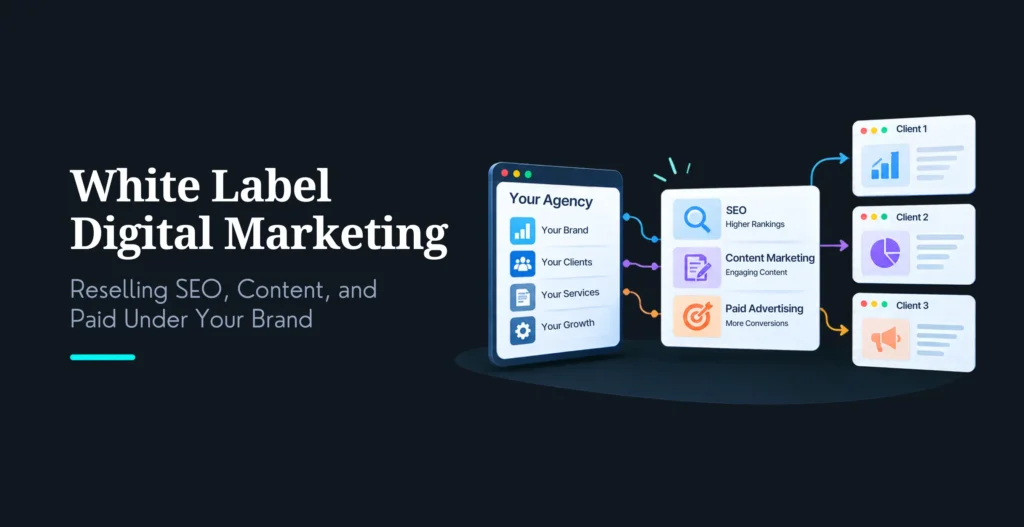
Most agencies hit the same ceiling. A client asks for SEO when you only do PPC, or you win more work than your team can deliver, and you’re stuck choosing between turning revenue away and making a slow, expensive hire. White label digital marketing is how a lot of agencies quietly get past that ceiling, delivering services their clients never know were produced by someone else.
White label digital marketing is an arrangement where a specialist partner delivers marketing services, SEO, content, PPC, social, reporting, that you resell to your clients under your own brand. The partner stays invisible: your logo is on the reports, your name is on the calls, and the client never sees the team doing the production. You keep the relationship, the branding, and the margin. The economics are the point: instead of carrying fixed salaries, tools, and the bench time that quietly eats profit between projects, you pay a wholesale rate only when there’s billable work, mark it up, and keep the spread. Resold well, agencies typically run 2x-3x markups on SEO retainers at 45-65% gross margin, without a single new hire.
This guide covers what you can actually resell, exactly how the partner stays invisible (the detail agency owners worry about most), real pricing and margin math, the risks worth planning for, and how to vet a partner. It’s written for the agency owner or ops director weighing whether white label belongs in how they scale. Capacity is one of the **[bottlenecks that stall agency growth](https://www.krishaweb.com/blog/bottlenecks-that-stop-digital-agencies-from-scaling/)**, and this is one of the cleaner ways around it.
That’s the model behind our own **[white label digital marketing](https://www.krishaweb.com/white-label-digital-marketing-services/)**, NDA-first, fully branded to you, and this guide will help you hold any partner to that bar.
## What White Label Digital Marketing Is
White label digital marketing is a wholesale-to-retail arrangement for marketing services. A specialist partner produces the work at a wholesale rate; you, the reseller agency, add your markup and sell it to the client under your own brand. (It’s distinct from private label and OEM, which are product terms, white label here means rebranded services.) It runs on three parties: the end client who needs the service, the reseller agency (you) who owns the relationship, and the white label provider who delivers invisibly behind the scenes.
The workflow is simple once it’s running. You sell and close the deal under your brand, brief the partner with campaign requirements and brand guidelines, they execute and optimize, you quality-check and present the results as your own, and they handle ongoing optimization and reporting. Your job is strategy, sales, and client relationship; theirs is production. That division is exactly what lets a lean agency present a deep service menu.
The breadth is the appeal. You can resell SEO (technical, local, national, ecommerce, and increasingly AI-search/GEO), paid media across Google, Microsoft, Meta, LinkedIn and TikTok, content marketing, social media management, marketing automation, web development, and white label reporting. In practice, an agency can look full-service while staffing only its core, which pairs naturally with the broader shift toward **[AI-powered agency offerings](https://www.krishaweb.com/blog/ai-powered-agency-websites/)**.
## What You Can Resell
Here’s the practical menu, grouped by channel, with the wholesale-and-retail picture drawn from commonly cited 2026 benchmarks. Treat these as scope-dependent planning ranges, and get a real quote. The wholesale bands mostly reflect offshore fulfillment; onshore partners typically cost two to three times more for equivalent scope, which changes your margin math.
SEO is the most mature category and the most commonly resold. Wholesale runs roughly 300–800/month for local, 800–3,000 for national, and higher for ecommerce and enterprise. Agencies resell at 2x-3x, so a local program bought at $500 typically sells to the client at 1,000–1,500, landing a 50-65% margin. The scope spans audits, on-page and technical work, content, link building, citation management, and reporting, plus the fast-growing AEO/GEO (AI-search optimization) line.
Paid media (PPC) is priced differently, usually 10-25% of ad spend (12-18% is the common band) or a flat 500–4,000/month per account, with ad spend separate and often a setup fee. A partner fulfilling a mid-spend account might charge you several hundred dollars; you bill the client enough to net a healthy margin after your management time. Watch this one, PPC margins compress fastest if you underprice the account management.
Content is often bundled into SEO retainers or priced per piece (edited long-form SEO articles commonly run 120–450 in 2026, with the floor dropping as AI drafting plus human editing becomes standard). Social media typically runs 500–3,000/month per client depending on platforms and frequency. Reporting is usually included or available as a low per-account dashboard fee. And marketing automation and web development round out the menu for agencies that want to present a genuinely full stack.
The pattern across all of them: cheaper wholesale services carry higher markup multiples, and the fastest-to-resell channels (SEO, content, reporting) are the ones with predictable, recurring scope.
## How It Stays Invisible to Clients
This is the part agency owners worry about most, and it’s worth being precise, because invisibility isn’t automatic, it’s something you structure into the engagement. Done right, the client sees one agency: yours. The partner works under your name and never surfaces.
What makes it invisible, concretely: you own the client relationship, the strategy, the pricing, and all the communication, while the partner handles execution behind the scenes. Every deliverable and report is branded to your agency, your logo, your name, with no trace of the fulfillment partner. Your name is on the calls; the partner stays off them. And critically, the partner has no direct contact with your client unless you choose to introduce them. The client experiences a single, unified brand that is undeniably yours.
To guarantee it, verify these before you sign: that deliverables and reports will be fully white-labeled with no partner branding, that there’s a clear review-and-revision step before anything goes out under your name, that the partner contractually won’t contact your clients directly, and, the backstop for all of it, a written NDA plus an explicit non-solicitation clause. Invisibility and client protection are the same problem viewed from two angles, and a signature on a non-solicitation is what turns “they promise they won’t poach” into something enforceable. A partner who treats full white-labeling and non-solicitation as obvious understands the relationship; one who resists is telling you to walk.
## Pricing and Margin Math
To price profitably you need both what you’ll pay wholesale and what the market supports at retail, and you need to read the margin honestly. The commonly cited 2026 standard for SEO retainers: agencies resell at a 2x-3x markup, landing a 45-65% gross margin (median around 55%). Paid media, social and other services typically land lower.
Worked through: buy a local SEO program at $500/month wholesale, sell at 1,000–1,500, and you keep 500–1,000/month per client at roughly 50-67% gross. Stack ten and that’s 5,000–10,000/month in gross profit with no specialist on payroll, the core appeal of the model. National SEO, PPC, and content follow the same shape at their own price points.
Two honest caveats separate real margin from paper margin, and they’re where agencies get burned. First, that gross figure is before your own account-management and strategy time, so a 2x markup nets closer to 35-45% once you count the hours you spend managing the partner and the client. Price for that layer explicitly. Second, mind the floor: below roughly a 50% markup (1.5x) on a managed retainer, you’re effectively doing the client management for free once overhead lands, so treat 2x as your target and 1.5x as the absolute floor. The agencies that win on white label don’t compete on price, they justify the markup with strategy, reporting, and relationship, which is exactly what the client is paying the premium for.
## The Risks, and How to Manage Them
White label is genuinely useful, but it carries real risks, and naming them is how you protect your brand. The one owners fear most is client poaching, the partner going around you, which the NDA-plus-non-solicitation and a no-direct-contact rule are built to prevent. Close behind is quality inconsistency, which damages your brand (your logo’s on the work), so vet hard, run a small trial on one client first, and build a review step before anything reaches the client. The rest are manageable with discipline: communication breakdowns (fix with clear channels, response-time expectations, and structured check-ins), over-dependence on one partner (diversify for critical services, keep a backup), margin compression (negotiate volume rates, review margins often), and loss of control (clear SLAs, final approval on every deliverable). None should stop you using white label; all should shape the contract.
## Choosing a Partner, and When to Build Instead
Vet a partner like a hire, because functionally it is one. The non-negotiables: a signed NDA and non-solicitation, full white-label branding on every deliverable and report, a documented QA and review process, a dedicated account manager, clear SLAs, transparent pricing, a flexible month-to-month model, and checkable references from other agencies. The questions that surface the truth fast: Will deliverables be fully white-labeled with no trace of you? What’s the review process before work goes out under my name? Will you sign NDA and non-solicitation? Can I speak to two agency references? And will you do a trial on one client before I commit to volume? Walk away from anyone who won’t sign protections, can’t show a QA process, or resists a trial.
On whether to white label at all: the trade is flexible cost and speed versus fixed cost and control. White label wins for overflow, specialized or occasional needs (AI search, technical SEO, paid media), testing a new service line, and variable demand, you pay only against revenue, launch in days not months, and offload turnover risk. Build in-house when a service is core to your identity, demand is steady and predictable, or you need total control. Most agencies land on a hybrid: core in-house, overflow and specialized lines white label, and a smart sequence is to white label a new line first, prove the demand, then hire once bench-time risk is gone. If you want to run the actual numbers, our breakdown of **[agency vs in-house cost](https://www.krishaweb.com/blog/ai-agency-vs-in-house-cost/)** does the math, and the same vetting rigor a client applies when [**choosing a web design agency**](https://www.krishaweb.com/blog/how-to-choose-web-design-agency/) is the rigor to apply to your own partners.
##### Additional Read
- [White Label Services Explained: How Agencies Deliver More Without Hiring](https://www.krishaweb.com/blog/white-label-services-explained-agencies/)
- [White Label Web Development: What to Look For in a Reliable Partner](https://www.krishaweb.com/blog/white-label-web-development-reliable-partner/)
- [White Label NDA, IP Assignment & Code Ownership: What Every Agency Must Get in Writing](https://www.krishaweb.com/blog/white-label-nda-ip-code-ownership/)
### Frequently Asked Questions
****What is white label digital marketing?****It’s an arrangement where a specialist partner delivers marketing services, SEO, content, PPC, social, reporting, that you resell to clients under your own brand. The partner stays invisible: your logo is on the reports, your name is on the calls, and the client never sees the production team. You keep the client relationship, the branding, and the margin while the partner handles execution behind the scenes. It lets a lean agency offer a full service menu without full-service headcount.
**How does white label digital marketing work?**You sell the service to your client under your brand, brief the partner with requirements and brand guidelines, the partner executes and optimizes, you quality-check and present the results as your own, and the partner handles ongoing optimization and reporting. You own the relationship, strategy, pricing, and all communication; the partner owns production. The client interacts only with you and experiences a single, unified brand, they never know, or interact with, the fulfillment partner.
**What marketing services can be resold under white label?**The full digital menu: SEO (technical, on-page, local, national, ecommerce, and AI-search/GEO), paid media across Google, Microsoft, Meta, LinkedIn and TikTok, content marketing, social media management, marketing automation (email, CRM, workflows), web development, and white label reporting dashboards. In practice this lets an agency present as full-service while keeping only its core expertise on staff and sourcing everything else through partners, adding or dropping lines as client demand shifts.
**How does white label marketing stay invisible to clients?**By structure, not by accident. You own the relationship, strategy, pricing, and communication; the partner works behind the scenes. Every deliverable and report is branded to your agency with no trace of the partner, your name is on the calls, and the partner has no direct client contact unless you introduce them. The backstop is contractual: a written NDA plus an explicit non-solicitation clause. Verify full white-labeling, a review step, and no-direct-contact before you sign, that’s what makes invisibility real rather than promised.
**How much does white label digital marketing cost, and what can I charge?**Wholesale, roughly: SEO 300–800/month local and 800–3,000 national; PPC 10-25% of ad spend or 500–4,000/month flat (ad spend separate); content often bundled or roughly 120–450 per article; social 500–3,000/month. SEO retainers resell at 2x-3x, so a $500 SEO program typically bills the client 1,000–1,500; other channels run at lower multiples. These wholesale bands mostly reflect offshore fulfillment, so treat figures as scope-dependent planning ranges and get a real quote, volume and complexity drive the number.
**What markup and margin should agencies target?**The commonly cited standard for SEO retainers is a 2x-3x markup, landing a 45-65% gross margin (median ~55%), with other channels typically lower. A 2x markup (~50% gross) is the sensible default when you own the relationship and strategy; specialized niches justify 3x. Treat a ~50% markup (33% gross) as your absolute floor. The honest caveat: gross isn’t net, a 2x markup nets closer to 35-45% once you count your account-management time, so price for that explicitly or the margin is illusory.
**What are the biggest risks, and how do I protect against them?**Client poaching (counter with NDA, non-solicitation, and client comms routed only through you), quality inconsistency that damages your brand (vet hard, run a one-client trial, require a review step and QA process), communication breakdowns (clear SLAs and a dedicated AM), over-dependence on one partner (diversify, keep a backup), margin compression (volume rates, frequent margin reviews), and loss of control (final approval on everything). None should stop you using white label; all should shape the contract you sign.
**Should I use white label or build the service in-house?**White label wins for overflow, specialized or occasional needs, testing a new service line, and variable demand, you pay only against revenue, launch in days not months, access expertise you couldn’t staff for, and offload turnover risk. Build in-house when a service is core to your agency’s identity, demand is steady and predictable, or you need total control. Most agencies run a hybrid: core in-house, overflow and specialized lines white label. A smart play is to white label a new line first, then hire once demand proves steady.
### Conclusion
White label digital marketing solves the core tension of a growing agency: how to deliver more than your headcount should allow. By turning the fixed cost of specialists into a variable, pay-for-work model, it lets you expand your service menu, absorb overflow, and offer expertise you could never afford to hire, all under your own brand, while your team stays focused on the strategy and relationships that actually differentiate you.
The model rewards clarity on three things. Invisibility: structure it deliberately, full white-labeling, no direct client contact, and NDA-plus-non-solicitation in writing. The margin math: aim for the commonly cited 2x-3x markup on retainers, price in your management time, and never drop below a 50% markup on a managed service. And risk: protect your clients, your brand, and your margins by contract, not by hope. Get those right and white label is one of the highest-impact growth moves an agency can make. Get them wrong and it’s a reputation risk wearing a margin disguise. Choose the partner as carefully as you’d make the hire it replaces.
##### Ready to add service lines without adding payroll?
**[Explore our White Label Digital Marketing Services](https://www.krishaweb.com/white-label-digital-marketing-services/)** to see how we deliver SEO, content, paid, and social under your brand, fully white-labeled, NDA and non-solicitation standard.
**[Book a consultation](https://www.krishaweb.com/contact-us/)** to talk through your capacity gaps and get a white label proposal scoped to your agency.

###### Parth Pandya
Founder & CEOFounder & CEO of KrishaWeb, leads an Enterprise Web Agency. With contributions to WordPress and organization of WordCamps, he pioneers innovation and community engagement in the digital realm.
 Interact With Me- [ ](https://twitter.com/imparthpandya)
- [ ](https://www.linkedin.com/in/parthjpandya/)
- [ ](mailto:parth@krishaweb.com)
---
_View the original post at: [https://www.krishaweb.com/blog/white-label-digital-marketing-reselling/](https://www.krishaweb.com/blog/white-label-digital-marketing-reselling/)_
_Served as markdown by [Third Audience](https://github.com/third-audience) v3.6.1_
_Generated: 2026-10-14 12:41:53 UTC_