---
title: "How to Choose a White Label Partner: 10 Questions Every Agency Should Ask"
url: "https://www.krishaweb.com/blog/white-label-partner-questions-to-ask/"
date: "2026-07-14T12:52:25+00:00"
modified: "2026-07-15T09:00:51+00:00"
type: "Article"
resource: "https://www.krishaweb.com/blog/white-label-partner-questions-to-ask/"
timestamp: "2026-07-15T09:00:51+00:00"
author:
name: "Parth"
url: "https://www.krishaweb.com/"
categories:
- "Web Development"
word_count: 2457
reading_time: "13 min read"
summary: "The agency owners who get burned by white-label partnerships rarely pick a bad partner on purpose. They picked one who said the right things on the call, had a decent portfolio, and quoted a number..."
description: "Top 10 questions agency owner should ask a white-label web partner. NDAs, ownership, communication, and questions most agencies forget until it's too late."
keywords: "white label partner questions to ask, Web Development"
language: "en"
schema_type: "Article"
related_posts:
- title: "AI Automation Cost for Mid-Sized Businesses: A 2026 Budget Guide"
url: "https://www.krishaweb.com/blog/ai-automation-cost-mid-sized-business/"
- title: "React + AI: A Decision-Maker’s Guide to Building AI-Powered Apps"
url: "https://www.krishaweb.com/blog/react-ai-development/"
- title: "How to Choose an AI Development Agency in 2026"
url: "https://www.krishaweb.com/blog/how-to-choose-ai-development-agency/"
---
# How to Choose a White Label Partner: 10 Questions Every Agency Should Ask
_Published: Tuesday,July 14, 2026_
_Author: Parth_
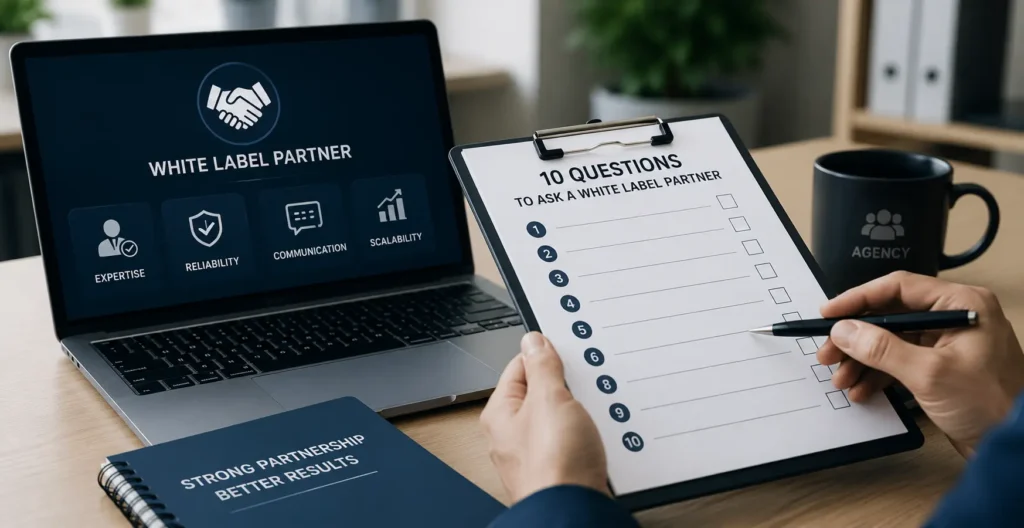
The agency owners who get burned by white-label partnerships rarely pick a bad partner on purpose. They picked one who said the right things on the call, had a decent portfolio, and quoted a number that worked. Then the first real project landed, and something went sideways: slow communication, rework that ate the margin, a developer who emailed the client directly. By the time it became obvious the relationship wasn’t going to work, there was a client deadline in three days and no clean exit.
The questions in this blog are designed to surface those problems before they happen. Not after the contract is signed. Not mid-project. Before you hand over a single brief.
Some of these will feel obvious. Ask them anyway. How a partner answers a question they’ve heard before tells you as much as the answer itself.
## Will you sign our NDA before seeing the brief?
Start here. Not because it’s the most interesting question, but because the answer is binary and the stakes are high.
A white label relationship only works if your clients never know the partner exists. That means the partner needs to be legally bound to maintain confidentiality before they see anything about your clients, project scope, pricing, or internal processes. If a partner hesitates, wants to use their own template without amendments, or suggests you can “sort the paperwork after we align on the project,” you have your answer before the meeting is over.
The NDA needs to cover more than general confidentiality. It should prohibit direct contact with your clients, prevent the partner from referencing any project in their public portfolio without your written consent, and explicitly cover the existence of the white label relationship itself. Our[ white label web development partner checklist](https://www.krishaweb.com/blog/white-label-web-development-partner-checklist/) goes into the specific clauses that need to be in the NDA for the relationship to be properly protected. Read it before you get to contract negotiations.
## Who actually builds the work?
You’d be surprised how often the person presenting the portfolio isn’t the person who’ll be touching your code.
Some partner agencies sell you on senior talent, put you through a polished discovery process, and then hand the build to junior developers or their own subcontractors. Ask directly: who writes the code for my projects? Is that person a full-time employee or a contractor? Will the developer I meet during onboarding be the one working on day one?
A credible partner answers this without hesitation. One that pivots to talking about “our team’s overall capabilities” or “our rigorous vetting process” without answering the actual question is usually telling you something without saying it.
***Already comparing two or three partners and not sure which questions matter most for your specific project type?** The[ 12-point agency evaluation checklist](https://www.krishaweb.com/blog/white-label-web-development-partner-checklist/) gives you a weighted scoring framework you can run every candidate through before committing. Takes about 20 minutes per partner.*
## Can you send live URLs, not screenshots?
Screenshots and Figma exports don’t tell you how a site actually performs under real conditions. Ask for live, working URLs of completed projects similar to the type of work you’d be sending them.
When you get the URLs, open them on your phone. Run them through PageSpeed Insights. Click through the CMS to see if it’s clean. Check the mobile experience. Any partner delivering quality work for serious clients will have live sites that hold up to a five-minute review. If the portfolio is all static images with no live links, or if the links redirect to pages that have been redesigned, take note.
Pay attention to whether the work matches your actual project mix. A partner with 30 eCommerce builds and zero SaaS marketing sites may not be the right fit for Webflow campaigns, even if their Shopify work is genuinely excellent.
## How do you communicate during a project?
Communication is the variable most agencies underweight in the evaluation and regret most in the delivery.
Ask specifically: who is my point of contact? What’s the expected response time for a standard query, and what happens if something urgent comes up outside business hours? How are status updates shared: daily messages, weekly summaries, or a shared project board?
A partner who takes 24 hours to respond during the sales process will take longer once you’re a signed client. Test this before you agree to anything. Send a detailed technical question early in the evaluation. If the response comes back in four hours and actually addresses what you asked, that’s a green flag. If it takes two days and answers a different question than the one you sent, you’ve learned something useful.
## What does your staging delivery process look like?
There’s only one acceptable answer here: every project goes to staging for your review before anything touches production.
Ask whether this is standard on every project or something they do when specifically requested. Then ask what happens if a client sees broken work on a live site before your team caught it. The response tells you whether QA is baked into how they work or treated as an optional add-on.
A partner without a formal staging process is asking you to carry quality risk that should sit on their side of the delivery. That’s fine to accept if you’ve built the margin to absorb it. Most agencies haven’t.
***Not sure whether your current volume justifies building a formal white label delivery process, or whether you should test the model first on a few projects?** We’ve run this conversation with a lot of agencies.[ Book a partnership call](https://api.leadconnectorhq.com/widget/bookings/book-a-call-with-parth-krishaweb) and we’ll give you an honest read on what makes sense for where you are right now.*
## What’s your revision policy, and is it in writing?
Scope ambiguity is the single most common source of financial friction in white label work. If the contract doesn’t define what’s included in the quoted price, how many revision rounds are covered, what constitutes a scope change versus a correction, and how out-of-scope requests are handled, you will be negotiating those terms under pressure at the worst possible moment.
Ask to see how the revision policy appears in a standard project agreement. A partner who handles this case by case rather than through a documented process is creating conditions for conflict every time feedback comes back from your client.
## Who owns the code and deliverables at the end?
Your client pays you. You should own everything. Full stop.
The contract needs to be unambiguous: all code, design files, CMS structures, and any other deliverable created specifically for your client’s project transfer to your agency as work for hire upon final payment. You should be able to take every file to a different developer for ongoing maintenance without needing to involve the original partner again.
There’s a reasonable nuance here. A partner’s proprietary base templates, internal frameworks, or reusable components remain theirs. You get a licence to use them in the delivered product, not ownership. That’s fair. What isn’t fair is vague IP language or “as licensed” phrasing in places where you expected “assigned.” If the ownership terms are fuzzy, ask for a rewrite. A partner confident in their work won’t resist it.
## Do you have references from other agencies, specifically?
End-client references and agency references measure different things. A firm that delivers excellent direct work isn’t automatically ready to operate invisibly under your brand. White label demands specific discipline: no portfolio credit, no direct client contact, comfort working within another agency’s process rather than their own, and accountability to your account team rather than a business owner. Those are learned behaviors, not defaults.
Ask for references from agencies that currently use or have recently used them as a white label partner. Then call those agencies. The questions that matter: Did the partner ever contact a client directly without authorization? Did their work ever appear in the partner’s public materials? How did they handle feedback that challenged their technical choices? What happened when something went wrong?
***Ready to see how KrishaWeb answers each of these questions directly?** We’ve been a white label development partner for agencies since 2008. NDAs signed before briefs. Full IP transfer at final payment. Dedicated account manager on every engagement.[ Book a partnership call](https://api.leadconnectorhq.com/widget/bookings/book-a-call-with-parth-krishaweb) and bring any questions from this list.*
## What’s your developer retention rate?
This one doesn’t get asked enough, and it matters more than most agencies realize.
Institutional knowledge is valuable in a white label relationship. A developer who has worked on five of your client projects over 18 months understands your standards, your communication style, your common client requests, and the nuances of how you deliver. When that developer leaves and a new one starts, you lose all of that and start the context-building process from scratch. Every restart costs you in briefing time, early-project rework, and inconsistent quality.
Ask what the retention rate is. Ask what drives it. A partner that can give you a real number and talk specifically about what they do to maintain it (compensation structure, career development, culture) has thought carefully about the thing that most directly affects your delivery consistency. One that pivots to vague culture talk hasn’t.
## Can we start with a paid pilot project?
This is the most reliable test in the entire evaluation, and every confident partner welcomes it.
Ask to pay for one well-scoped, medium-complexity project before you commit any client work to them. A single page, a defined feature, a contained CMS build. The goal isn’t to catch them out. It’s to see what working with them actually feels like: the quality of their code at first pass, how they communicate when something is ambiguous, whether they hit the deadline they committed to, and what receiving their deliverable looks like when it arrives.
A partner who declines a paid pilot is telling you they’re not confident in the first impression they’d make. That’s useful information, and it costs you almost nothing to find it out at this stage rather than after a client project is underway.
### Red Flags to Watch For
None of these are reasons to keep talking:
A proposal was sent within hours of the first conversation, with no discovery questions asked. That’s a template with your name inserted, not a scoped response to your project. No live portfolio URLs, only screenshots. An NDA was declined or treated as something to sort out later. Vague or deflected answers about who actually builds the work. No written revision policy. Pricing dramatically below market. Pressure to sign before you’ve run a pilot. And any resistance to the IP transfer clause on client-specific deliverables.
One of these might be a misunderstanding. More than one is your answer.
##### Additional Read
- [White Label Web Developer vs. Hiring an In-House Developer: The Real Cost Comparison](https://www.krishaweb.com/blog/white-label-vs-in-house-developer-cost/)
- [B2B White Label Agency Partnership: What SLAs and NDAs Should Cover](https://www.krishaweb.com/blog/white-label-agency-partnership-sla-nda/)
- [White Label vs Subcontracting vs Hiring: The Real Cost Comparison for Agencies](https://www.krishaweb.com/blog/white-label-vs-subcontracting-vs-hiring-agency/)
### How KrishaWeb Handles This
We get asked all ten of these questions regularly. Here’s where we land on each one.
NDA signed before the first brief, no exceptions. Full IP transfer on all client-specific deliverables at final payment, in plain language in the contract. Staging delivery on every project before anything touches production. Fixed-price quotes on standard builds so your margin is predictable before you commit. Paid pilots available for any agency that wants to test us on a contained project before trusting us with a client relationship. References from agencies available on request. Developer retention is tracked and is something we can speak to specifically.
We’ve built our white label practice around the requirements in this article because these are the things that protect your client relationships and your reputation. If you’re scaling your agency and need a[ **white label development partner**](https://www.krishaweb.com/white-label-web-development-services/) who can operate invisibly and consistently under your brand, the best place to start is a call.
[**Book a White Label Partnership Call with KrishaWeb**](https://api.leadconnectorhq.com/widget/bookings/book-a-call-with-parth-krishaweb)
### Frequently Asked Questions
**What’s the most important question to ask a white label web development partner?**If you could only ask one, ask about the NDA. Will they sign your NDA before seeing any brief, and does it cover direct client contact, portfolio disclosure, and the existence of the relationship itself? Everything else in the evaluation follows from whether the partner understands and respects the confidentiality requirements that make white label work viable. A partner hesitant on this point is not ready for the model.
**How do I know if a white label partner is actually experienced with agencies?**Ask specifically for references from other agencies who use them as a white label partner, not from end clients they’ve built for directly. Call those agencies and ask whether the partner ever contacted their clients without authorization, whether their work appeared in the partner’s public portfolio without consent, and how problems were handled when they arose. Agency experience is a specific skill set. End-client experience doesn’t automatically translate.
**What should a white label development contract cover?**At a minimum: full IP and code ownership transferred to your agency at final payment, the NDA terms including prohibition on direct client contact and portfolio disclosure, a written revision policy with defined scope and out-of-scope pricing, SLA response times per issue severity, staging delivery as standard process, and a termination clause that includes asset handover and surviving confidentiality obligations. If any of those are missing or vague, negotiate before signing.
**Is a paid pilot project standard with white label partners?**It should be, and confident partners offer it readily. A paid pilot on a low-stakes internal project or minor client update reveals more than any portfolio review or reference call. You see actual code quality, communication under real conditions, and what receiving the deliverable feels like. Any partner who declines a reasonable paid pilot is signaling something about the first impression they expect to make. Pay attention to that signal.
**How much should I expect to mark up white-label development work?**Industry data puts the sustainable gross margin for agency white label work at 50% to 70%. That’s the margin on your total cost of delivery, which includes your account management time, client communication, quality review, and the reputational risk you carry as the named agency on the project, not just markup on the partner invoice. If your current white label arrangements aren’t producing margins in that range, either the partner’s rate is too high or your account management overhead is eating more than it should. The[ white label vs in-house cost comparison](https://www.krishaweb.com/blog/white-label-vs-in-house-developer-cost/) works through this math in detail.
**What’s the difference between a white label partner and a freelancer for agency work?**A white label partner is a structured, ongoing relationship with an agreed process, SLA commitments, a confidentiality framework covering multiple engagements, and often dedicated capacity for your agency. A freelancer is typically project-to-project, with no SLA, limited process structure, and higher continuity risk if they become unavailable. For one-off projects, a freelancer can work. For building a reliable delivery capacity that can scale against client demand, a white label partner model is structurally more appropriate.

###### Parth Pandya
Founder & CEOFounder & CEO of KrishaWeb, leads an Enterprise Web Agency. With contributions to WordPress and organization of WordCamps, he pioneers innovation and community engagement in the digital realm.
 Interact With Me-
-
- [ ](mailto:)
---
_View the original post at: [https://www.krishaweb.com/blog/white-label-partner-questions-to-ask/](https://www.krishaweb.com/blog/white-label-partner-questions-to-ask/)_
_Served as markdown by [Third Audience](https://github.com/third-audience) v3.6.1_
_Generated: 2026-07-15 09:00:52 UTC_