---
title: "White Label React Native & Cross-Platform Apps: Adding Mobile to Your Agency Menu Overnight"
url: "https://www.krishaweb.com/blog/white-label-react-native-cross-platform-apps/"
date: "2026-11-12T12:42:23+00:00"
modified: "2026-11-12T12:42:24+00:00"
type: "Article"
resource: "https://www.krishaweb.com/blog/white-label-react-native-cross-platform-apps/"
timestamp: "2026-11-12T12:42:24+00:00"
author:
name: "Nirav"
url: "https://www.krishaweb.com"
categories:
- "Web Development"
word_count: 3241
reading_time: "17 min read"
summary: "A client asks if you can build them an app, and right now your answer is probably "let me get back to you", which usually means losing the work, or the whole relationship, to an agency that said ye..."
description: "Add mobile to your agency's menu under your own brand: React Native vs Flutter vs native, the 5-phase build, invisibility, pricing and App Store risk."
keywords: "white label react native app development, Web Development"
language: "en"
schema_type: "Article"
related_posts:
- title: "AI-Assisted Development: What It Is and When It Makes Sense for Your Business"
url: "https://www.krishaweb.com/blog/what-is-ai-assisted-development/"
- title: "White Label Front-End Developer vs. Hiring In-House: The Real 2026 Cost Comparison"
url: "https://www.krishaweb.com/blog/white-label-front-end-developer-vs-in-house-cost/"
- title: "How to Speed Up Your WordPress Site"
url: "https://www.krishaweb.com/blog/how-to-speed-up-your-wordpress-site/"
---
# White Label React Native & Cross-Platform Apps: Adding Mobile to Your Agency Menu Overnight
_Published: Thursday,November 12, 2026_
_Author: Nirav_
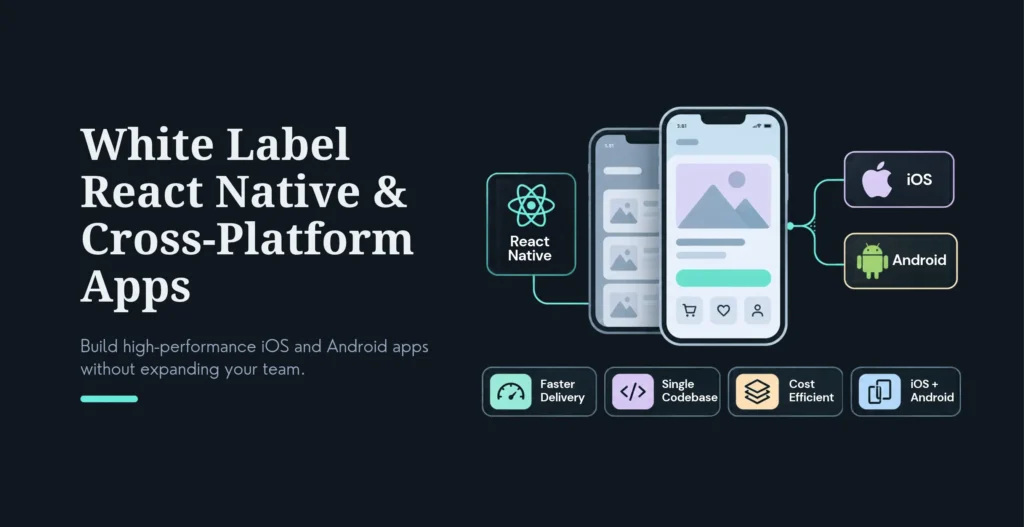
A client asks if you can build them an app, and right now your answer is probably “let me get back to you”, which usually means losing the work, or the whole relationship, to an agency that said yes faster. The frustrating part is that you don’t need a mobile team to say yes. White label React Native and cross-platform development lets you add mobile to your menu under your own brand, deliver it invisibly through a specialist partner, and keep the client, the pricing, and a healthy margin.
White label React Native and cross-platform app development is branded mobile engineering: a specialist partner builds a cross-platform app, from a single codebase that ships to both iOS and Android, under your agency’s brand, and your client never knows a subcontractor was involved. You own the client relationship, strategy, and pricing; the partner owns the build, the integrations, QA, and store submission. React Native is the natural choice when your team already works in React or TypeScript, or when the app shares logic with a React website, because it reuses that ecosystem and ships to both platforms at near-native quality. Pricing spans a wide range by ambition, a focused MVP commonly runs into the tens of thousands over a few months, a full custom platform higher, with ongoing maintenance as a recurring retainer, and agencies typically run healthy gross margins reselling it. It stays invisible by design: an NDA before the first call, all assets branded to you, and the partner never contacting your client.
This is the decision playbook for agency owners and product leads: which framework to pick (React Native vs Flutter vs native), how the build actually runs, how invisibility works, real pricing and margins, how to vet a partner, and the risks unique to white-label mobile (App Store rejection chief among them). Not being able to offer mobile is one of the **[bottlenecks that stall agency growth](https://www.krishaweb.com/blog/bottlenecks-that-stop-digital-agencies-from-scaling/)**, and this is how you clear it without hiring. It’s the model behind our own **[white label design and development](https://www.krishaweb.com/white-label-web-design-services/)** (**[web development services](https://www.krishaweb.com/white-label-web-development-services/)** included).
##### Key Highlights
- **What it is:** A specialist builds a cross-platform mobile app under your brand; your client never knows. You keep the client, strategy, pricing, and margin; the partner owns the engineering, integrations, QA, and store submission.- **Framework in one line:** React Native when your team is React/TS or the app shares logic with a React site; Flutter when pixel-perfect design consistency matters most; native (Swift/Kotlin) when the app needs deep hardware access or platform-specific polish.- **The 5-phase build:** discovery and scoping → UX design → development and integration → testing and QA → launch and post-launch support. Don’t skip paid discovery; it’s where budget is protected.- **Pricing (vendor-reported ranges):** a focused MVP commonly runs the tens of thousands over a few months; mid-range platforms higher; enterprise builds into six figures over many months. Maintenance is a recurring monthly retainer. Verify with a scoped quote.- **Margins:** agencies typically run 40-75% gross reselling white-label mobile, higher on maintenance retainers than on one-off builds. Mark up on the value you add (strategy, PM, client relationship).- **The invisibility rule:** NDA before the first call, all assets (proposals, design files, builds) branded to you, communication through your tools, store submission under the client’s developer account, partner never contacts the client.- **The risk competitors ignore:** App Store / Play Store rejection of thin, template-style apps. A custom-built, genuinely-valuable app clears review; a rebranded template often doesn’t. Apple’s guideline 4.2.6 even requires template-built apps to be submitted by the content owner. This is the single biggest reason to build custom rather than reskin a clone.
## What White Label React Native App Development Is
It’s branded mobile engineering, not a product you resell. A specialist partner builds the app behind the scenes while you manage the client and ship the finished product as your own, the client sees your name on the proposal, the design files, the progress updates, and the final delivery, and the partner stays invisible throughout. The scope is full-service: native iOS and Android or cross-platform (React Native, Flutter), UI/UX design, backend and API development, third-party integrations, store submission, and ongoing maintenance.
React Native specifically is an open-source framework created by Meta and, since February 2026, governed by the independent **[React Foundation](https://www.theregister.com/2026/02/25/meta_sends_react_to_live/)** under the Linux Foundation, for building mobile apps in JavaScript or TypeScript with React, using native platform components for the interface while sharing application logic across platforms. That’s its core advantage for a lot of agencies: one codebase ships to both iOS and Android, and if your team already lives in the React/JS ecosystem, or the app shares business logic and types with an existing React website, you reuse all of that rather than standing up two separate native builds. The important distinction to hold onto, and it matters for the risk section later, is that white label React Native is custom delivery, a real app built for your client with their logo, colors, and features, not a template you reskin. That difference is small on a spec sheet and enormous at App Store review.
## Which Framework: React Native vs Flutter vs Native
This is the first real decision, and getting it right is part of the value you add as the agency. The honest framing: all three can build an excellent app, and the right one depends on your team, the app’s needs, and the budget, not on which is “best.”
Choose React Native when your developers already write **[React](https://www.krishaweb.com/reactjs-development/)** or TypeScript, when the app shares logic with a React website (you reuse business logic and types), when the budget needs to cover both platforms from one codebase, and when time to market matters more than squeezing out every drop of platform-specific polish. Choose Flutter when design consistency and pixel-perfect UI across both platforms is the top priority, its single Dart codebase renders its own UI, giving tight control over look and feel. Choose native (Swift for iOS, Kotlin for Android) when the app genuinely needs deep hardware access or platform-specific capabilities that cross-platform frameworks handle less cleanly, or when platform-specific polish is the whole point, accepting that you’re maintaining two separate codebases at higher cost and slower pace.
The reality for most business-grade apps in 2026 is that cross-platform (React Native or Flutter) delivers near-native quality from a single codebase, which is why it’s the default for the majority of white-label work, with vendors commonly reporting roughly half the development cost of two native builds. Reserve native for the genuine deep-hardware cases. And when you’re choosing between the two cross-platform options, let your team’s existing stack break the tie: a React/TS shop should almost always pick React Native, because the reuse advantage is real and compounding.
## How the Build Runs: The 5 Phases
A proper white-label mobile engagement runs in five phases, and knowing them lets you set client expectations accurately, which is half your job as the agency of record.
Phase one, discovery and scoping, is the most undervalued and the one agencies are tempted to rush. This is where requirements get formally documented, edge cases surface, and the budget gets protected, a good partner runs a paid discovery sprint (user stories, wireframes, data schemas, a fixed-price estimate) precisely because clarity here prevents expensive surprises later. Phase two, UX design, produces wireframes, user flows, and high-fidelity designs, branded to your client from the very first mockup (their logo, colors, and typography), so there’s never a generic-looking artifact to hide. Phase three, development and integration, runs in two-to-four-week sprints with demo builds shared for review at each one, which keeps the client engaged and catches direction changes while they’re cheap, and it’s where third-party services get integrated and the app gets tested on real iOS and Android devices, not just simulators. Phase four, testing and QA, puts the app through structured testing across a real device lab on both platforms. Phase five, launch and post-launch support, handles store submission (under your client’s own developer account, which matters for ownership), followed by ongoing maintenance, OS-compatibility updates, bug fixes, and feature work, typically as a monthly retainer.
That last phase is where a lot of the business value lives: the build is a one-time fee, but mobile apps need continuous maintenance (OS updates alone force regular work), so the maintenance retainer is recurring, high-margin revenue that turns a single project into an ongoing client relationship. Price and sell the retainer deliberately; it’s often worth more over time than the build itself.
## How It Stays Invisible
Invisibility is the promise you’re selling, and with mobile it has a few specifics worth nailing. The principle is simple: the client sees your agency’s name on everything, proposals, progress updates, design files, builds, final delivery, and the partner never surfaces. Nothing the partner produces goes to the client directly; it all routes through you, and every touchpoint (Slack, email, meeting invites, even developer email addresses if the partner joins a shared channel) carries your brand.
To make it hold: get a mutual NDA signed before the first real conversation (any competent partner signs before the first call, not after discovery), covering client names, project specs, business logic, and all deliverables, backed by non-solicitation so the partner can’t approach your client. Run communication through your own project tools. Ensure all code, design files, and documentation carry your branding, not the partner’s. And get the mobile-specific ownership details right: full source code and repository access should transfer to you (or the client) at a defined project milestone, not “available on request,” and the app should be submitted under the client’s own App Store and Play Store developer accounts so they own their store presence. A quick vetting test: ask to see a sample deliverable from a previous white-label engagement, if it’s genuinely unbranded and client-ready, the partner does this properly.
## Pricing and Margins
Treat these as vendor-reported planning ranges that vary widely with scope, complexity, and partner geography, and scope every real quote. The shape by ambition: a focused MVP, a single cross-platform app with core features, commonly runs into the tens of thousands over roughly three to four months; a mid-range platform with more customization and a backend runs higher over four to seven months; and an enterprise-grade build with a custom backend, deep integrations, and multi-tenant architecture reaches well into six figures over many months. At the fast, cheap end, some partners offer rapid “clone” deliveries of a ready-made platform for a few thousand dollars in days, useful for speed but carrying the template risks covered below. Maintenance is separate and recurring, commonly a few thousand dollars a month depending on the app’s complexity and the retainer’s scope.
On margins, white-label mobile is attractive precisely because the resale spread is large: agencies typically run gross margins in the 40-75% range, with the lower end on one-off project builds and the higher end on ongoing maintenance retainers, where disciplined operators do best. You mark up on the value you add, strategy, design direction, project management, and the client relationship, so the more of that you own, the more markup you justify. Two honest caveats a product lead should price in: that gross figure is before your own account-management and QA time, so net runs lower; and mobile has real ongoing obligations (OS updates, store-policy changes) that the maintenance retainer must actually fund, don’t under-price it to win the build. For the deeper build-vs-partner economics, our **[agency vs in-house cost](https://www.krishaweb.com/blog/ai-agency-vs-in-house-cost/)** breakdown runs the comparison.
## Choosing a Partner, and the Risks to Manage
Vet a white-label mobile partner on both the standard criteria and the mobile-specific ones. The non-negotiables: an NDA signed before the first call and non-solicitation; genuine stack depth across the frameworks you’ll sell (React Native, Flutter, and native Swift/Kotlin for the cases that need it); contractual IP transfer with full repository access at a milestone (not “code on final payment”); a structured discovery process and milestone-based billing (not open-ended time-and-materials); strong QA habits including a real device lab; compliance credentials if you serve regulated clients; and a few hours of timezone overlap for daily coordination. The questions that cut through: How do you handle the NDA, code ownership, and client contact? Can you show live apps in the stores (not just mockups) from similar engagements? What’s your discovery and change-control process? And can we start with a small paid pilot? Walk away from anyone who won’t sign protections upfront, is vague on IP, or can only show screenshots instead of shipped apps. Apply the rigor a client uses when **[choosing an agency](https://www.krishaweb.com/blog/how-to-choose-web-design-agency/)**; you’re making the same bet.
The risks here are mostly manageable, but one is specific to white-label mobile and deserves emphasis: App Store and Play Store rejection of template-style apps. Apple’s [App Store Review Guidelines](https://developer.apple.com/app-store/review/guidelines/) are specific about this. Guideline 4.2.6 says apps created from a commercialized template or app-generation service will be rejected unless they are submitted directly by the provider of the app’s content, and guideline 4.3 (spam) targets apps that duplicate one another or are indistinguishable from what the store already carries. That is why submitting under the client’s own developer account is a requirement, not only an ownership nicety, and why an agency pushing many reskinned apps through one account is the pattern most likely to be rejected. A rebranded template can get rejected and leave your client (and your reputation) stranded, so the mitigation is to build custom, or at least genuinely customize features and UX beyond a template, and to use a partner with a track record of actually getting apps approved on both stores. The related risks all point the same way: vendor dependency (a SaaS clone means you’re renting technology that can go down, versus owning source code on a custom build), generic UX (a shared template is hard to differentiate and reflects on your brand), and limited customization (a template sandbox blocks client-specific features). Every one of these is mitigated by the same choice, favor a custom cross-platform build with full source-code ownership over a reskinned clone, except where speed and budget genuinely outweigh ownership and differentiation. That trade-off is the real decision underneath the pricing.
##### Additional Read
- [White Label Front-End Developer vs. Hiring In-House: The Real 2026 Cost Comparison](https://www.krishaweb.com/blog/white-label-front-end-developer-vs-in-house-cost/)
- [White Label Next.js & Headless Development: Reselling High-Performance Sites Clients Now Expect](https://www.krishaweb.com/blog/white-label-nextjs-headless-development/)
- [White Label Front-End Development: How Agencies Turn Design Files Into Production Code, Fast](https://www.krishaweb.com/blog/white-label-front-end-development/)
### Frequently Asked Questions
**What is white label React Native app development?**It’s branded mobile engineering: a specialist partner builds a cross-platform app (one codebase shipping to iOS and Android) under your agency’s brand, while you manage the client and present the finished product as your own. The client sees your name on everything, proposals, designs, builds, delivery, and the partner stays invisible. You own the client relationship, strategy, and pricing; the partner owns the build, integrations, QA, and store submission. It lets an agency add mobile to its menu without hiring and retaining scarce mobile developers.
**React Native vs Flutter vs native, which should I choose?**React Native when your team already writes React or TypeScript, or the app shares logic with a React website, you reuse that ecosystem and ship to both platforms from one codebase, with fast time to market. Flutter when pixel-perfect design consistency across platforms is the top priority. Native (Swift/Kotlin) when the app needs deep hardware access or platform-specific polish, accepting two codebases at higher cost and slower pace. For most business apps, cross-platform delivers near-native quality at roughly half the cost of two native builds, as vendors report; let your team’s existing stack break the React-Native-vs-Flutter tie.
**How does the build process work?**Five phases: discovery and scoping (requirements documented, edge cases found, budget protected, often a paid discovery sprint), UX design (wireframes and high-fidelity designs branded to your client from the first mockup), development and integration (two-to-four-week sprints with demo builds for review, third-party integrations, real-device testing), testing and QA (structured testing across a real device lab on both platforms), and launch and post-launch support (store submission under the client’s developer account, then an ongoing maintenance retainer). Don’t let discovery be rushed, it’s where the budget is protected.
**How does it stay invisible to my client?**By design. The client sees your agency’s name on every proposal, design file, update, and build; nothing from the partner goes to the client directly; communication runs through your tools; and all code and documentation carry your branding. It’s locked with a mutual NDA signed before the first call (covering client names, specs, and deliverables) plus non-solicitation. Mobile-specific: full source code and repo access transfer to you or the client at a defined milestone, and the app is submitted under the client’s own App Store and Play Store accounts, so they own their store presence and the partner never appears.
**How much does white label React Native development cost, and what margin can I make?**Vendor-reported ranges, so verify with a scoped quote: a focused MVP commonly runs into the tens of thousands over three to four months; a mid-range platform higher over four to seven months; an enterprise build into six figures over many months; rapid template “clones” a few thousand dollars in days (with trade-offs). Maintenance is a separate recurring retainer, commonly a few thousand a month. Agencies typically run 40-75% gross margin reselling it, higher on maintenance retainers than one-off builds. Mark up on the value you add; price net of your own PM and QA time; and fund the maintenance retainer properly, since OS updates force ongoing work.
**Why do template/clone apps get rejected from the App Store?**Because Apple and Google both have strict policies against apps that are too similar to existing ones or offer little genuine value, and reskinned templates frequently trip those rules. Apple’s guideline 4.2.6 specifically rejects apps created from a commercialized template or app-generation service unless the provider of the app’s content submits them. A rejected app leaves your client stranded and damages your reputation, so it’s the single biggest reason to favor a custom build, or at minimum genuine customization of features and UX, over a cheap clone. Use a partner with a demonstrated track record of getting apps approved on both stores, and treat “can you show me live apps you’ve shipped to the stores?” as a required vetting question, not an optional one.
**How do I choose a white label mobile partner?**Require an NDA before the first call and non-solicitation; genuine depth in the frameworks you’ll sell; contractual IP transfer with full repo access at a milestone (not “on final payment”); a structured discovery process and milestone-based billing; strong QA with a real device lab; compliance credentials if you serve regulated clients; and timezone overlap for coordination. Ask how they handle NDA, code ownership, and client contact; ask to see live, shipped apps from similar work (not mockups); and start with a small paid pilot. Walk away from anyone vague on IP, unwilling to sign protections upfront, or who can only show screenshots.
**Should I use a cheap clone or a custom React Native build?**A clone is fast and cheap (a few thousand dollars, days to launch) but carries real downsides: vendor dependency (you’re renting technology that can go down), limited customization (a template sandbox), generic UX that’s hard to differentiate, and elevated App Store rejection risk. A custom cross-platform build costs more and takes longer but gives full source-code ownership, unlimited customization, a differentiated UX, and a far cleaner path through store review. Choose the clone only when speed and budget genuinely outweigh ownership and differentiation; for anything client-critical or meant to last, the custom build is the safer, more defensible call.
### Conclusion
Clients will keep asking for apps, and the agencies that grow are the ones who can say yes immediately, under their own brand, without having built a mobile team they then have to keep busy. White label React Native and cross-platform development is how you do exactly that: a specialist owns the engineering invisibly while you keep the client, the pricing, and a strong margin, and turn a one-off build into a recurring maintenance relationship.
The model rewards a product lead who gets three calls right. Pick the framework by your team and the app’s real needs, React Native when you’re a React/TS shop or sharing web logic, and be honest about when native is genuinely required. Keep the partner invisible and the ownership yours, NDA before the first call, source code and store accounts in your or the client’s hands. And steer clear of the clone trap: build custom enough to clear App Store review and differentiate your client’s brand, because a rejected or generic app costs you the reputation the whole arrangement was meant to protect. Do that, and you can add mobile to your menu overnight, and actually keep the clients it wins you.
**Ready to add mobile to your agency menu?**
**[Explore our White Label Web Design & Development](https://www.krishaweb.com/white-label-web-design-services/)** to see how we build React Native and cross-platform apps under your brand, with NDA, clean source-code transfer, store submission under your client’s account, and QA on real devices as standard.
**[Book a consultation](https://www.krishaweb.com/contact-us/)** to talk through the app your client is asking for and get a scoped proposal.

###### Nirav Panchal
Lead – Custom DevelopmentLead of the Custom Development team at KrishaWeb, holds AWS certification and excels as a Team Leader. Renowned for his expertise in Laravel and React development. With expertise in cloud solutions, he leads with innovation and technical excellence.
 Interact With Me- [ ](https://twitter.com/iamNiravPanchal)
- [ ](https://www.linkedin.com/in/nirav-panchal-5b299385/)
- [ ](mailto:niravp@krishaweb.com)
---
_View the original post at: [https://www.krishaweb.com/blog/white-label-react-native-cross-platform-apps/](https://www.krishaweb.com/blog/white-label-react-native-cross-platform-apps/)_
_Served as markdown by [Third Audience](https://github.com/third-audience) v3.6.1_
_Generated: 2026-11-12 12:42:25 UTC_