---
title: "White Label vs. Outsourcing vs. Freelancers: Which Model Actually Scales an Agency?"
url: "https://www.krishaweb.com/blog/white-label-vs-outsourcing-vs-freelancers/"
date: "2026-09-14T13:37:53+00:00"
modified: "2026-09-14T13:37:56+00:00"
type: "Article"
resource: "https://www.krishaweb.com/blog/white-label-vs-outsourcing-vs-freelancers/"
timestamp: "2026-09-14T13:37:56+00:00"
author:
name: "Parth"
url: "https://www.krishaweb.com/"
categories:
- "Web Development"
word_count: 2921
reading_time: "15 min read"
summary: "Ask ten agency owners the difference between white label, outsourcing, and freelancers, and you will get ten slightly different answers, right up until a project goes sideways and the difference su..."
description: "White label, outsourcing, or freelancers? All three can work, but only one scales brand-critical agency work. Here is when to use each and why it matters."
keywords: "white label vs outsourcing agency, Web Development"
language: "en"
schema_type: "Article"
related_posts:
- title: "White Label Webflow CMS & Advanced Interactions: Selling Premium Builds Your Team Cannot Produce In-House"
url: "https://www.krishaweb.com/blog/white-label-webflow-cms-interactions/"
- title: "Figma to Webflow: How Agencies Deliver Client-Editable Sites Without a Webflow Developer on Payroll"
url: "https://www.krishaweb.com/blog/figma-to-webflow-white-label/"
- title: "8 Best Laravel Development Tools to Know"
url: "https://www.krishaweb.com/blog/8-best-laravel-development-tools-to-enhance-development-performance/"
---
# White Label vs. Outsourcing vs. Freelancers: Which Model Actually Scales an Agency?
_Published: Monday,September 14, 2026_
_Author: Parth_
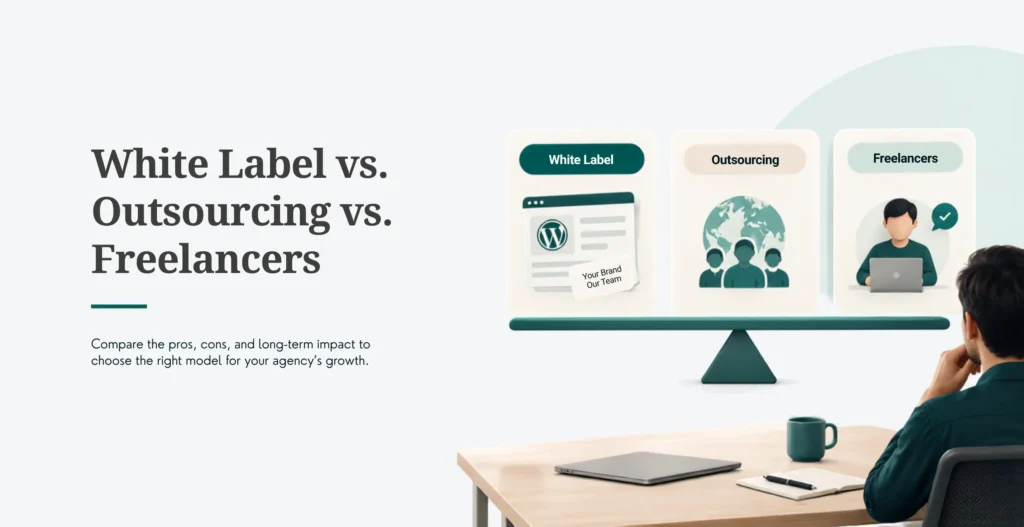
Ask ten agency owners the difference between white label, outsourcing, and freelancers, and you will get ten slightly different answers, right up until a project goes sideways and the difference suddenly matters a great deal. The white label vs outsourcing agency question is not just semantics. It decides who your client thinks they are working with, who is on the hook when a deadline slips, and how much margin you actually keep.
Here is the short version. Outsourcing is about who does the work. White label is a specific kind of outsourcing where that “who” stays invisible and everything ships under your brand. Freelancers are individual contractors you hire by the task or the hour. All three can work. The mistake that quietly kills agency margins and client trust is using the wrong one for the wrong kind of work.
By the end of this, you will know exactly when to reach for each and why white label tends to be the only one of the three built to scale the work your reputation actually depends on. If you want the deeper mechanics of the model itself, [**our white label web development guide**](https://www.krishaweb.com/blog/white-label-web-development-guide/) covers those; this piece is about choosing between the three.
## What Each Model Actually Means
Before comparing them, it is worth being precise, because the loose usage is exactly where agencies get into trouble.
White label development means a partner builds the work and you deliver it under your own name. Your client never sees the partner, never talks to them, and never receives a deliverable with anyone else’s logo on it. The whole arrangement is built for agencies: defined SLAs, a QA process, and brand consistency baked in, because the partner’s business depends on making yours look good. Invisibility is the point, not a side effect.
Traditional outsourcing is broader. It simply means handing work to an external team or company that you would otherwise do in-house. Sometimes the client knows about them, sometimes they do not; the branding and the communication vary from deal to deal. It tends to be task- or project-based, and it is not necessarily woven into your brand at all. A hosting provider is outsourcing. So is a specialist studio you bring in for one piece of a project.
Freelancers are individuals you hire per task or per hour. They give you flexibility, and the good ones are excellent, but quality, availability, and process vary from person to person, and you are the one holding it together. You write the brief, you run the QA, and you chase the timeline.
One line clears up most of the confusion: every white label arrangement is a form of outsourcing, but not every outsourcing arrangement is white label. The white label part is specifically about staying invisible and delivering under your brand. Miss that distinction, and you will pick the wrong model for your most important work.
## The Honest Side-by-Side
Here is how the three compare on the things agency owners actually feel, not the things that look good on a vendor’s website.
| **Factor** | **White Label Partner** | **Traditional Outsourcing** | **Freelancers** |
|---|---|---|---|
| Client sees your brand | Always | Sometimes | Sometimes |
| Direct client contact by provider | No, by design | Possible, often common | Possible |
| Branding on deliverables | 100% yours | May carry vendor branding | Mixed |
| Quality control | Documented QA and peer review | Variable, may lack formal QA | Variable, you often fix it |
| Project management load | Partner-managed | You often coordinate | You coordinate and chase |
| Reliability and cover | Team continuity, backups | Depends on vendor | One person’s availability |
| Scalability | Built for concurrent projects | Flexible, needs your PM | Breaks under volume |
| Pricing predictability | Retainers or packaged rates | Project or hourly, varies | Hourly, prone to surprises |
| Best for | Core, brand-critical, recurring work | One-off specialist tasks | Small fixes, niche one-offs |
| Risk to client relationship | Low, NDA and non-solicit | Medium to high if visible | Medium, depends on the person |
Read down the columns and a pattern shows up fast. White label wins wherever brand continuity, predictability, and scale matter. Outsourcing and freelancers hold their own for isolated, low-risk work, the stuff where nobody’s reputation is on the line if it wobbles. The trick is matching the model to the stakes, which is what the rest of this comes down to. If you are ready to evaluate partners specifically, [**our guide on how to choose a white label partner**](https://www.krishaweb.com/blog/white-label-web-development-partner-checklist/) walks through it.
## When White Label Is Clearly the Right Call
There are a handful of situations where white label does not just edge out the alternatives, it is the obvious answer, and recognizing them saves you a lot of pain.
The first is brand-critical work. Rebrands, full website builds, multi-channel campaigns, anything where consistency is the product. If a client is judging your agency on the quality and coherence of what ships, you cannot afford the variance that comes with a rotating cast of freelancers or a visible third party who does things their own way.
The second is recurring work. Retainers, ongoing development, the steady stream of improvements a live product needs. This is where white label genuinely compounds: once a client sits on a maintenance or development retainer delivered under your brand, the revenue is predictable, the margin is steady, and the relationship stays anchored to you. Freelance roulette cannot give you that continuity.
The third is scaling without hiring. When you want to take on more work than your current team can handle but you are not ready to carry the fixed cost of new salaries, white label turns that fixed cost into a variable one. You pay for delivery when you have a paying client in front of you, and not a rupee before.
The fourth is protecting the client relationship itself. If the idea of a third party being visible to your client, or able to go around you, makes you uneasy, white label is the only model built to prevent it. NDAs and non-solicit terms are standard, and the partner’s whole incentive is repeat agency work, not poaching your client.
And the fifth is margin predictability. Packaged pricing and SLAs make it far easier to quote a project, protect your gross margin, and know what you will clear before you start.
Picture the common before-and-after. An agency juggling five freelancers across three client projects, playing project manager, QA lead, and firefighter all at once, moves to a single white label pod. The missed-deadline problem largely disappears, because continuity and backup cover are built in, and the freed-up time goes into the thing that actually grows the agency: upselling retainers. That shift, from coordinating chaos to selling recurring work, is the whole case in miniature. If you are also weighing this against hiring internally, **[our breakdown of white label vs in-house cost](https://www.krishaweb.com/blog/white-label-vs-in-house-developer-cost/)** runs the numbers.
## When Plain Outsourcing Still Makes Sense
It would be dishonest to pretend white label is always the answer, so here is where ordinary, non-white-label outsourcing is genuinely the better fit.
Specialist one-offs are the clearest case. Sometimes the client actually benefits from knowing who did the work, a renowned illustrator, a named technical consultant, or a specialist whose reputation adds value to the engagement. Hiding them would be counterproductive.
Back-office and infrastructure work is another. Hosting, server infrastructure, and data tasks the client never sees and never needs to. There is no brand perception at stake, so invisibility buys you nothing.
Co-branded partnerships, where the partner’s brand genuinely adds credibility to the engagement, are a third. And so is internal agency work: building your own website, your own tools, and your own marketing assets, where there is no client-facing angle at all.
The principle underneath all of these is simple. If there is no client-facing relationship to protect and no brand perception on the line, standard outsourcing is perfectly fine and often the more sensible choice.
## When Freelancers Are Enough, and When They Quietly Become the Bottleneck
Freelancers deserve a fair hearing, because they are genuinely the right tool in the right spot.
They work well for small, well-defined tasks: a single landing page, a component, or a quick fix with clear edges. They suit flexible timelines and work that can absorb a delay without a client ever noticing. And they are fine wherever brand risk is low, where a bit of quality variance will not dent anyone’s trust in you.
Where they stop working is the moment the stakes rise. Core client delivery, where a missed deadline or a quality slip lands directly on your reputation, is not a place for single-point-of-failure staffing. Neither is a stretch of multiple concurrent launches, because individual capacity simply breaks when three projects peak in the same week; one person cannot be in three places. And retainer-style work, where continuity and consistent QA matter more than one-off speed, is exactly what freelancers are worst suited to.
The honest way to put it: freelancers are a tool, not a scaling strategy. They are a complement to your delivery model, not the backbone of it. Agencies that try to build their core delivery on freelancers alone tend to hit a ceiling and mistake it for bad luck. When you are ready to move past that, knowing how to choose a white label partner is the next step.
## The Part Everyone Gets Wrong: Cost Versus Margin
Here is where agencies talk themselves into the wrong decision. The cheapest option on paper is very often the least profitable in practice, because the paper price leaves out the expensive part.
Take freelancers. The apparent cost is low, an attractive hourly rate, a tidy quote. The hidden cost lives in the rework, the coordination, and the QA you absorb. Every hour a senior person on your team spends fixing a freelancer’s output or herding three contractors is margin quietly bleeding out, and it never shows up on the original invoice.
Traditional outsourcing sits in the middle. Project or hourly rates can be genuinely cost-effective for isolated work. But your real margin depends on two things the quote does not mention: how visible the vendor is, and how much project management you end up carrying yourself.
White label is priced for exactly this problem. Packaged or retainer pricing is designed to be resold, and the industry norm in 2026 is a gross margin of 50 to 70% on the total cost of delivery when you price at market rates. The phrase “total cost of delivery” is the key: it is not markup on the partner’s fee alone, it is markup on the partner’s fee plus your own overhead, the account management, the client communication, the quality review, and the risk premium for guaranteeing a result you are delivering through someone else. Over time the unit economics get better still, because less rework and more predictable delivery mean fewer of those invisible hours.
The scenario makes it concrete. A freelancer builds something for $3,000, and it needs ten hours of senior internal time to fix and finish before it is client-ready. A white label partner delivers a comparable build for $4,000, client-ready, nothing to fix. On paper the freelancer is a thousand dollars cheaper. Once you price in ten hours of your most expensive people, plus the delay, plus the context-switching, the “cheaper” option is frequently the one that costs you more and ships later. The higher sticker price with none of the rework is usually the better deal, and reliably the better margin. **[Our white label vs in-house cost piece](https://www.krishaweb.com/blog/white-label-vs-in-house-developer-cost/)** takes this further against the hiring option.
## Risk and Control: What Actually Breaks First When You Scale
Margins are one half of the decision. Risk is the other, and it is the half agency owners feel most sharply, usually at the worst possible moment.
There is brand risk. Freelancers and some outsourcers produce inconsistent quality and branding, because nothing structurally ties them to your standards. A white label partner is incentivized to match your brand precisely, because their entire business depends on repeat work from agencies like yours. Their interests and yours point the same direction.
There is client-relationship risk. A visible third party can, over time, form a direct relationship with your client, and in the worst case bypass you entirely. Proper white label agreements close that door with NDAs and non-solicit clauses. It is not that you distrust the partner; it is that the model is built so the question never comes up.
There is delivery risk. A freelancer can get sick, disappear, or simply prioritize a better-paying gig, and suddenly your client project has no one on it. A white label partner brings team continuity and backup capacity, so one person’s bad week is not your emergency.
And there is process risk, the quiet one. With freelancers and ad-hoc outsourcing, you gradually become the default project manager and QA gate for work you are paying someone else to do. A white label partner brings its own PM layer and its own QA checkpoints, which lifts that load off your team instead of adding to it.
Add it up and the pattern is clear: white label shifts risk away from you, while freelancers and generic outsourcing leave most of it sitting on your shoulders. When you are scaling, that difference is the difference between growth that feels controlled and growth that feels like a series of near-misses.
## A Simple Framework for Deciding
You do not need a spreadsheet for this. You need to match the work to the stakes.
Reach for white label when the work is brand-critical and client-facing, when you need predictable throughput across several clients at once, when you want to grow retainer revenue without hiring, or when the client relationship is long-term and high-value. This is your core delivery, the work your reputation rides on.
Reach for traditional outsourcing when the work is specialist or one-off and the brand risk is low, when the client does not need to see a single unified team, or when you are genuinely comfortable with the vendor being visible or credited.
Reach for freelancers when the scope is small and well-defined, when the timeline is flexible and not client-critical, and when you have enough internal QA to absorb the variance without it reaching a client.
If your agency’s whole positioning is “we handle everything under one roof,” then white label is almost always the right fit for core delivery, because it is the only one of the three that lets you keep that promise while someone else does the building.
##### Picked white label? Now pick the right partner.
Grab our free 15-point White Label Partner Scorecard to vet and compare partners, then book a call.
[Download the Free Scorecard](https://www.krishaweb.com/download/white-label-partner-scorecard/) [Book a Partnership Call](https://api.leadconnectorhq.com/widget/bookings/book-a-call-with-parth-krishaweb)
## How We Structure White Label at KrishaWeb
For the sake of being concrete rather than theoretical, here is how we run it.
Client invisibility is absolute: no direct contact, every communication routed through your team, and neutral staging with nothing that identifies us. Brand alignment means we work to your templates, your naming, and your processes where you need us to. Delivery is SLA-backed, with clear timelines, a defined revision policy, and an escalation path, so you always know where a project stands. QA gates sit before anything reaches your team or your client, so what you see is already checked. IP and confidentiality are handled with an NDA, IP assignment to you, and non-solicit terms as standard, not as an upsell. And the engagement model flexes to your pipeline, project-based, retainer, or dedicated capacity, depending on what you actually need.
If you are weighing white label against outsourcing and freelancers for your 2027 capacity, the low-risk way to test the fit is a small pilot project. You will learn more from one real build than from any sales call. That is exactly what **[our white label web development services](https://www.krishaweb.com/white-label-web-development-services/)** are set up to do.
##### Additional Read
- [White Label Web Development in 2026: The Complete Agency Guide to Scaling Without Hiring](https://www.krishaweb.com/blog/white-label-web-development-guide/)
- [White Label WooCommerce Development: How Agencies Add eCommerce Without eCommerce Developers](https://www.krishaweb.com/blog/white-label-woocommerce-development/)
- [Which White Label Pricing Model Is Best for Your Agency? Fixed Price vs. Retainer vs. Dedicated Developer](https://www.krishaweb.com/blog/white-label-pricing-model/)
### Frequently Asked Questions
**What is the difference between white label and outsourcing for an agency?**Outsourcing is about who does the work. White label is a specific type of outsourcing where the partner stays invisible to the client and everything is delivered under your brand. Every white label arrangement is outsourcing, but not every outsourcing arrangement is white label.
**Is white label better than using freelancers?**For core, brand-critical client work, yes. White label offers more reliability, documented QA, and real scalability. Freelancers are better suited to small, well-defined, low-risk tasks, and they work best as a complement to your delivery model rather than its backbone.
**Can an outsourced team contact my clients directly?**In traditional outsourcing, it is possible and sometimes expected. In a proper white label arrangement, no: NDAs and non-solicit clauses prevent any direct client contact without your approval. That protection is a core feature of the model.
**Which model is best for scaling an agency in 2026 and 2027?**White label is usually best for scaling brand-critical, recurring work without adding headcount. Outsourcing and freelancers work well for one-off or low-risk tasks, but they do not scale core delivery the way white label does.
**How do margins compare between white label, outsourcing, and freelancers?**White label commonly supports 50 to 70% gross margins when priced at market rates, on the total cost of delivery. Freelancers can look cheaper on paper but often erode margin through rework and management time. Outsourcing sits in between, depending on vendor visibility and how much project management you absorb.
### Not Sure Which Model Fits Your 2027 Plan?
If you are looking at your pipeline for next year and trying to work out where white label, outsourcing, and freelancers each fit, we are happy to talk it through, no pressure and no obligation. We work with agencies across a wide range of platforms and project types, so we can be honest about where each model serves you and where it does not.
**[Book a white label strategy call](https://www.krishaweb.com/contact-us/)**, or start with a pilot project and let the work speak for itself.
Explore **[our white label web development services](https://www.krishaweb.com/white-label-web-development-services/)**, read the full white label web development guide, or compare the numbers in **[our white label vs in-house cost breakdown](https://www.krishaweb.com/blog/white-label-vs-in-house-developer-cost/)**.

###### Parth Pandya
Founder & CEOFounder & CEO of KrishaWeb, leads an Enterprise Web Agency. With contributions to WordPress and organization of WordCamps, he pioneers innovation and community engagement in the digital realm.
 Interact With Me- [ ](https://twitter.com/imparthpandya)
- [ ](https://www.linkedin.com/in/parthjpandya/)
- [ ](mailto:parth@krishaweb.com)
---
_View the original post at: [https://www.krishaweb.com/blog/white-label-vs-outsourcing-vs-freelancers/](https://www.krishaweb.com/blog/white-label-vs-outsourcing-vs-freelancers/)_
_Served as markdown by [Third Audience](https://github.com/third-audience) v3.6.1_
_Generated: 2026-09-14 13:37:56 UTC_