---
title: "White Label Web Design: Delivering Design Work Under Your Agency’s Brand"
url: "https://www.krishaweb.com/blog/white-label-web-design-agencies-brand/"
date: "2026-10-15T12:40:40+00:00"
modified: "2026-10-15T12:40:41+00:00"
type: "Article"
resource: "https://www.krishaweb.com/blog/white-label-web-design-agencies-brand/"
timestamp: "2026-10-15T12:40:41+00:00"
author:
name: "Praful Patel"
categories:
- "Web Development"
word_count: 2497
reading_time: "13 min read"
summary: "Design demand is lumpy. One month you're turning away a redesign because your one designer is slammed; the next, that same designer is between projects and billing nothing. Hiring a second designer..."
description: "White label web design lets agencies deliver design work under their own brand. See how it works, pricing, margin math and the risks to plan for."
keywords: "white label web design, Web Development"
language: "en"
schema_type: "Article"
related_posts:
- title: "White Label Digital Marketing: Reselling SEO, Content, and Paid Under Your Brand"
url: "https://www.krishaweb.com/blog/white-label-digital-marketing-reselling/"
- title: "White Label Web Development: What to Look For in a Reliable Partner"
url: "https://www.krishaweb.com/blog/white-label-web-development-reliable-partner/"
- title: "White Label Services Explained: How Agencies Deliver More Without Hiring"
url: "https://www.krishaweb.com/blog/white-label-services-explained-agencies/"
---
# White Label Web Design: Delivering Design Work Under Your Agency’s Brand
_Published: Thursday,October 15, 2026_
_Author: Praful Patel_
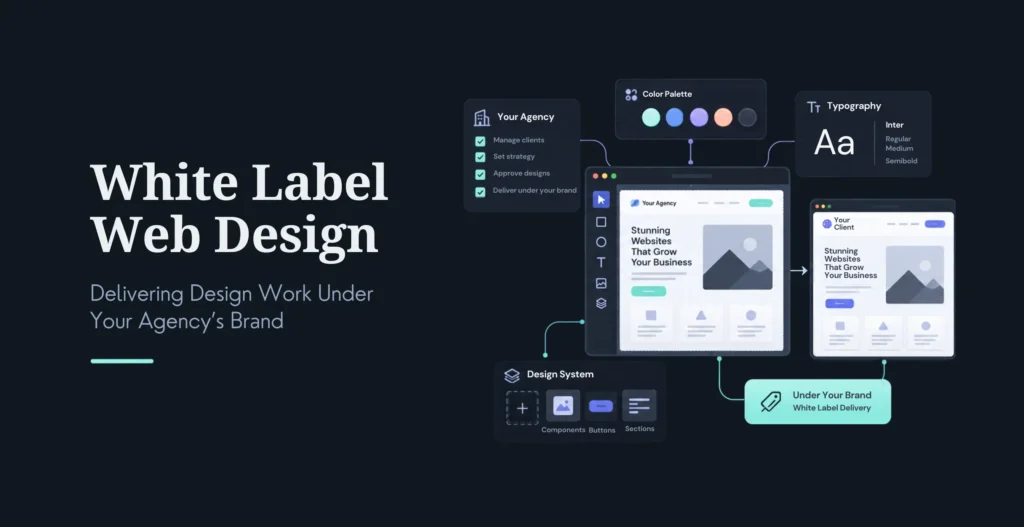
Design demand is lumpy. One month you’re turning away a redesign because your one designer is slammed; the next, that same designer is between projects and billing nothing. Hiring a second designer fixes the first problem and makes the second one worse. White label web design is how agencies break that cycle, delivering polished design work under their own name without carrying the fixed cost of a design team.
White label web design is when one studio produces the design work, websites, UI/UX, landing pages, redesigns, that another agency resells under its own brand. The client only ever sees your agency; the production partner stays invisible. You own the relationship, the brand, and the pricing; the partner does the creative work behind the scenes and never surfaces. The economics are why agencies do it: instead of a designer’s salary, benefits, tools, and the bench time between projects, you pay a wholesale rate only when there’s billable work, mark it up, and keep the margin. Resold well, design work typically goes to the client at roughly 2x-2.5x its wholesale cost, a 50-60% gross margin, with no new hire.
This guide covers what you can resell, exactly how the partner stays invisible (the thing agency owners worry about most), real pricing and margin math, the risks, and how to vet a design partner. It’s written for the agency owner or ops director deciding whether white label design belongs in how they scale. Design capacity is one of the **[bottlenecks that stall agency growth](https://www.krishaweb.com/blog/bottlenecks-that-stop-digital-agencies-from-scaling/)**, and this is a clean way around it.
That’s the model behind our own **[white label web design](https://www.krishaweb.com/white-label-web-design-services/)**, fully branded to you, NDA-first, and this guide will help you hold any partner to that bar.
**Key Highlights:**
- White label web design lets your agency resell design work (websites, UI/UX, landing pages, redesigns) under your own brand. A partner does the production and stays invisible, so you add design capacity without hiring.
- Design work typically resells at about 2x to 2.5x wholesale cost, which is a 50% to 60% gross margin. After your own account management and revision time, a 2x multiple nets closer to 40% to 50%, and 1.5x should be your absolute floor.
- Invisibility is something you build into the contract. Confirm full white-labeling, a review step before anything reaches the client, a no-direct-contact rule, and a signed NDA with non-solicitation before you start.
- The biggest risks are client poaching, inconsistent quality, and scope creep. A written revision policy, a QA step, and a small paid test project reduce all three.
- White label suits overflow work, specialist needs like UI/UX and conversion design, and variable demand. Most agencies end up with a hybrid: core design in-house, overflow and specialist work white label. Hire in-house only once demand proves steady.
## What White Label Web Design Is
White label web design is a wholesale-to-retail arrangement for creative work. A design partner produces the deliverable at a wholesale rate; you, the reseller agency, add your markup and present it to the client under your own brand. The client sees your name, your style, your process, while a trusted partner handles part or all of the creative production invisibly. It runs on three parties: the end client who needs the design, the reseller agency (you) who owns the relationship, and the white label provider who delivers behind the scenes.
The workflow is straightforward. You sell and close the project under your brand, brief the partner with requirements and brand guidelines, they design (and often build and test), you quality-check and present it as your own, and they handle revisions and ongoing support within the plan. Your job is strategy, sales, and client relationship; theirs is the craft.
The scope covers the full design surface: conversion-focused website design, UI/UX, custom builds, landing pages and microsites, redesigns, responsive layouts, mobile app interfaces, and work either inside an established design system or built from scratch to match a client’s brand. For most agencies the appeal is simple, you can present as a full-service design shop while staffing only your core, and tap specialist expertise (conversion design, UX, branding) you couldn’t justify hiring full-time. If your agency sells service-page or landing-page work specifically, our roundup of **[strong service-page designs](https://www.krishaweb.com/blog/best-service-page-designs/)** is a useful reference for the quality bar to hold a partner to.
## How It Stays Invisible to Clients
This is the part agency owners lose sleep over, so it’s worth being precise: invisibility isn’t automatic, you structure it into the engagement. Done right, the client experiences one team, yours, and never learns a partner exists.
What makes it invisible, concretely: you own the client, the brand, and the price, while the partner does the production and stays off the stage. Everything the client touches, the portal, the project updates, the finished site, carries only your agency’s name, with no visible trace of who built it or what tools were used. The partner doesn’t talk to the client; all communication flows through you; the client sees one team and one point of contact. That’s the entire promise of “white label,” and it holds only if you set the rules.
To guarantee it, confirm these before you sign: deliverables and project updates fully branded to you with no partner trace, a clear review step before anything goes out under your name, a contractual rule that the partner never contacts your client directly, and the backstop for all of it, a written NDA plus an explicit non-solicitation clause. Invisibility and client protection are the same issue from two angles: the branding keeps the partner unseen, the non-solicitation keeps them from using what they saw. A partner who treats full white-labeling and non-solicitation as obvious understands the relationship; one who hesitates is telling you to walk.
## Pricing and Margin Math
You need both the wholesale rate and the retail the market supports, and you need to read the margin honestly. Treat these as commonly cited 2026 planning ranges, and get a real quote. They mostly reflect offshore fulfillment, and the site prices usually cover some build work, not design alone. Onshore partners typically cost considerably more.
Wholesale, by project type: a landing page runs roughly 150–850; a small business site (5-8 pages) 500–2,500; a custom WordPress or mid-range site 2,500–6,500; ecommerce 1,200–10,000 depending on complexity; a redesign 800–3,000; and a custom web app 3,000–12,000+. Ongoing maintenance runs 50–300/month, dedicated-resource retainers 2,000–5,000+/month, and hourly rates commonly 20–40.
On margin, start with the arithmetic. Reselling at 1.5x wholesale is a 33% gross margin, 2x is 50%, and 2.5x is 60%. Design work commonly resells at around 2x to 2.5x. Published benchmarks differ on what agencies actually keep: one 2026 provider benchmark puts web design and development at 35-55% gross (median about 45%), while some pricing guides target 50-70%. Worked through: buy a small business site design at $1,000 wholesale, sell at 2,000–2,500, and you keep 1,000–1,500 per project at 50-60% gross. Two caveats that separate real margin from paper margin: that gross is before your own account-management, revision-handling, and client-communication time, so a 2x multiple nets closer to 40-50% once you count the hours; and treat 1.5x (a 50% markup, 33% gross) as your absolute floor, below it, you’re doing the client management for free once overhead lands. The agencies that win on white label design don’t compete on price, they justify the markup with strategy, art direction, and the client relationship, which is exactly what the premium buys.
## The Risks, and How to Manage Them
White label design is genuinely useful, but it carries real risks worth planning for. The one owners fear most is client poaching, prevented by the NDA-plus-non-solicitation and a no-direct-contact rule. Close behind is quality inconsistency, which damages your brand since your name is on the work, so vet hard, start with a small paid test project, and build a QA review step before anything reaches the client. Scope creep is the design-specific killer: without a written revision policy and defined limits, “just one more round” quietly erases your margin, so put the revision count and change-request process in writing. The rest are manageable with discipline: communication breakdowns (clear channels, a 24-hour response expectation, structured check-ins), over-dependence on one partner (diversify for critical work, keep a backup), and technical gaps, because good-looking design that isn’t responsive, accessible, SEO-sound, or secure becomes your problem, so verify the partner’s technical fundamentals, not just their visual portfolio. None of this should stop you using white label; all of it should shape the contract.
## Choosing a Partner, and When to Build Instead
Vet a design partner like a hire, because functionally it is one. The non-negotiables: a signed NDA and non-solicitation, a portfolio of relevant work in your clients’ industries (live sites, not just Dribbble shots), a documented QA process and a clear revision policy with limits, transparent pricing with what’s-included spelled out, responsive communication with a defined workflow, agency references you can actually call, and, because design has to work and not just look good, verified technical fundamentals (responsive, accessible, SEO-sound, secure). The questions that cut through fast: Can you show work for clients like mine? Will you stay fully behind the scenes and follow my communication rules? What’s your QA step before I see anything? How are revisions and scope handled? Will you sign NDA and non-solicitation, and can I talk to two agency references? Walk away from anyone who won’t sign protections, can’t show a QA process, or is vague on revisions, scope ambiguity is where design margins die.
On whether to white label at all: the trade is flexible cost and speed versus control and institutional knowledge. White label wins for overflow, specialized needs (UI/UX, conversion design), testing a new design line, and variable demand, you pay only against revenue, launch in days, and offload turnover risk. Build in-house when design is the core of your identity, demand is steady and predictable, or you need total control over craft. Most agencies land on a hybrid: core design in-house, overflow and specialized work white label, and a smart sequence is to white label first, prove the demand, then hire once bench-time risk disappears. To run the actual numbers, our **[agency vs in-house cost](https://www.krishaweb.com/blog/ai-agency-vs-in-house-cost/)** breakdown does the math, and the vetting rigor a client applies when **[choosing a web design agency](https://www.krishaweb.com/blog/how-to-choose-web-design-agency/)** is the rigor to apply to your own partner.
##### Additional Read
- [White Label Services Explained: How Agencies Deliver More Without Hiring](https://www.krishaweb.com/blog/white-label-services-explained-agencies/)
- [White Label Web Development: What to Look For in a Reliable Partner](https://www.krishaweb.com/blog/white-label-web-development-reliable-partner/)
- [White Label Digital Marketing: Reselling SEO, Content, and Paid Under Your Brand](https://www.krishaweb.com/blog/white-label-digital-marketing-reselling/)
### Frequently Asked Questions
**What is white label web design?**It’s when one studio produces design work, websites, UI/UX, landing pages, redesigns, that another agency resells under its own brand. The client sees only your agency’s name, style, and process; the production partner stays invisible. You own the client relationship, the branding, and the margin, while a trusted partner handles part or all of the creative work behind the scenes. It lets a lean agency present as a full-service design shop without carrying a full design team’s payroll.
**How does white label web design work?**You sell the design project to your client under your brand, brief the partner with requirements and brand guidelines, the partner designs (and often builds and tests), you quality-check and present the work as your own, and the partner handles revisions and ongoing support. You own strategy, pricing, and all client communication; the partner owns production. The client interacts only with you and sees a single, unified brand, they never know, or deal with, the fulfillment partner.
**How does white label web design stay invisible to clients?**By structure, not by accident. You own the client, the brand, and the price; the partner does the production and stays off the stage. Everything the client sees, portal, updates, the finished site, carries only your name, with no trace of who built it. The partner doesn’t contact the client, all communication flows through you, and the client sees one team and one point of contact. Verify full white-labeling, a review step, no direct contact, and an NDA-plus-non-solicitation before signing, that’s what makes invisibility real.
**How much does white label web design cost, and what can I charge?**Wholesale, roughly: landing pages 150–850, small business sites (5-8 pages) 500–2,500, custom/mid-range sites 2,500–6,500, ecommerce 1,200–10,000, redesigns 800–3,000, custom apps 3,000–12,000+, and maintenance 50–300/month (hourly 20–40). You resell at roughly 2x-2.5x, so a $1,000 small-business site design typically bills the client 2,000–2,500. These bands mostly reflect offshore fulfillment, so treat figures as scope-dependent planning ranges and get a real quote, complexity and revision scope drive the number.
**What markup and margin should agencies target on white label design?**Design work commonly resells at around 2x-2.5x wholesale, which is a 50-60% gross margin (1.5x is 33%, 2x is 50%, 2.5x is 60%). Published benchmarks for what agencies actually keep vary: one 2026 provider benchmark puts web design and development at 35-55%, while some pricing guides target 50-70%. Treat 1.5x (a 50% markup) as your absolute floor. The honest caveat: that gross is before your account-management, revision-handling, and client-communication time, so a 2x multiple nets closer to 40-50% once you count the hours. Price for that explicitly, and control revision scope in writing, or the margin erodes.
**What are the biggest risks, and how do I protect against them?**Client poaching (counter with NDA, non-solicitation, and client comms routed only through you), quality inconsistency that damages your brand (vet hard, run a small test project, require a QA step), scope creep, the design-specific killer (counter with a written revision policy and defined limits), communication breakdowns (clear channels and response-time expectations), over-dependence on one partner (diversify, keep a backup), and technical gaps (verify responsive, accessible, SEO-sound, secure work, not just visuals). None should stop you using white label; all should shape the contract.
**Should I use white label web design or hire an in-house designer?**White label wins for overflow, specialized needs (UI/UX, conversion design), testing a new design line, and variable demand, you pay only against revenue, launch in days, access expertise you couldn’t staff for, and offload turnover risk. Build in-house when design is core to your identity, demand is steady and predictable, or you need total control over craft. Most agencies run a hybrid: core design in-house, overflow and specialized work white label. A smart play is to white label first, then hire once demand proves steady.
**What’s included in white label UI/UX design?**White label UI/UX design is when a partner produces interface and experience design that you resell under your brand. It typically covers responsive website layouts, landing pages, mobile app interfaces, and full design systems, either built from scratch to match a client’s brand or designed within an established system. The partner handles the UX and UI craft; you deliver it under your name. It lets agencies offer specialized UX expertise without hiring a dedicated UX designer, and it’s one of the highest-value white label design lines because good UX directly affects conversion.
### Conclusion
White label web design solves the lumpy-demand problem every agency with a design offering eventually hits: how to deliver more design work than your headcount should allow, without the fixed cost and bench-time risk of hiring. By turning a designer’s salary into a variable, pay-for-work cost, it lets you expand capacity, absorb overflow, and offer specialist expertise, all under your own brand, while your team stays focused on strategy and the client relationship.
The model rewards clarity on three things. Invisibility: structure it deliberately, full white-labeling, no direct client contact, NDA-plus-non-solicitation in writing. The margin math: aim for roughly 2x-2.5x wholesale, price in your revision and account time, and never drop below 1.5x. And scope: a written revision policy with limits is what protects design margins specifically. Get those right and white label design is one of the highest-impact growth moves an agency can make. Get them wrong and it’s a reputation risk wearing a margin disguise. Choose the partner as carefully as you’d make the hire it replaces, because that’s exactly what it is.
##### Ready to add design capacity without adding payroll?
**[Explore our White Label Web Design Services](https://www.krishaweb.com/white-label-web-design-services/)** to see how we deliver design work under your brand, fully white-labeled, with NDA and non-solicitation standard.
**[Book a consultation](https://www.krishaweb.com/contact-us/)** to talk through your design capacity gaps and start with a scoped paid test project.

###### Praful Patel
Lead – CMS DevelopmentA Full-Stack Developer and Technical Project Manager with expertise spanning WordPress, WooCommerce, Headless WordPress, Next.js, React, and AI Automation, I deliver end-to-end web solutions that combine technical depth with practical, business-focused thinking.
 Interact With Me- [ ](https://x.com/praful2111)
- [ ](https://www.linkedin.com/in/praful2111/)
- [ ](mailto:praful@krishaweb.com)
---
_View the original post at: [https://www.krishaweb.com/blog/white-label-web-design-agencies-brand/](https://www.krishaweb.com/blog/white-label-web-design-agencies-brand/)_
_Served as markdown by [Third Audience](https://github.com/third-audience) v3.6.1_
_Generated: 2026-10-15 12:40:41 UTC_