---
title: "White Label Web Development for Small Agencies: How to Scale Without Hiring"
url: "https://www.krishaweb.com/blog/white-label-web-development-small-agency/"
date: "2026-07-30T12:35:48+00:00"
modified: "2026-07-30T12:57:44+00:00"
type: "Article"
resource: "https://www.krishaweb.com/blog/white-label-web-development-small-agency/"
timestamp: "2026-07-30T12:57:44+00:00"
author:
name: "Parth"
url: "https://www.krishaweb.com/"
categories:
- "Web Development"
word_count: 1986
reading_time: "10 min read"
summary: "You just won a project you cannot fully deliver. It happens to every growing agency. A client wants a full website build, or a WooCommerce store, or a migration, and your team is already at capacit..."
description: "How small agencies use white label web development to scale without hiring: the real cost math, the real risks, and how to run it so it works."
keywords: "white label web development small agency, Web Development"
language: "en"
schema_type: "Article"
related_posts:
- title: "AI Readiness Assessment: How to Budget for Your First AI Initiative"
url: "https://www.krishaweb.com/blog/ai-readiness-assessment-budget/"
- title: "The Cost of Integrating AI into Existing Enterprise Systems (2026 Guide)"
url: "https://www.krishaweb.com/blog/cost-of-integrating-ai-into-enterprise-systems/"
- title: "Healthcare Portal Development Cost in 2026: The Complete Budget Guide"
url: "https://www.krishaweb.com/blog/healthcare-portal-development-cost/"
---
# White Label Web Development for Small Agencies: How to Scale Without Hiring
_Published: Thursday,July 30, 2026_
_Author: Parth_
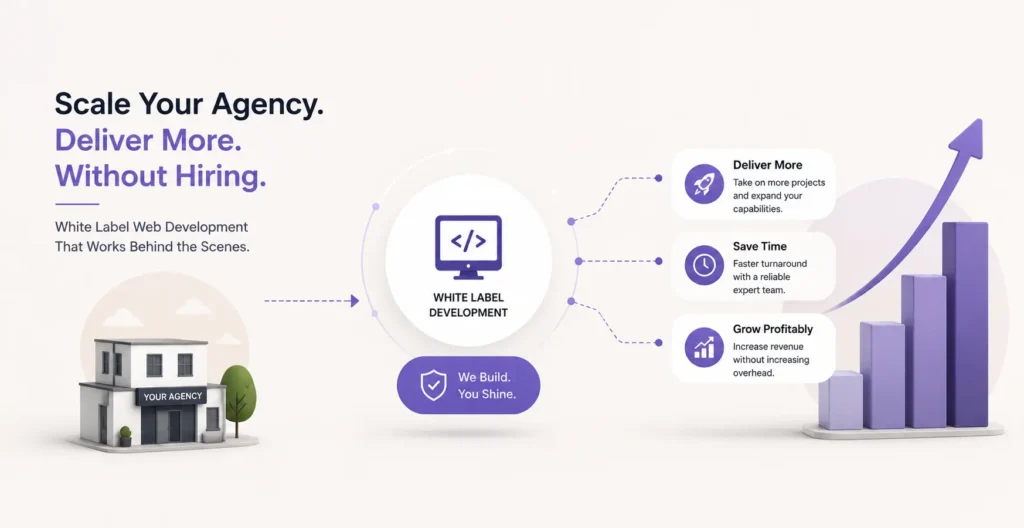
You just won a project you cannot fully deliver. It happens to every growing agency. A client wants a full website build, or a WooCommerce store, or a migration, and your team is already at capacity. So you face the choice that quietly caps most small agencies: turn the work away or hire a developer you are not sure you can keep busy next quarter.
There is a third option, and it is the one agencies scaling fastest in 2026 are using. White label web development lets you take the project, deliver it under your own brand, and never add a full-time salary to do it. A partner builds it behind the scenes. Your client only ever sees you.
This guide is for the agency owner who already knows what “white label” means and is now deciding whether to use it and how to do it without the risks that make owners nervous. The real hire-versus-partner math. The fears worth taking seriously and how to handle them. And how to actually run the partnership so it feels like your team, not an outsourcing gamble.
## The math that makes this decision for you
Let me start with the numbers, because they are stark and they settle most of the argument.
Hiring one senior web developer in the US runs $70,000 to $110,000 a year in salary alone, before benefits, software, hardware, management time, and onboarding. In the UK it is £50,000 to £80,000. That is a fixed cost that shows up every single month, whether you have three projects in the pipeline or none.
That last part is the trap. Agency work is not steady. You will have three deadlines stacked in one month and a quiet pipeline the next. An in-house developer is a fixed cost sitting on top of an income that swings. In the busy month, they cannot keep up alone. In the slow month, you are paying full salary for someone with little to build.
White label flips that fixed cost into a variable one. You pay per project, scaled to demand. Busy month, you scale up. If it’s a slow month, you pay nothing. Your cost of delivery moves with your revenue instead of fighting it. For a small agency, that single shift, from fixed payroll to variable project cost, is the difference between growth that is safe and growth that is a gamble.
There is a threshold worth being honest about. If you have a genuinely constant, high volume of development work, a full-time hire eventually becomes more economical. But most small agencies do not have that steady volume, and for them the flexibility wins clearly.
## **What you are actually buying (it is not just code**)
This is where a white label partner beats the freelancer you might otherwise reach for.
A freelancer gives you one person. When they get sick, go quiet, or take another client, your project stops and your client is waiting. There is no one reviewing their work, no backup, and no accountability beyond a single individual.
A white label partner gives you a system. Project managers, QA processes, staging environments, backup developers, and an NDA baked into how they operate. When one developer is out, the work continues. When something breaks on a Friday afternoon, there is a team, not a voicemail. You are buying the whole production layer your agency does not have to build: the process, the safety net, and the accountability, not just the hours.
That structure is the entire reason this model protects your reputation instead of risking it. Your client is trusting you. You need a partner who behaves like a team, because that is what your reputation is resting on.
## The fears worth taking seriously (and how to handle each)
Every agency owner considering this has the same three worries. They are legitimate. Here is how each one actually gets solved.
### “What if my client finds out?”
This is the big one, and it is handled by design. A real white label partnership is built on invisibility: no partner branding on anything, no direct contact with your client, no footprint in the final product. You stay the single point of contact and the owner of the relationship. The partner operates entirely behind the scenes. This is standard legal commercial practice, and done properly, your client simply experiences your agency delivering great work. Confirm the invisibility terms in writing before you start.
### “What if the quality is bad and it lands on me?”
This is why you vet before you bet. The protection is a small paid test project before any real client work: hand over one contained task and judge the code quality, the communication, and whether they hit the deadline. A good partner welcomes this. It is also why the system matters, a partner with real QA and staging catches problems before they reach you, which a lone freelancer cannot promise.
### “What if I lose control of the project?”
You do not, if the partnership is set up right. You keep the client relationship, the communication, the timeline, and the final say. The partner plugs into your workflow, your Slack, your project management tool, and your design files and executes to your standards. Control stays with you. Execution moves to them. That division is the whole point.
Handle these three upfront, in the agreement and the trial, and the model stops feeling like a risk and starts feeling like leverage.
## How to actually run a white label partnership
The agencies that succeed with this treat the partner as an extension of their team, not a vendor they throw briefs at. Here is what that looks like in practice.
They integrate tools. The partner works inside the agency’s existing stack: Figma for design, Slack for communication, and their project management platform for tracking, so delivery feels connected rather than handed off.
They keep the client relationship firmly on their side. All client communication runs through the agency. The partner never appears. This is non-negotiable, and it is what keeps the white label intact.
They start with overflow, then grow into a rhythm. Most agencies begin by handing over the work they cannot staff and then, once trust is built, lean on the partner as steady elastic capacity, expanding and contracting with the pipeline.
They pick a partner whose platform depth matches their clients. A partner who lives in WordPress and WooCommerce daily will handle the edge cases, performance issues, and integrations far better than a generalist. Match the specialization to the work you actually sell.
Done this way, the partnership becomes a growth engine. You say yes to bigger projects, offer services you could not staff before, and price with stable, predictable margins instead of guessing around your team’s capacity.
## What it costs
So you can budget, here are the going 2026 models.
Flat-rate monthly retainers typically start around $1,500 a month for a block of development hours, which suits an agency with steady, predictable work. Project-based pricing for a standard WordPress site runs from a few hundred dollars for a simple landing page up to $5,000 and beyond for complex builds. Many partners also offer a dedicated-team model for agencies that want reserved, ongoing capacity.
Compare that to the $70,000-plus annual salary of a single hire and the variable model speaks for itself for most small agencies. You are converting a large fixed bet into a cost that only exists when there is revenue attached to it.
## How to choose the right partner
Before you hand over a single project, protect your agency with these checks.
Demand full code ownership. You and your client must own 100% of the final code and assets, never locked into a partner’s proprietary system. Get it in writing.
Sign an ironclad NDA and confirm the invisibility terms. No partner branding, no client contact, no disclosure.
Test their responsiveness before you commit. Send a normal inquiry and see how fast they reply. If a sales question takes three days, imagine a client emergency.
Run a small paid trial. One contained task tells you more about code quality, communication, and reliability than any sales call.
Match their platform depth to your client base, and confirm they bring real processes: project management, QA, and staging, not just a developer for hire.
Get these right, and you have a partner. Skip them, and you have a risk.
##### Additional Read
- [10 Signs Your Agency Needs a White Label Web Design Partner](https://www.krishaweb.com/blog/signs-agency-needs-white-label-partner/)
- [How to Choose a White Label Partner: 10 Questions Every Agency Should Ask](https://www.krishaweb.com/blog/white-label-partner-questions-to-ask/)
- [White Label Web Developer vs. Hiring an In-House Developer: The Real Cost Comparison](https://www.krishaweb.com/blog/white-label-vs-in-house-developer-cost/)
### Where KrishaWeb fits
We have run [**white-label web development for agency**](https://www.krishaweb.com/white-label-web-development-services/) partners since 2008, across WordPress, Webflow, Shopify, and custom builds, for agencies in the US, UK, Australia, and beyond. Full invisibility, your brand on everything, named account management, real QA and staging, and code your client fully owns.
If you are an agency owner tired of choosing between turning work away and hiring ahead of your pipeline, that is exactly the problem we solve. Start with a small test project and judge the work for yourself.
Tell us what you are trying to deliver. [**Schedule a call**](https://api.leadconnectorhq.com/widget/bookings/book-a-call-with-parth-krishaweb) to talk it through, or [**contact us**](https://www.krishaweb.com/contact-us/) with your project.
### Frequently Asked Questions
**What is white label web development for a small agency?**White label web development is when a specialist team builds websites for your agency that you deliver to your clients under your own brand. Your client sees your agency as the provider, while the technical work happens behind the scenes. You keep the client relationship, communication, and final say; the partner handles execution invisibly. For a small agency, it means offering full web development without hiring an in-house development team.
**How does white label web development help an agency scale without hiring?**It converts development from a fixed cost into a variable one. Instead of paying a $70,000-plus annual salary regardless of workload, you pay per project, scaled to demand. In busy months you scale up; in slow months you pay nothing. This lets you take on more projects and larger builds without adding payroll, so your delivery cost moves with your revenue instead of sitting on top of it as fixed overhead.
**Is white label web development the same as outsourcing?**It is a specific form of outsourcing. The difference is invisibility and branding. General outsourcing does not guarantee separation from your client, but a white label partnership is built so the partner has no branding on deliverables, no direct contact with your client, and no footprint in the final product. You remain the single point of contact and the owner of the relationship. The work is delivered as your agency’s own.
**How much does white label web development cost in 2026?**Pricing follows a few models. Flat-rate monthly retainers typically start around $1,500 for a block of development hours. Project-based pricing for a standard WordPress site ranges from a few hundred dollars for a simple landing page to $5,000 and up for complex builds. Dedicated-team models are available for agencies wanting reserved ongoing capacity. Compared to a $70,000-plus annual salary for one in-house developer, the variable model is more economical for most small agencies with fluctuating demand.
**Will my clients know I used a white label partner?**Not if the partnership is set up correctly. A proper white label arrangement is built on strict invisibility: no partner branding, no direct client contact, and no disclosure in the final product. You present the work as your agency’s own, which is standard and legal commercial practice. Confirm the invisibility and NDA terms in writing before starting, and keep all client communication on your side.
**How do I choose a reliable white label web development partner?**Demand full ownership of the final code and assets, sign an NDA with clear invisibility terms, and test their responsiveness with an inquiry before committing. Run a small paid trial project to judge code quality, communication, and reliability. Confirm they bring real structure, project management, QA, and staging environments, rather than a single freelancer. Finally, match their platform depth (WordPress, Webflow, Shopify) to the clients you actually serve, since specialists handle edge cases far better than generalists.

###### Parth Pandya
Founder & CEOFounder & CEO of KrishaWeb, leads an Enterprise Web Agency. With contributions to WordPress and organization of WordCamps, he pioneers innovation and community engagement in the digital realm.
 Interact With Me-
-
- [ ](mailto:)
---
_View the original post at: [https://www.krishaweb.com/blog/white-label-web-development-small-agency/](https://www.krishaweb.com/blog/white-label-web-development-small-agency/)_
_Served as markdown by [Third Audience](https://github.com/third-audience) v3.6.1_
_Generated: 2026-07-30 12:57:45 UTC_