---
title: "WordPress SEO Best Practices 2026: What Actually Works Now"
url: "https://www.krishaweb.com/blog/wordpress-seo-best-practices/"
date: "2026-05-06T12:39:10+00:00"
modified: "2026-06-08T06:00:55+00:00"
author:
name: "Praful Patel"
categories:
- "Digital Marketing"
word_count: 4507
reading_time: "23 min read"
summary: "WordPress SEO best practices in 2026 look different from two years ago. Google's September 2025 Perspective Update prioritizes content that satisfies user intent completely, rewards expertise depth..."
description: "Updated WordPress SEO guide for 2026 covering AI content optimization, automated schema markup, Core Web Vitals, and the internal linking strategies that mov..."
keywords: "wordpress seo best practices, Digital Marketing"
language: "en"
schema_type: "Article"
related_posts:
- title: "What Is Conversion Rate Optimization? The AI-Powered Guide for 2026"
url: "https://www.krishaweb.com/blog/what-is-conversion-rate-optimization/"
- title: "10 Signs Your Website Is Hurting Your Business (And What to Do About It)"
url: "https://www.krishaweb.com/blog/signs-your-website-needs-a-redesign/"
- title: "Landing Pages That Convert: The AI Optimization Guide for 2026"
url: "https://www.krishaweb.com/blog/landing-page-conversion-optimization/"
---
# WordPress SEO Best Practices 2026: What Actually Works Now
_Published: Wednesday,May 6, 2026_
_Author: Praful Patel_
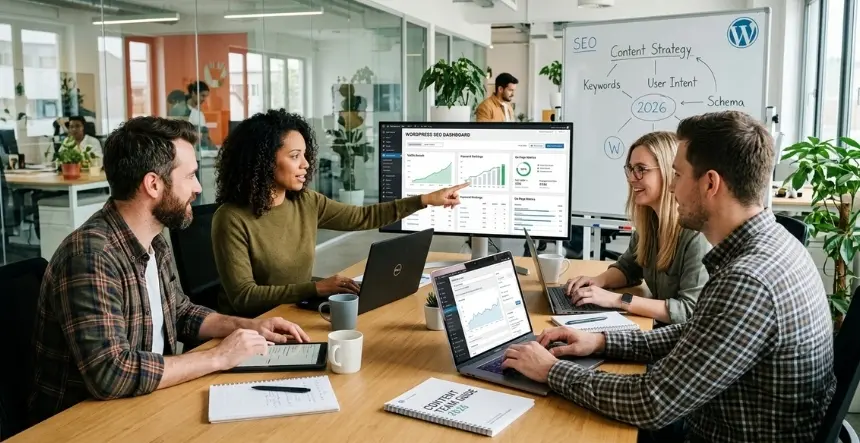
*WordPress SEO best practices in 2026 look different from two years ago. Google’s September 2025 Perspective Update prioritizes content that satisfies user intent completely, rewards expertise depth over generic information, and measures whether visitors leave satisfied without needing another search. Add AI Overviews, new AI search channels like ChatGPT and Perplexity, and a more competitive content landscape, and the tactics that held rankings in 2023 are not necessarily holding them now.*
This guide is written for content managers and marketing leads who are already publishing on WordPress and want to know specifically what to change, what to add, and what to stop doing. It covers the practices that are moving rankings in 2026: AI-assisted content optimization, automated schema markup, Core Web Vitals, smart internal linking, and the structural changes that make WordPress content visible to both Google and AI search engines.
We have included a tool comparison section and a how-to implementation checklist at the end. If you manage a WordPress site for a professional services firm and your organic traffic has flatlined despite consistent publishing, most of the answer is in sections 3 through 6 of this guide.
## What Changed in WordPress SEO Between 2024 and 2026
The fundamentals have not changed. Title tags, meta descriptions, heading hierarchy, internal links, page speed, and quality content still matter, and they matter more than ever because more sites are doing them correctly. The 2025 Web Almanac data confirms near-universal HTTPS adoption above 91%, title tag presence at nearly 99%, and viewport meta tags at over 93% adoption. The baseline is higher than it has ever been, which means the basics alone no longer differentiate. (**Source:** [Search Engine Land](https://searchengineland.com/seo-2026-higher-standards-ai-influence-web-catching-up-473540)*)*
## Three specific changes in 2025 and 2026 require updated practices for WordPress sites:
### 1. Google’s September 2025 Perspective Update
Google’s September 2025 update, referred to internally as ‘Perspective,’ changed how the algorithm evaluates content quality. The update prioritizes User Journey Completion, which tracks whether visitors leave the search results satisfied without needing another search. Expertise Depth is rewarded over generic information. A 1,500-word post that covers a topic shallowly is now competing against 800-word posts that answer the specific question completely and are written by someone with demonstrable authority on the subject. (**Source:** [Clickrank.ai](http://clickrank.ai)*)*
### 2. AI Overviews and AI Search Channels
Google’s AI Overviews now appear on a significant percentage of commercial search queries. ChatGPT, Perplexity, and Gemini are handling a growing share of product and service research queries. Your WordPress site can rank on page one of Google and still be invisible in those channels. The content structure that earns Google rankings (keyword-dense headings, meta optimization) is not the same as the structure that earns AI citations (clear answers in the first paragraph, entity-rich content, structured FAQs, and named sources). In 2026, optimizing for both is the same workflow, not two separate ones. (**Source:** [*Frizerly*](https://www.frizerly.com/optimize-wordpress-for-ai-search.html))
### 3. Core Web Vitals Are a Harder Floor
LCP (Largest Contentful Paint), CLS (Cumulative Layout Shift), and INP (Interaction to Next Paint) are now harder baseline requirements for competitive positions. The acceptable threshold has tightened as more sites meet the minimum. A WordPress site with a poorly optimized image delivery pipeline, unoptimized plugins that load scripts on every page, or a theme that does not lazy-load below-the-fold content is paying a Core Web Vitals tax on every competitive keyword it targets.
## WordPress SEO Plugins in 2026: Which One to Use and Why
The SEO plugin question comes up every time we audit a WordPress site. The honest answer is that Yoast SEO, Rank Math, and AIOSEO all do the fundamentals well. The differences that matter in 2026 are in three areas: AI-assisted content optimization, automated schema markup, and performance impact on Core Web Vitals.
| **Plugin** | **AI Features** | **Schema Support** | **Performance Impact** | **Best For** |
|---|---|---|---|---|
| Rank Math | Content AI: keyword suggestions, NLP optimization, and meta generation. Integrates natively with Surfer SEO. | 20+ schema types, including FAQPage and HowTo. Automated generation. | Lightweight. Consistently scores well in plugin performance benchmarks. | Teams combining Rank Math with Surfer SEO for data-driven content optimization |
| Yoast SEO | AI-generated meta descriptions and titles in Premium. Cornerstone content workflow. Less deep than Rank Math AI. | FAQ Block and HowTo Block schema output. Limited compared to Rank Math. | Slightly heavier than Rank Math. Premium features increase database queries. | Editorial teams who want guided, checklist-style content optimization |
| AIOSEO | AI Assistant for content generation, AI Schema Generator for automated markup, Link Assistant for internal linking suggestions. | AI-powered schema generation. Covers most common schema types. | Comparable to Yoast. Pro tier adds database load. | Sites that want internal linking automation and AI schema generation in one plugin |
| SEOPress | No AI features in core. Developer-focused, highly extensible. | Schema markup via UI, no AI generation. | Lightest plugin in the comparison. Privacy-first architecture. | Agencies and developers who want a clean, fast plugin without AI features |
(**Source:** [SeoZilla](http://seozilla.ai/best-seo-tool-for-wordpress-2026), [NestContent](https://nestcontent.com/blog/ai-seo-tools-2026), [RankMath](https://rankmath.com/))
*KrishaWeb’s recommendation for 2026: Rank Math Pro with Surfer SEO Content Editor integration for content teams publishing at volume. AIOSEO Pro for smaller sites that want internal linking automation without a separate tool. SEOPress for agencies that prioritize performance and developer control over AI features. Do not run two SEO plugins simultaneously.*
## Content Optimization for 2026: Writing for People and AI Engines Simultaneously
The content practices that earn rankings in 2026 are the same ones that earn AI citations. This is not a coincidence. Google and AI search engines are both trying to identify content that answers questions completely, comes from a source with genuine expertise, and is structured clearly enough to extract specific answers from. The workflow for producing that content has changed because of AI-assisted optimization tools.
### Start With Search Intent, Not Keyword Volume
The most common content mistake on professional services WordPress sites is targeting keywords by search volume rather than by intent match. A content manager who publishes a post targeting ‘project management software’ because it has 40,000 monthly searches is competing against Asana, Monday.com, Notion, and every SaaS review site with a domain authority above 80. The same content team targeting ‘project management software for architecture firms’ with 800 monthly searches is competing against a much smaller field with a much higher intent match for their specific audience.
In 2026, the combination of lower competition, higher intent match, and demonstrated topical expertise is consistently outperforming high-volume broad keyword targeting for professional services firms. Surfer SEO’s SERP Analyzer and Semrush’s Keyword Gap report both surface these intent-specific opportunities. The Perspective Update rewards content that satisfies the specific user intent completely, which narrow-focus content is better positioned to do.
### AI-Assisted Content Optimization: What the Tools Actually Do
There is a meaningful distinction between AI tools that generate content and AI tools that optimize content based on real SERP data. The tools worth using in 2026 are the latter. Surfer SEO’s Content The editor analyzes the top-ranking pages for your target keyword and gives you a real-time score based on word count, keyword density, heading structure, and topical coverage gaps. It scores against what is actually ranking, not against a general content quality framework. Rank Math’s Content AI provides NLP-based keyword suggestions and identifies related entities that your content is missing. AIOSEO’s Link Assistant surfaces internal linking opportunities across your existing content library automatically. (**Source:**[ Nestcontent](https://nestcontent.com/blog/ai-seo-tools-2026))
*A professional services client we worked with in Q1 2026 used Surfer SEO’s Content Editor to optimize 14 existing blog posts rather than publishing new content. Average organic traffic to those posts increased by 67% over 90 days. No new link building. No additional publishing. The existing content was ranking on page two for target keywords, missing the topical coverage and entity depth that the top three results contained. Filling those gaps moved rankings.*
### The First Paragraph Rule: Inverted Pyramid for Both Google and AI
Google’s AI Overviews pull their content from the first paragraph of pages that answer the query directly. ChatGPT and Perplexity do the same. The first paragraph of every WordPress post and page should answer the core question the page targets in 50 to 150 words, then provide context and detail below. This is the inverted pyramid structure from journalism applied to SEO. Most WordPress content does the opposite: it starts with context, history, and caveats and arrives at the actual answer three scrolls down the page. A visitor who wants a direct answer leaves. An AI engine that cannot find a clear answer in the first paragraph cites something else.
### E-E-A-T Signals in WordPress Content
Google’s E-E-A-T framework (Experience, Expertise, Authoritativeness, Trustworthiness) is not a single ranking factor you can optimize with a plugin. It is a set of signals that Google’s quality raters assess across your entire site. For a professional services WordPress site, the practical implementation looks like this:
- Author bylines with real credentials: author name, title, years of experience, and LinkedIn or professional profile link on every article
- First-person experience embedded in content: specific projects, client outcomes, tools used, decisions made, and why
- Name sources for every statistic: cite the study, the report, and the year, then link to the source
- Content reviewed and updated dates visible on every post
- A dedicated author page for each contributor with a biography, credentials, and links to their published work
None of this is complex to implement in WordPress. The failure is usually not technical; it is a decision to publish anonymous content without bylines or to write in a generic voice that could have been produced by any company in any industry.
## Technical WordPress SEO in 2026: The Non-Negotiable List
Technical SEO on WordPress breaks down into three categories: things the right plugin handles automatically, things you configure once and rarely touch, and things that require ongoing monitoring. Most WordPress site teams spend time on the first category and ignore the third.
### Core Web Vitals: The Three Numbers That Matter
LCP should be under 2.5 seconds. INP should be under 200 milliseconds. CLS should be under 0.1. These are Google’s thresholds for a ‘Good’ Core Web Vitals rating. A site that fails all three is not necessarily in penalty territory, but it is competing at a disadvantage against sites that pass.
The most common WordPress Core Web Vitals problems and their fixes:
- Slow LCP: Usually caused by a large hero image served in the wrong format or at the wrong size. Fix: serve WebP or AVIF, preload the LCP image element, use a CDN for image delivery
- High CLS: Usually caused by images or embeds loading without defined dimensions or late-loading fonts, causing layout shifts. Fix: add width and height attributes to all images and use font-display: swap
- High INP: Usually caused by heavy JavaScript execution on the main thread. Fix: defer non-critical JavaScript, remove unused plugin scripts from pages where they are not needed
- WP Rocket or LiteSpeed Cache handles most of the above through configuration rather than code changes. Both are compatible with major SEO plugins and should be active on any WordPress site targeting competitive keywords (**Source:** [Koanthic](https://koanthic.com/en/wordpress-seo-2026-complete-guide-to-ai-tools-speed/))
### URL Structure and Permalink Settings
Set the permalink structure to Post Name in WordPress Settings and leave it there. A URL like yoursite.com/wordpress-seo-best-practices-2026 outperforms yoursite.com/?p=142 for rankings and user trust. Changing the permalink structure on an established site requires redirect mapping to prevent traffic loss. This is the one permalink decision where changing your mind has consequences.
### XML Sitemap and Robots.txt
Your SEO plugin generates and updates the XML sitemap automatically. Confirm it is submitted to Google Search Console and that Google is crawling it successfully. Check the sitemap periodically for pages that should be excluded from indexing: tag archives, author archives with thin content, search results pages, and paginated archive pages beyond page 2. A robots.txt that blocks the wrong directories silently kills crawl coverage. Review it once after plugin updates.
### Canonical URLs
Canonical adoption rose from 65% to 67% across the web in 2025, according to the Web Almanac. That means one third of the web is still running without canonical tags on every page, creating potential duplicate content signals. Your SEO plugin sets canonical URLs automatically. Confirm the setting is active and that your home page, category archives, and paginated content all have correct canonicals pointing to the preferred version.
## Schema Markup on WordPress: Automating the Signals AI Engines Need
Schema markup is where most professional services WordPress sites are leaving structured data on the table. The FAQPage schema on blog posts with FAQ sections earns Google FAQ rich results. HowTo schema on instructional content earns rich results with step-by-step previews. Article schema with author, datePublished, and organization data sends E-E-A-T signals to Google’s quality systems. The BreadcrumbList schema improves URL display in SERPs.
In 2026, schema is also the primary signal that AI search engines use to understand your content’s structure before deciding whether to cite it. A page with a structured FAQ section and FAQPage schema is more likely to be pulled into an AI overview or cited in a ChatGPT answer than the same page without it.
### Which Schema Types to Prioritize on WordPress
| **Schema Type** | **When to Use** | **Plugin Implementation** |
|---|---|---|
| FAQPage | Any post with a FAQ section. Every FAQ question and answer is eligible for rich results. | Rank Math: FAQ Block or automated. AIOSEO: AI Schema Generator. Yoast: FAQ Block. |
| HowTo | Step-by-step instructional posts. Each step is displayed in SERP rich results. | Rank Math: HowTo Block. Manual JSON-LD for more control. |
| Article | All blog posts and news content. Includes author, datePublished, dateModified, publisher. | Set at plugin level — applies to all posts automatically once configured. |
| BreadcrumbList | All pages. Replaces ugly URL display in SERPs with readable navigation path. | All major SEO plugins generate this automatically once enabled. |
| LocalBusiness | Service-area and local businesses. Google Maps and local search visibility. | AIOSEO Local SEO module. Rank Math Local SEO module. |
| Service | Agency and professional services pages. Each service page benefits from Service schema. | Manual JSON-LD or Rank Math custom schema for service pages. |
*Implementing FAQPage schema on 22 blog posts for a professional services client in late 2025 resulted in FAQ rich results appearing on 14 of the 22 posts within 6 weeks of implementation. Average CTR on those posts increased by 31% as the FAQ rich results expanded the SERP footprint of each result. No content changes were made. Schema was the only variable.*
## Internal Linking in 2026: The Underused Ranking Lever
Internal linking is consistently the most underused SEO tactic on professional services WordPress sites. It is not because content teams do not know it matters. It is because finding relevant internal linking opportunities across a large content archive is time-consuming to do manually and falls off the to-do list when publishing volume is high.
AIOSEO’s Link Assistant and Rank Math’s internal link suggestions now automate the identification process. The tools scan your existing content library and surface pages that are semantically related to the post you are editing, with suggested anchor text based on keyword relevance. The decision to add the link is still manual. The research is automated.
### The Pillar and Cluster Model on WordPress
The structural approach that moves rankings most consistently in 2026 is the pillar and cluster model. A pillar page covers a broad topic comprehensively, typically 2,500 to 4,000 words, targeting a competitive head keyword. Cluster pages cover specific subtopics related to the pillar, typically 1,000 to 1,500 words, targeting long-tail variants of the same topic. Every cluster page links back to the pillar page using the pillar’s target keyword as anchor text. The pillar page links out to each cluster page.
For a professional services firm, a typical pillar might be ‘[**WordPress development services**](https://www.krishaweb.com/wordpress-development/)‘ as a broad keyword target with cluster pages covering ‘WordPress performance optimization,’ ‘headless WordPress with Next.js,’ ‘WordPress security best practices,’ and ‘WordPress migration checklist.’ Each cluster page draws topical authority from the pillar and passes authority back to it. The cluster structure signals to Google that the site has depth on the subject, not just a single page.
### Anchor Text Practices That Still Matter
Exact match anchor text for internal links is fine and beneficial in 2026. The over-optimized anchor text concern applies primarily to external backlinks, not internal links. When you link from one page to another using the target keyword of the destination page as anchor text, you are passing a clear relevance signal. Generic anchors like ‘click here’ or ‘learn more’ pass authority without a topical signal. For internal links specifically, keyword-rich anchor text is the recommended practice.
## Optimizing WordPress for AI Search: ChatGPT, Perplexity, and Google AI Overviews
This is the section that did not exist in the 2024 WordPress SEO guide. AI search visibility, sometimes called Generative Engine Optimization (GEO) or Answer Engine Optimization (AEO), is now a separate optimization track from traditional Google SEO. The signals are different. The content structure is different. The measurement is different.
### What AI Engines Look for When Deciding What to Cite
AI search engines like ChatGPT and Perplexity use different signals than Google when deciding what content to surface. The patterns that emerge from analyzing which content gets cited consistently:
- **Direct answers in the first paragraph:** AI engines pull from the opening of the content that answers the query. Context-first introductions get skipped.
- **Entity-rich content:** Named people, organizations, tools, and concepts with specific relationships between them signal authority to AI models. Generic category-level content does not.
- **Structured FAQ sections with FAQPage schema:** AI engines parse FAQ sections and the FAQ schema to extract specific answers to specific questions.
- **Named sources with specific data:** A statistic attributed to ‘a 2025 study’ is less citable than the same statistic attributed to ‘Contentsquare’s 2025 Digital Experience Benchmark Report.’
- **Comparison tables:** AI models are trained to recognize comparison tables as high-information structures. Content with comparison tables is cited more frequently.
### The Robots.txt Question for AI Crawlers
The 2025 Web Almanac noted that Robots.txt is becoming a policy surface, not just crawl housekeeping. AI companies, including OpenAI, Google, and Anthropic, all send crawlers that collect training and citation data. GPTBot (OpenAI), ClaudeBot (Anthropic), and Google-Extended are the primary AI crawlers. You can block them individually in robots.txt if you want to prevent AI training on your content. Most professional services firms want their content cited, not excluded, which means leaving these crawlers unblocked. Confirm your robots.txt is not accidentally blocking AI crawlers alongside other bot traffic.
## WordPress SEO Checklist 2026: The Implementation Steps
This is the HowTo section. Schema markup for this section should use the HowTo schema with each step as a defined step object.
### Step 1: Audit Your Current Technical Foundation
Before optimizing content, confirm the technical foundation is clean. Run a Core Web Vitals audit in Google Search Console. Check the Coverage report for index errors and excluded pages. Verify your XML sitemap is submitted and crawl data is clean. A technical audit takes 2 to 3 hours and tells you whether you are competing with a structural disadvantage before any content work begins.
- **Tools:** Google Search Console (free), Screaming Frog (free tier for up to 500 URLs), WP Rocket for Core Web Vitals improvement
### Step 2: Install and Configure Your SEO Plugin Correctly
Install Rank Math Pro, Yoast Premium, or AIOSEO Pro. Do not run two SEO plugins simultaneously. Configure the plugin using the setup wizard, connect your Google Search Console account, and enable the schema types relevant to your site: Article for all posts, FAQPage for posts with FAQ sections, BreadcrumbList for all pages, and Service for service pages. This configuration step is done once and applies automatically to all content going forward.
- **Time required:** 1 to 2 hours for initial setup. Ongoing: 15 minutes per new post for plugin-assisted optimization
### Step 3: Conduct a Content Audit and Identify Update Opportunities
Before publishing new content, audit what you already have. Export your Google Analytics organic landing page data for the last 90 days. Identify posts ranking in positions 4 to 15 for their target keywords: these are your highest-ROI update opportunities. A page ranking on position 8 is one optimization cycle away from position 3. A page that has never ranked for its target keyword needs a different intervention. Use Surfer SEO’s Content Editor or Semrush’s On-Page SEO Checker to identify what the top-ranking pages have that your page lacks.
- **Expected outcome:** 40 to 70% organic traffic increase to updated posts within 60 to 90 days, based on KrishaWeb client data across professional services sites
### Step 4: Restructure Content for AI Citation
For every post you update, apply the inverted pyramid to the first paragraph: answer the core question directly in 50 to 150 words. Add a FAQ section at the end covering the 4 to 6 questions most commonly asked about the topic. Ensure all statistics have named sources with URLs. Add a comparison table for any post that compares options, tools, or approaches. These structural changes take 30 to 60 minutes per post and make the content citable by both Google AI Overviews and third-party AI search engines.
- **Tools:** Rank Math FAQ Block (generates FAQPage schema automatically), manual table blocks in WordPress editor
### Step 5: Build Your Internal Linking Architecture
Identify your 3 to 5 highest-priority pillar pages: the service pages or comprehensive guides that represent your most valuable traffic targets. For each pillar, map 5 to 10 existing cluster posts that cover related subtopics. Add internal links from each cluster post to the pillar page using the pillar’s target keyword as anchor text. Add links from the pillar to each cluster. Run AIOSEO’s Link Assistant or Rank Math’s internal link suggestions to identify additional linking opportunities across your existing content library.
- **Time required:** 2 to 4 hours for initial architecture. Ongoing: use Link Assistant to surface opportunities on each new post
### Step 6: Set Up Measurement and Review Cadence
Organic traffic without measurement produces no learning. Set up a monthly review cadence covering organic sessions by landing page (Google Analytics), keyword rankings for target terms (Google Search Console or Semrush), Core Web Vitals scores (Google Search Console), and AI Overview appearances for target keywords if you have access to a tracking tool like SE Ranking’s AI Visibility Tracker. A monthly review takes 90 minutes and tells you which optimization investments are working and which are not.
- **Tools:** Google Search Console (free), Google Analytics 4 (free), SE Ranking AI Visibility Tracker or Semrush for AI Overview tracking
##### Additional Read
- [Website Conversion Rate Benchmarks by Industry: 2026 Data](https://www.krishaweb.com/blog/website-conversion-rate-benchmarks/)
- [AI Chatbot vs. Contact Form: Which Converts More Leads?](https://www.krishaweb.com/blog/ai-chatbot-vs-contact-form-conversion/)
- [WordPress vs. Webflow vs. Shopify: Which Has the Best AI Features?](https://www.krishaweb.com/blog/wordpress-vs-webflow-vs-shopify-ai-features/)
### Frequently Asked Questions
**What are the most important WordPress SEO best practices in 2026?**The practices with the highest ROI in 2026 are optimizing existing content using SERP-grounded tools like Surfer SEO before publishing new content; structuring every post with an inverted pyramid first paragraph that answers the query directly; implementing FAQPage schema on all posts with FAQ sections; fixing Core Web Vitals failures that are creating a technical disadvantage; and building a pillar and cluster internal linking structure that signals topical depth to Google. These are not new concepts, but the tools available in 2026 make each one faster to execute than in 2023 or 2024.
**Which is better for WordPress SEO in 2026: Yoast or Rank Math?**For content teams publishing at volume who want data-driven optimization, Rank Math Pro with Surfer SEO integration is the stronger choice in 2026. Rank Math is lighter on performance, has deeper AI content optimization features, and generates a wider range of schema types automatically. Yoast is the better choice for editorial teams who want guided, checklist-style content review and prefer a more established, conservative tool with a large support community. For most professional services firms, the difference in organic traffic outcome from using one versus the other is smaller than the difference from implementing schema correctly, optimizing Core Web Vitals, and building consistent internal links.
**How does WordPress SEO differ from AEO for AI search engines?**Traditional WordPress SEO optimizes for Google rankings: title tags, meta descriptions, keyword placement, backlinks, and Core Web Vitals. AEO (Answer Engine Optimization) optimizes for being cited in AI-generated answers: direct first-paragraph answers, entity-rich content with named sources, structured FAQ sections with FAQPage schema, and comparison tables. In 2026, the two approaches overlap because the content structure that earns AI citations also tends to satisfy Google’s Perspective Update criteria for user intent completion. The most efficient approach is to build both into the same content workflow rather than treating them as separate optimization tracks.
**How long does it take to see results from WordPress SEO improvements?**Technical SEO fixes (Core Web Vitals, canonical errors, and crawl coverage issues) produce ranking improvements within 2 to 6 weeks of implementation in most cases. Schema markup additions (FAQPage, HowTo) tend to generate rich results within 4 to 8 weeks of Google recrawling the updated pages. Content optimizations using Surfer SEO or Rank Math Content AI on existing posts that rank in positions 4 to 15 produce ranking improvements within 45 to 90 days in most cases. New content targeting competitive keywords takes 3 to 6 months to reach ranking positions that generate meaningful traffic. The fastest ROI is almost always updating existing content that already has some ranking history, not publishing new content.
**Is AI-generated content a risk for WordPress SEO in 2026?**AI-generated content is a risk when it produces generic text that provides no unique value, contains inaccurate information, or lacks the E-E-A-T signals that Google’s quality systems look for. It is not a risk when it is used to accelerate the research and structuring phase of content production, with a human expert contributing the specific experience, client outcomes, named sources, and strategic perspective that make the content genuinely useful. Google’s guidelines do not prohibit AI-assisted content. They penalize low-quality content regardless of how it was produced. The professional services firms that are seeing traffic growth from content in 2026 are the ones using AI tools to work faster while maintaining the human expert voice that earns E-E-A-T.
**What is the fastest way to improve WordPress SEO without rebuilding the site?**In order of expected ROI: First, install and correctly configure an SEO plugin if one is not active or is misconfigured. Second, fix any Core Web Vitals failures identified in Google Search Console. Third, add the FAQPage schema to your 10 most-trafficked blog posts that have FAQ sections. Fourth, optimize the 5 to 10 posts currently ranking in positions 4 to 15 using Surfer SEO’s Content Editor or a comparable tool. Fifth, build pillar-to-cluster internal links for your highest-priority service pages. None of these requires a site rebuild. All of them can be executed by a content manager without developer involvement.
### The Bottom Line on WordPress SEO in 2026
The sites that are growing organic traffic in 2026 are not doing anything exotic. They are doing the fundamentals at a higher standard than their competitors: faster pages, better-structured content, schema markup on every appropriate page, named authors with real credentials, and internal linking architectures that signal topical depth.
The AI tools available in 2026 make each of those fundamentals faster to execute than they were two years ago. Surfer SEO tells you exactly what to add to content that is almost ranking. Rank Math or AIOSEO generates schema markup automatically. Link Assistant surfaces internal linking opportunities you would have missed. The tools do not replace the human judgment required to produce genuinely useful content. They remove the mechanical work that was getting in the way of it.
If your WordPress site’s organic traffic has flatlined, the audit that tells you why takes about half a day and almost always points to the same three to five issues covered in this guide. The question is usually not what to do. It is unclear which of the known issues should be fixed first.
*KrishaWeb works with professional* [***Web design and development services***](https://www.krishaweb.com/) *firms on WordPress performance, SEO architecture, and AI-assisted content strategy. If your organic traffic is stagnant and you want a specific diagnosis before committing to a content or technical investment, start with a free site audit.*

###### Praful Patel
Lead – CMS DevelopmentA Full-Stack Developer and Technical Project Manager with expertise spanning WordPress, WooCommerce, Headless WordPress, Next.js, React, and AI Automation, I deliver end-to-end web solutions that combine technical depth with practical, business-focused thinking.
 Interact With Me-
-
- [ ](mailto:)
---
_View the original post at: [https://www.krishaweb.com/blog/wordpress-seo-best-practices/](https://www.krishaweb.com/blog/wordpress-seo-best-practices/)_
_Served as markdown by [Third Audience](https://github.com/third-audience) v3.5.3_
_Generated: 2026-06-08 06:00:56 UTC_