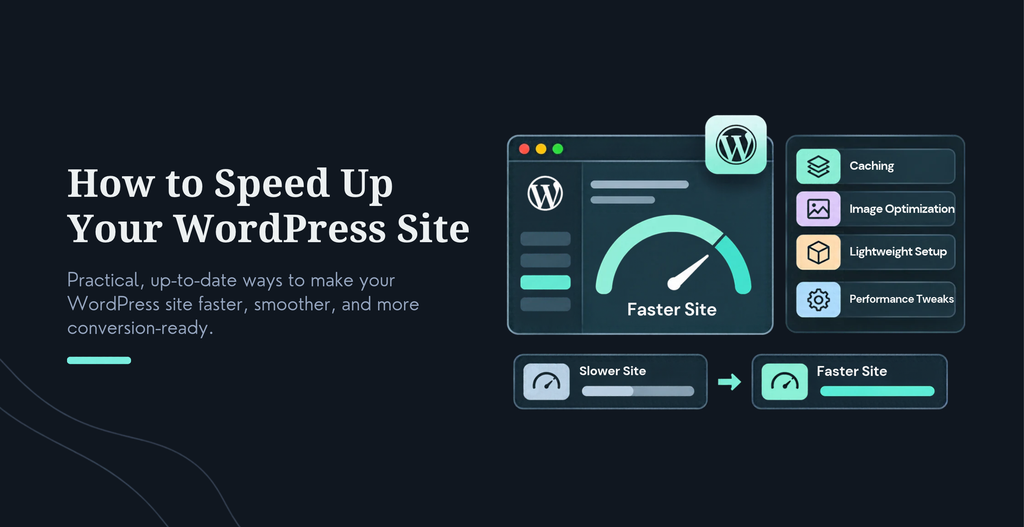
The fastest way to speed up your WordPress site is to measure first, then fix the biggest bottleneck, not the easiest one. For most sites that means full-page caching, properly sized WebP or AVIF images, a prioritized hero image, fewer plugins and scripts, and PHP 8.3 or newer. Do those in that order and re-test after each change. Skip the order and you will spend a weekend tuning things that were never slow.
Speed pays. In Google’s Milliseconds Make Millions study, run by Deloitte and Fifty-five and published in 2020, a 0.1 second improvement lifted retail conversions by 8.4% and average order value by 9.2%. Yet in the HTTP Archive’s 2026 data, only about 48% of WordPress sites passed all three Core Web Vitals on mobile. Half the WordPress web is leaving money on the table.
I wrote this guide the way I would walk a client through it: test, rank, fix, prove. The short version is right below.
Key Highlights
Measure with PageSpeed Insights and Search Console before you change anything. Field data beats lab scores.
Fix in order of impact: caching, hosting, images, hero image priority, then plugins and scripts.
Never lazy-load your LCP image. Lazy-load everything below the fold.
Run PHP 8.3 or newer. PHP 8.2 reaches end of life on December 31, 2026.
Re-test after every change and keep a dated before-and-after record.
Why Is Your WordPress Site Slow?
WordPress core is not the problem. A fresh install is lean. Sites get slow because of what gets added: a heavy theme, a page builder, twelve plugins that each load their own scripts, uncompressed hero images, a cheap shared server, and tracking tags nobody remembers adding. Every one of those adds weight or delays something on the way to the first paint. The slowdown is almost always a stack of small decisions, not one big mistake.
There are three places where slowness shows up, and each needs a different fix. A slow server means a long wait before anything arrives. Heavy frontend means the page arrives, but rendering comes late. Heavy JavaScript means the page appears to be ready but doesn’t respond to your taps. Knowing which one you have saves hours.
What you see
Likely cause
Where to look
Long wait before anything appears
Hosting, no page cache, slow PHP
Server response time (TTFB) in PageSpeed Insights or WebPageTest
Hero image shows up late
Oversized or lazy-loaded LCP image, render-blocking CSS
The LCP element in the PageSpeed Insights diagnostics
Page looks ready but taps lag
Too much JavaScript, third-party scripts
Long tasks in the Chrome DevTools Performance panel
Content jumps while loading
Images without dimensions, late fonts, injected ads
Layout shift culprits in Chrome DevTools
Images matter more than most people expect. Per the 2025 HTTP Archive Web Almanac, 76% of mobile pages have an image as their LCP element. Your home page also deserves its own test. The same chapter found that 45% of mobile home pages passed Core Web Vitals, against 56% of secondary pages. The home page is usually your weakest template.
How Do You Test Your WordPress Site Speed?
Start with Google PageSpeed Insights. Paste your URL, switch to the mobile tab, and read the top section first. That section is field data, collected from real Chrome users over the previous 28 days. The Lighthouse score below it is a lab test on a simulated phone. Field data decides how Google sees your site. The lab score helps you debug.
Then open the Core Web Vitals report in Search Console. It groups URLs that share the same problem, so one fix can clear hundreds of pages. Google judges each metric at the 75th percentile of visits, and a page passes only when all three metrics are good. The thresholds come from Google.
Metric
What it measures
Good
Needs improvement
Poor
LCP
Loading speed
2.5 s or less
2.5 to 4.0 s
Over 4.0 s
INP
Responsiveness
200 ms or less
200 to 500 ms
Over 500 ms
CLS
Visual stability
0.1 or less
0.1 to 0.25
Over 0.25
A quick reality check. Google has described Core Web Vitals as a small ranking factor, and its page experience documentation says no single signal exists. I would not sell speed work as a ranking trick. Sell it as what it is: fewer lost visitors and more conversions. Keep a record too. Screenshot your mobile PageSpeed Insights results, note LCP, INP, CLS and server response time, and save them with the date. You need that baseline to prove the work paid off.
What Is the Bottleneck-First Method?
I use one simple method on every WordPress speed job. I call it the Bottleneck-First method. It has four steps. Measure on mobile with field data. Rank problems by the time they cost, not by how easy they are to fix. Fix one thing at a time. Then prove it by re-testing and writing the result down.
The fix that takes five minutes is rarely the fix that moves your score. Rank by cost, not convenience. That one habit separates a speed project from a pile of tweaks. Changing five things at once feels productive, but it makes it impossible to know which change helped and which one broke checkout. One change, one test.
How Do You Speed Up WordPress? 12 Fixes, Ranked by Impact
These fixes are ordered by how much they usually move Core Web Vitals. Your own baseline should overrule my order. If your test says the server is fine and your images are the problem, start with images. Each fix below says what to do, why it helps, and when to skip it.
1. Turn on full-page caching
A page cache saves a finished HTML copy of each page, so WordPress does not rebuild it for every visitor. It is usually the single biggest win, because it cuts the wait before the first byte arrives. Use your host’s built-in cache if it has one. Otherwise pick one caching plugin, not two. Two caches fighting each other is a common cause of broken layouts and stale pages.
WordPress 6.8 also added speculative loading to core. By default it prefetches links conservatively, and per the WordPress core team’s notes it stays off for logged-in users and for sites with plain permalinks. Speculative loading speeds up the move from one page to the next, so it will not change a first-visit PageSpeed result. Check your own setup before you assume it is working.
2. Pick hosting that matches your traffic
If your server takes a full second to respond, no plugin will save you. Check server response time in PageSpeed Insights or WebPageTest. An overloaded shared plan is the most common reason a well-optimized site still feels slow. Look for current PHP, SSD or NVMe storage, built-in server caching and a data center near your visitors. If you cannot tell whether the host or the site is at fault, our WordPress development team can run that diagnosis.
3. Optimize images and use WebP or AVIF
Images are the heaviest thing on most pages, and they are usually the LCP element. Export at the size you display, not the size your camera shot. Convert to WebP or AVIF, which hold quality at far smaller file sizes than JPEG and PNG. Current WordPress versions accept both formats, and most caching and image plugins can convert a whole library in bulk.
Keep width and height attributes on every image. Most themes add them, but page builders and custom blocks sometimes strip them. Without dimensions, the browser cannot reserve space, and the page jumps as images arrive. Check a few templates, not just posts. For store catalogs, our guide to ecommerce image optimization goes deeper.
4. Prioritize the hero image and lazy-load the rest
This is the fix older guides get wrong. Lazy loading is great for images below the fold. It hurts on your largest above-the-fold image, because the browser waits to confirm the image is visible before it starts downloading. Google’s image priority guidanceis direct: never put loading=”lazy” on the LCP image.
Instead, add fetchpriority=”high” to that one image so the browser fetches it early. Do not add it to more than one or two images, or the hint stops meaning anything. WordPress core has tried to add the hint to the likely LCP image since version 6.3, but themes and page builders often override it. Open the page source and check. Lazy-load what people scroll to. Prioritize what they see first.
5. Audit plugins and third-party scripts
Plugin count is a weak signal. One badly written plugin can cost more than thirty good ones, so measure. Install Query Monitor on a staging copy, load your slowest templates, and sort by time. Then deactivate suspects one at a time and re-test. The P3 profiler that older guides recommend is long outdated. Query Monitor does the job now.
Third-party scripts deserve the same scrutiny: chat widgets, heatmaps, ad tags, social embeds. They run on the main thread and hurt INP. Ask of each one who owns it, what it earns, and whether anyone would notice if it vanished. Remove what fails that test. If a slow plugin is business-critical, you canhire a WordPress developer to replace it with leaner code.
6. Cut unused CSS and JavaScript
Minification strips whitespace and comments from CSS and JavaScript files. Combining files mattered under the old HTTP/1.1 protocol. Under HTTP/2 and HTTP/3 it matters much less, and aggressive combining can hurt. The bigger win is shipping less code in the first place. Open the Coverage tab in Chrome DevTools to see how much CSS and JavaScript a page loads but never uses. Page builders and bundled themes are the usual offenders. Google’s guidance on avoiding unnecessary JavaScript is a good starting point.
Also switch off what you do not use. Emoji scripts, embeds and old pingbacks add requests. Pingbacks and trackbacks are a separate feature from minification. Disable them under Settings, Discussion if you do not need them, and handle minification on its own. Each of these is a small win, and together they add up.
7. Run a current PHP version
WordPress.org recommends PHP 8.3 or newer, MySQL 8.0 or newer or MariaDB 10.11 or newer, and HTTPS. The minimum for WordPress 7.0 is PHP 7.4, but that is a floor, not a target. PHP 8.2 reaches end of life on December 31, 2026, so treat it as a bridge. Check your version under Tools, Site Health, Info, Server. Test the upgrade on staging first, because old plugins are what usually break. We covered the latest critical PHP security update separately.
8. Use a CDN where it helps
A CDN serves static files such as images, CSS and JavaScript from a location near each visitor. It helps most when your audience is spread across countries or your server sits far from them. It helps less when nearly all your visitors are in one city and your host is close by. Test with and without it, and compare LCP in field data, not just a lab score.
9. Set browser caching and compression correctly
Browser caching tells a returning visitor’s browser to keep static files instead of downloading them again. The modern way is the Cache-Control header, with long lifetimes for files that never change and versioned file names so updates still reach people. The old Expires header still works, but Cache-Control is the one to learn.
Compression here means HTTP compression, not zip files. The server shrinks text files such as HTML, CSS and JavaScript on the way out, and the browser unpacks them. Brotli usually produces smaller files than Gzip, and Gzip is the safe fallback. To verify, open DevTools, go to the Network tab, click a CSS file, and look for content-encoding: br or gzip in the response headers.
10. Tidy up fonts and your theme
Fonts delay text and cause layout shifts when they swap in late. Use two font families at most, host them yourself, preload the one used above the fold, and set font-display so text shows right away. Then look at the theme. A theme that ships sliders, animation libraries and six icon sets will lose to a lean block theme before you tune a thing. Our WordPress block editor guide explains what block themes change. Switching themes is a rebuild, so decide on data.
11. Clean the database and autoloaded data
Every page load reads your autoloaded options from the database. Over the years, plugins you deleted leave large autoloaded rows behind, and that query slows down. Site Health reports the size of your autoloaded options and warns when it grows large. Back up first. Then clear old revisions, expired transients and spam comments, and remove options that belong to plugins you no longer use.
12. Add persistent object caching where it fits
An object cache, usually Redis or Memcached, keeps the results of repeated database queries in memory between requests. It matters most on busy sites, membership sites and WooCommerce stores, where pages cannot be fully cached. On a small brochure site with a good page cache, it adds complexity for little gain. Ask your host whether it is included before you pay for it separately.
How Do You Improve Core Web Vitals on WordPress?
Core Web Vitals sit on top of the fixes above. If you pass all three, leave them alone. If you fail one, here is where to look. Fix them in the order your own report shows, and use the Search Console groups to see how many pages share each problem. Each metric below gets its own causes and fixes. For a deeper walkthrough, see our guide to improving Core Web Vitals in WordPress.
Improve LCP
LCP is the metric developers struggle with most, according to Google’s web.dev team. Find out what your LCP element is first. On most mobile pages it is an image. Make sure the browser can find it in the HTML, not buried in CSS or JavaScript, and give it fetchpriority=”high”. Then cut server response time with caching, because LCP includes the wait before the first byte.
Improve INP
INP measures how fast the page responds after a tap or click. Any task over 50 milliseconds counts as a long task, and it blocks the page from responding, as web.dev explains. On WordPress the usual cause is too much JavaScript: sliders, chat widgets, tag managers, animations. Remove what you can, defer the rest, and test on a mid-range phone, not your laptop.
Reduce CLS
Layout shift comes from images without dimensions, late-loading fonts, and ads or embeds injected without reserved space. Add width and height to images, reserve room for embeds, and preload your main font. Fonts are the sneaky one, because the shift happens after the text first paints. These are themost common causes listed by web.dev.
Failing one of these and cannot tell why? Ourtechnical SEO team can read the waterfall with you and point to the fix.
Which WordPress Speed Tools Are Worth Using?
Tools overlap, and running six at once just gives you six numbers that disagree. Pick one tool per job. Field data tells you whether there is a problem. A lab tool tells you why. The table shows what each one is good for and where it falls short. Most teams need three or four of them, not all six.
Tool
Best for
Limitation
PageSpeed Insights
Field data plus lab diagnostics for one URL
Lab score varies between runs; field data needs enough traffic
Search Console, Core Web Vitals report
Finding groups of failing URLs
Shows groups, not exact causes; uses a 28-day window, so changes show slowly
WebPageTest
Waterfalls, server response time, tests from other locations
Takes more skill to read
Lighthouse and Chrome DevTools
Debugging long tasks, layout shifts and unused code
Lab only, and it runs on your own machine
Query Monitor
Slow queries, hooks and plugins on a staging copy
Do not leave it running on production
Host cache or caching plugin
Page cache, compression and minification settings
Misconfiguration can break layouts; run only one at a time
How Do You Speed Up a WooCommerce Store?
Online stores break the usual rules, because cart, checkout and account pages cannot be cached like blog posts. Exclude those pages from the page cache and check whether the cart fragments request fires on every page. Then put your effort where caching cannot help: product images, database queries and object caching.
Product images are the usual LCP element on category and product pages. Set a consistent aspect ratio, serve WebP or AVIF, and do not lazy-load the first product image. Heavy filters and search plugins hit the database hard, so test them on staging with your real catalog size. OurWooCommerce development team tunes stores for exactly this. More store-specific fixes are in our WooCommerce speed optimization tips. Remember the Deloitte result: for retail, small speed gains moved real conversion numbers.
Can AI Help You Speed Up WordPress?
Yes, in two ways, and with one warning. AI assistants are good at reading a PageSpeed Insights report or a DevTools waterfall and turning it into a plain-English list of suspects. They are also quick at drafting small snippets, such as removing an unused script. Run any AI-written code on staging first. I would never paste it into production unreviewed.
The warning is about AI-built sites. Pages generated by AI builders often ship heavy, duplicated code and unreviewed scripts, and that hurts INP and LCP. If you inherited a slow AI-built WordPress site, read our guide torefactoring AI-generated code or talk to our AI build rescue team. Review the output before it goes live. We also cover AI tools for speed work in our AI-powered WordPress performance guide.
Speed also supports AI visibility, indirectly. A fast page with clear headings and direct answers is easier for search and answer engines to read. That improves eligibility, not guaranteed citations. Write for the human reader first, then check the page still reads cleanly with styles switched off. Our AEO and GEO optimization work covers the rest.
WordPress Speed Optimization Checklist
Quick fixes you can do today
Run PageSpeed Insights on mobile and save the results with the date.
Turn on page caching, through your host or one caching plugin.
Delete unused plugins and themes.
Resize images, convert them to WebP or AVIF, and keep width and height attributes.
Remove lazy loading from the hero image and add fetchpriority=”high” to it.
Check your PHP version under Tools, Site Health.
Fixes that need a developer
Cache-Control headers and Brotli compression.
Replacing a heavy plugin with lean custom code.
Cutting render-blocking CSS and JavaScript.
Fixing long tasks that hurt INP.
Database and autoload cleanup.
Redis object caching and server tuning.
Frequently Asked Questions
Why is my WordPress site slow?
Most slow WordPress sites share a few causes: weak hosting, no page cache, oversized images, heavy plugins and third-party scripts, and an old PHP version. Run PageSpeed Insights on mobile to see which one applies to you. A long wait before anything loads points to the server and caching. A late hero image points to image handling. A page that looks ready but lags when you tap points to JavaScript.
Can too many plugins slow down WordPress?
They can, but quality matters more than the count. One badly built plugin that runs heavy database queries or loads large scripts on every page can slow a site more than twenty lightweight ones. Use Query Monitor on a staging copy to find the slow ones, and remove plugins that duplicate each other. Delete plugins you do not use instead of only deactivating them.
How do I make WordPress faster without plugins?
You can do a lot at the server and code level. Use a host with built-in page caching, run PHP 8.3 or newer, upload images already resized and converted to WebP, keep width and height attributes on images, set Cache-Control headers, enable Brotli or Gzip, and remove unused themes and scripts. A caching plugin mainly makes some of this easier to manage.
Does website speed affect SEO?
Slightly, and mostly indirectly. Google has described Core Web Vitals as a small ranking factor, and its documentation says page experience is not a single ranking signal. The bigger effect is on visitors. In Google’s Milliseconds Make Millions study, a 0.1 second mobile speed gain lifted retail conversions by 8.4%. Faster pages keep people on the page, and that is where speed pays you back.
What is a good PageSpeed Insights score?
A mobile Performance score of 90 or above is rated good by Lighthouse, but do not chase the number. The score comes from a simulated lab test and varies between runs. What counts for Google is field data: LCP at or under 2.5 seconds, INP at or under 200 milliseconds, and CLS at or under 0.1 for at least 75% of visits. Pass those first.
How often should I test my WordPress site speed?
Test after every significant change, such as a new plugin, a theme update or a design change. Review the Core Web Vitals report in Search Console monthly. Field data covers a rolling 28-day window, so give changes a few weeks to show up there. Keep dated results so you can spot trends and catch regressions early.
Where Should You Start to Speed Up Your WordPress Site?
Do not try all twelve fixes this week. Run your baseline test. Find the one bottleneck costing the most time. Fix that, re-test, and write down the result. Then pick the next one. Speed work is a loop, not a project with an end date. Small, measured steps beat a big rebuild. A fast site also stays fast longer when somebody owns it. Set a monthly check of the Core Web Vitals report, and re-test after every major plugin or theme change.
Ready to Scale Your Agency?
Tell us what you are trying to deliver. Schedule a call to talk it through, or contact us with your project.
Lead of the Custom Development team at KrishaWeb, holds AWS certification and excels as a Team Leader. Renowned for his expertise in Laravel and React development. With expertise in cloud solutions, he leads with innovation and technical excellence.




 KrishaStudio
 KrishaStore