



 KrishaLabs
 KrishaStudio
 KrishaStore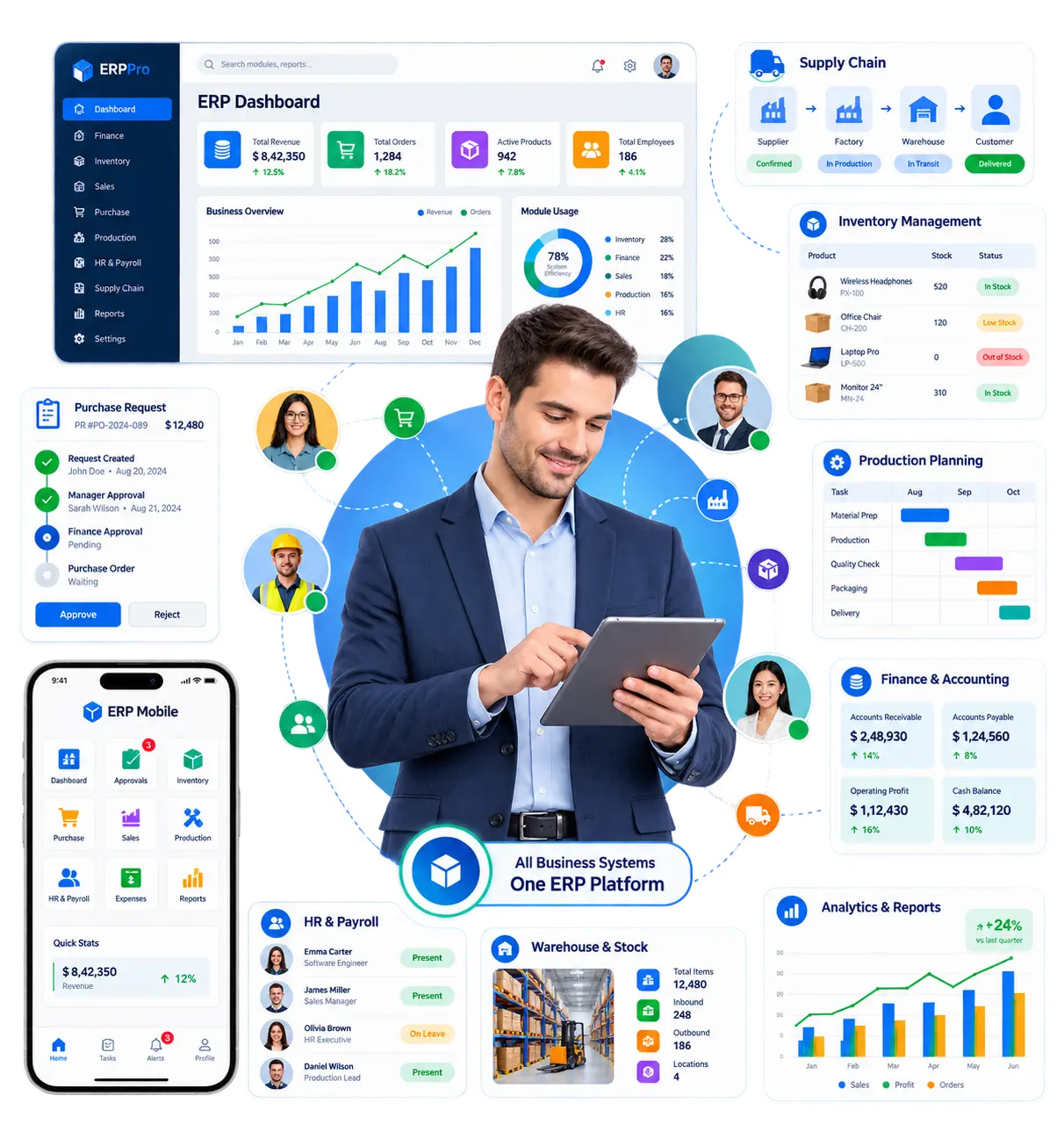
Why Businesses Come to Us for a Custom ERP
Most businesses do not go looking for a custom ERP. They go looking for a way out of the mess they are in. Data living in a dozen spreadsheets that never agree. Finance, inventory, and operations each running their own disconnected tool. A monthly close that takes a week because nobody trusts the numbers until they are reconciled by hand.
We have built ERP systems since 2008 for businesses across North America, Europe, and Australia, and the reason they come to us is consistent. The off-the-shelf platform either could not handle the way their business actually works, or it forced so many workarounds that it created more friction than it removed. A custom ERP fixes that. It unifies your operations into one source of truth, built around your real processes, and you own it outright instead of paying per-seat licensing forever.
Signs Your Current Systems Are Holding You Back
See how many of these sound familiar:
- Your teams run on spreadsheets because the systems you have do not talk to each other
- The same data gets entered three times in three places, and the three rarely match
- Monthly close takes days because the numbers have to be reconciled by hand first
- You cannot get a real-time view of your business without someone building a report manually
- Finance, inventory, sales, and operations each have their own tool, none of them connected
- Your off-the-shelf ERP charges a premium for a module that almost fits but never quite does
- Decisions wait on data that takes too long to pull together to be useful when it arrives

Three or more and your systems are costing you time, accuracy, and decisions. A custom ERP connects what is fragmented and gives you one place where the numbers are right and current.
What Makes a KrishaWeb ERP Different
Every ERP project carries the same three risks: it does not fit how you actually work, it locks your data inside a platform you do not control, or it becomes a multi-year implementation that never quite finishes. We build to avoid all three.
Built around your real operations
We map how your business actually runs before we build anything. The ERP matches your workflows, your approval chains, and your reporting needs, so your team works in the system instead of around it. No paying for modules you will never use.
You own the system and the data
A custom ERP is yours. The code, the database, every record. No per-seat licensing that climbs as you grow. No vendor controlling your pricing or your access to your own operational data. Full ownership, full portability.
Integrated, not isolated
Your ERP should connect to the tools you already run: your CRM, your accounting software, your eCommerce platform, and your warehouse systems. We build those integrations so data flows automatically and you finally get one source of truth instead of a dozen versions of it.
AI-ready from the architecture up
The value of an ERP is not just storing data, it is what the system does with it. We build ERPs ready for demand forecasting, anomaly detection, automated data entry, and predictive analytics, so the system surfaces what needs your attention instead of waiting for someone to go looking.
ERP Development Services We Offer
From a full custom ERP to extending or modernizing the platform you already run, here is what our ERP team delivers.
-
A complete ERP built around your operations from the ground up. Finance, inventory, procurement, HR, sales, and reporting unified into one system that matches how your business actually works. Built on a modern, maintainable stack with the modules you need and none of the ones you do not.
- Custom Build
- Module Design
- Unified Data
- Reporting
-
Connecting your ERP to the systems around it, or modernizing a legacy platform that has become a liability. We integrate with SAP, Oracle, NetSuite, Microsoft Dynamics, your CRM, your accounting tools, and your eCommerce stack, and we modernize aging systems without the rip-and-replace risk.
- System Integration
- Legacy Modernization
- API Development
- Data Sync
-
Targeted modules that extend an ERP you already run or replace a spreadsheet-driven process that has outgrown its limits. Job costing, custom inventory logic, project-based accounting, non-standard revenue flows, the specific things off-the-shelf platforms force into manual workarounds.
- Custom Modules
- Workflow Logic
- Process Automation
- Extensions
-
The financial core: general ledger, accounts payable and receivable, billing automation, financial planning, and reporting that closes the month in hours instead of days. Auditable, accurate, and connected to the rest of your operations.
- General Ledger
- AP/AR
- Billing Automation
- Financial Reporting
-
Inventory planning, warehouse management, procurement automation, and vendor management in one system. Real-time stock visibility, demand forecasting, and the integrations that connect your inventory to your sales and your suppliers.
- Inventory Control
- Warehouse Management
- Procurement
- Vendor Management
-
AI built into your ERP where it earns its place. Demand forecasting from your real data, anomaly detection that flags problems before they become losses, automated data entry that reads documents and invoices, and predictive analytics that turn your operational data into decisions.
- Demand Forecasting
- Anomaly Detection
- Auto Data Entry
- Predictive Analytics
-
Prefer to build in-house? Through our ERP staff augmentation service, you can hire experienced, qualified professionals and move the project forward with your own team, backed by our expertise when you need it.
- Dedicated Developers
- Skill Matching
- Flexible Scaling
- Team Extension
-
Ongoing support that keeps your ERP running as your business changes. New modules as you grow, integrations as you adopt new tools, performance monitoring, security updates, and a team that knows your system. An ERP grows with the business, and we maintain it through that growth.
- Module Updates
- Monitoring
- Security
- Ongoing Support
Industries We Build ERPs For
ERP requirements change completely from one sector to the next. We have built for industries where the standard template does not fit.

Finance and Services
Financial planning, billing automation, resource management, and the auditable records and reporting that service and finance businesses run on.

Healthcare
Operations, inventory, and compliance-ready records built to the privacy and audit standards healthcare demands, connected to the systems your facility already runs.

Retail and Distribution
Multi-location inventory, procurement, order management, and the supplier and sales integrations that keep stock accurate across every channel you sell on.

Logistics and Supply Chain
Real-time inventory, shipment tracking, warehouse operations, and demand forecasting in one system that gives you visibility across the whole chain instead of piece by piece.

Manufacturing
Production planning, bill of materials, shop floor tracking, and quality control connected to inventory and finance, so what happens on the floor shows up in the numbers in real time.

Construction and Projects
Project-based accounting, job costing, resource planning, and the non-standard cost flows that generic ERP platforms force into spreadsheets.
We learn how your business runs
Before any code, we map your operations, your data flows, and the constraints your current systems put on you. Everything we build follows what we find.
We design and architect
Modules, data model, integrations, and the AI capabilities your ERP will use. We phase it around your priorities so the highest-value pieces land first. You sign off before development starts.
We build it, in stages
You see working software at every milestone and we connect it to your existing systems as we go, so value arrives in phases rather than waiting for one big launch at the end.
We launch and stay on
Data migration, team training, and ongoing support that adds modules and integrations as your business grows. The build is the start of the relationship, not the end of it.
Let's Build an ERP Your Business Will Actually Run On
Tell us how your operations work today and where your current systems get in the way. We will come back with a specific plan.
AI Platforms and Engineering Tools We Trust
Empowering your business with the latest technologies we use!
 Open AI
 Gemini
 Claude AI
 Codex
Codex GoHiLevel
 GoogleAIStudio
 Heygen AI
 Langchain
 Langflow
 LLama
LLama Make
Make Perplexity
 Tensor Flow
 Zapier
 Antigravity
 Appify
 Bolt
Bolt ElevenLabs
 Lovable
 n8n
n8n
 CSS3
CSS3 HTML5
HTML5-
 ReactJs
  AngularJS
 Vue.js
 Next.js


 AWS
AWS Google Cloud
 Digital Ocean
 Azure
Azure
 Salesforce
 HubSpot
 Zoho
Zoho
Client Feedback
Real feedback from the clients we build for!

KrishaWeb delivered a site that met all our expectations. Their friendly attitude and speedy work stood out, even while working remotely under tight deadlines. They accommodated our needs seamlessly, making the entire engagement a success.

The collaborative projects with Krishaweb Technologies have garnered several compliments and positive feedback. The team takes the initiative and manages projects well. Excellent work quality, timeliness, and reasonable price structures are key to their success.

KrishaWeb’s web development has positively impacted our business, saving us 4–5 hours of manual work every month. Their technical expertise and creativity result in exceptional outcomes. This trustworthy and hard-working team is a true asset to any project.

KrishaWeb has consistently delivered on their development tasks. The collaboration has always been characterized by their insanely quick turnaround time and incredible customer support. They listen to your challenges and needs and return with a viable solution, every time.



FAQs
We hope these questions and answers help you find the best digital transformation partner for your business.
-
It depends on scope: how many modules, how many integrations, the complexity of your operations, and whether AI features are included. A targeted module that extends an existing ERP or replaces a spreadsheet process is a smaller project than a full custom build unifying finance, inventory, HR, and operations. Rather than an open-ended estimate, we scope the build to your actual requirements and give you a fixed price before work begins. The free consultation is where we work that out.
-
Off-the-shelf platforms are powerful when your operations fit their model. Businesses build custom when the platform forces expensive workarounds, when licensing gets costly at scale, when they need their ERP to match a nonstandard process, or when data ownership matters. A custom ERP costs more upfront and fits your business exactly. In many cases, the right answer is a hybrid: keep the off-the-shelf core and build custom modules where it falls short. We will tell you honestly which path fits.
-
Yes. Connecting your ERP to your CRM, accounting software, eCommerce platform, warehouse systems, and existing tools is core to what we build. We also integrate with and extend major platforms like SAP, Oracle, NetSuite, and Microsoft Dynamics. The goal is one source of truth instead of data scattered across disconnected systems.
-
Often, yes. Rip-and-replace is risky and disruptive, and it is not always necessary. We frequently modernize legacy ERP systems by adding modern integrations, real-time analytics, and AI capabilities on top of the existing core, or by replacing specific modules while keeping what still works. We assess your current system and recommend the lowest-risk path to where you need to be.
-
It depends on scope. A targeted module or extension can be delivered in weeks. A full custom ERP unifying multiple business functions is a multi-phase project measured in months. We phase delivery so the highest-value modules go live first rather than waiting for the entire system to be complete. We give you a realistic timeline after the discovery phase.
-
Yes, It usually should be. We build in demand forecasting, anomaly detection, automated data entry from invoices and documents, and predictive analytics that turn your operational data into decisions. The point is always to surface what needs attention and reduce manual work, not to add AI for its own sake.
-
Completely. The code, the database, and every operational record belong to you. No per-seat licensing, no platform you are renting, no vendor that can change the terms or restrict access to your own data. For a lot of businesses, that ownership is the main reason they go custom.
Start With a Free ERP Consultation
Bring us your operations and the things your current systems cannot do. We will tell you honestly whether a custom build, a modernization, or a set of targeted modules makes the most sense for your business and what it would take.