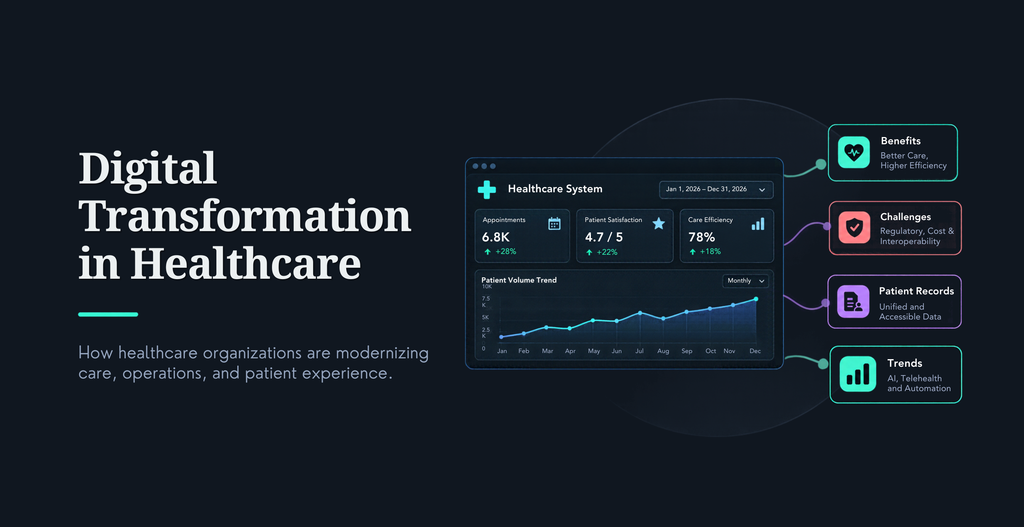
Digital transformation in healthcare means redesigning how care and operations work around connected data, interoperable systems, automation and AI. It is not paper turned into screens. The American Medical Association’s2026 survey found that 81% of physicians now use AI in their practice, up from 38% in 2023. The tools arrived faster than most organizations’ plans for them.
We wrote the first version of this guide in 2022, when telemedicine and chatbots still counted as trends. They are standard now. This update covers what changed, the benefits that hold up, the nine challenges that stall projects, where AI fits, and a roadmap you can use on Monday.
Quick answer
Digital transformation in healthcare is the redesign of clinical, administrative and patient-facing workflows using connected data, interoperable systems, cloud platforms, automation and AI. In 2026 the goal is not to digitize old processes. It is to cut administrative work, connect fragmented systems and introduce AI safely, with human oversight. The opportunity is large. Success depends on data quality, cybersecurity, compliance, clinical adoption and clear governance.
Key Takeaways
Digitizing records is the starting line. Connected data, redesigned workflows and governed AI are the 2026 goal.
Whether AI helps or just adds noise depends on interoperability and data quality.
Most failures are adoption and governance problems, not software problems.
Start with one workflow problem, map it, then choose technology.
What is digital transformation in healthcare?
Digital transformation in healthcare is the redesign of clinical, administrative and patient-facing workflows using connected data, interoperable systems, cloud platforms, automation and AI.
Three terms get mixed up. Digitization moves information from paper to software. Digitalization uses that software to change a workflow. As data flows across systems and staff are supported by automation and AI, this changes how the organization delivers care and runs its business. A scanned chart is digitized. A chart that updates scheduling, triggers a prior authorization and flags a care gap is transformed.
What changed in healthcare digital transformation in 2026?
Three things changed. AI moved from pilot to daily use. Interoperability moved from a talking point to a technical requirement. And governance moved from an afterthought to a gating factor.
The adoption numbers tell the story. Doctors said they used an average of 2.3 artificial intelligence use cases each in the AMA survey, up from 1.1 in 2023. The most common use cases were medical research summarization and care documentation. AMA coverage in August 2026of health system leaders described AI moving from experiments to enterprise strategy. One health system CIO’s warning stood out: do not assume AI will fix broken systems.
Interoperability tells a similar story. ASTP/ONC’s February 2026 data brief on hospital API use found that most hospitals exchange data with third-party technology, but mostly through non-standards-based methods. In plain terms, data moves, but often through one-off connections. Those connections are expensive to maintain and make it harder to feed clean data to new tools.
That is why I retired the old “upcoming trends” list. Telemedicine, patient portals, wearables and basic chatbots are baseline now. The story is how well they connect.
What are the benefits of digital transformation in healthcare?
The strongest benefits are less administrative work, faster access to the right patient information, easier patient communication, connected remote care, and clearer operational visibility. Each one depends on how well your systems connect.
Less administrative work
Documentation, scheduling, intake and prior authorization eat clinical time.Process automationand AI assistants can take on much of the repetitive work. In the AMA survey, more than three-quarters of physicians said AI improves their ability to care for patients, up from 65% in 2023. That is self-reported sentiment, not proof of outcomes, so read it that way.
Better access to patient information
When systems share data, a clinician sees one picture instead of five. That cuts duplicate tests, repeated questions and re-keyed entries. It also depends on data quality. Connected bad data is still bad data.
Easier patient communication
Portals, secure messaging and conversational assistants let patients book, ask and follow up without calling a front desk. The win is speed and convenience. The risk is privacy, so every channel needs the same access controls as the EHR. Good healthcare UI and UX design matters here, because a portal patients cannot use is not a portal.
Remote care and monitoring
Telehealth and remote monitoring extend care beyond the clinic. Consumer wearables and medical-grade connected devices can provide ongoing measurements that may support monitoring and care decisions, depending on the device and the clinical use case. The value appears when device data lands inside the clinical workflow, not in a separate dashboard nobody checks.
Clearer operational visibility
Connected data lets leaders see wait times, bed use, claim delays and staffing patterns in one place. Predictive analytics can help flag risk or forecast demand. Clinicians still make the call.
Room to scale
Cloud platforms and API-based architectures let organizations add locations, services and tools without rebuilding the core each time. This is where incremental modernization pays off.
Digital transformation in healthcare: benefits vs challenges
Every benefit has a matching challenge. Plan for both at the start, not after launch.
Benefit
Matching challenge
Less administrative work
Workflow redesign and staff adoption
Better access to patient information
Data quality and interoperability
Faster patient communication
Privacy and security
AI-assisted workflows
AI governance and human oversight
Improved operational visibility
Fragmented legacy systems
Remote care and monitoring
Device integration and data overload
Better scalability
Modernization and migration cost
What technologies are driving digital transformation in healthcare in 2026?
Seven technology areas matter most: generative AI, agentic AI, EHR integration, FHIR and APIs, cloud and data platforms, remote patient monitoring, and conversational interfaces.
Technology
What it does in 2026
What to watch
Generative AI
Drafts notes, summarizes records and research, answers staff questions
Inaccurate outputs, so it needs review
Agentic AI
Runs multi-step tasks such as intake or claim follow-up
Needs tight permissions and audit logs
EHR and EMR integration
Moves data between the EHR and other systems
One-off connections are costly to maintain
FHIR and APIs
Gives applications a standard way to read and write health data
Standards help, but data mapping still takes work
Cloud and data platforms
Scalable storage, analytics and AI-ready data
Configuration errors and vendor risk
Remote patient monitoring
Brings device data into care workflows
Data overload if nothing filters it
Conversational interfaces
Answers patient and staff questions by chat or voice
Privacy and a clear handoff to a person
At KrishaWeb we connect software to EHR and EMR systems through HL7 and FHIR, so staff are not re-entering the same data twice. That work sits inside our healthcare IT solutions. Agentic AI deserves a careful word. These systems take several steps on their own, like checking eligibility, drafting a message and updating a record. I like them for narrow, well-defined tasks with logs and approvals. I do not like them with broad permissions. Our guide to what AI agents can and cannot do covers the limits.
At KrishaWeb we connect software to EHR and EMR systems through HL7 and FHIR, so staff are not re-entering the same data twice. That work sits inside our healthcare IT solutions. Agentic AI deserves a careful word. These systems take several steps on their own, like checking eligibility, drafting a message and updating a record. I like them for narrow, well-defined tasks with logs and approvals. I do not like them with broad permissions. Our guide to what AI agents can and cannot do covers the limits.
What are the biggest challenges of digital transformation in healthcare?
The nine biggest challenges are fragmented legacy systems, weak interoperability, poor data quality, cybersecurity, compliance, AI governance, clinician adoption, modernization risk and unclear ROI. Most are people and process problems wearing a technology costume.
1. Fragmented legacy systems
Old EHRs, standalone departmental software and brittle integrations create duplicate entry and slow reporting. Staff end up as the integration layer, retyping data between screens. I call it the human API, and it is the first thing I look for in any healthcare audit.
2. Interoperability
FHIR and HL7 are standards for exchanging health data, and APIs are how applications use them. As the ASTP data brief showed, most hospitals still exchange data with third-party tools through non-standards-based methods. Standards-based integration costs more upfront. It tends to cost less to maintain over time.
3. Healthcare data quality
AI is only as useful as the data underneath it. Duplicate patient records, inconsistent coding and unstructured free-text notes all weaken analytics and AI. Clean the data first. It is unglamorous work, and it decides the outcome.
4. Cybersecurity and PHI protection
The HHS Office for Civil Rights reported that hacking and IT incidents made up 81% of large breaches in 2024 and 99% of the individuals affected, including a ransomware attack on a healthcare clearinghouse that exposed about 192 million people. Passwords alone are not a security model. Real protection means encryption in transit and at rest, role-based access, strong authentication, audit logging, vendor risk reviews, careful cloud configuration and tested ransomware recovery.
5. Regulatory and compliance requirements
HIPAA applies in the United States, and other regions add their own rules for health data, consent and AI. Compliance is an architecture decision, not a final checklist. On our builds, PHI handling, access logging and encryption are designed in from the first data model.
6. AI governance
Who approves a tool? Which data can go to which model? Who reviews the output? What happens when a model updates? The AMA’s August 2026 coverage stresses guardrails and fixing foundational problems as AI scales. Write your answers down before the pilot, not after the first incident.
7. Clinical workflow adoption
A technically correct system can still fail if clinicians dislike using it. Extra clicks, duplicate entry and alerts nobody trusts kill adoption fast. Involve clinical staff in design early, test with real workflows, and measure time per task before and after.
8. Legacy modernization risk
Mission-critical systems cannot simply be ripped out. Incremental modernization, meaning you wrap old systems with APIs and replace pieces in order of risk and value, is usually safer. It looks slower on paper and runs faster in practice, because care never stops.
9. Measuring ROI
Teams track logins and feature use, then wonder why leadership is unimpressed. Adoption metrics are not outcomes. Track time saved, error rates, cost per task, wait times and staff satisfaction against a baseline captured before launch.
How does AI fit into healthcare digital transformation?
AI fits as a layer on top of clean data, connected systems and redesigned workflows. It helps most with documentation, administrative automation, patient communication, analytics and internal knowledge search. It needs validation, monitoring and human oversight. If you are unsure whether you are ready, our AI readiness assessment is the place to start.
Search across policies and procedures using retrieval-augmented generation (RAG)
Answers show their sources
AI agents
Multi-step administrative tasks
Tight permissions and audit trails
Where should AI not operate without human oversight?
Diagnosis, treatment decisions, medication changes and anything that denies or delays care. AI can produce inaccurate or inappropriate outputs, reflect bias and make confident mistakes. The old claim that AI removes human error does not hold. It swaps some errors for others. That is why the AMA survey finding that 88% of physicians worry about skill loss matters. Oversight only works if people keep the skills to check the work. For build support, see our AI transformation services.
How do you build a healthcare digital transformation strategy?
Start with the problem, not the technology. I use a six-step routine I call the Map-Before-You-Build method. It moves from a workflow problem to a measured outcome, and it fits inside our wider digital transformation services.
Name the problem. Pick one care or operations problem with an obvious owner (long intake times, duplicate data entry).
Map the workflow. Walk the real process with the people who do it. Mark manual steps, handoffs and every place staff retype data.
Check data and interoperability. List what data exists, where it lives, and whether systems can exchange it through standards or only through one-off connections.
Rate the options. Score modernization, automation and AI ideas by value, feasibility and risk. Do the high-value, low-risk ones first.
Combine governance and security. Decide access controls, audit logging, review steps and AI approval rules before development starts, not after.
Measure and scale. Compare time saved, errors, cost and patient experience against your baseline. Scale only what moves the numbers.
How do you measure healthcare digital transformation ROI?
Measure outcomes against a baseline captured before launch, and keep adoption metrics separate from results.
Category
Example metrics
Why it matters
Adoption
Active users, feature use, training completion
Shows people use it. Does not prove value
Operational
Time per task, intake time, claim turnaround, no-show rate
Shows workflow gains
Financial
Cost per task, rework, avoidable denials
Shows cost impact
Clinical and patient
Wait times, patient satisfaction, relevant care measures
Capture the baseline first. It is the step most teams skip, and without it every later claim is impossible to defend. Even a rough baseline, such as a week of timed intake calls, beats none.
What does the healthcare digital maturity ladder look like?
The KrishaWeb Healthcare Maturity Ladder has five levels. It helps you see where you are and which step to take next.
Level
What it means
Typical sign
1. Digitized
Records and workflows have moved from paper to software
Data lives in separate systems
2. Connected
Systems exchange data through APIs, FHIR and integrations
Staff stop retyping data
3. Automated
Repeatable operational tasks run without manual steps
Fewer handoffs and delays
4. Intelligent
AI assists staff with knowledge, decisions and communication
Governed AI tools in daily workflows
5. Adaptive
Data, AI and workflows improve continuously from measured outcomes
Regular review cycles tied to KPIs
Skipping Level 2 is the classic mistake. AI on disconnected data gives you fast, confident, wrong answers.
What should healthcare leaders prioritize next?
If you take three things from this guide, take these. Fix the foundations first: data quality, interoperability and security. Redesign one workflow before you buy a platform. And write your AI governance rules before the first pilot goes live. Everything else, from ambient documentation to agents, sits on top of those three. Organizations that scale AI tend to be the ones that connected their systems, set the rules and measured results first.
Ready to turn a healthcare workflow into a connected one?
If you are weighing EHR integration, legacy modernization or AI, our team can map the workflow and flag the compliance decisions before anyone writes code. Talk to us about healthcare IT solutions and EHR integration, or start with an AI readiness assessmentif AI is your first question.
Frequently Asked Questions
What is digital transformation in healthcare?
It is the redesign of clinical, administrative and patient-facing workflows using connected data, interoperable systems, cloud platforms, automation and AI. The aim is better outcomes, less administrative work and safer use of AI, not simply replacing paper with software. In 2026 it also includes governance, cybersecurity and measurement, because projects without them tend to stall.
How is AI being used in healthcare digital transformation?
FHIR is a standard for exchanging healthcare data through APIs. It gives applications a common way to read and write information in electronic health records, which reduces one-off integrations and double entry. U.S. certification rules require FHIR-based APIs for certified health IT. Data mapping and data quality work still apply, so FHIR is a foundation, not a finished solution.
Where should a healthcare organization start its digital transformation?
Start with one workflow problem that has a clear owner and a measurable cost, such as duplicate data entry or slow patient intake. Map how the work really happens, check whether your systems can exchange the data involved, and capture a baseline before you build. Choose technology last. Our six-step Map-Before-You-Build method follows exactly this order.
How long does healthcare digital transformation take?
It depends on scope. A single workflow fix or one integration is a very different project from an enterprise program that touches the EHR, the cloud platform, the security model and AI governance. Treat transformation as a series of measured phases, not one launch. Plan for change management alongside the build, because adoption often takes longer than development.
How should healthcare organizations measure digital transformation ROI?
Capture a baseline before launch, then compare time per task, error rates, cost per task, wait times, and staff and patient satisfaction after launch. Keep adoption metrics, such as logins and feature use, separate from outcome metrics. Adoption shows people are using the tool. Outcomes show whether the tool is working.
Ready to Scale Your Agency?
Tell us what you are trying to deliver. Schedule a call to talk it through, or contact us with your project.
A Digital Marketing Project Manager and Lead, excels as a strategist and Digital Marketing expert. With a focus on driving digital initiatives, Delivers targeted results and effective marketing solutions.




 KrishaLabs
 KrishaStudio
 KrishaStore