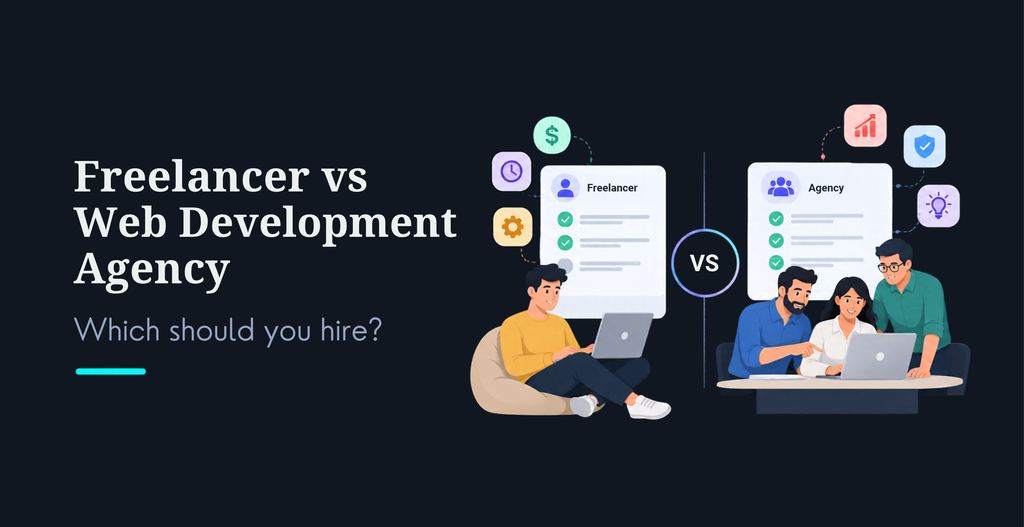
Hire a freelancer when your website is small, the scope is clear, and one skilled person can own it. Hire a web development agency when the site carries real business risk, needs several disciplines, or has to keep working long after launch. That is the short answer to freelancer vs web development agency in 2026. The rest of this guide shows you how to tell which side your project falls on.
Finding a freelancer is easy. Upwork’s Freelance Forward 2023 study, run by Edelman Data & Intelligence, counted 64 million Americans who freelanced that year, about 38% of the US workforce. Choosing the right one is the hard part. Price is usually the smallest piece of that decision. Scope, risk, ownership, and support matter more.
AI website builders now add a third option for simple sites, so we cover that too. One disclosure first. KrishaWeb is an agency. I will say plainly where a freelancer is the better call, because a guide that always recommends its own service model is not worth reading.
Key Takeaways
Scope decides it. A small, clear, low-risk site suits a freelancer. A site with integrations, several disciplines, or real revenue riding on it suits an agency.
Compare proposals at the same scope. In our worked example, an $8,000 sticker gap shrank to about $4,400 once both quotes covered the same work.
Budget for life after launch. Maintenance and enhancements commonly run 15 to 25% of the build cost every year, on top of hosting and licenses.
Reliability comes from track record, not labels. Judge both options on references, process, contracts, and live work.
Put ownership in writing. Source code, design files, domain, hosting accounts, and any AI-assisted work should all be assigned to you in the contract.
AI builders fit simple sites. They do not replace strategy, integration work, or someone accountable when the site breaks.
Freelancer vs Web Development Agency: The Quick Answer
Start with one question. What happens to your business if this website is late, broken, or hacked? If the honest answer is “not much,” a freelancer is probably enough. If the answer is “we lose leads or sales,” you need more than one person’s calendar behind it.
Who should hire a freelancer?
A freelancer fits when you can describe the whole job on one page. Think of a five-to-ten page brochure site, a landing page, a template customization, or a one-time fix on a platform the developer already knows well. It also helps if you can write the brief, review the work yourself, and live with a delay of a few weeks.
Who should hire a web agency?
An agency fits when the site supports revenue or operations. That means eCommerce, customer accounts, CRM or ERP integrations, several stakeholders, or a fixed launch date. It also fits when you need design, development, SEO, and testing running in parallel, and want one team answerable for the result after launch.
A lot of the clients who come to us already own a site that looks fine on the surface and does not perform. The fix is rarely a prettier design. It is usually a gap in testing, integration, or ongoing ownership.
Freelancer vs Web Agency: Key Differences at a Glance
This table shows the patterns we see most often. Use it for a fast first pass, then read the sections below before you decide.
Factor
Freelancer
Web agency
Upfront cost
Often lower
Often higher
Expertise
Individual or specialized skills
Multiple disciplines available
Best project fit
Small or well-defined scope
Complex or evolving scope
Communication
Direct with the person doing the work
Usually coordinated through a project lead
Project management
May be client-led
Often managed by the agency
Scalability
Depends on one person’s capacity
Depends on team capacity
Quality assurance
Varies by professional
May have dedicated QA processes
Ongoing support
Depends on availability and contract
Often offered through support agreements
Accountability
Defined by the freelancer’s contract
Defined by the agency’s contract
These are typical operating patterns, not guarantees. A seasoned freelancer with a tight process can beat a badly run agency every time. If your project is mostly design, remember that “freelancer vs web design agency” is often a two-person problem. You may need a freelance designer and a freelance developer, and the coordination between them lands on you.
What Is a Freelance Web Developer?
A freelance web developer is an independent professional who sells their own skills by the project, the hour, or the day. Some are narrow specialists. Others are experienced full-stack generalists who can handle design, build, and launch alone. They run their own sales, delivery, and communication, which means you often manage the project yourself.
Old advice says freelancers are less credible because they are not registered businesses. That is too blunt. Reliability comes from references, contracts, process, and years of delivered work, and you can test all four. We cover how in the hiring questions below.
What Is a Web Development Agency?
A web development agency is a team that covers the full job: a project manager, designers, developers, QA testers, andsearch engine optimization specialists, often with content support too. Agencies range from boutique studios of two to five people to large firms. You pay for process and coverage as well as skill, and you get continuity if one person leaves the project.
KrishaWeb has built websites since 2008, and our own published figure is more than 2,400 projects across 42 countries. That experience is why we have strong views on scope and handover. It is also why we tell some clients to hire a freelancer.
How Much Does a Freelancer Cost Compared With a Web Agency in 2026?
Published price ranges vary wildly, and most guides never say what region they cover or what the price excludes. The numbers below come from our own cost guides, in US dollars. Your quotes will differ with region, platform, and scope. Treat them as a reality check, not a quote.
The build is not the whole bill. Our standard scope usually leaves out copywriting, photography, hosting, domain renewal, third-party licenses, and maintenance after the support window. Copywriting runs about $80 to $200 per page. Premium themes, plugins, and tools cost about $50 to $500 a year each. On larger projects, a standalone discovery phase can cost $2,500 to $15,000.
Then comes ownership of the running site. In our cost guide, annual maintenance and enhancements commonly come to 15 to 25% of the initial investment. A $10,000 site should carry a $1,500 to $2,500 yearly line item in your plan. If a quote ignores this, ask why.
Worked example: two proposals for the same site
Here is the test we use. We call it the Same-Scope Test. Before you compare prices, rewrite both proposals against one checklist of work. Every figure below is hypothetical, so swap in your own. The site is a 10-page professional website with CRM integration.
Line item
Freelancer proposal
Agency proposal
Quoted price
$6,000
$14,000
Discovery and wireframes
Not included, add $1,500
Included
QA and accessibility testing
Not included, add $1,000
Included
CRM integration
Not included, add $1,200
Included
30-day post-launch support
Not included, add $500
Included
Same-scope build price
$10,200
$14,000
Copywriting, 10 pages at $120
$1,200
$1,200
Hosting, domain, and licenses
$600
$600
Year-one maintenance at 15% of build
$1,530
$2,100
Year-one total
$13,530
$17,900
The sticker gap was $8,000. After the same-scope adjustment and year-one costs, it is $4,370. That remaining gap buys a team, a documented process, and someone to call when a plugin update breaks checkout. Whether it is worth paying depends on your cost of failure. A freelancer who already includes QA and integrations would close the gap further, which is exactly what the test is for.
8 Key Differences Between Freelancers and Web Agencies
The table gave you the pattern. Here is what each difference means in practice, and what to ask about it.
1. Skills and expertise
Some freelancers are deep specialists. Others are full-stack generalists with a decade of launches behind them. An agency gives you breadth: design, development, SEO, content, and QA under one roof. The real question is whether your project needs breadth. If it does, hiring three freelancers means you become the project manager.
2. Quality and testing
Ask how the work is tested, and on what. Real devices, real browsers, and a written performance target are the minimum. Speed has a measurable payoff. A Google-commissioned study by 55 and Deloitte, covering 37 brand sites and more than 30 million sessions, found that a 0.1 second faster mobile load lifted retail conversion rates by 8.4% (web.dev, data from late 2019). We write Core Web Vitals targets into scope: LCP under 2.5 seconds, INP under 200 ms, and CLS under 0.1.
Fixing problems early is also cheaper. By our own measure, a layout problem caught in a wireframe takes about 30 minutes to fix, versus about three hours once it is in a finished design.
3. Project management and timelines
With a freelancer, you usually run the schedule. With an agency, a project manager does. Agencies can compress timelines by running design, development, and QA in parallel, but that costs more. A five-page site typically takes four to eight weeks either way. Ask what usually makes their projects run long. Good providers have a straight answer.
4. Communication and collaboration
A freelancer gives you direct access to the person doing the work. That is a real advantage. Nothing gets lost between a salesperson and a developer. An agency usually routes communication through a project lead, which suits complex projects with several stakeholders. Either way, agree on a weekly demo, a single channel, and response times before you sign.
5. Security and compliance
Who patches the site, stores the credentials, and takes backups? Those answers matter more than any badge. Accessibility needs the same scrutiny. The WebAIM Million 2026 report found detectable WCAG 2 failures on 95.9% of a million home pages, averaging 56.1 errors per page. Ask whoever you hire how they test for accessibility, and what they do about privacy and consent for your markets. Our guide on AI website accessibility and compliance goes further.
6. Scalability and integrations
A freelancer’s capacity is one calendar. When your project grows, that calendar fills. Agencies scale by adding people, and some, like our dedicated developer service, can have a pre-vetted developer contributing to your sprint within five days. Integrations with a CRM, ERP, payment, or inventory system are where solo builds most often stall.
7. Maintenance and ongoing support
Launch is the start of the cost, not the end. Our standard includes 30 days of post-launch support, and many agencies sell optimization retainers beyond that. Our Webflow guide notes that many agencies charge $2,000 to $7,500 a month for 20 to 80 hours of ongoing optimization. A freelancer may cost less per hour, but ask who covers you when they are on holiday or fully booked.
8. Accountability and ownership
Accountability lives in the contract, whoever you hire. Confirm in writing that you own the source code, design files, content, and domain, and that hosting, CMS, and analytics accounts sit in your name. For us, full asset transfer happens on final payment. Add one more clause if your builder uses AI tools. Human involvement is a condition of US copyright protection, and the Copyright Office’s AI reports and the D.C. Circuit’s 2025 Thaler decision both point that way, asVenable LLP summarized in July 2025. Ask for human review of AI-assisted work and an explicit assignment of rights. This is not legal advice, so have counsel read your contract.
Freelancer vs Agency vs AI Website Builder in 2026
AI website builders have changed what a first version costs. For a simple site, you can generate layouts, draft copy, and publish without commissioning a custom build. But publishing a site is different from making it work for a business.
Option
Best for
Main strength
Main limit
AI website builder
A simple site with limited customization
Fast, low-cost first version
Limited strategy, integration, and ownership options
AI website builder
A defined scope on a familiar platform
Tailored work and direct access to one expert
Capacity, continuity, and coordination across disciplines
Web agency
A site tied to revenue, integrations, or growth
Coordinated design, build, QA, SEO, and support
Higher cost and more process
A local consultant launching a five-page site may be well served by a builder or a freelancer. An eCommerce business with inventory integrations, customer accounts, performance targets, and a marketing plan will probably need an agency’s wider coverage. The question is never how quickly the first version goes live. It is what the site has to accomplish next.
An AI tool can publish a site in an afternoon. It cannot tell you whether the site is working.
AI also changes freelancer and agency proposals. Ask how they use AI tools on your project, who reviews the output, and where your data goes. If you already started with an AI tool and it has stalled, our AI build rescue and rebuild serviceexists for that case, and our guide to choosing the right AI stack for your website helps you plan the next step.
Which Option Is Right for Your Project?
Use what I call the Cost-of-Failure test. Ask what it costs you if the site is down for 48 hours, leaks customer data, or launches a month late. The bigger the number, the more your project needs a team. The smaller the number, the more a freelancer or a builder makes sense.
Startups and small businesses
If you are still validating the idea, spend little. A builder or freelancer is often the right first step. If the site is already your main sales engine, buy more help. Either way, plan for a rebuild as you grow, and read our comparison of custom versus template websites before you commit to a platform.
Growing businesses
Once the website feeds your pipeline, the gaps start to hurt: no CRM sync, no testing, no one to ask about conversion. A hybrid often works well. An agency handles the build and the technical foundation, and a freelancer or in-house person handles small changes afterward.
eCommerce and complex web applications
Payments, inventory, customer accounts, and performance under load are hard to carry alone. We usually recommend a team here, such as ourecommerce development services, because the cost of a bad launch is high and the integrations multiply. A freelancer can still be valuable as a specialist inside the project.
Website redesigns and ongoing optimization
Audit first. A redesign without a diagnosis tends to repeat old problems in new colors. Our website conversion audit checklist shows what we check before recommending a redesign, and we offer a free AI website and CRO audit with a report delivered within five business days.
Your situation
Usually the better fit
Landing page or five-page brochure site
Freelancer or AI website builder
Small business site with a clear brief and light integrations
Freelancer with strong references
Site that is your main source of leads or sales
Agency, or agency plus freelancer
eCommerce, accounts, payments, or custom features
Agency
Redesign of an underperforming site
Agency-led audit first, then decide who builds
Small ongoing changes after launch
Freelancer or a small support retainer
10 Questions to Ask Before You Hire a Freelancer or Agency
Ask the freelancer and the agency the same ten questions. Then compare answers, not prices. We built our own scoring around this idea. In our guide on how to evaluate a web development agency, case studies with metrics carry 25% of the score and a documented process carries 20%.
Can I see three similar projects live? And can I speak with two of those clients? Live sites on a phone beat screenshots.
Who exactly will work on my project? What happens if that person is unavailable for two weeks?
What is in the quote and what is not? Check discovery, QA, content, integrations, hosting, and licenses.
Is the price fixed? What triggers a change order, and what does extra work cost?
Who owns the code, design files, domain, and hosting accounts? And when does ownership transfer?
How do you test? Ask about devices, accessibility, and written performance targets.
How do you use AI tools on my project? Who reviews the output, and what happens to my data?
What does support look like after launch? How long does it last and what does it cost afterward?
How do you handle security? Backups, updates, and where credentials are stored.
Tell me about a project that went wrong. What did you change afterward? A provider who cannot answer is a red flag.
If you are vetting a freelancer, add one step: a small paid trial. One or two days of real work shows communication and quality better than any portfolio.
What We’ve Learned From Building and Managing Business Websites
Most failed website projects we are asked to fix did not fail on design. They failed on scope, testing, handover, or support. That is why our process front-loads discovery, writes performance targets into scope, and ends with a full asset transfer. You can see the kinds of projects we build in our case studies.
Final Verdict: Freelancer or Web Development Agency?
Neither is automatically the better choice in 2026. Choose a freelancer when your project has a clear scope, a manageable budget, and few technical dependencies. An experienced freelancer can deliver excellent work without a larger team’s overhead.
Consider a web development agency when the website supports important business operations, needs several areas of expertise, or needs structured delivery and ongoing technical support. And if you are unsure, run the Same-Scope Test and the Cost-of-Failure test before you sign anything.
Before choosing, compare proposals on deliverables, relevant experience, communication, ownership, testing, and post-launch responsibilities. Need help planning a website that supports your business goals? Explore our web development services, ortalk to our teamabout the options for your project.
Frequently Asked Questions
Is it cheaper to hire a freelance web developer or an agency?
Usually the freelancer is cheaper upfront. Our guides put a complete freelance project at about $1,000 to $5,000, while agencies typically start at $5,000 to $15,000. Total cost is a different story. Cheaper quotes often leave out discovery, testing, integrations, and support, and you pay for those later. Compare both proposals at the same scope, then add hosting, content, and 15 to 25% a year for maintenance and enhancements before you decide which one costs less.
Can a freelancer build a professional business website?
Yes. Many do, and some do it better than a mid-size agency. A skilled freelancer is enough when the scope is clear, the site is a brochure site, landing page, or small store on a standard platform, and you can review the work yourself. Check portfolios, code samples, and client references, and ask how they test on real devices. The risk is rarely skill. It is capacity, because one person has one calendar.
When should a growing business hire a web development agency?
Hire an agency when the website drives revenue or runs part of your operations. Typical triggers are CRM or ERP integrations, customer accounts, payments, several stakeholders, a fixed launch date, or a need for design, development, SEO, and testing at the same time. An agency also makes sense when you want one team accountable after launch, with a support agreement that outlasts the first 30 days.
Who owns the website after a freelancer or agency builds it?
The contract decides, not the builder. Get in writing that you own the source code, design files, content, and domain, and that hosting and CMS accounts are registered in your name. Ask when ownership transfers, usually on final payment. If the builder uses AI tools, add a clause requiring human review and an explicit assignment of rights, because purely AI-generated output may not be protected by US copyright. This is not legal advice, so have counsel review the contract.
Should I use an AI website builder instead of hiring a developer in 2026?
For a simple site with few pages, standard layouts, and no integrations, an AI website builder can be enough. For anything that supports sales, needs custom features, or must perform well and stay secure, it is a starting point rather than a replacement. Check whether you can export your site, who handles updates, and who is responsible when something breaks. Many businesses use a builder to draft and a developer to finish.
How do I find and vet a trustworthy freelance web developer?
Start with referrals and portfolios of sites similar to yours. Ask for two client references and call them. Review live sites on a phone, not only in screenshots. Ask for a written scope, a fixed price, and clear ownership terms. Then run a small paid trial, one or two days of real work, before committing to the full project. A trial task tells you more about communication and quality than any portfolio.
Ready to Scale Your Agency?
Tell us what you are trying to deliver. Schedule a call to talk it through, or contact us with your project.




 KrishaLabs
 KrishaStudio
 KrishaStore