



 KrishaLabs
 KrishaStudio
 KrishaStore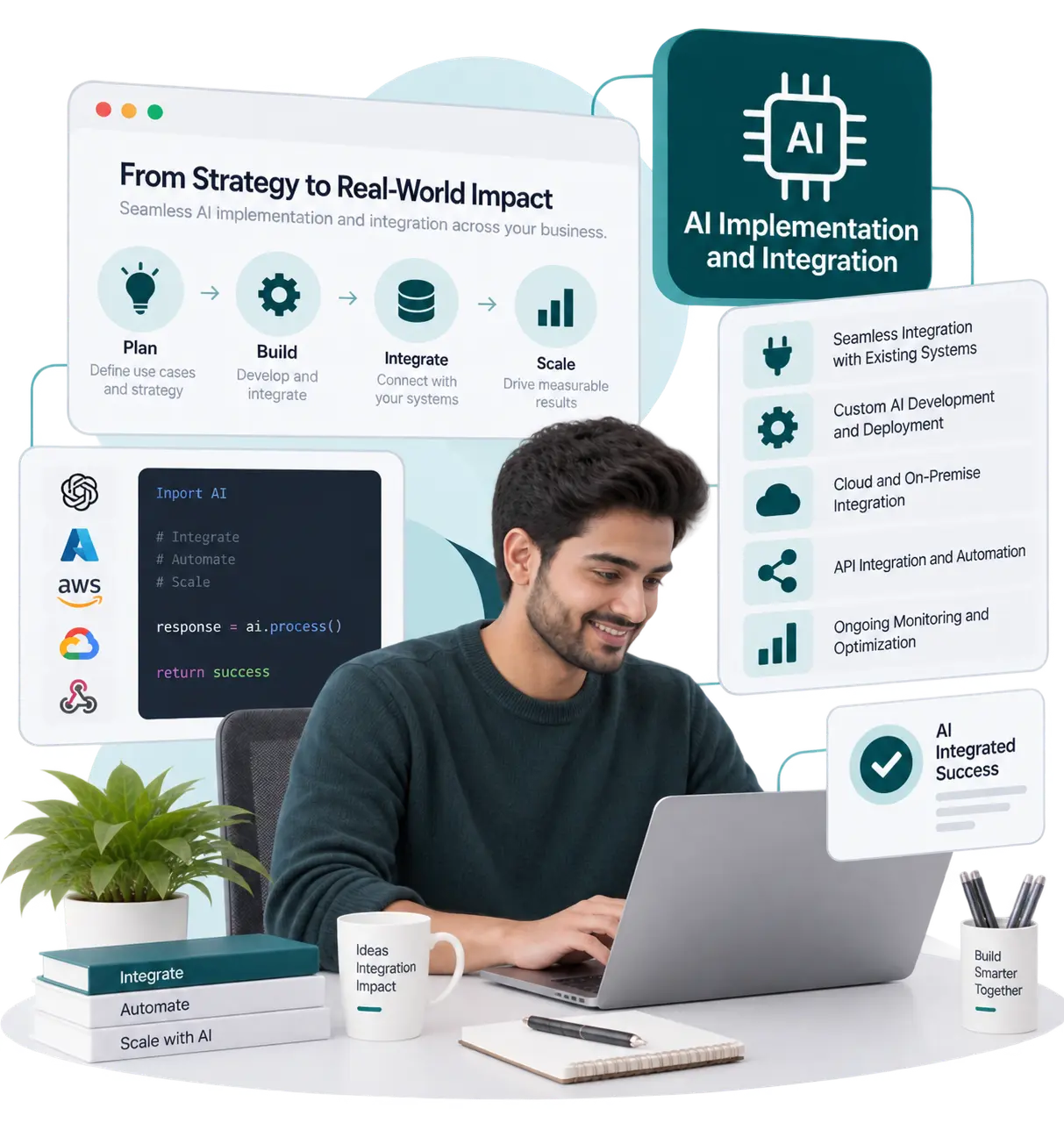
AI Implementation That Goes Beyond the Pilot
Most AI programs stall not because the model fails but because everything around it was not built for production. The data pipeline delivers stale inputs. The API does not fit the existing system. The security review nobody planned for holds deployment for three months. The team gets handed a system they do not know how to operate.
We have seen all of these. We fix them before they become the reason your AI program stalls. We connect AI to the systems your business already runs, build the pipelines and monitoring that keep it working reliably after launch, and hand over a system your team owns from day one.

Why Engineering and Tech Leaders Choose KrishaWeb for AI Implementation
You need an implementation partner that understands your existing stack, not one that asks you to rebuild it before AI can work inside it.
We integrate with the systems you already run
Salesforce, SAP, HubSpot, Snowflake, Oracle, legacy on-premise databases: we have integrated AI into all of them. We do not show up and tell you that your infrastructure needs to change before we can start. We work with what is there and build the integration layer around it.
From pilot to production in a defined timeline
Pilots that never reach production are the most expensive AI investment a business makes. We scope every engagement with defined milestones and a clear path from proof of concept to live deployment. You know the timeline before the work begins, not at the end of it.
MLOps and monitoring built in from the start
A production AI system without monitoring is a liability waiting to surface. Every implementation we deliver includes model performance tracking, drift detection, retraining triggers, and alerting. Your system tells you when something is slipping. You do not find out from a user complaint.
Security and governance at every integration point
Connecting AI to enterprise systems opens attack surfaces that a standard software integration does not create. We build security controls, access management, and data governance into the integration layer. Not as a review at the end. From the architecture phase.
AI Implementation Services We Deliver
The model works. Getting it connected to your systems, data, and workflows so it does something useful in production is the harder part. That is what this practice covers.
-
We connect AI to Salesforce, SAP, HubSpot, Snowflake, and whatever else your business runs on. Through APIs, webhooks, or direct database connections, whichever way actually works for your environment.
-
Plugging a language model into your existing workflows, knowledge base, or customer-facing tools. We handle the RAG architecture, the data pipeline, and the guardrails so it does not embarrass you in production.
-
Your data science team built the model. We get it out of the notebook and into a production API that runs reliably, versioned properly, and monitored from day one.
-
Models degrade quietly after launch. We build the monitoring layer that tells you when accuracy is slipping before your users notice it.
-
AI combined with your existing process workflows to handle the tasks that rule-based automation breaks on because the inputs are too variable or the decisions too complex.
-
Custom APIs that expose AI capabilities to your internal tools, customer applications, and third-party integrations with proper authentication, versioning, and documentation.
-
The infrastructure that feeds your models clean, timely data from your operational systems. Without this, the model is only as good as the last manual export someone remembered to run.
-
Deployment on AWS, Azure, or Google Cloud sized to your actual usage, with cost optimization built into the architecture so the first invoice is not a surprise.
-
Thirty days of post-launch monitoring is standard. Ongoing model management is available for teams that want someone watching performance after we leave.
How We Work On Your Behalf
We design before we build, test before we deploy, and document everything so your team runs it after we leave.
We Start With Your Existing Stack
Before anything is designed, we sit down with your engineering team and go through what is actually running: the systems, the data sources, the APIs, the integration constraints. We want to find the problems before they find us three weeks into a build.
We Define the Integration Architecture First
Architecture decisions made late are expensive. We design the full integration before the first line of code: data pipelines, API contracts, model serving setup, authentication, and system dependencies. Changes at this stage cost hours. Changes at deployment cost weeks.
We Build Data Pipelines That Feed the Model Correctly
A model is only as good as what it receives. We build the pipelines, preprocessing steps, and validation layers that make sure your operational data arrives clean, formatted correctly, and on time. This is the work that most implementation projects are under scope, and then spend months fixing.
We Connect AI to Your Business Systems Directly
REST APIs, webhooks, event-driven triggers, and direct database connections: we pick what fits the system, not what is easiest to build. The goal is AI outputs surfacing inside the tools your teams already use, not in a separate interface nobody opens.
We Validate in Staging Before Every Production Deploy
Nothing goes to production until it has run in a staging environment that mirrors it. We do not discover problems after your users have found them. We find them in testing, fix them there, and deploy solutions.
We Build MLOps From Day One
Monitoring, drift detection, retraining triggers, version control for models and pipelines. This goes in on day one, not as a follow-up engagement after someone notices the accuracy has dropped.
We Document What We Build
Architecture diagrams, API specs, data flow documentation, runbooks, model cards. Your team should be able to open our documentation and understand exactly what is running and why. If they need to call us to explain a decision we made six months ago, we have not done our job properly.
We Train Your Team to Own It
Handover is not sending a zip file. We sit with your engineering team and walk them through the system, showing them how to monitor it, how to update it, and what to do when something breaks. Your team runs it from day one after delivery.
From Proof of Concept to Production in a Defined Timeline
Every engagement starts with a technical discovery session. We scope before we build.
Technical Discovery and Integration Scoping
A focused session on your current systems, data landscape, integration constraints, and the specific AI use case. We leave with an integration architecture proposal, a defined scope, a fixed-price estimate, and a delivery timeline. Nothing starts until you have agreed to all four.
Data Pipeline and Integration Architecture Build
We build the data pipelines, preprocessing layers, API integrations, and system connections the model needs before it can run in your environment. This phase ends when we have validated data flowing from source systems to model inputs against your real data. Not synthetic test data.
Model Integration, Testing, and Staging Deployment
The model goes into your system architecture, gets connected to pipelines and downstream systems, and is deployed to staging. Functional testing, performance benchmarking, and security review all happen here. Production is not considered until staging passes.
Production Deployment, Monitoring, and Handover
Live deployment with MLOps monitoring running from the first day. Dashboards, alerting, and runbooks delivered. Team training done. Your AI system is live, monitored, and owned by your team before we close the engagement.
What KrishaWeb's AI Implementation Team Delivers
Every capability below has been delivered in production across multiple client environments. Not prototyped. Not piloted. Deployed, monitored, and running at scale.
Enterprise System Integration — CRM, ERP, and Data Platforms
(Featured Panel) AI connected to Salesforce, HubSpot, SAP, Oracle, Snowflake, and custom databases through REST APIs, webhooks, and direct database integrations. AI outputs surfaced inside the tools your teams already use, not in a separate interface nobody opens. Built for the data volumes, authentication requirements, and uptime expectations of enterprise systems.
Generative AI and LLM Integration
Large language models connected to your business data through retrieval-augmented generation, fine-tuning, and prompt engineering. Knowledge assistants, document processing, content automation, and customer service AI running inside your existing workflows with proper governance controls in place.
Machine Learning Model Deployment and MLOps
Trained models moved from data science environments into production APIs. Model serving, versioning, A/B testing, performance monitoring, drift detection, and automated retraining. Your ML investment runs reliably in production rather than sitting in a notebook waiting for someone to run it manually.
Intelligent Process Automation
AI-powered automation for document processing, data extraction, classification, and decision workflows. RPA combined with machine learning for the processes that rule-based automation cannot handle because the inputs are too variable. Automation that handles exceptions, not just the clean path.
AI-Powered API Development
Custom APIs that expose AI capabilities to your internal systems, customer-facing applications, and third-party integrations. Rate limiting, authentication, versioning, and OpenAPI documentation included. AI capabilities your development team can build on without needing to understand what is running behind them.
Data Pipeline and Feature Engineering
Ingestion pipelines from operational systems, feature stores, data quality monitoring, and preprocessing that turn raw business data into something a model can actually use. AI-ready data delivered on the schedule the business requires, not whenever someone remembers to run an export.
Cloud AI Infrastructure
AI deployment on AWS, Azure, and Google Cloud using managed AI services, container orchestration, and cloud-native integration patterns. Infrastructure sized to your actual usage, with cost optimization built into the architecture before the first invoice arrives.
Choose the AI Implementation Engagement That Fits Your Project
Three models. Every engagement includes full documentation, MLOps monitoring, and team handover at delivery.
Full Production Implementation
End-to-end AI implementation from technical discovery through production deployment and handover. Data pipeline build, system integration, model deployment, MLOps setup, security review, and team training. Right for organizations moving a defined AI use case from pilot or planning into production for the first time.
- Production system
- MLOps monitoring
- Documentation
- Team handover
Integration Sprint
A focused engagement for organizations that have an AI model or API and need it connected to their existing business systems. API integration, data pipeline build, system connections, testing, and staging deployment. Right when the model works and the integration is the remaining gap.
- Connected system
- Integration documentation
- Production deployment
MLOps and Monitoring Setup
A targeted engagement for organizations with AI systems in production that lack proper monitoring, drift detection, retraining pipelines, and operational runbooks. Right when AI is running but nobody is confident it is still performing correctly.
- Audit report
- Redesigned exception handling
- Performance-tested rebuild
Industries We Serve With AI Implementation and Integration
Every sector has different systems, different compliance requirements, and different integration constraints. Here is where we have done the work.








Ready to explore how AI can drive real business outcomes for your organization?
Client Feedback
Delve into the feedback from our valued customers!

The collaborative projects with Krishaweb Technologies have garnered several compliments and positive feedback. The team takes the initiative and manages projects well. Excellent work quality, timeliness, and reasonable price structures are key to their success.

KrishaWeb’s web development has positively impacted our business, saving us 4–5 hours of manual work every month. Their technical expertise and creativity result in exceptional outcomes. This trustworthy and hard-working team is a true asset to any project.

KrishaWeb has consistently delivered on their development tasks. The collaboration has always been characterized by their insanely quick turnaround time and incredible customer support. They listen to your challenges and needs and return with a viable solution, every time.




Frequently Asked Questions
Questions we get before most implementation engagements. If yours is not here, book a call and ask about it directly.
-
Implementation is the full scope: building or deploying the model, creating the data pipelines, setting up monitoring, and training the team. Integration is the specific work of connecting an existing AI model or capability to your systems and data. In practice, most clients need both, and we deliver them as a single connected engagement rather than two separate projects.
-
We have connected AI to Salesforce, HubSpot, SAP, Oracle, Snowflake, BigQuery, marketing automation platforms, custom internal tools, legacy databases, and AWS, Azure, and Google Cloud. If it has an API or a database connection, we can work with it. If it does not, RPA covers most of what is left.
-
A full production implementation for a well-scoped use case runs six to twelve weeks from technical discovery to handover. An integration sprint runs three to six weeks. An MLOps setup runs two to four weeks. The main variable is data: clean, accessible data shortens timelines significantly. We give you a specific estimate after the discovery session, not before it.
-
Yes, but we are upfront about what that means. We assess your data against what the specific use case actually needs, not against a generic clean data standard. Some quality issues we handle at the pipeline level. Others need remediation before production will work reliably. We tell you which is which before the build starts.
-
It will if nobody is watching it. Real-world data drifts from training data over time, and model accuracy drops. Every system we deliver has monitoring that tracks performance metrics and triggers a defined retraining process when they fall below agreed thresholds. Your team gets an alert. The process is documented. No emergency intervention required.
-
Yes. Enterprise knowledge assistants using RAG, AI customer service tools, document processing, content generation workflows, and conversational interfaces connected to your business data: we have built all of these. Every GenAI implementation includes governance controls for hallucination risk, data privacy, and appropriate use. These are not afterthoughts. They go into the architecture design.
-
This is actually one of the most common engagement models we run. Data science teams are excellent at building and training models. Getting those models through production integration, MLOps setup, and enterprise system connectivity is a different set of engineering skills. We handle the production side while your data science team retains full ownership of the model development and business logic.
Ready to Take Your AI From Pilot to Production?
Book your free AI Implementation Consultation. A technical conversation, not a sales call. 30 minutes with an engineer who has shipped AI in production.