



 KrishaLabs
 KrishaStudio
 KrishaStore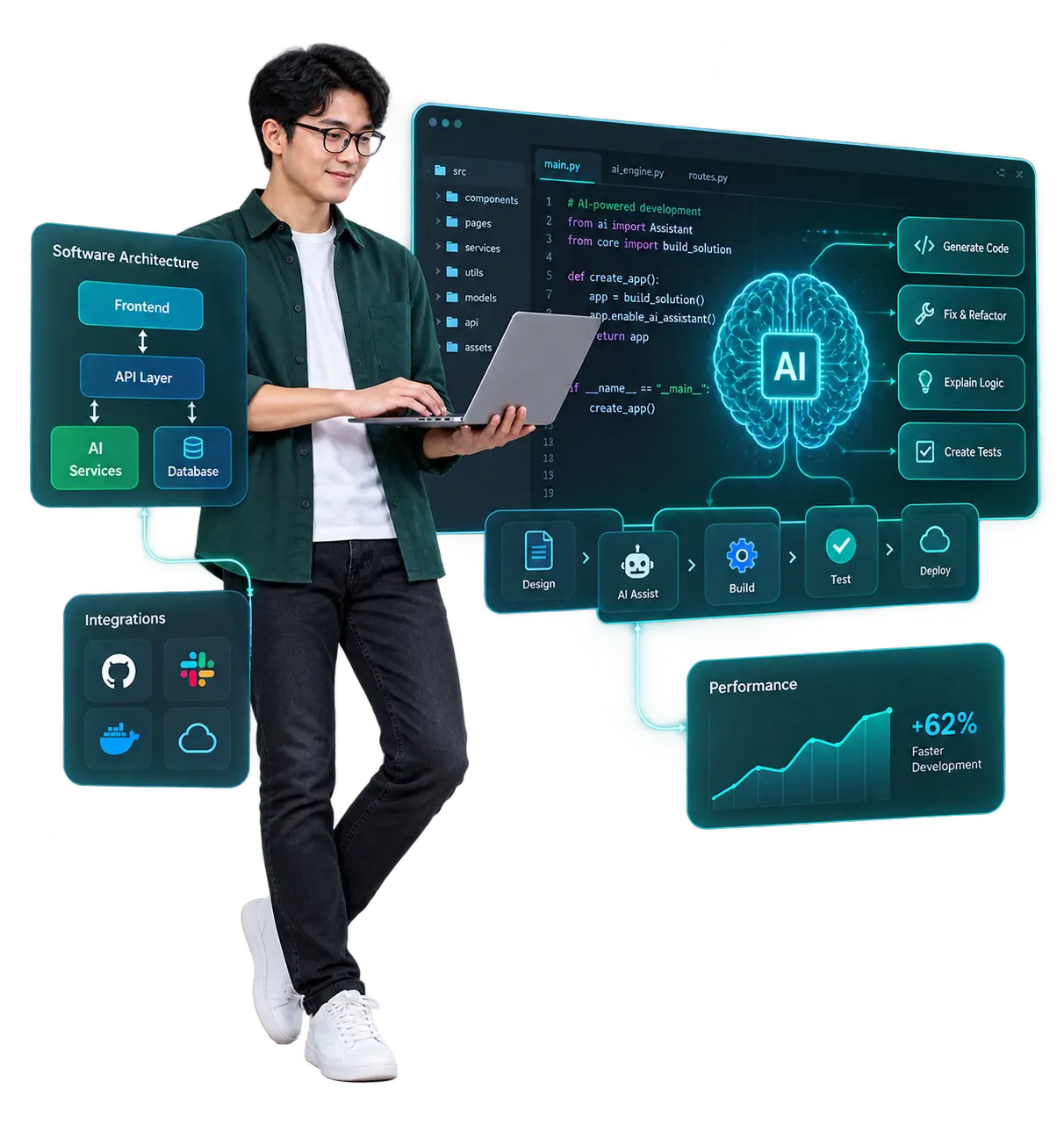
AI-Powered Development: Faster Delivery and Smarter Products
When people search for AI-powered software development, they want one of two things. A team that uses AI to build and ship software faster. Or software that has AI capabilities built into it.
Most agencies imply both without being clear about either. KrishaWeb delivers both, and we establish which one your project needs before the first sprint begins.
If you need faster, higher-quality delivery, we use AI-assisted development, intelligent code review, and automated testing to ship production-quality software in less time. If intelligence is the product, we plan for it at the architecture stage. Not in a future sprint.

Which AI-Powered Software Development Do You Actually Need?
Before we scope anything, we need to answer one question. Most agencies blur the line between these two. We do not.
AI-assisted development: ship faster, with fewer defects
AI tools accelerate the delivery team. GitHub Copilot handles boilerplate. AI code review catches vulnerabilities before they reach production. Automated test generation builds coverage in hours rather than weeks. The output is the same software you would build without AI, delivered faster and at higher quality.
AI-native software: products that think, recommend, and adapt
Some software is intelligent by design. A recommendation engine that gets better as users interact with it. A document processor that reads, extracts, and routes without a human in the loop. A dashboard that tells you what is likely to happen next, not just what already happened. Building this kind of software requires different decisions at the architecture stage, different data infrastructure, and different criteria for measuring whether it is actually working.
Often, both at once
Most projects need both. KrishaWeb applies AI-assisted delivery tooling to every engagement regardless of whether the product itself is intelligent. What changes is the architecture and data infrastructure when intelligence is in the product.
Our commitment on both
We tell you which combination your project needs before the first sprint begins, scope them separately, and price them honestly. No inflated AI claims. No surprises mid-build.
AI Software Development Services We Deliver
Some clients want software delivered faster. Others want software that does something intelligent. We handle both, and on most projects, it ends up being the same engagement.
-
Built with AI in the architecture from day one. Recommendations, predictions, and adaptive interfaces that improve as your data grows, not features added after the product ships.
-
ERP extensions, CRM additions, and operations platforms where AI handles the decisions your team currently makes manually, based on your own historical data.
-
We build the product and the AI layer together, not sequentially. The recommendation logic, the adaptive onboarding, and the usage triggers, all of it gets designed into the architecture before the first sprint, not bolted on when someone asks why retention is dropping.
-
Applications built around natural language interfaces connected to your specific knowledge base. Not public model knowledge. Your documentation, your answers.
-
Dashboards that show what is likely to happen next, not just what already happened. Anomaly detection that surfaces problems before your team notices them manually.
-
Tooling selection, security configuration, code review framework updates, and three months of hands-on advisory for engineering teams adopting AI-assisted development practices.
-
Adding a specific AI capability to an existing product without rebuilding it. Scoped to the feature, designed around your current architecture, deployed with monitoring from day one.
-
Review process specifically configured to catch the security vulnerabilities and anti-patterns that AI-generated code introduces and that standard code review misses.
-
AI-generated code introduces attack surfaces that a standard pull request review will not catch. We look specifically at prompt injection exposure, places where generated code was merged without proper review, and whether model outputs are being validated before they touch anything downstream.
Our Approach to Custom AI Development
We use AI in our delivery process on every project. When intelligence belongs in the product, we design for it before the first sprint begins.
We Define Intelligence Requirements Before Architecture
What data does the AI feature need? At what speed? What happens when it is wrong? These questions get answered before a database schema or framework is chosen, not after.
We Use AI Across the Entire Development Lifecycle
AI-assisted coding, AI-powered code review, automated test generation, and intelligent documentation on every project. Standard delivery process, not an optional add-on.
We Build AI Security Into the Architecture
Prompt injection, training data exposure, model output validation failures: AI-generated code introduces risks standard code reviews miss. We cover these at the architecture stage, not after deployment.
We Keep Humans in the Loop Where It Matters
Architecture decisions, security review, performance optimization, and edge cases that automated tools get wrong. Every project is delivered by engineers who use AI tooling, not by AI tools that occasionally involve an engineer.
We Design for Maintainability After Delivery
AI-generated code that passes velocity checks but fails readability is a maintenance problem six months later. Our code standards apply to AI-generated code the same way they apply to human-written code.
We Validate AI Features Against Real User Behavior
Model accuracy on the test set is not the metric that matters. We validate against real usage data and measure how often users ignore or override AI recommendations until the feature earns genuine trust.
We Instrument AI Features for Continuous Improvement
Accuracy drift, recommendation click-through, and confidence score distribution: AI features need different monitoring than standard software. Every AI feature ships with this instrumentation from day one.
We Hand Over Systems Your Team Can Own
Code they understand, architecture they can extend, and AI infrastructure they can retrain and monitor. We do not build software that only we can maintain.
From Requirements to Production in a Defined Timeline
We scope before we build. Architecture, sprint plan, and fixed price agreed before the first line of code.
Technical Discovery and Architecture Design
Before anything gets built, we sit with your team and work through what you are actually making. Requirements, data sources, integrations, where AI fits. Everything is agreed on paper before a sprint plan is written.
AI-Assisted Sprint Delivery
Sprints run with AI tooling through the whole process. At the end of each one, you review working code against what you signed off on at the start. Not a deck. Not a demo. Code that runs.
AI Feature Validation and Integration Testing
We test intelligent features against the accuracy thresholds you agreed to in discovery on real data, including the inputs the feature was not trained to expect. Then we confirm it still behaves when the rest of the application changes around it.
Production Deployment and Handover
Goes live in your infrastructure. Monitoring runs from the first request. You walk away with the full codebase, architecture documentation, and everything your team needs to retrain, update, and operate the system without coming back to us.
AI Powered Software Development Capabilities
From intelligent enterprise applications to AI-native SaaS products, every capability below has been delivered in production across multiple client environments.
AI-Native Web and Mobile Applications
Full-stack application development where AI capabilities are embedded in the product architecture from the design phase. Intelligent search, personalized recommendations, predictive analytics, conversational interfaces, and adaptive user experiences built into the application at the data model and API layer. Not features added after launch. Not third-party widgets. Proprietary AI features that improve as your data grows.
Enterprise Software With Embedded Intelligence
Legacy modernization and greenfield enterprise application builds where AI is embedded in the workflow engine, the reporting layer, the decision support tools, and the user interface. ERP extensions with predictive analytics. CRM additions with churn scoring. Operations platforms with anomaly detection. Enterprise software that uses your historical data to make the next action smarter.
SaaS Product Development with AI Features
End-to-end SaaS product development for organizations building AI-powered products for market. From MVP to enterprise-grade multi-tenant architecture. AI features designed for differentiation: intelligent onboarding, adaptive product experiences, AI-powered tier upsell triggers, and usage-based recommendation engines that generate revenue while reducing churn.
Conversational and Knowledge AI Applications
Applications built around natural language interfaces: internal knowledge assistants connected to your documentation, customer-facing AI support tools, enterprise search with semantic understanding, and voice interfaces for operational tools. Built with RAG architecture on your proprietary knowledge base, not on public model knowledge that does not know your business.
Data and Analytics Platforms With Predictive Capability
Data platforms that do more than display what happened. Dashboards with predictive models that tell operations teams what is likely to happen next, anomaly detection that surfaces exceptions before they become incidents, and natural language query interfaces that let non-technical users access data without writing SQL.
AI-Augmented Development for Your In-House Team
For organizations with existing engineering teams who want to adopt AI-assisted development tooling and practices, KrishaWeb offers a structured adoption engagement: tooling selection and configuration, team training, code review framework update, security protocol update for AI-generated code, and ongoing advisory for the first three months of adoption.
Three Ways to Engage KrishaWeb for AI Powered Software Development
From a full product build to an AI tooling adoption program for your engineering team. Every engagement starts with a technical discovery.
Full Product Build
End-to-end software development from technical discovery through production deployment. Covers architecture design, AI feature specification, sprint delivery using AI-assisted tooling, AI feature validation, integration testing, production deployment, monitoring setup, and full codebase handover. Right for organizations building a new product or modernizing an existing one with AI capabilities embedded from the start.
Output: Production application, full IP ownership, documentation, monitoring, handover
AI Feature Integration
A focused build engagement that adds AI capabilities to an existing software product. Covers AI feature specification, data infrastructure assessment, model development or integration, feature build, integration testing, and deployment. Right when your product is established, and you are adding the next layer of intelligence to differentiate or retain users.
Output: AI feature in production, model monitoring, data pipeline, documentation
AI Development Tooling Adoption
A structured program for in-house engineering teams adopting AI-assisted development practices. Covers tooling selection, configuration, security protocol setup for AI-generated code, team training, and a three-month advisory period. Right for engineering leaders who want their team delivering faster and at higher quality using AI tooling they understand and control.
Output: Configured toolset, updated code standards, trained team, AI security framework
Every engagement: full IP ownership of all code and AI features, no proprietary wrappers, AI security review included as standard, documentation delivered at every milestone.
Industries We Build AI-Powered Software For
AI-powered software delivers the most value where proprietary data creates a competitive advantage. Here is where we have shipped production systems.







Ready to explore how AI can drive real business outcomes for your organization?
Client Feedback
Delve into the feedback from our valued customers!

The collaborative projects with Krishaweb Technologies have garnered several compliments and positive feedback. The team takes the initiative and manages projects well. Excellent work quality, timeliness, and reasonable price structures are key to their success.

KrishaWeb’s web development has positively impacted our business, saving us 4–5 hours of manual work every month. Their technical expertise and creativity result in exceptional outcomes. This trustworthy and hard-working team is a true asset to any project.

KrishaWeb has consistently delivered on their development tasks. The collaboration has always been characterized by their insanely quick turnaround time and incredible customer support. They listen to your challenges and needs and return with a viable solution, every time.




Frequently Asked Questions
We hope these questions and answers help you find the best AI Development partner for your business.
-
AI-assisted development uses AI tools to make the development team faster and produce higher-quality code: coding assistants, automated test generation, and AI-powered code review. The output is standard software, delivered more efficiently. AI-native software development builds AI capabilities into the product itself: recommendation engines, intelligent interfaces, predictive features, and adaptive behavior. The output is software that learns from data and produces outputs that standard code cannot. Most projects benefit from both.
-
Yes, and most agencies do not address this directly. AI-generated code can introduce security vulnerabilities that standard code review processes are not configured to catch: prompt injection vectors, over-reliance on AI-suggested implementations that have not been properly reviewed, and model output validation gaps. KrishaWeb’s development process includes an AI-specific security review layer that audits AI-generated code for these attack surfaces before it reaches production. This is documented in every engagement contract.
-
No. AI development tools accelerate specific tasks: boilerplate generation, test scaffolding, documentation drafting, pattern-matching code review. Architecture decisions, system design, security review, performance optimization, and the judgment required when requirements are ambiguous or conflicting remain human responsibilities on every KrishaWeb project. The developers use the tools. The tools do not replace the developers.
-
The honest answer is that velocity improvement varies significantly by project type and team adoption maturity. Deloitte research indicates that AI-assisted tooling automates approximately 40% of routine development tasks, which translates to meaningful velocity improvement on codebases with high boilerplate content and mature test coverage requirements. For projects that are primarily architecture-intensive, the improvement is smaller because the bottleneck is design judgment, not code production. We give project-specific velocity estimates after the technical discovery, not generic percentage claims.
-
Yes. KrishaWeb’s AI Feature Integration engagement is specifically designed for established products adding AI capabilities. We assess your existing architecture for AI integration readiness, design the AI feature in the context of your current data model and API layer, build and test the feature, and deploy it with monitoring specific to AI feature performance. Adding AI to an existing product requires different considerations than building AI-native from scratch, and we scope these engagements accordingly.
-
Our current toolset includes GitHub Copilot for AI-assisted coding, AI-powered code review tools for security and quality analysis, automated test generation frameworks, and AI-assisted documentation tools. For AI-native product features, we work with the OpenAI API, Anthropic API, open-source models via Hugging Face, LangChain and LlamaIndex for RAG architecture, and cloud AI services from AWS, Azure, and Google Cloud. Tool selection for each project is based on the specific requirements of the use case, the deployment environment, and the data privacy constraints, not on a fixed preferred stack.
-
AI features require different QA approaches than deterministic software. We test across the full input distribution, including edge cases and adversarial inputs, measure accuracy against held-out test data from your actual domain, validate that the feature degrades gracefully when the model is uncertain rather than producing confident wrong outputs, and confirm that the user interface communicates AI confidence levels appropriately. QA criteria for AI features are defined before the build begins, not evaluated after deployment.
Ready to Build Software That Ships Faster or Software That Thinks?
Book your Free Software Development Consultation. An engineer, not a sales team. 30 minutes on your specific build.