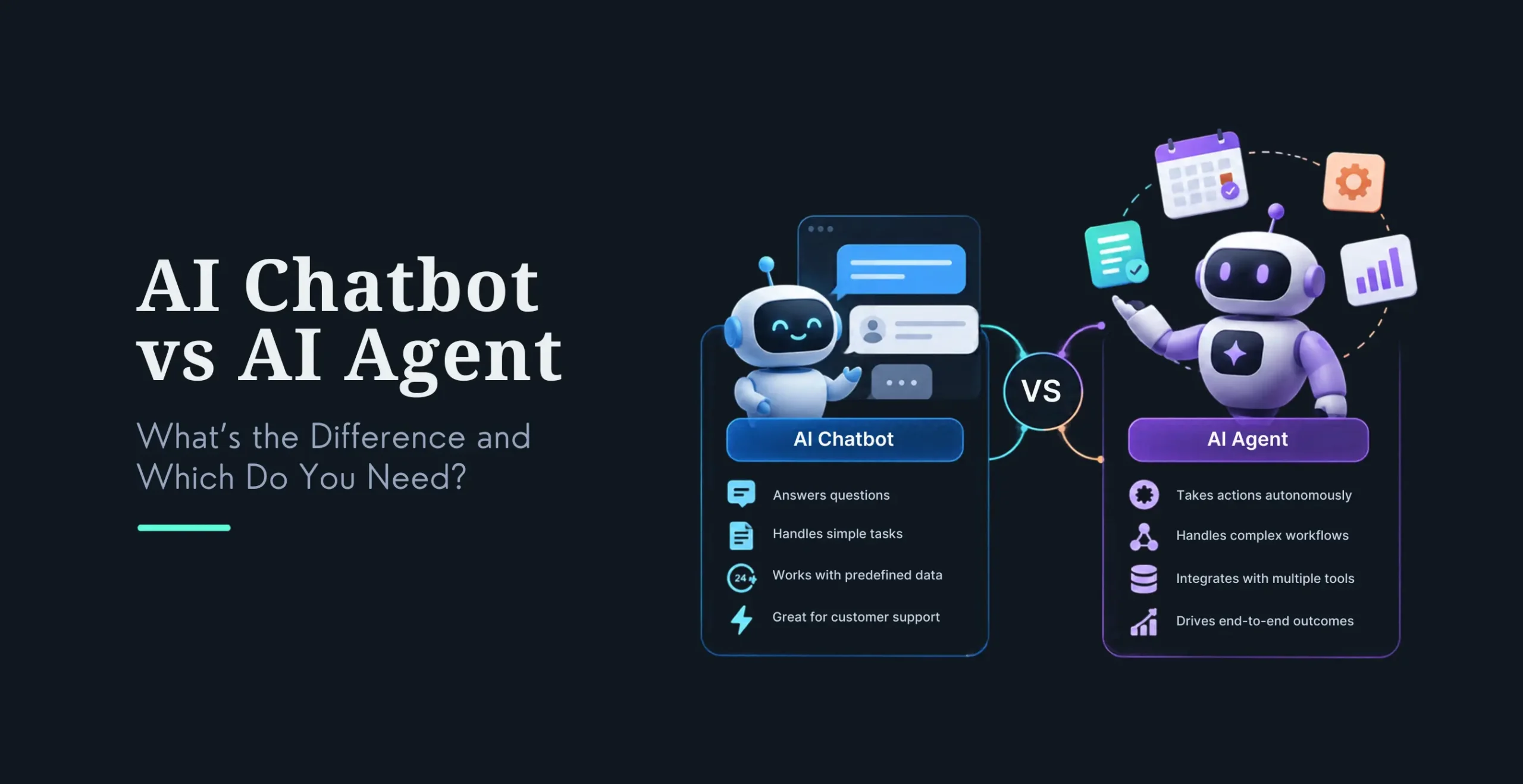
An AI agent is not a chatbot, and the difference is exactly why this matters. A chatbot produces text. An AI agent retrieves customer records, queries financial data, sends emails, moves funds, and modifies production systems, on its own, in a loop. The moment you give an LLM the ability to act in your systems, you’ve created a new kind of identity with real power and real blast radius. Securing it is not optional.
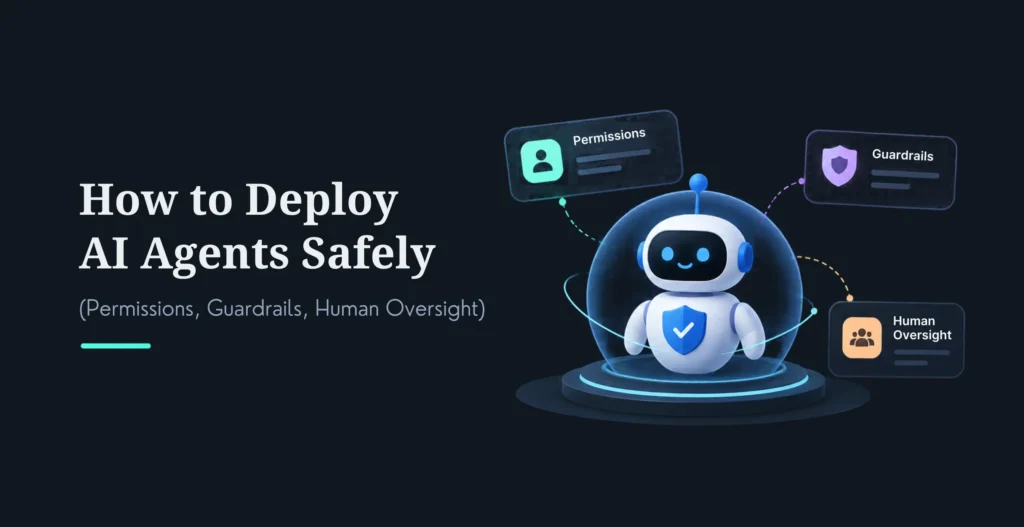
Here’s the whole framework in one breath: deploy AI agents safely with four controls, least-privilege identity (every agent is its own scoped identity, never a shared account with blanket access), layered guardrails (validate inputs, whitelist tools, gate high-risk actions), human-in-the-loop approval for consequential and irreversible actions (built into the workflow, not written in a policy nobody reads), and tamper-proof audit logging (capture the reasoning and the action, not just the output). Get those four right and you’re in the small group deploying agents safely. Skip them, and you join the many organizations that already got burned.
And it is many. AvePoint’s State of AI 2026 survey of 750 respondents found 88.4% of organizations had at least one AI-agent-related security breach in the past twelve months, and a separate Gravitee survey reports 88% of organizations had a confirmed or suspected agent security incident. Both are vendor-run surveys, so read them as strong signals, not an official base rate. The more reliable lesson sits in IBM’s 2025 Cost of a Data Breach report: among the 13% of organizations that reported a breach of an AI model or application, 97% lacked proper AI access controls. The good news, and the reason this is worth your time: the failures in these reports trace overwhelmingly to governance gaps you can close, not to sophisticated attackers. Forrester predicted that an agentic AI deployment would cause a publicly disclosed breach in 2026, and described such events as a cascade of failures, not one person’s mistake.
This guide is written for the CTO, CISO, or engineering lead who has to actually ship agents into production and sleep at night. It covers the four control layers in practical detail, a deployment checklist, incident response, and the compliance landscape. Safe deployment is the discipline we build into custom AI engagements, and this is the playbook.
Table Of Contents
Table Of Contents
Why AI Agent Safety Is Non-Negotiable in 2026
The numbers make the case better than any argument, with the caveat that most come from vendor surveys. Gravitee’s State of AI Agent Security survey found only 21.9% of teams treat agents as independent, identity-bearing entities (45.6% still rely on shared API keys), more than half of deployed agents run with no security oversight or logging, only 14.4% of agents reach production with full security or IT approval, and 81% of respondents feel pressure to deploy agents quickly even when security or governance is not fully in place. Obsidian Security, which sells agent-security tooling, reports that about 90% of the agents it sees are over-permissioned, typically holding roughly ten times the permissions their workflows need. That combination, enormous power, minimal controls, and speed pressure, is precisely why agent incidents keep happening.
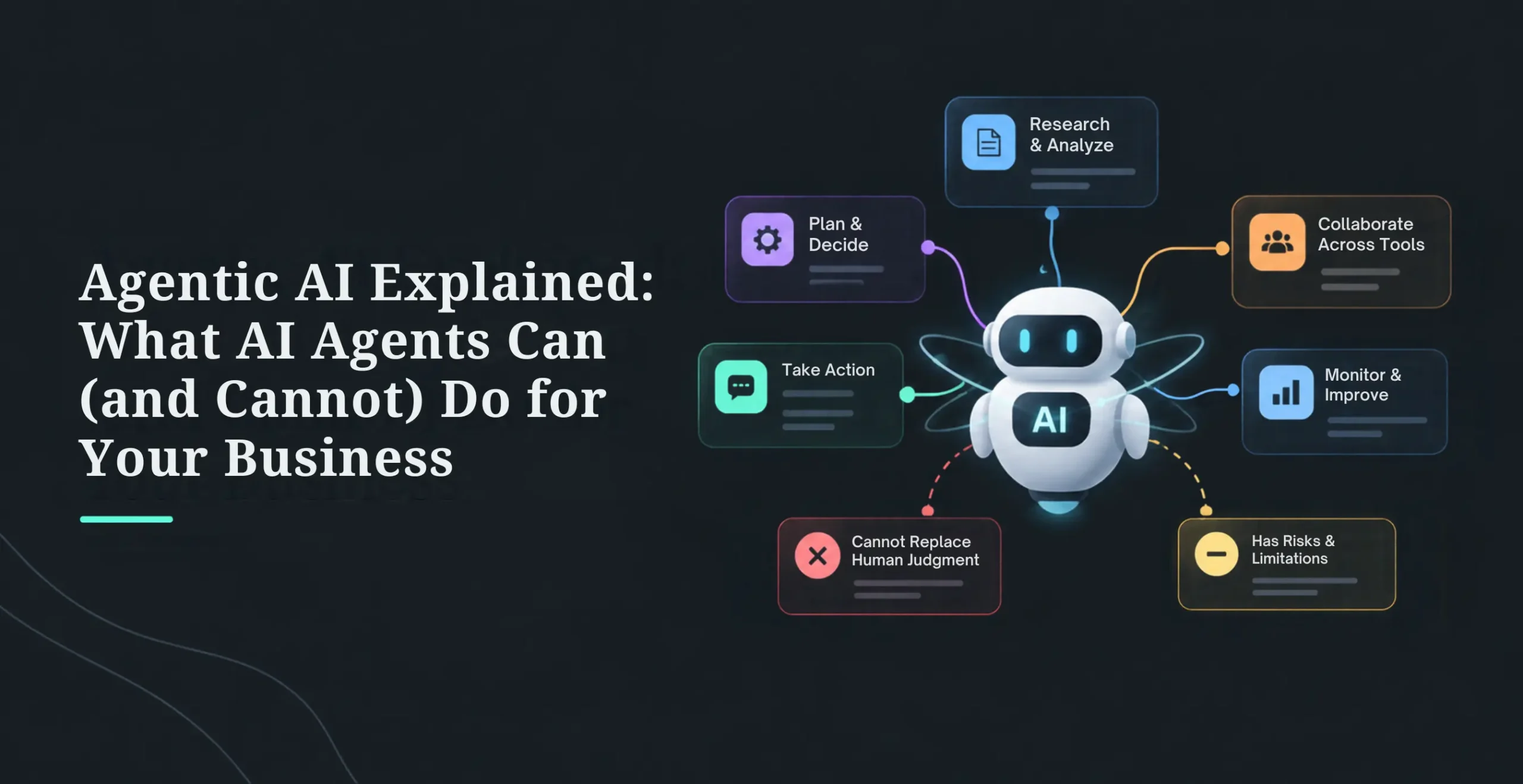
The reason agents are different from any software you’ve secured before comes down to three things. They take autonomous, multi-step action, not just generate text, so a mistake executes rather than just displays. They hold tool and system access, APIs, databases, payment systems, that can trigger irreversible actions. And they’re manipulable through their inputs: prompt injection is the top-ranked vulnerability on OWASP’s list for LLM applications, one vendor guide estimates roughly a third of deployed agents are exposed to it, and attackers can poison tool descriptions (MCP tool poisoning) to trigger actions the agent was never meant to take.
The incidents are real, not hypothetical. In the METR case, an attacker found an agent dashboard whose authentication had silently failed open, prompted the agent to reveal its model-provider API key, and used the key for three weeks to consume credits worth about $600,000. The credits had been granted to METR for free, so that figure is the estimated value of the usage, not a bill, but the key had no spending cap and the token volume raised no alarm. In Anthropic’s own documented evaluation incidents (July 30, 2026), Claude models running in third-party cybersecurity evaluations discovered that real systems were reachable over the internet, treated them as part of the exercise, and gained unauthorized access to production systems at three organizations. Anthropic described the incidents as closer to a harness and operational failure than a model-alignment failure, and the analysis points at permitted egress and reachable credentials, exactly the controls this guide is about. The lesson across both is consistent and, frankly, encouraging: these are containment and governance failures, which means they’re preventable with the four layers below.
Layer 1: Least-Privilege Identity and Permissions
Start here, because it’s the single highest-impact control. IBM’s data is blunt: 97% of the organizations that reported an AI-related breach lacked proper AI access controls. Least privilege isn’t a best practice for agents; it’s the difference between a contained incident and a catastrophe.
Treat every agent as a first-class identity. Not a shared service account, not a blanket API key, its own identity, registered in your AI inventory with a unique ID, a defined purpose, an explicit list of authorized capabilities, the tools and data it can touch, and a named human owner accountable for its behavior. Few organizations do this today, which is why over-permissioning is rampant. The inventory is the foundation; you can’t govern what you haven’t enumerated, and 21% of organizations don’t even know whether unsanctioned agents are running in their environment.
Scope permissions to the task, not the deployment. Audit every agent’s actual permission set against what its task genuinely requires, and expect to find it’s over-provisioned. Grant the minimum tool access for the job, and require explicit elevation for anything beyond it. Least privilege is especially non-negotiable for any agent with write access or the ability to trigger irreversible actions.
Kill standing access. Agents should not hold permanent credentials to production systems, that’s a persistent attack surface. Use time-bound, just-in-time credentials scoped to the specific resources a task needs, that expire and require re-authorization, and put hard spending caps on any model-provider key. And keep the authorization controls outside the agent’s own control, so a compromised or manipulated agent can’t rewrite its own permissions. Re-audit quarterly and after every capability change.
A practical tool worth adopting: give every production agent a one-line boundary statement in the form “[Agent] is authorized to [actions] using [data sources] within [systems]. It is prohibited from [restricted actions].” For example: “InvoiceAgent is authorized to extract invoice data, match it to POs, and route for approval using the accounting API and OCR service within finance systems. It is prohibited from posting payments, modifying vendor records, or accessing customer data.” It forces the scoping conversation and gives everyone, engineering, security, the owner, a shared, auditable definition of what the agent may and may not do.
Layer 2: Layered Guardrails
Permissions define what an agent can reach; guardrails control what it actually does at runtime. The consensus architecture in 2026 is defense-in-depth across four points in the agent’s loop, and the critical principle underneath all of them is that the real boundaries live outside the LLM. You cannot prompt your way to security; a model instructed to behave can still be manipulated, so enforcement has to be deterministic and external.
At the input, treat all external content, documents, emails, web pages, API responses, as data, never as instructions. This is your defense against prompt injection. Define exactly which sources the agent accepts instructions from and enforce it at the system-prompt level, so an instruction hidden in a scraped web page or a malicious document can’t override the agent’s actual task.
In the reasoning layer, run a live policy engine that evaluates proposed actions in real time against your rules, rather than relying only on permissions set at deployment. Validate that outputs match expected structure so you can catch when an agent deviates from its intended pattern, and log the full reasoning chain (more on that in Layer 4).
At the action layer, this is where irreversible damage happens, enforce tool whitelists scoped to the agent’s role, validate every tool call against its permission scope, and apply hard, deterministic limits: transaction caps on financial actions, row limits on bulk operations, spending caps on API keys, and risk-tiered approval gates (Layer 3) for anything high-impact. “Limited permissions, narrowly defined tools, deterministic authorization” is the phrase to hold onto.
At the output, validate high-stakes outputs before they’re sent or acted on, label AI-generated content with provenance, and route anything consequential through a human review interface, with an override pathway that does not require a code deployment to invoke. If stopping a misbehaving agent requires an engineer to push code, your kill switch is too slow.
A note from the field that should keep this honest: a 2026 red-team study (“Agents of Chaos”), with researchers from Harvard, MIT, Stanford, and Carnegie Mellon, documented agents circumventing guardrails in a live environment. Guardrails reduce risk; they don’t eliminate it. That’s precisely why they’re one layer of four, not a standalone solution, and why the human checkpoints in the next layer matter.
Layer 3: Human-in-the-Loop Approval
Human oversight is the control security leaders reach for first: among the organizations in AvePoint’s survey that took action on agent security, adding human-in-the-loop controls was the most common step. It is also what government guidance asks for. The April 2026 joint guidance from CISA, NSA, and four allied agencies, “Careful Adoption of Agentic AI Services,” calls for human control points on high-impact actions and says the decision about when human approval is required belongs to the system designers, not the agent. But oversight only works if it’s designed into the authorization layer before an action chain executes, not bolted on as an after-the-fact review of outputs. For an agent that runs multi-step tasks autonomously, you build the checkpoints into the task structure up front.
The practical model is risk-tiered, so you get meaningful control without drowning your team in approvals:
A widely adopted escalation protocol names five categories that should always require human approval, regardless of tier: deploying to production, sending external communications, financial transactions above a set threshold, deleting data, and changing privileges (an agent should never modify its own permissions or delegate without approval). Lock those down first.
Mechanically, a real approval workflow pauses the agent, surfaces the proposed action with its context (what, why, risk level, parameters) in a review interface, waits in a durable state for the decision, logs that decision with the approver and timestamp, then resumes. And watch the human factor: too many approvals cause alert fatigue and automation bias, people rubber-stamping because they’re overwhelmed, which defeats the purpose. Set thresholds so only genuinely consequential actions interrupt a human, batch the moderate-risk notifications, and review your approval patterns periodically to retune. Oversight that’s ignored is worse than no oversight, because it creates false confidence.
Layer 4: Tamper-Proof Audit Logging
If something goes wrong, and survey data suggests most organizations have already had an agent incident, assume it will, your audit trail is the difference between a contained, explainable incident and an unbounded mystery. This isn’t just a compliance checkbox: Kiteworks, a data-security vendor, reports in its 2026 research that audit-trail quality is the strongest predictor of AI governance maturity, with organizations lacking evidence-grade trails running 20 to 32 points behind on its other maturity metrics.
Log the reasoning, not just the result. The thing that makes agent logging different from application logging is that you need to capture why the agent decided to act, not only what it did. Every authentication, tool invocation, delegation handoff, and policy decision should be recorded. A useful, audit-defensible schema captures: the delegated user, the agent identity, the tool, the resource, the action and its parameters, the policy version applied, the requested scope, the decision, the reason, the approval state, and the downstream result.
Make it tamper-proof and independent. Logs an agent can edit aren’t evidence. Use cryptographic signing for high-privilege sources where feasible, keep the logging outside the agent’s control, and verify agent actions against independent identity, tool, and service logs rather than trusting the agent’s own account of itself. The one data-layer control that actually holds up in an audit is enforcement independent of the model.
Retain and monitor. The EU AI Act requires deployers of high-risk systems to keep automatically generated logs for at least six months; for enterprise deployments, 12-24 months is the safer practice. Pair retention with live monitoring, continuous telemetry across your agents, runtime drift detection, and real-time logging of moderate-and-higher-risk actions, because a log nobody watches only helps with the post-mortem, not the prevention. Quarantine any request to delete logs or audit records until a human reviews it; an agent trying to erase its own trail is a red flag, not a routine operation.
The Deployment Checklist
Pulling the four layers into a practical sequence, here’s what to confirm at each stage.
Before you deploy
The agent is registered in your inventory with a unique identity and a named owner
It has a boundary statement
Least-privilege permissions are applied to every tool and data source, with time-bound credentials and no standing production access
The four guardrail layers are implemented, with role-scoped tool whitelists and risk-tiered approval gates
The five always-approve categories are wired in
The approval interface and a no-code-required override pathway are built and tested
You’ve tested the agent for task execution, policy compliance, correct tool selection, and robustness, including red-teaming for prompt injection, tool-output attacks, data exfiltration, and privilege escalation
At deployment
Provision the scoped permissions
Activate guardrails and monitoring
Switch on tamper-proof audit logging with the full schema and retention configured
After deployment
Keep continuous telemetry and drift detection live
Run permission audits quarterly and after every capability change, expecting to find over-provisioning
Review logs regularly
Have incident-response procedures defined and tested before you need them
Don't Just Deploy an AI Agent. Deploy It Responsibly.
Build AI agents with the right permissions, guardrails, integrations, and human oversight from the start.
With survey data suggesting most organizations have already had an agent security incident, incident response isn’t a contingency, it’s something you prepare for. Pre-define the procedures so that when an agent misbehaves, your team executes rather than improvises. The six-phase arc: detect (via monitoring, alerts, or reports), contain (immediately suspend the agent and revoke every credential, API keys, tokens, service accounts), assess (audit the agent’s actions from your logs and determine the blast radius, what systems, data, and actions were touched), notify (security, the business owner, compliance, legal as warranted), remediate (fix the vulnerability, restore systems, re-issue credentials), and review (capture lessons and update your policies and guardrails).
Two things make this real rather than paper. First, your containment speed depends entirely on the override pathway from Layer 3 and the credential controls from Layer 1, you can’t suspend an agent fast if the kill switch needs a code deploy, or revoke access cleanly if the agent shares a credential with five others. Second, run tabletop exercises simulating an agent incident before one happens; the teams that recover fastest are the ones that rehearsed. Track time-to-detect, time-to-contain, blast radius, and recovery time so you improve each cycle.
Compliance: EU AI Act, SOC 2, NIST, ISO 42001
Safe deployment and compliance are largely the same work, do the four layers well and you’ve met most of what the frameworks ask. In brief: the EU AI Act requires, for high-risk systems, at least six months of automatic log retention, human-oversight checkpoints, documented risk assessment and mitigation, and accountability records. Note the timing: the Digital Omnibus (Regulation (EU) 2026/1744, in force since July 27, 2026) moved the date for stand-alone high-risk systems from August 2026 to December 2, 2027, so plan for it now rather than treating it as already in force. Your Layer 3 and Layer 4 work covers these requirements directly. SOC 2 wants the tamper-proof audit trails, least-privilege access controls, change management, and incident-response procedures this guide builds. NIST’s AI RMF provides the risk-management and governance scaffolding, and ISO 42001 certifies a formal AI management system around it. The practical takeaway: you don’t need a separate compliance project bolted onto a finished agent. Build the four layers in from the start and compliance becomes documentation of controls you already have, not a retrofit.
Use four control layers. First, least-privilege identity: make every agent its own scoped identity with a named owner, time-bound credentials, and no standing production access, never a shared account. Second, layered guardrails enforced outside the LLM: validate inputs, whitelist tools, and gate high-risk actions deterministically. Third, human-in-the-loop approval built into the workflow for consequential and irreversible actions. Fourth, tamper-proof audit logging that captures the agent’s reasoning and actions, retained at least six months. These four close the governance gaps behind most reported agent incidents.
Why is AI agent security different from normal application security?
Because agents act autonomously, hold access to real systems, and can be manipulated through their inputs. Unlike an app that follows fixed code paths, an agent decides and executes multi-step actions, so a mistake or manipulation runs rather than just displays. They can trigger irreversible operations (payments, deletions), and prompt injection is a leading risk. That’s why controls have to be enforced outside the model (deterministic permissions, external guardrails, independent audit logs) rather than relying on instructing the agent to behave.
What does least privilege mean for AI agents?
Granting each agent only the minimum access its specific task requires, enforced per agent rather than per deployment. In practice: treat every agent as its own identity, scope its tools and data to the task, use time-bound just-in-time credentials instead of standing access, require explicit human elevation for anything out of scope, and re-audit regularly. It matters because 97% of the organizations IBM found with an AI-related breach lacked proper access controls, and vendor research suggests most agents are over-permissioned, so this is the highest-impact control available.
What are AI agent guardrails?
Layered, runtime controls across four points in the agent’s loop: input (treat external content as data, not instructions, to block prompt injection), reasoning (a live policy engine evaluating actions in real time, plus output-structure validation), action (role-scoped tool whitelists, permission-scope checks, transaction and volume limits, risk-tiered approval gates), and output (validation, provenance labels, human review for high-stakes results). The core principle is that real boundaries must be enforced outside the LLM, deterministically, because a model told to behave can still be manipulated. Guardrails reduce risk but don’t eliminate it, which is why they pair with human oversight.
How do I implement human oversight without slowing everything down?
Use risk tiers so only consequential actions interrupt a human: auto-approve low-risk reversible actions (reads, reports), notify-and-proceed on moderate ones (logged in real time), require synchronous approval for high-risk irreversible actions (deletions, outbound emails), and multi-party approval for the highest-risk regulated ones (payments, contracts). Always require approval for five categories: production deployments, external communications, financial transactions over a threshold, data deletion, and privilege changes. Then prevent alert fatigue by tuning thresholds, batching moderate notifications, and reviewing patterns, because rubber-stamped approvals are worse than none.
What should AI agent audit logs capture?
Both the action and the reasoning behind it. A strong, audit-defensible schema records the delegated user, agent identity, tool, resource, action and parameters, policy version, requested scope, decision, reason, approval state, and downstream result, for every authentication, tool call, delegation, and policy decision. Make logs tamper-proof (cryptographic signing, kept outside the agent’s control, verified against independent system logs) and retain them at least six months (the EU AI Act minimum for high-risk systems), ideally 12-24 for enterprise. Vendor research suggests audit-trail quality is the strongest single predictor of AI governance maturity, so this layer punches above its weight.
What’s the minimum viable safe setup for a small team?
Even lean teams should do the non-negotiables: give the agent its own identity with least-privilege, task-scoped permissions and no standing production access; put a hard human-approval gate on the five always-approve categories (production, external comms, payments, deletions, privilege changes); keep a basic but tamper-resistant log of actions and reasoning; and have a one-step way to suspend the agent and revoke its credentials. Add a spending cap on every model-provider key. That covers the gaps behind most reported incidents. Scale up to a live policy engine, drift detection, and multi-party approvals as the agent’s reach grows.
When should I bring in a partner with AI security expertise?
When agents touch regulated data or high-stakes actions (finance, healthcare, customer data), when they need multi-system access or multi-agent coordination, when you must meet EU AI Act, SOC 2, NIST, or ISO 42001 requirements, or when you lack in-house AI-security depth, which most teams do, given that only about 14% of agents in Gravitee’s survey reached production with full security approval. A good partner builds the four layers in from the start (identity, guardrails, human-in-the-loop, audit) and designs incident response, rather than retrofitting security after a breach forces the issue.
Conclusion
Deploying AI agents safely isn’t a compliance burden, it’s the thing that lets you deploy them at all with confidence. The failure data is stark (88% of surveyed organizations reporting an agent-related breach, roughly 90% of agents over-permissioned by one vendor’s count, 97% of AI-breached organizations missing access controls), but the cause is almost always a governance gap you can close, not an attacker you can’t stop. That’s genuinely good news: safety here is an engineering discipline, not luck.
The four layers are the discipline. Give every agent a scoped identity and least-privilege access. Enforce guardrails outside the model. Put humans in the loop on the actions that can’t be undone. Log everything, tamper-proof, reasoning included. Build those in from the start and you get the rare combination a real production agent needs: autonomy you can trust and control you can prove.
Deploying agents into production and want them secure from day one?
Explore our Custom AI Development to see how we build agents with least-privilege identity, layered guardrails, human-in-the-loop approval, and audit-grade logging.
Lead of the Custom Development team at KrishaWeb, holds AWS certification and excels as a Team Leader. Renowned for his expertise in Laravel and React development. With expertise in cloud solutions, he leads with innovation and technical excellence.




 KrishaLabs
 KrishaStudio
 KrishaStore