A client hands you a beautiful Figma file. They love the design. Now they want it built in Webflow, pixel-perfect, with smooth interactions, a working CMS, and a launch date three weeks out.
Your design team can nail the concept. Whether you can actually build it depends entirely on whether you have a Webflow developer available right now, and most agencies don’t.
Webflow adoption among agencies has grown fast. It now powers roughly 24.6% of digital and design agency websites, up from just 6.8% in 2022. That’s a real shift in client expectations, and it’s created a real capacity problem for agencies that built their team around a different stack.
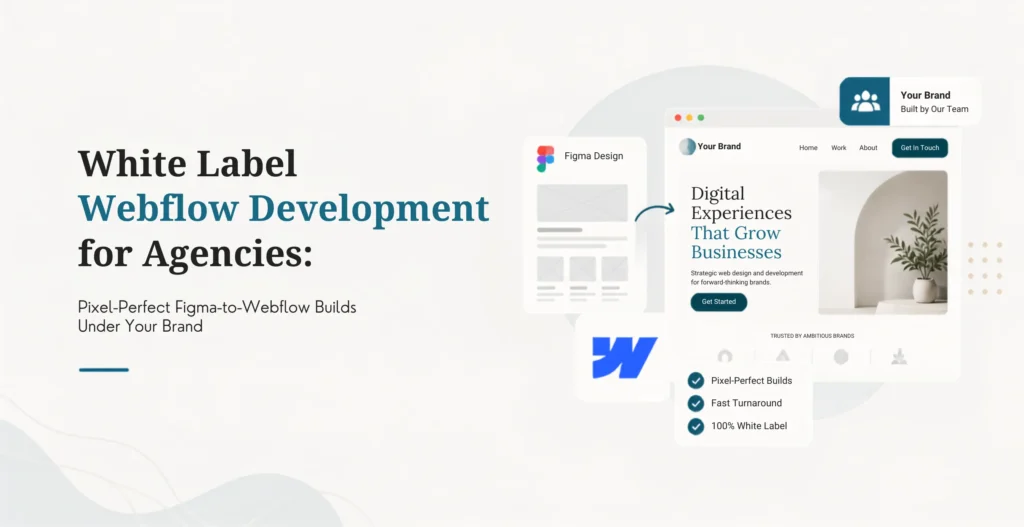
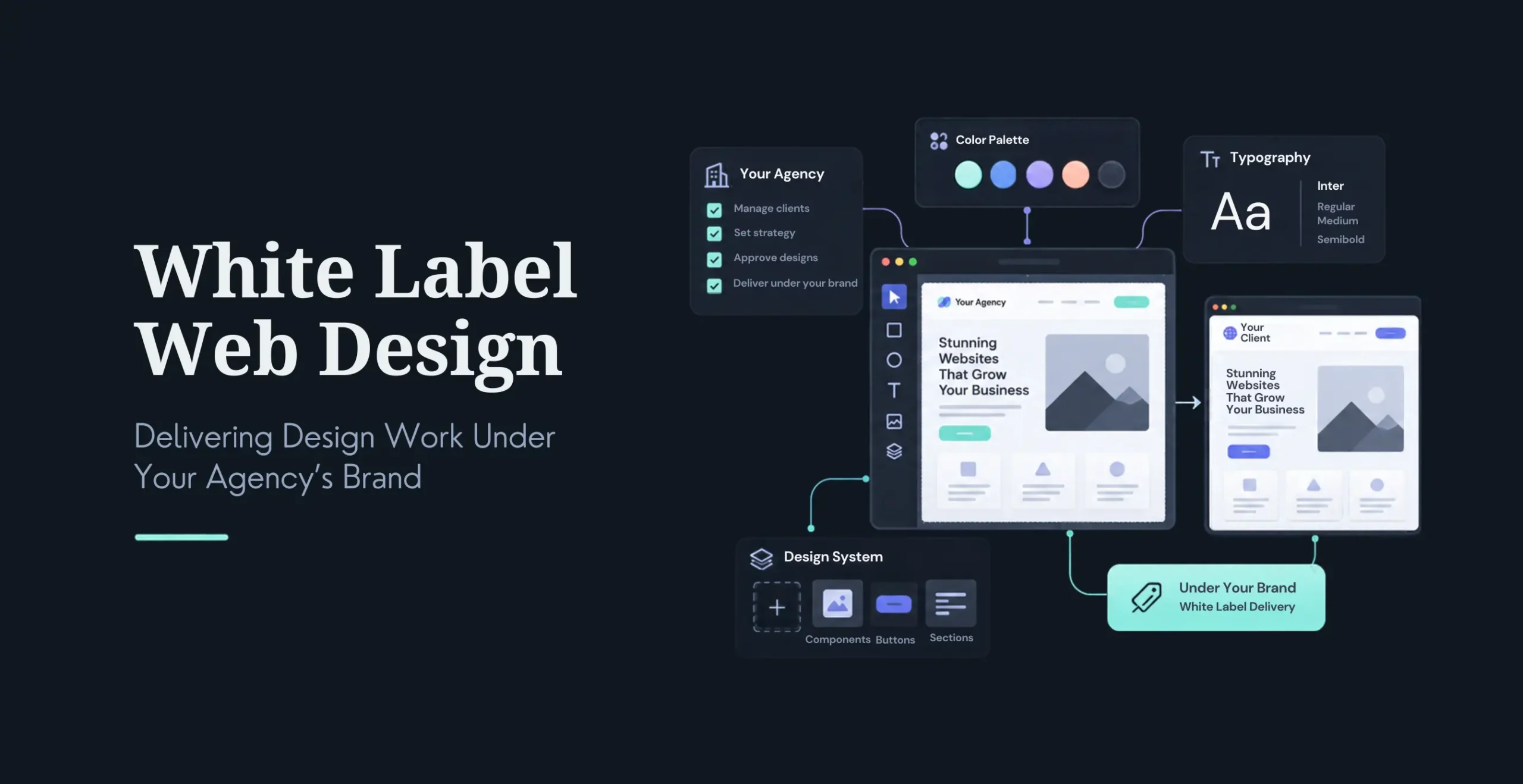
White label Webflow development is when an external Webflow specialist builds websites, CMS architectures, and interactions for your clients under your own brand. You keep the client relationship and the margin. The partner handles the technical build.
This article covers how the process actually works, what you can hand off, how to protect quality and ownership, when a partner beats hiring, and how to choose one you can trust with a client’s live site. For a broader look at how Webflow stacks up against WordPress for a given project,our WordPress vs Webflow comparison covers the platform decision in detail before you even get to the delivery question.
Table Of Contents
Table Of Contents
What Is White Label Webflow Development?
White label Webflow development is a behind-the-scenes delivery arrangement. A specialist Webflow team builds websites or specific features for your clients. You manage the relationship, present the work under your own brand, and control the commercial side entirely.
Standard outsourcing and white label delivery aren’t the same thing. With standard outsourcing, the provider might be visible to the client, credited somewhere, or working alongside your brand rather than behind it. With white label delivery, the partner stays completely invisible. You own client communication, presentation, and positioning from start to finish.
What stays with your agency
Client relationship. Scope and the commercial proposal. Brand presentation. The feedback process. Final approval on everything. Billing. The ongoing account relationship. None of that transfers, no matter how the technical work gets split up.
What a partner typically handles
Figma-to-Webflow conversion. Webflow CMS architecture. Interactions and animations. Custom code. Integrations. Staging and QA. Deployment support. Documentation. Ongoing maintenance.
Where that line falls exactly should be written into the agreement, not assumed. Some agencies want the partner touching nothing but the build itself. Others are comfortable with the partner joining a staging review call directly. Both work fine, as long as it’s agreed upfront.
How Does White Label Webflow Development Work?
A typical project starts with your brief, an NDA, and technical scoping. The partner then builds inside your Webflow workspace, sends staging updates, runs QA, works through your feedback, and hands over documentation. You present the finished site to your client, and the partner’s involvement never comes up.
Your agency puts together the brief first. Goals, designs, content requirements, functionality, integrations, hosting details, and launch constraints all go in before anything gets scoped.
The partner reviews scope and flags risk. This is where a good partner catches technical dependencies, CMS complexity, interaction requirements, and vague acceptance criteria before they become problems mid-build.
NDA and working agreement get finalized. Confidentiality, IP ownership, Webflow workspace access, communication channels, client-contact rules, and escalation procedures should all be settled here.
Development begins in your workspace. Ideally, the project lives in your agency’s own Webflow workspace from the start, not a partner-owned workspace transferred at the end.
Staging and QA happen before anything ships. Responsive behavior, interactions, CMS functionality, performance, accessibility, browser compatibility, and content entry all get tested against real conditions.
Your agency consolidates feedback. You stay the client-facing owner throughout, sending organized, prioritized feedback rather than letting the client and developer talk directly.
Launch and handover close it out. The production site goes live, credentials transfer securely, and you get documentation, deployment notes, and maintenance recommendations.
KrishaWeb’s own process runs through NDA completion, PM assignment, tool connection to whatever your agency already uses, development, staging, review, documentation, and a fully branded handover.
What Services Can Agencies Outsource?
Most Webflow delivery work can be handed off, from Figma-to-Webflow conversion through to CMS architecture, interactions, custom code, integrations, and maintenance. The best candidates are repeatable or technically specialized tasks that need real Webflow expertise but don’t require the external team to own the client relationship.
Figma-to-Webflow conversion
Pixel-perfect implementation, responsive layouts, component systems, interactions and animations, the content editing experience, cross-browser and cross-device testing, and performance optimization all belong here.
It’s worth being clear about what “pixel-perfect” actually means before a project starts. There’s a real gap between a true custom implementation built to match a design exactly and a lightly adapted template that’s close enough. A good partner documents the build clearly enough that a different developer could pick up maintenance a year later without confusion.
Webflow CMS architecture
Collection structures, reference fields, template design, dynamic content, editorial workflows, content permissions, and multi-language setups are the kind of work that separates a genuinely usable CMS from one the client’s marketing team quietly avoids touching.
Interactions and animations
Page transitions, scroll-based animations, hover effects, micro-interactions, custom JavaScript, and performance optimization. This is where a lot of Webflow builds either impress a client or quietly slow the site down, and the difference usually comes down to whether the developer understood performance trade-offs while building the animation, not after.
Custom code and integrations
Custom JavaScript, third-party integrations, API connections, form handling, embed code, and analytics setup round out the technical work most clients eventually need, even on a site that started out looking simple.
Ongoing maintenance and support
Content updates, CMS changes, interaction fixes, performance monitoring, security updates, backup checks, and small feature enhancements keep a site running well past launch day.
Migrations and redesigns
Platform migrations into Webflow, redesign implementation, URL and redirect mapping, content migration, staging validation, Search Console checks, and form and analytics testing all belong in this bucket. Migrations are where undocumented shortcuts from a previous build tend to surface, which is exactly why a partner with a disciplined QA process matters most here.
Benefits for Design Agencies
White label Webflow development helps agencies add delivery capacity without immediately adding full-time payroll. It supports larger project volumes, cuts hiring delays, opens access to specialized skills, and keeps your brand front and center with the client throughout.
You can say yes to more work. An external production layer means you’re not forced to route every technical task through one overloaded internal developer.
You avoid hiring ahead of demand. A full-time Webflow developer is a fixed cost: salary, benefits, equipment, management time, software, training. You also carry the risk of paying that salary through a slow month. KrishaWeb notes that hiring and onboarding an in-house developer can realistically take 8 to 12 weeks before they’re fully productive, which is a provider observation worth treating as directional rather than a universal hiring benchmark, but most agency owners who’ve hired recently will recognize the pattern.
You get access to specialized expertise. Senior Webflow developers, CMS specialists, interaction designers, custom code experts, technical project managers, QA resources, and performance specialists, all without recruiting for five specialties at once.
Your internal team stays focused on what grows the agency. Strategy, branding, UX, sales, client relationships, creative direction, and account growth are where your team’s time compounds. Execution doesn’t need to compete for that same attention.
Delivery gets more consistent. A partner running a repeatable process brings standardized staging, reusable QA checklists, consistent code review, better documentation, and predictable handover. That also removes the single-person dependency risk that hits smaller agencies hard when one developer is unavailable.
One honest caveat: none of this guarantees profitability automatically. Partner fees, your own PM time, QA, revisions, and client communication all factor into whether a given engagement actually makes money.
A lot of white label comparisons focus on capacity and cost and barely touch governance. That’s exactly the part that determines whether the relationship holds up past the first project.
Code ownership and workspace access
Confirm who owns the Webflow project, where it’s stored, whether the partner is using proprietary frameworks you can’t take with you, whether every dependency is documented, how access gets revoked if the relationship ends, and whether another developer could inherit the project cleanly.
KrishaWeb signs an NDA and IP assignment and writes code directly into the agency’s own repository from the first commit, not a partner-owned workspace handed over at the end.
Performance checklist
Area
What to Verify
Core Web Vitals
LCP, CLS, and INP targets
Page speed
Lighthouse Performance score
Responsive design
Mobile, tablet, and desktop layouts
Interactions
Smooth, genuinely performant animations
CMS
Efficient collection structures
Custom code
Minimal, optimized JavaScript
Hosting
Webflow hosting and CDN configuration
SEO
Meta tags, Open Graph, structured data
Accessibility
Basic WCAG compliance
Browser testing
Cross-browser compatibility
Webflow sites generally pass Core Web Vitals at a meaningfully higher rate than WordPress sites, because the platform handles hosting, CDN, and optimization automatically. Some 2026 sources put Webflow’s pass rate around 68.9% against 49.3% for WordPress. Average Largest Contentful Paint on Webflow runs around 3.2 seconds, with the top 10% of sites hitting 1.8 seconds, which shows there’s still real range depending on how well a site was actually built, not just which platform it’s on.
Quality assurance checklist
Design fidelity, responsive layouts, cross-browser testing, Core Web Vitals checks, basic accessibility, form delivery confirmation, analytics and tag validation, SEO metadata, redirect testing, 404 handling, CMS functionality, content-editor testing, and backup and rollback readiness all belong on a standard pre-launch pass.
White label controls worth confirming explicitly
NDA in place. IP assignment signed. Non-solicitation terms covering both clients and staff. No unauthorized client contact, ever. Branded reporting with no partner watermarks. Confidential handling of every project. Agency-owned accounts wherever practical. No partner branding anywhere in the deliverables.
White Label Partner vs. Hiring vs. Freelancers
Factor
White Label Partner
In-House Developer
Freelancer
Activation speed
Usually fast
Requires recruitment and onboarding
Can be fast if available
Fixed employment cost
Lower
Higher
Usually lower
Capacity flexibility
High to medium
Lower
Variable
Technical breadth
Often broader team capability
Depends on the hire
Usually individual-dependent
Management
May include project management
Internal responsibility
Usually agency responsibility
Continuity
Depends on partner model
Usually strong
May vary
Scalability
Can add resources quickly
Recruitment required
Availability may be limited
Client confidentiality
Agreement and process dependent
Internal control
Agreement and process dependent
Main risk
Vendor dependency or inconsistent quality
Idle capacity and hiring cost
Reliability and handover gaps
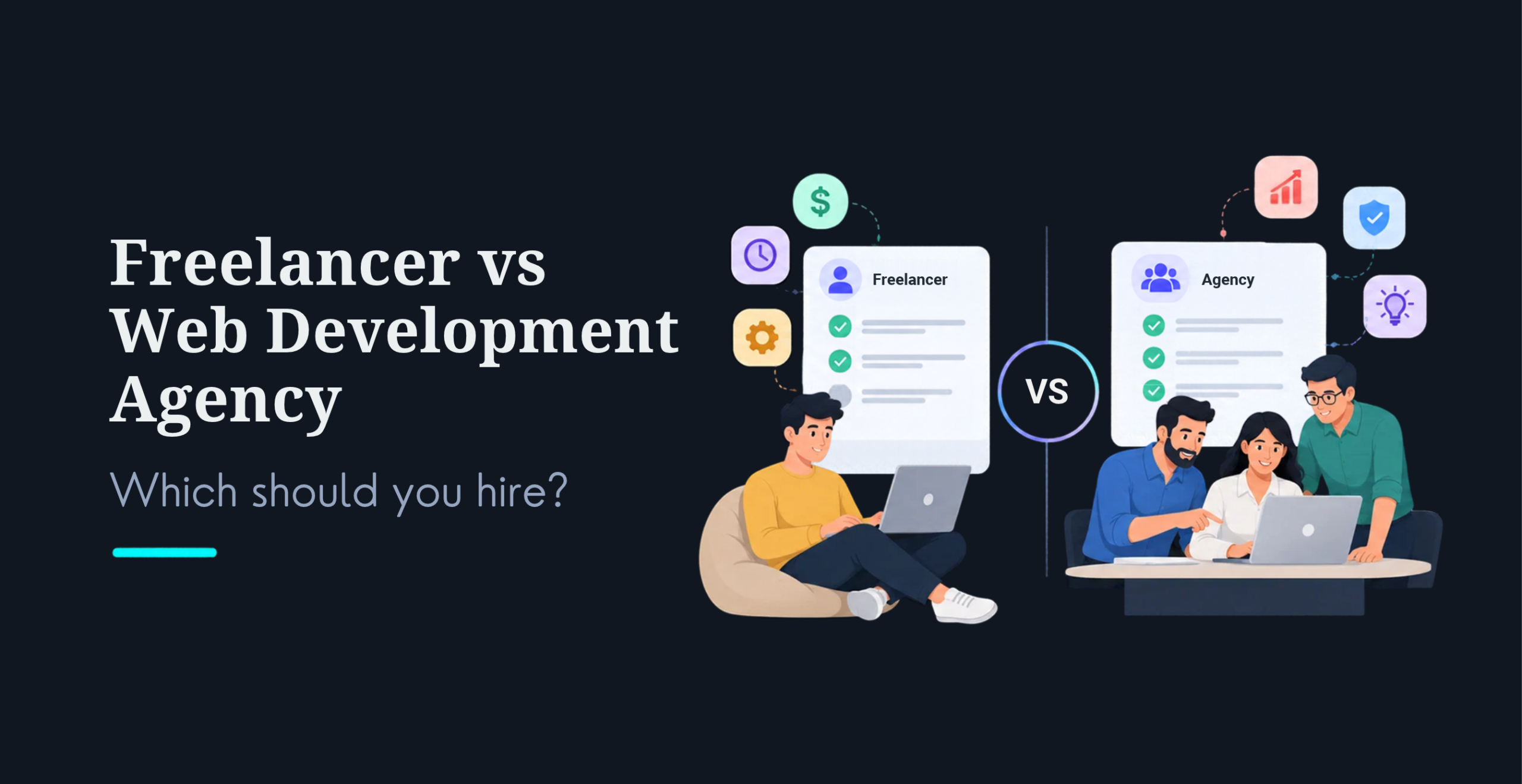
A white label partner tends to fit when your workload fluctuates, when you need capacity fast, when you want to accept more projects than you currently can, when you need several Webflow specialties at once, or when you’re not ready to hire a full-time developer yet.
Hiring tends to fit when Webflow is a core part of your long-term offer, when demand is predictable, when your team needs daily internal collaboration, and when you’re building proprietary technical expertise on purpose.
A freelancer tends to fit for small, well-defined projects, when you already trust the specific person, when you have strong technical oversight, and when the work doesn’t need long-term continuity.
For real numbers on this trade-off, freelance Webflow developers typically charge $50 to $150 an hour in 2026. Full-time salaries range from $65,000 to $140,000 a year in the US depending on experience. Agencies bill $100 to $300 an hour. A typical 5-page site runs $3,000 to $10,000 through a freelancer and $10,000 to $50,000 through an agency. For a deeper breakdown of how these compare on total cost of ownership,our white label vs in-house cost comparison works through the full math.
Pricing and Engagement Models
White label Webflow work gets priced per project, through a monthly retainer, hourly, or through dedicated developer capacity. Project pricing suits defined builds. Retainers suit recurring work. Dedicated capacity suits volume that’s high and predictable enough to justify the commitment.
Model
Best For
Main Advantage
Main Risk
Fixed project
Defined websites and migrations
Predictable project cost
Scope creep
Hourly / time-and-materials
Unclear or evolving work
Flexibility
Less cost certainty
Monthly retainer
Ongoing maintenance and enhancements
Continuity and priority access
Unused capacity
Dedicated developer
High, predictable volume
Maximum continuity
Greater commitment
Market pricing varies considerably. Project-based work typically runs $1,000 to $15,000 or more per site. Hourly rates range from $25 to over $100 depending on region and expertise. Monthly retainers for continuous design, development, or maintenance work run $500 to $3,000 a month.
For context on KrishaWeb’s own structure, monthly retainers for development capacity start at $1,299 a month and can be scoped to include Webflow tasks alongside other work. Treat that as a provider-specific starting point, not a universal rate.
Questions worth asking before you compare quotes
Is PM and QA included in the fee? Are revisions included, and how many? Are premium integrations billed separately? Is hosting or deployment part of the package? Do unused hours roll over? Is emergency work priced differently? What happens when scope changes mid-project? Is there a minimum commitment? Can capacity flex up or down? Are documentation and handover included?
Total delivery cost should include the partner fee, your internal PM time, QA and review, client communication, rework, software and licenses, payment processing, and the admin overhead of managing scope changes.
How to Choose a White Label Webflow Partner
Choose based on code quality, documentation, security practices, communication, platform depth, client confidentiality, and commercial flexibility. Ask to see relevant work. Understand their delivery process. Confirm ownership terms in writing. Test the relationship with a defined pilot before you hand over anything client-critical.
Score candidates from 1 to 5
Webflow expertise. Figma-to-Webflow capability. CMS architecture experience. Interactions and animations. Custom code and integrations. Performance and security knowledge. QA process. Documentation quality. Repository and IP ownership. NDA and confidentiality protections. Project management maturity. Response times. Pricing transparency. Capacity scalability. Handover process. Client references.
Questions worth asking directly
How do you scope a Webflow project? Who owns the code? Where will the project actually be developed? Who handles QA? How are client revisions managed? What happens when the brief changes mid-project? How do you manage plugin or integration licensing? What’s your process for security updates? Can you work inside our existing tools? Can you take over an existing site you didn’t build? How quickly can you realistically start? What does your project manager’s role actually cover? How do you handle an urgent production issue? What happens if we need to scale workload down? Could a different developer inherit this cleanly if needed?
Start with a pilot, not a client-critical project
A small, clearly scoped site. A single landing page. A maintenance backlog item. A staged component of a larger redesign. A non-critical integration. A clearly scoped small business site. Any of these work as a low-risk first test.
Measure scope accuracy, communication quality, revision handling, how organized the code actually is, documentation, delivery speed, how much of your own PM time it consumed, and client feedback if you can get it.Our 12-point checklist for evaluating a white label partner covers this evaluation process in full detail.
Common Mistakes and Myths
White label Webflow development doesn’t remove your agency’s responsibility for client expectations, quality assurance, or scope control. It adds delivery capacity. You still need a clear brief, a real review process, a solid ownership agreement, and reliable communication.
Mistakes that show up repeatedly
Choosing a partner on lowest price alone. Sending incomplete designs and hoping the gaps get filled in sensibly. Letting the client send unfiltered feedback straight to the developer. Never defining a revision limit. Testing changes directly in production. Ignoring integration licenses and who owns them. Never testing backups or rollback procedures. Accepting undocumented customizations because the site “just works.” Not tracking your own internal PM and QA hours. Relying on a single developer with no handover plan. Treating maintenance as unlimited support by default. Neglecting Webflow hosting and workspace compatibility checks.
Four myths worth retiring
“White label means low-quality outsourced work.” Quality depends on technical standards, QA discipline, code review, documentation, and accountability. None of that is determined by whether the work happens externally.
“A template is always faster and better.” The right implementation depends on the client’s editing needs, performance goals, design system, maintenance plan, and technical requirements. Sometimes a template is the right call. Often it isn’t.
“Security is only Webflow’s responsibility.” Webflow handles hosting security. The site owner and development team remain responsible for application configuration, access control, backups, and custom code security.
“The client will eventually discover the partner.” A properly structured agreement, a branded workflow, an agency-owned workspace, and controlled communication keep the partner behind the scenes reliably. Still review your own client contracts for any relevant disclosure obligations.
Standardize your brief. A reusable intake template covering client goals, sitemap, designs, content status, functionality, integrations, hosting, SEO requirements, accessibility expectations, launch date, and acceptance criteria saves rework on every project.
Keep feedback centralized. Consolidate client feedback on your end before it goes to the partner. This prevents contradictory instructions and protects everyone’s time.
Build one QA checklist and reuse it. Visual, functional, technical, security, SEO, analytics, and launch checks, applied consistently rather than reinvented each time.
Use agency-owned accounts wherever practical. Webflow workspace, hosting, analytics, domain, integration licenses, DNS provider, and project management tools should sit under your control, not the partner’s.
Document decisions, not just deliverables. Architecture, CMS structure, custom functionality, deployment process, environment variables, third-party integrations, known limitations, and maintenance recommendations all belong in the handover.
Review profitability project by project. Track partner cost and your internal time separately. A project that looks profitable on the invoice can look very different once PM, QA, revision, and client-communication hours are counted honestly.
Match the pricing model to actual demand. Fixed pricing for defined builds. Retainers for recurring maintenance. Dedicated capacity only once predictable volume genuinely supports it.
Frequently Asked Questions
What is white label Webflow development?
White label Webflow development is when an external Webflow team builds websites or features that your agency presents to clients under your own brand. You retain the client relationship while the partner handles agreed technical delivery, invisibly.
Is white label Webflow development profitable?
It can be, when you price the work above the combined cost of partner delivery, project management, QA, communication, rework, and software. Profitability comes down to scope control, utilization, client pricing, and delivery quality, not the model itself.
What Webflow services can be white labeled?
Figma-to-Webflow conversion, CMS architecture, interactions and animations, custom code, integrations, migrations, redesigns, performance optimization, security updates, maintenance, and ongoing feature work are all commonly delegated.
Will the client know a white label partner is involved?
Not if the agreement defines confidentiality, client-contact rules, branding, reporting, and ownership clearly. Confirm your own client contracts permit this kind of delivery arrangement too.
Who owns the Webflow code?
That depends entirely on the contract. Insist on clear IP-assignment language, workspace access from the start, documentation, and confirmation that the build doesn’t quietly depend on an undisclosed proprietary framework.
How much does white label Webflow development cost?
Project-based work typically runs $1,000 to $15,000 or more per site. Hourly rates range from $25 to over $100 depending on region and expertise. Monthly retainers run $500 to $3,000 a month.
Can a white label partner maintain an existing Webflow website?
Yes, provided they can safely access the existing workspace, hosting, staging environment, integration licenses, backups, and documentation. A technical audit should come before any maintenance work begins on a site the partner didn’t originally build.
Is white label Webflow development better than hiring?
It depends on your demand pattern. White label offers flexible capacity and faster activation. Hiring offers more direct internal control and continuity. Agencies with fluctuating demand tend to benefit most from a partner.
How quickly can an agency actually start?
It depends on scope, access, NDA turnaround, and the partner’s current capacity. KrishaWeb typically onboards agencies within 48 hours, with development starting three to five business days after a complete, approved brief.
Conclusion
Webflow demand from clients isn’t slowing down, and the agencies capturing that work aren’t necessarily the ones with the biggest in-house team. They’re the ones who found a way to say yes to the brief without betting the agency’s margin on hiring ahead of demand they weren’t sure would last.
White label Webflow development gives you a practical way to deliver more sites without immediately building out a bigger internal team. The right partner offers more than spare developer hours. Clear scoping, real QA discipline, secure practices, code you’d actually want to inherit, transparent ownership, and a workflow that fits how your agency already operates.
If you’ve got a Webflow project sitting in your pipeline right now waiting on capacity, bring it to a scoping conversation before you either turn it down or take the risk on your own.
Pricing figures reflect a mix of market examples and KrishaWeb’s published rates at the time of writing. Confirm current pricing directly before quoting a client. All figures are for planning purposes.
Nisarg Pandya
Project Manager
Experienced Project Manager and Scrum Master at KrishaWeb, delivers expertise in Scrum methodologies, Laravel, React.js, UX design, and project management, ensuring efficient project delivery and agile implementation.




 KrishaLabs
 KrishaStudio
 KrishaStore