AI coding tools feel like a superpower right up until the day they don’t. The first few weeks are euphoric. Features ship in hours, the demo looks great, everything feels fast.
Then, somewhere around month three or four, the whole thing turns to tar. Every new feature takes longer than the last. A change in one place breaks something unrelated in another. Nobody can confidently say how a given piece works.
The code still runs. It’s just become almost impossible to change safely. This is the most common and least-discussed failure mode of AI-assisted development, and it’s entirely reversible.
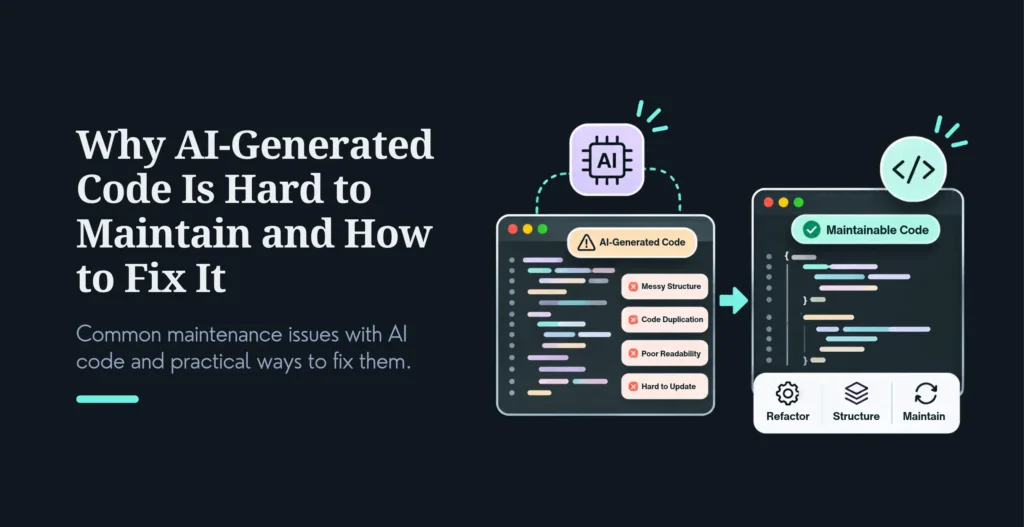
AI-generated code becomes hard to maintain because AI tools generate volume but rarely consolidate. They paste new variations instead of reusing what exists, bury business rules in the wrong layer, give things generic names that hide intent, and skip the tests that would make future changes safe, all over code nobody actually read or understands.
The fix is AI generated code refactoring: a disciplined, behavior-preserving cleanup. You map the blast radius, build a safety net of tests first, then work in small reviewed steps, consolidating duplication, moving logic to the right place, restoring clear naming, and adding the structure the AI left out, so the code becomes clean, maintainable, and safe to extend.
The scale is measured, not anecdotal. GitClear’s 2026 analysis of 623 million code changes found genuine refactoring collapsed from 21% of changed lines in 2022 to just 3.8% in 2026, while duplicated code blocks rose 81%.
And the people building with AI feel it. In New Relic’s 2026 survey of 200 US enterprise technology leaders, 41% said at least half of their AI-generated code needs significant rework. In Sonar’s survey of 1,100+ developers, 40% said AI had increased their technical debt by generating unnecessary or duplicative code, and 53% cited code that looks correct but proves unreliable.
This guide explains why AI code decays, mechanism by mechanism. Then it walks through the safe five-step refactoring workflow to fix it, how to keep AI code maintainable going forward, the refactor-versus-rebuild call, and real costs and timelines. It’s the work our AI code restructuring service does.
Key Highlights
Why it happens: AI generates rather than consolidates, so it pastes variations instead of reusing code, buries business logic in the wrong layer, uses generic names that hide intent, and skips tests, over code nobody fully read.
The measured scale: GitClear found refactoring down from 21% of changed lines (2022) to 3.8% (2026) and duplicated code up 81%. New Relic: 41% of leaders say at least half their AI code needs significant rework. Sonar: 40% of developers say AI increased technical debt through unnecessary or duplicative code.
The symptom you notice first: every new feature takes longer than the last, and small changes break unrelated things, the signature of accumulated, unmanaged complexity.
The fix is AI generated code refactoring, done safely (5 steps): map the blast radius → build a safety net of characterization tests → refactor in small reversible steps → verify every step → merge as small single-purpose commits.
The rule that keeps it safe: diffs under ~200 lines, one change at a time, tests before you touch anything, mechanical cleanup before structural work, and a human owning every merge.
Refactor vs rebuild: if the data model is sound and the faults fit on a list, refactor in place; if the data structure is wrong or every change breaks something unrelated, it’s a rebuild decision, decided by an audit, not frustration.
Cost (vendor-reported ranges): a focused 12-16 week refactor with a 2-3 engineer pod commonly runs 60,000–120,000; AI assistance can cut a large legacy refactor’s cost ~30-35%. Verify with a scoped quote.
Table Of Contents
Table Of Contents
Why Does AI-Generated Code Become Hard to Maintain?
The decay isn’t random, and it isn’t a sign of a bad model. It’s structural, a predictable consequence of how these tools work, and the root cause is simple: AI generates rather than consolidates.
Adding code to a new file takes almost no understanding of a codebase’s existing architecture. So when you ask for a feature similar to something you already have, the AI tends to produce a fresh variation rather than reuse or extend what’s there.
Do that fifty times over a few months and the same logic ends up implemented five slightly different ways in five places. That’s exactly why fixing a bug in one spot leaves it alive in the other four.
GitClear’s 2026 study of 623 million changes documents the result precisely. Duplicated code blocks up 81% (the highest on record), within-commit copy-paste up 41%, cross-file reuse down 35%, and genuine refactoring collapsing from 21% of changed lines to 3.8%, all as AI-assisted commits grew to roughly a quarter of all commits.
One honest caveat GitClear itself makes: the data is correlational. It shows what AI-era codebases look like, not a proof that AI alone caused it. But the direction is consistent across every study.
Duplication is only the most visible symptom. The deeper maintainability problems follow the same “generate without understanding the whole” pattern.
AI routinely puts business logic in the wrong layer, writing rules into controllers and request handlers that belong in a domain or service layer. That makes them impossible to reuse and hard to test.
It gives functions and variables generic names like “handleData” or “processItem” that hide what they do. So the next person, or the next AI session, has to reverse-engineer intent before changing anything.
It skips the tests that would make future changes safe, covering at most the happy path and leaving failure, edge, and rollback cases untested. There’s no safety net to catch a regression.
And underneath it all is the comprehension gap. The code was generated and never really read, so nobody made, or remembers, the decisions it embodies. When something breaks, there’s no mental model to debug against.
This is why the people shipping AI code report exactly these problems. In New Relic’s survey of enterprise leaders, 41% said at least half their AI code needs significant rework, and 86% said senior engineers now spend more time fixing AI-generated code. (New Relic, which sells observability tooling, surveyed 200 US technology decision-makers at upper mid-market and enterprise firms; the same survey found 94% rated AI code higher quality at review time, so the problems show up after shipping.) In Sonar’s developer survey, 88% cited at least one negative effect of AI on their technical debt, 40% pointed to bloat from unnecessary or duplicative code, and 53% to code that looks correct but is not reliable. The same survey found 93% also saw at least one positive effect, such as better documentation (57%), test coverage (53%) and refactoring (47%).
The telltale signs you’ll recognize, every feature taking longer, errors slipping past a half-any TypeScript layer, legacy code sitting untouched, are all downstream of these four mechanisms.
What Is AI-Generated Code Refactoring, and Why Is It the Right Fix?
If the problem is that AI generated volume without structure, the fix is to restore the structure without changing what the software does. That’s exactly what AI generated code refactoring is: a behavior-preserving cleanup.
The critical word is behavior-preserving. Refactoring improves the internal structure, consolidating duplication, relocating misplaced logic, clarifying names, adding tests, while leaving the external behavior identical.
It is not rewriting, not adding features, and not fixing bugs. Those are separate, later jobs, done separately. Refactoring just makes the existing, working code clean and safe to change.
Done right, it reverses each of the four decay mechanisms directly. It consolidates the duplication, moves business logic back to where it belongs, replaces generic names with domain terms that reveal intent, and adds the characterization tests that give the codebase the safety net it never had.
It’s the right fix, rather than a rebuild, for a specific and common situation: when the product is validated and the underlying code is fundamentally sound but messy. Most AI-built apps are in exactly that state, the thing works and users want it, but the code underneath has rotted to where extending it is painful and risky.
Refactoring salvages the validated product and the working code, which is most of your investment, instead of throwing it away. It does so at a fraction of the cost and risk of starting over.
The one thing refactoring is not is a way to fix a broken foundation. If the data model itself is wrong, or you genuinely can’t verify what the code does, that’s a deeper decision (covered below). But for the typical “it works, it’s just become unmaintainable” case, refactoring is precisely the right tool.
How Do You Refactor AI-Generated Code Safely? The 5-Step Workflow
The fear that stops teams from fixing unmaintainable AI code is reasonable. If the code is already fragile and nobody fully understands it, won’t refactoring just break it?
It won’t, if you follow a disciplined, behavior-preserving method rather than diving in and tidying. The whole approach rests on one principle: make small, tested, reversible changes a human reviews before they ship. It runs in five steps.
Step one: map the blast radius. Before touching anything, answer three questions about the code you want to change.
Does it carry business logic that must survive exactly as-is? Then it needs behavior-preserving treatment, not a confident rewrite. Does anything else depend on it? Generated code often has more callers than you’d expect, because the same pattern was written in several places. And can you verify its behavior today?
That last question is decisive. If there’s no way to prove behavior is preserved, cleanup is a gamble.
Step two: build a safety net before you change a line. Pin the current behavior with characterization tests, tests that capture what the code does today, including behavior that looks wrong.
Cover at least the happy path and the two most common error paths, so the tests fail if behavior changes. Around that, establish contracts (APIs, events, schemas), telemetry on the invariants that matter, and rollback controls (feature flags, canary releases, reversible migrations).
If test coverage is below ~50%, write tests before you refactor, not after.
Step three: refactor in small, reversible steps. One seam or one extraction at a time, running the tests after each.
Keep diffs small enough, around 200 lines, that a reviewer can hold the whole change in their head. Never let an AI rewrite a whole module in one shot: a refactoring commit spanning 40 files can’t be reviewed and can’t be rolled back.
Start narrow and low-risk, a single structural problem in a low-business-logic area with tests you trust. Begin with mechanical transforms (renames, type changes, dead-code removal) before anything structural.
Consolidate duplicates last, only once the individual copies are clean enough to confirm they really do the same thing. And ship intermediate states, a refactoring branch left open three weeks collides with everything.
Step four: verify every step. Run the tests after each small change, so problems surface while they’re cheap to undo.
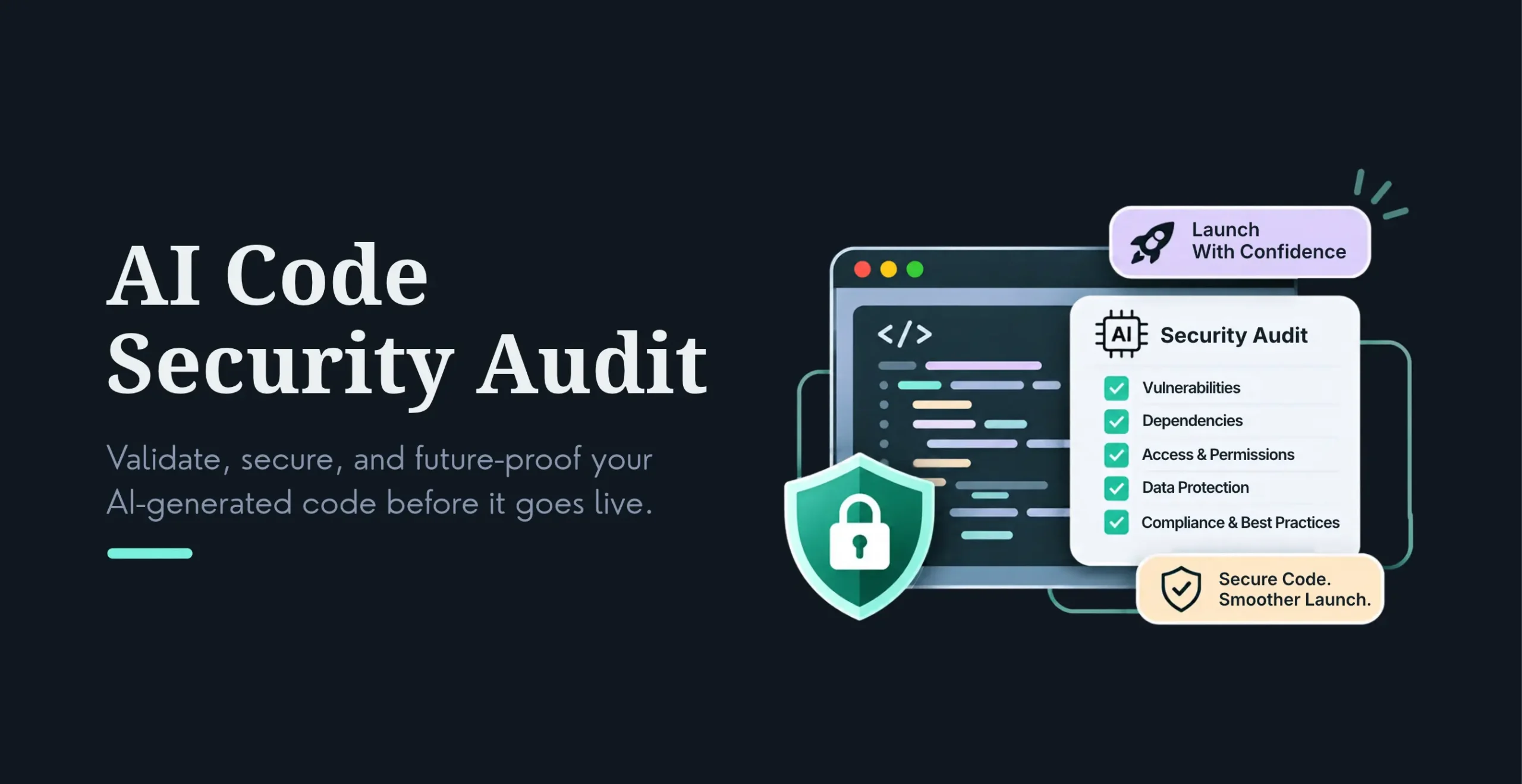
Before any human reviews it, send the diff through the full pipeline, linting, type checks, unit and integration tests, static analysis, dependency scanning, as a blocking gate, not an advisory report. A human then checks specifically for behavior drift: a silently altered edge case, a swapped default, a removed guard clause. If you also want the security side reviewed, see our AI code security audit.
Step five: merge as small, single-purpose commits. Each approved change merges as a small commit that references its plan, which makes bisecting a future regression practical.
Keep refactoring commits separate from feature work, and structural changes separate from behavioral ones. Mixing them makes the result far harder to validate and revert.
Throughout, track the outcome, not just the output. Measure code health, complexity, duplication, coverage, before and after. If the numbers don’t improve, the refactoring didn’t achieve its goal, no matter how much cleaner the code looks.
How Do You Keep AI-Generated Code Maintainable Going Forward?
Fixing the current mess is half the job. The other half is not recreating it.
The governing principle: treat AI-generated code as fast draft work that still needs system ownership, engineering review, and disciplined refactoring, not finished output you merge on sight.
In practice, that starts with module boundaries, because generated output so often crosses responsibilities the architecture meant to keep separate. Before optimizing anything smaller, ask the placement questions: where does this business rule belong, where does data access belong, where should side effects fire?
If a generated change touches too many concerns, split it along those boundaries before you tidy the details. Clean boundaries reduce coupling, expose duplication, and make every later edit safer. Then rename methods around domain terms and delete the generic helpers that blur intent.
A fast way to apply this, both when refactoring and when reviewing new AI output, is a signal-to-action map for the common AI code smells:
Signal in the generated code
The fix
Change touches more than one system boundary
Split into smaller modules before merge, so each owner reviews one concern
Business policy sits inside a controller or handler
Move the rule into the domain/service layer where tests and reuse stay stable
A new helper hides intent behind a generic name
Rename with domain terms so later edits don’t require guesswork
A small task added a fresh dependency
Remove the package, or document the case that justifies its maintenance cost
Tests cover only the happy path
Add failure, edge, and rollback tests before approval
Underpinning all of it are three habits. Make tests target failure paths, edge cases, and policy boundaries rather than just the happy path. Review AI output with context-rich prompting and partial rewriting before accepting it. And run static analysis on AI-generated code as a matter of course, something 57% of developers already do in Sonar’s survey.
The shift that keeps a codebase healthy is cultural more than technical. Stop treating AI output as finished code, and start treating it as a draft that earns its place through the same review any contributor’s first pull request would get.
Should You Refactor or Rebuild Your AI-Generated Code?
This is the one decision that determines cost, timeline, and whether refactoring is even the right tool. Getting it wrong is expensive either way.
The test is simple, and worth applying honestly. If the data model is sound and the faults fit on a list, refactor. If the data structure itself is wrong, or every change breaks something unrelated, rebuild, with discipline this time.
Refactor when the structure is fundamentally sound and the problems are local, isolated issues in access control, validation, or specific features sitting on a reasonable foundation, and when the product is validated. That’s most cases, and refactoring salvages your working code far more cheaply than starting over.
Rebuild territory is narrower. A tangled data model with no honest structure, authentication that can’t be made safe, framework choices that fight you at every turn, or a codebase where fixing one thing reliably breaks two others because the coupling is pathological. In those cases, no amount of careful small-step refactoring fixes the underlying problem.
The discipline that matters most here is to audit first, not out of frustration. The decision to refactor or rebuild should come out of a real assessment, not a snap call at 11pm after the fifth broken fix.
If three or more structural warning signs are present, every fix breaks something, nobody understands the code, paying users affected, that’s a signal to get an audit before spending a dollar on a rewrite.
The honest way to compare is to price both paths in hours, audit-plus-refactor versus full rebuild. The real cost turns on three things an audit reveals: how much already works, how tangled the broken parts are with the working parts, and how much of the original design intent you can reconstruct.
A common middle path is a mix. Refactor and keep what’s sound, rebuild only the specific broken layer (often the data or identity layer) behind stable interfaces.
If the signs point to rebuild, our AI build rescue guide covers that path. A security audit is often the right first step to surface what you’re actually dealing with, and our AI prototype to production service covers getting an AI-built app launch-ready.
How Much Does AI-Generated Code Refactoring Cost, and How Long Does It Take?
Treat these as vendor-reported planning ranges that vary far more with the code’s condition than its size, and scope a real quote.
The most useful benchmark for a serious cleanup: a focused refactor of a production system unfamiliar to the team, a 2-3 engineer pod over 12-16 weeks, commonly runs 60,000–120,000. That’s roughly 1.50–3 per line touched for something like a 40,000-line module.
The critical cost driver isn’t raw size. It’s test coverage and how tangled the module is. Understanding and verifying the code is where the effort goes, which is why refactoring is rarely priced cleanly per line.
AI assistance meaningfully compresses this on larger legacy work. One documented comparison put refactoring an 80,000-line system at roughly €27,000-€39,000 with AI assistance versus €42,000-€57,000 by hand, a 30-35% saving, over 45-65 person-days. The human review stays essential.
For smaller or more contained work, cleanup engagements and focused refactors commonly run in the low-to-mid five figures over a few weeks. Anything that tips into partial or full rebuild climbs well beyond that, and belongs in the rebuild decision above, not here.
Two honest caveats a cost-conscious reader should hold.
First, AI refactoring tools and agents are cheap per run but have a low success rate on anything structural. Benchmarks vary widely: one 2026 benchmark of performance-oriented refactoring (FrontierRefactor) reports single-pass strict success of roughly 22-36% for frontier agents, and another (SWE Refactor Bench) found only 5.4% of full-repository migration runs passed every stage, though simpler, instructed refactors score far higher. So the real cost is the senior review time to validate and fix the attempts, not the token spend.
That’s exactly why the mechanical-vs-structural split matters. Use AI for the renames and extractions where it’s reliable and cheap, and keep humans on the structural judgment where it isn’t.
Second, if you’re managing this as an ongoing discipline rather than a one-time project, a workable budgeting rule is the 70/20/10 split. Roughly 70% of engineering capacity on new features, 20% on planned refactoring, 10% on opportunistic cleanup inside feature tickets.
Present that as a standing allocation rather than an ad-hoc ask, so the debt gets paid down continuously instead of accumulating until it needs a $100K intervention.
Frequently Asked Questions
Why does AI-generated code become hard to maintain?
Because AI tools generate rather than consolidate. Adding code to a new file takes almost no understanding of a codebase’s architecture, so AI pastes a fresh variation instead of reusing what exists, GitClear measured duplicated code up 81% and genuine refactoring down from 21% of changed lines (2022) to 3.8% (2026). It also buries business logic in the wrong layers, uses generic names that hide intent, and skips tests. Underneath is a comprehension gap: the code was generated, never really read, so nobody made or remembers the decisions in it. The people shipping it feel this directly, 41% of enterprise leaders in New Relic’s survey say at least half their AI code needs significant rework.
What is AI generated code refactoring?
It’s a behavior-preserving cleanup of AI-generated code, improving the internal structure while leaving what the software does unchanged. Concretely, it consolidates duplicated logic, moves business rules to the layer where they belong, replaces generic names with domain terms that reveal intent, and adds the tests the AI skipped. It is not rewriting, not adding features, and not fixing bugs, those are separate jobs done separately. The goal is to make existing, working code clean, maintainable, and safe to extend, so the next change doesn’t take a week or break something unrelated. It directly reverses the four mechanisms that made the code unmaintainable.
How do I refactor AI-generated code without breaking my app?
Follow the five-step workflow. Map the blast radius (does it carry business logic, what depends on it, can you verify it today). Build a safety net first, characterization tests that pin current behavior, plus contracts, telemetry, and rollback controls (if coverage is under ~50%, write tests before refactoring). Refactor in small reversible steps, one change at a time, diffs under ~200 lines, mechanical cleanup before structural work, consolidating duplicates last. Verify every step with tests and a blocking CI pipeline, and a human check for behavior drift. And merge as small single-purpose commits, refactoring separate from feature work, structural separate from behavioral, tracking code health before and after.
How do I keep AI-generated code maintainable going forward?
Treat AI output as fast draft work that still needs ownership, review, and refactoring, not finished code. Start with module boundaries: if a generated change crosses several concerns, split it along those boundaries before optimizing smaller details, then rename around domain terms and delete generic helpers. Use a signal-to-action habit, a change touching multiple boundaries gets split, business policy in a controller moves to the domain layer, a generic helper gets a domain name, a new dependency gets removed or justified, happy-path-only tests get failure and edge tests added. Make tests target failure paths and policy boundaries, review with context-rich prompting, and run static analysis on AI code routinely.
Should I refactor or rebuild my AI-generated code?
Apply one test: if the data model is sound and the faults fit on a list, refactor in place; if the data structure itself is wrong, every change breaks something unrelated, or the foundation (schema, auth, framework) is broken, it’s a rebuild decision. Refactoring suits the common case, a validated product on a reasonable foundation that’s just messy, and salvages your working code far more cheaply than starting over. Rebuild is for a genuinely broken foundation. Decide from a short audit, not frustration: if three or more structural warning signs are present, audit before spending on a rewrite, and price both paths in hours before choosing. A frequent middle path is refactoring what’s sound and rebuilding only the specific broken layer.
How much does it cost to refactor AI-generated code, and how long does it take?
Vendor-reported ranges: a focused refactor of an unfamiliar production system, a 2-3 engineer pod over 12-16 weeks, commonly runs 60,000–120,000 (roughly 1.50–3 per line touched). The driver is test coverage and how tangled the code is, not raw size, understanding and verifying the code is where the effort goes. AI assistance can cut a large legacy refactor’s cost about 30-35% (one 80,000-line example ran ~€27K-€39K with AI vs €42K-€57K by hand), but senior review stays essential, and AI refactoring agents succeed on only a minority of structural tasks in published benchmarks, so the cost is in validating the attempts. For ongoing debt, a 70/20/10 capacity split keeps it from accumulating into a six-figure intervention.
Can AI refactor its own messy code, or do I need a human?
Both, in defined roles. Trust AI with mechanical, pattern-level work where changes are local and easily verified, renames, dead-code removal, naming consistency, long-function decomposition, type annotations, and test scaffolding, where independent testing shows it performs reliably. Keep humans firmly in charge of the structural and high-consequence decisions AI can’t see the whole picture for: deciding where business logic belongs, how to untangle a data flow, merging duplicates, and authorization changes. The model: AI accelerates the investigation, planning, and execution of a refactor; engineers own the architectural decisions, the validation, and the risk. Review AI-generated refactoring to the same standard as a new contributor’s first pull request.
How do I know if the refactoring actually worked?
Measure code health before and after, don’t rely on “it looks cleaner.” Baseline the modules you’re touching on cyclomatic complexity, duplication rate, and test coverage before you start, ideally with a tool like CodeScene or a complexity reporter. After the refactoring, measure the same metrics. A genuine improvement shows lower complexity, less duplication, and better coverage, with no change in behavior (your characterization tests confirm the behavior part). If the numbers don’t move, the refactoring didn’t achieve its goal regardless of how much tidier the code looks. Tracking outcomes rather than output is also what lets you prove the value of the work to stakeholders.
Conclusion: Turning Unmaintainable AI Code Into Clean, Extendable Software
The maintainability wall that AI-built projects hit around month three isn’t a mystery or a dead end. It’s the predictable result of tools that generate volume without consolidating it.
The data confirms it’s a systemic pattern, not your team’s failing. GitClear’s 81% rise in duplication and collapse of refactoring to 3.8%. New Relic’s 41% of leaders reporting half their AI code needs rework. Sonar’s 40% of developers reporting more technical debt from unnecessary or duplicative AI code.
Once you can see the four mechanisms behind the decay, duplication from generate-don’t-reuse, logic in the wrong layer, generic names, and missing tests over code nobody understands, the fix becomes clear. AI generated code refactoring reverses each one while preserving exactly what the software does.
The way to do it safely is disciplined, not heroic. Map the blast radius, build a test safety net first, change in small reviewed steps, verify every one, and merge small single-purpose commits, while measuring code health so you know it worked.
Use AI for the mechanical parts and keep engineers on the judgment. Make the refactor-versus-rebuild call from an audit, not frustration. And keep it from recurring by treating AI output as a draft that earns review, not finished code.
Do that, and the app you validated and the code you’ve already paid for become an asset again, clean, maintainable, and safe to extend, instead of a liability you’re afraid to touch. The debt is real, but it’s the kind you can pay down deliberately. The teams that do are the ones who stay fast.
Sitting on AI-generated code that’s getting harder to change?
Explore our AI Code Restructuring service to see how we make AI-generated code clean, maintainable, and safe to extend, behavior-preserving, test-first, with code-health measured before and after.
Book a consultation and send us the repo, we’ll assess code health and tell you honestly whether it’s a refactor or a rebuild.
Nirav Panchal
Lead – Custom Development
Lead of the Custom Development team at KrishaWeb, holds AWS certification and excels as a Team Leader. Renowned for his expertise in Laravel and React development. With expertise in cloud solutions, he leads with innovation and technical excellence.




 KrishaStudio
 KrishaStore