Most agencies sell projects: a site, a campaign, a build, delivered, invoiced, and done, with the revenue resetting to zero every time. SaaS breaks that cycle. A software product your client sells on subscription generates revenue every month, deepens the relationship for years, and can carry margins a project never will. The problem is that building a real SaaS platform takes a product-engineering team most agencies don’t have. White label SaaS development is how you offer it anyway, recurring-revenue products built under your brand, without hiring in-house.
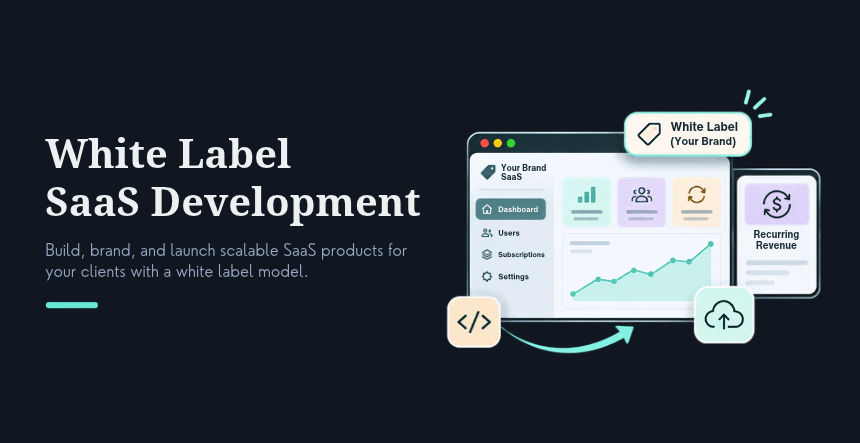
White label SaaS development is a fulfillment model where a specialist team builds a cloud-based software product, the full stack: multi-tenant architecture, user management, subscription billing, API integrations, and scalable infrastructure, on behalf of your agency, and it ships entirely under your brand. Your client receives the product as your work and never interacts with the partner; you own the client relationship, the roadmap, the pricing, and, critically, the source code. It runs through a repeatable six-phase workflow (discovery → architecture → MVP → iterative sprints → QA/security → branded deployment and ongoing retainers), protected by an NDA and clean IP transfer, so the product is genuinely yours. As planning ranges, rebranding an existing platform runs 5,000–60,000, a custom agency build 50,000–500,000, and a fully custom product you own outright 150,000–750,000+, with vendor-reported gross margins running roughly 40-80% depending on the model, before the ongoing support cost covered below.
This is the revenue-model playbook for agency owners and product leads: why SaaS is worth building, how the build actually works, how it stays invisible and the IP stays yours, real pricing and margins, the multi-tenancy models that are the genuinely hard part, how to vet a partner, the hidden risk that quietly erases margin, and when to build versus partner with an existing platform. Not being able to offer software products is one of the bottlenecks that stall agency growth, and this is how agencies move from project revenue to recurring revenue. It’s the model behind our own white label development.
Key Highlights
What it is: A specialist builds a full SaaS product (multi-tenant, billing, auth, infrastructure) under your brand, invisible to your client. You own the relationship, roadmap, pricing, and source code; the IP transfers to you.
Why build it: Recurring revenue instead of one-off project fees, stronger client retention, and a product you own, the shift from project-shop to product-revenue. Reported gross margins vary widely (roughly 40-80%) and are before support costs.
The 6-phase build: discovery → architecture → MVP → iterative sprints → QA/security → branded deployment + ongoing retainer. Branding is built in from day one, not bolted on.
Multi-tenancy is the hard part, not the logo: shared database (tenant ID per row, cheapest, weakest isolation), schema-per-tenant (stronger separation, more ops), or database-per-tenant (strongest isolation, highest cost). The choice is driven by compliance and isolation needs.
Pricing (vendor-reported ranges): rebrand 5K–60K, agency build 50K–500K, fully custom 150K–750K+; white-label MVP ~75K–175K; infrastructure ~300–1,500/mo at launch scaling to 3K–10K/mo. Verify with a scoped quote.
The hidden margin killer: the ongoing support obligation. You own first-line support, incidents, patches, and backups, and that workload can quietly erase the margin on the build if the contract doesn’t define responsibility boundaries.
Build vs partner: build custom when the software is the product and owning the code is the point; partner with an existing white-label platform when it’s an add-on you want live in weeks and someone else to maintain.
Table Of Contents
Table Of Contents
What Is White Label SaaS Development?
At its core, it’s building a software product so that another company can put their brand on it and sell it to their customers, and in the agency context specifically, a specialist team builds a cloud-based SaaS product on your behalf, it ships under your brand, and your client receives it as your work and never meets the partner. The scope is the full stack of a real product: multi-tenant architecture, user management and authentication, subscription billing, API integrations, an admin interface, and scalable cloud infrastructure, not a front end over someone else’s engine.
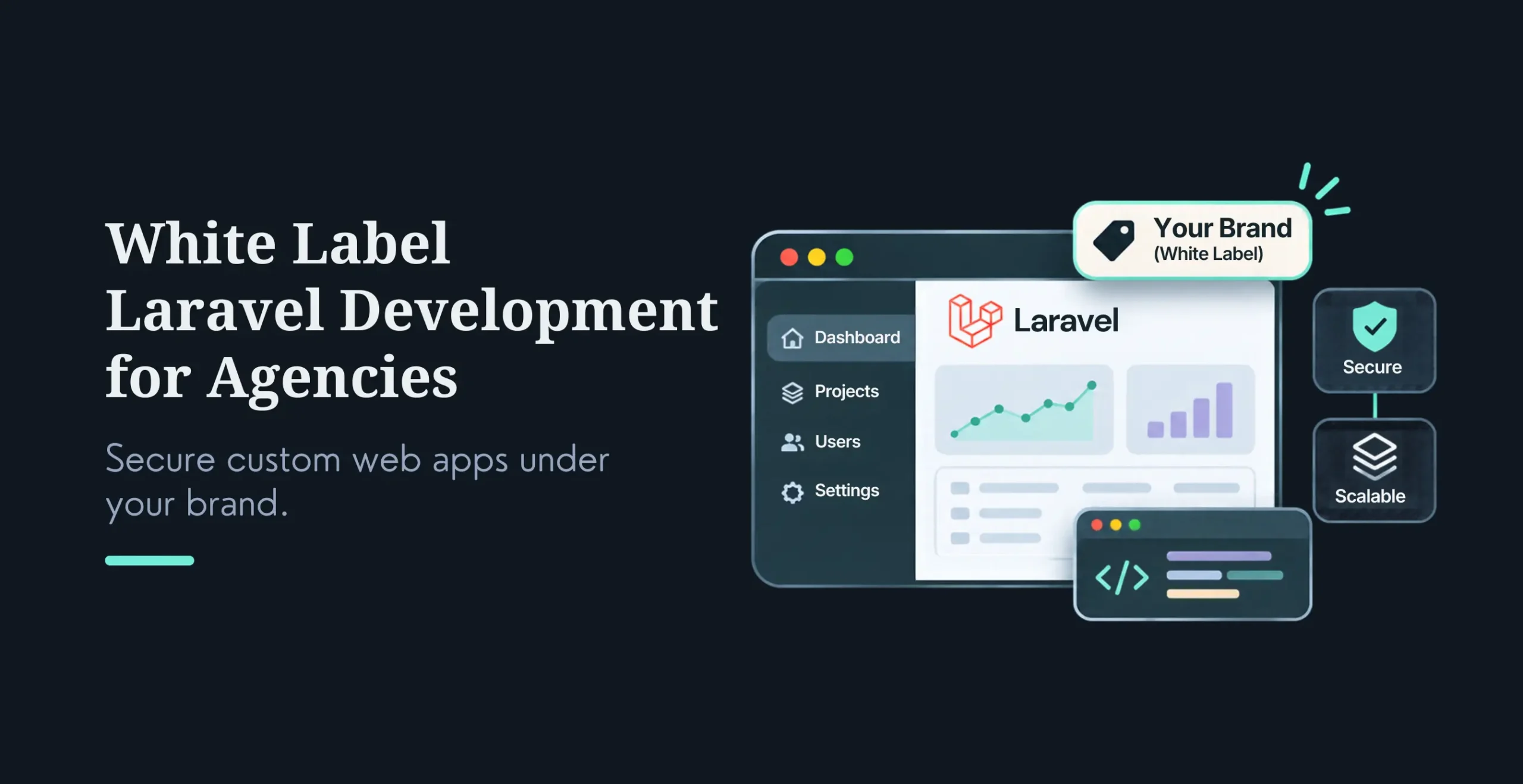
It helps to distinguish three different things people call “white label SaaS,” because they’re genuinely different businesses. You can build a product and license it to resellers (you’re a software company carrying the roadmap, uptime, and support). You can resell someone else’s SaaS under your brand (you’re configuring and supporting an existing platform like GoHighLevel or Vendasta). Or you can commission a custom build under your brand (you hire a development team that works invisibly and hands you code and IP as your own). This guide is mostly about the third, because it’s the one that gives an agency a genuine, owned, recurring-revenue product rather than a rebranded rental. And the thing to understand before anything else: white label SaaS is not a logo swap. The real engineering, and the part that determines whether it works, is the architecture that keeps each tenant’s data, branding, and configuration separate, plus a team that can maintain it for years. One codebase presented as many branded products: tenant isolation, theming, and partner-level configuration are the hard parts, not the interface. For the build itself, see our web application development and Laravel development services (many SaaS products are built on Laravel).
Why Do Agencies Build White Label SaaS?
The case rests on four compounding benefits, and the first reframes the whole business. Recurring revenue: a SaaS product generates monthly or annual subscriptions rather than one-time project fees, plus ongoing development retainers, so revenue compounds with every new customer instead of resetting to zero after each project. One often-quoted example is ModelNet, a white-label video-chat platform that its maker, the software company Scrile, reports earned $1.5M in sales at a 40-50% margin (listed on StarterStory); treat it as one illustration, not a benchmark, since it is a software company’s own product rather than an agency build, and the same listing elsewhere gives $1.2M a year. The structural point holds regardless: subscriptions build an asset, projects build a treadmill. Client retention: agencies that could only design, then handed development to a referral partner or freelancers, routinely lost the relationship after the design phase; a white-label build lets you own the whole engagement, and agencies with a reliable partner report dramatically better retention and revenue per client. A client paying a monthly subscription for a product you built and support is far stickier than one who bought a project.
Margin: you set the pricing, you own the roadmap, and you own the source code, so the margin is yours to control, and recurring revenue at a healthy markup compounds in a way one-off work can’t. Faster go-to-market: because the partner brings a ready engineering capability (and sometimes a proven architecture), launch timelines shrink dramatically versus building a product team from scratch, agencies report cutting launch times substantially and onboarding new client brands onto a multi-tenant platform in minutes rather than weeks. Taken together, these turn SaaS from a scary, capital-intensive bet into a route for a services agency to add product revenue without becoming a product company overnight. If you’re weighing this against hiring a product team, our agency vs in-house cost breakdown runs the comparison, and freelancer vs agency covers why a full partner team beats piecemeal hiring for work this complex.
How Does White Label SaaS Development Work?
A well-run engagement moves through the same six phases regardless of the vertical. Discovery and scoping: the partner maps what the product must do, who it’s for, and which features matter for launch versus version two, defining the product vision, core features, user personas, and technical requirements. Architecture design: engineers design the system, database schema, API structure, authentication, and, most importantly, the multi-tenancy model (more on that below), plus infrastructure planning, and they write the partner-facing requirements that define what you’ll be able to change yourself (logo, colors, domain, email sender) versus what needs engineering. MVP development: the partner builds a minimum viable product with a core, scalable feature set, ideally for one or two pilot customers, with branding built in from day one rather than bolted on later. Iterative development: additional features ship in sprint cycles with regular demos, feedback loops, and real-user QA, because the issues that matter most are the ones a customer’s staff hit in the first week, not the ones automated tests catch. Testing and security: comprehensive unit, integration, load, and security testing for production readiness, with the security baseline and any compliance attestations confirmed before work starts, not discovered at delivery. Deployment and ongoing support: the product launches on your cloud infrastructure under your domain and identity, with a full pipeline (server setup, CI/CD, SSL, staging and production environments), followed by ongoing development retainers for features, fixes, performance, security, and scaling.
The two phases agencies are tempted to rush, and shouldn’t, are architecture (where the multi-tenancy decision locks in your cost and scalability for years) and the ongoing-support planning (where the hidden margin risk lives). Branding built in from day one and real-user QA before launch are the other two markers of a partner who’s done this before rather than one treating your SaaS like a bigger website.
White Label SaaS Multi-Tenancy Models: The Hard Part Done Right
This is the architectural decision that matters most, and it’s where “white label SaaS is just a logo swap” falls apart, because serving many branded customers from one product is a genuine engineering problem. There are three models, and the right one depends on your isolation and compliance needs versus your cost and speed. Shared database (a single database with a tenant ID on every record) is the fastest to onboard and the cheapest to run, and it’s what most SaaS uses, but it offers the weakest isolation, a bug in a query filter can expose one tenant’s data to another, so the tenant-filtering logic has to be airtight. Schema-per-tenant (a separate schema per tenant within one database, commonly a 20,000–45,000 layer) gives stronger separation and per-customer backups, at the cost of multiplying your migrations and operating work. Database-per-tenant (a fully separate database per tenant, commonly 35,000–80,000) gives the strongest isolation and is often required for compliance-heavy or enterprise clients, but carries the highest cost and complexity.
There’s no universal right answer, and AWS’s own multi-tenant guidance describes the same three patterns (pool, bridge and silo: row-level security in a shared database, a dedicated schema per tenant, or a database instance per tenant) and says each trades isolation against cost. Isolation strategy depends on your domain, compliance obligations, and deployment model, which is exactly why this is an architecture decision to make deliberately with your partner rather than accept as a default. Whichever model you choose, a proper multi-tenancy layer includes automated tenant provisioning (so onboarding a new client brand is near-instant), tenant-context middleware, and row-level security policies that enforce isolation at the database level, not just in application code. The practical guidance: start with a shared database unless you have a specific compliance or enterprise-isolation reason not to, and make sure the isolation is enforced at the data layer, because a tenant-isolation failure is the SaaS equivalent of the data leaks that plague ungoverned apps, and it ships under your brand.
White Label SaaS Development Cost, Margins, and the Hidden Support Risk
Treat pricing as vendor-reported 2026 planning ranges and get a scoped quote. The overall shape: rebranding an existing platform runs 5,000–60,000 over 2-8 weeks; a custom agency build runs 50,000–500,000 over 2-9 months; and a fully custom product you own outright runs 150,000–750,000+ over 4-12 months. More granularly, a white-label MVP commonly lands around 75,000–175,000 and an enterprise platform well above that; white-labeling itself (custom domains, branded emails, deep theming) adds a meaningful premium over a standard single-brand SaaS; the multi-tenancy layer runs 20,000–80,000 depending on the model; branding/theming and tenant-management dashboards each add tens of thousands; and infrastructure runs roughly 300–1,500/month at launch, scaling to 3,000–10,000/month once you have many resellers and thousands of end customers. Engagement models vary, per-engineer-per-month (from ~7,500),hourly,orfixed-price,withready-maderesellerplatformsavailablefrom~97–$999/month if you choose to resell rather than build. For a dedicated engineer, see hire dedicated developers, and for how SaaS budgets break down, our SaaS development cost guide.
On margins, agencies report widely varying gross margins on white-label SaaS because you own the pricing and the recurring revenue. The published figures run from roughly 30-50% to 60-80% or more, and mostly describe reselling an existing platform rather than commissioning a custom build, where a one-time build margin is lower. All of them are before your own time and, above all, before the support cost below, so treat any single number with caution.
Which brings us to the risk that quietly kills those margins, and the reason this section pairs pricing with it: the ongoing support obligation. When you sell a SaaS product under your brand, you own the first-line support, you answer the technical questions, coordinate incidents, apply patches, preserve backups, explain availability, and handle data-location concerns, even if the partner handles the engineering behind the scenes. That workload is real and recurring, and if your contract doesn’t define it, it can erase the margin from the license markup. The mitigation is specific: the contract must identify who owns hosting, security controls, backups, supplier risk, data portability, and incident communication, with defined severity levels, notification paths, response expectations, and post-incident evidence, and you must price the support you’ll actually deliver, not just the build. The other risks follow from the same contract gaps: vendor dependency (easy onboarding paired with difficult data export becomes a liability when a client leaves, so insist on data portability), and security (a platform failure becomes your reputation problem, so insist on a SOC 2 report and verified tenant isolation). Get the contract right and these are manageable; skip it and the recurring revenue comes with recurring, unpriced obligations.
How Do You Choose a White Label SaaS Partner (and When to Build vs Partner)?
Vet a white-label SaaS partner on the things that determine whether the product is genuinely yours and genuinely safe. Non-negotiable: an NDA before scoping, and clean, written IP ownership transferring to you before work begins, if you don’t own the codebase outright, it’s a long-term rental, not white label. Then: branded deployment (your domain, branding, and support channels, with no partner trace in the client-facing product); a clear definition of who owns first-line support (you) versus escalation (them), in writing; a complete contract covering hosting, security, backups, data portability, and incident communication; a SOC 2 report (and which criteria it covers); pricing that still works at 3x and 10x your current scale; and genuine branding depth (not just logo and colors, but custom domains, branded emails, and per-tenant feature visibility). The questions that cut through: Who owns the code and IP? Who supports the end customer? What’s the data-portability story if a client leaves? And what does your SOC 2 cover? A partner who hesitates on the NDA or is vague on IP hasn’t done enough of this.
On the bigger decision, build versus partner with an existing platform: build a custom product when the software is your (or your client’s) core product, when owning the code is the point, and when you can justify a multi-quarter build, and accept that you then own every bug and API change. Partner with an existing white-label platform when the capability is an add-on rather than the core offering, when you need to go live in weeks rather than quarters, and when you want someone else to absorb every update continuously, preferring an embedded or branded-instance offering over an API-only one that leaves you building every screen. The honest default for most agencies: partner with an existing platform unless the software is genuinely the product you’re selling, in which case commission a custom build you own. Apply the same vetting rigor a client uses when choosing an agency, you’re making a years-long bet on someone else’s engineering and support.
It’s a fulfillment model where a specialist team builds a cloud-based software product, the full stack of multi-tenant architecture, user management, subscription billing, API integrations, and scalable infrastructure, on behalf of your agency, and it ships entirely under your brand. Your client receives it as your work and never interacts with the partner; you own the client relationship, roadmap, pricing, and source code. It’s distinct from reselling someone else’s platform: done as a custom build, the product and its IP are genuinely yours, which is what makes it a recurring-revenue asset rather than a rebranded rental.
Why should my agency build white label SaaS for clients?
Four compounding reasons. Recurring revenue (subscriptions and retainers compound with every customer instead of resetting after each project). Client retention (a product you built and support is far stickier than a one-off project, and agencies report much stronger retention with a reliable build partner). Margin (you set pricing, own the roadmap and source code, and reported gross margins on the recurring revenue run roughly 40-80% depending on the model). And faster go-to-market (a ready engineering capability cuts launch times dramatically versus building a product team). Together they let a services agency add product revenue without becoming a product company overnight.
How does white label SaaS development work?
Six phases: discovery and scoping (vision, features, personas, requirements); architecture design (schema, API, auth, the multi-tenancy model, infrastructure); MVP development (a core, scalable feature set, ideally for pilot customers, with branding built in from day one); iterative development (sprints, demos, feedback, real-user QA); testing and security (unit/integration/load/security, with the security baseline confirmed before work starts); and branded deployment plus ongoing support (your cloud, your domain, full CI/CD, then retainers for features, fixes, and scaling). The architecture and ongoing-support phases are the ones not to rush, they lock in your cost, scalability, and margin.
What are white label SaaS multi-tenancy models, and which should I use?
Three. Shared database (one database, a tenant ID on every record), cheapest and fastest to onboard but weakest isolation, used by most SaaS. Schema-per-tenant (a separate schema per tenant, ~20K–45K), stronger separation and per-customer backups, but multiplies migrations and operating work. Database-per-tenant (a separate database per tenant, ~35K–80K), strongest isolation, often required for compliance or enterprise, but highest cost. There’s no universal answer, it depends on your isolation and compliance needs. Start with shared unless you have a specific reason not to, and ensure isolation is enforced at the data layer (row-level security), not just in application code.
How much does white label SaaS development cost, and what margin can I make?
Vendor-reported ranges: rebranding an existing platform 5K–60K (2-8 weeks); a custom agency build 50K–500K (2-9 months); a fully custom owned product 150K–750K+ (4-12 months); a white-label MVP ~75K–175K; infrastructure ~300–1,500/month at launch scaling to 3K–10K/month. The multi-tenancy layer, branding, and tenant-management dashboards each add meaningfully. Reported gross margins range widely, roughly 30-50% up to 60-80% or more, mostly for reselling existing platforms. The critical caveat: that’s before your ongoing support obligation, which is real and recurring, so price the support you’ll actually deliver or it erases the margin.
What is the hidden support cost in white label SaaS?
The ongoing support obligation. Because the product sells under your brand, you own first-line support, you answer technical questions, coordinate incidents, apply patches, preserve backups, and handle availability and data-location concerns, even with the partner engineering behind the scenes. That workload is recurring and, if the contract doesn’t define it, can quietly erase the margin from your license markup. Mitigate it by making the contract identify who owns hosting, security, backups, supplier risk, data portability, and incident communication, with defined severity levels and response expectations, and by pricing the support, not just the build.
How do I choose a white label SaaS partner?
Require an NDA before scoping and clean written IP ownership transferring to you before work begins (without that, it’s a rental, not white label). Then: branded deployment with no partner trace, a clear definition of who owns first-line support versus escalation, a complete contract (hosting, security, backups, data portability, incident communication), a SOC 2 report, pricing that works at 3x-10x your scale, and real branding depth (custom domains, emails, per-tenant feature visibility, not just a logo). Ask directly: Who owns the code and IP? Who supports the end customer? What happens to the data if a client leaves? Hesitation on NDA or IP is a red flag.
Should I build a custom SaaS or partner with an existing white-label platform?
Build custom when the software is genuinely your or your client’s core product, when owning the code is the point, and when a multi-quarter build is justified, accepting that you then own every bug and API change. Partner with an existing white-label platform when the capability is an add-on rather than the core offering, when you need to launch in weeks, and when you want the vendor to absorb updates continuously, choosing an embedded or branded-instance product over an API-only one that leaves you building every screen. The honest default for most agencies is to partner unless the software is the product you’re actually selling, in which case commission a custom build you own.
Conclusion
White label SaaS development is how a services agency stops starting from zero every month. Instead of selling another project, you build a product your client sells on subscription, recurring revenue, deeper retention, better margins, and an asset you own, all under your brand, without hiring a product-engineering team. A specialist builds the full stack invisibly; you keep the relationship, the roadmap, the pricing, and the source code.
The model rewards getting three things right. The architecture, especially the multi-tenancy model, because that decision locks in your cost, scalability, and the data isolation that protects every client on the platform. The ownership, clean IP transfer and a complete contract, so the product is genuinely yours and the risks are bounded. And the support economics, because the recurring revenue comes with a recurring support obligation that, left unpriced, quietly eats the margin that made SaaS attractive in the first place. Nail those, choose between building custom and partnering with an existing platform honestly, and white label SaaS turns your agency from a project shop into a business with compounding, product-based revenue. Build the recurring revenue, keep the client, and own the product.
Ready to build a recurring-revenue SaaS product for your clients under your brand?
Explore our White Label Web Development services to see how we build multi-tenant SaaS products under your brand, NDA-first, with clean IP transfer, sound tenant isolation, and the architecture decisions made deliberately.
Book a consultation to talk through your SaaS idea and get a scoped, white-label proposal, including an honest build-versus-partner recommendation.
Parth Pandya
Founder & CEO
Founder & CEO of KrishaWeb, leads an Enterprise Web Agency. With contributions to WordPress and organization of WordCamps, he pioneers innovation and community engagement in the digital realm.




 KrishaStudio
 KrishaStore