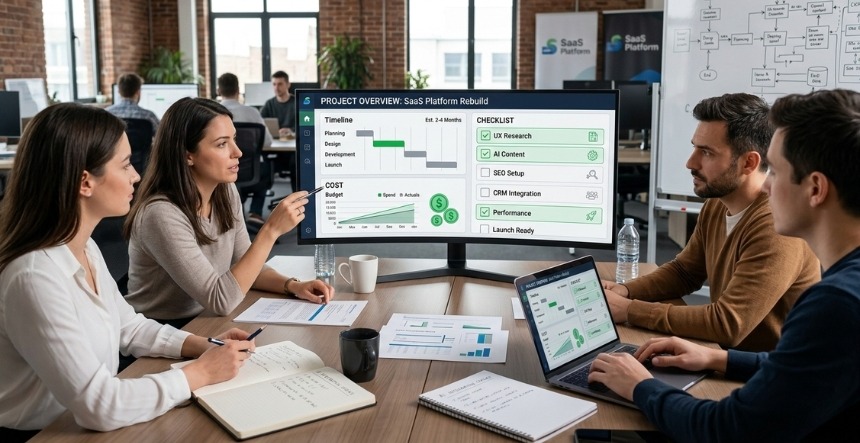
SaaS marketing teams rebuilding their sites with AI features need realistic timelines and budgets. Here is what the actual project scope looks like, based on real projects rather than agency estimates built to win the pitch.
If you have gone through an RFP process recently, you already know the problem. One agency quotes six weeks and $40,000. Another quotes six months and $280,000. A third asks clarifying questions for three weeks and never sends a number. None of them is necessarily lying. They are scoping different projects and calling them the same thing.
This article is for the CMO or Head of Marketing who has been burned by that process before and wants a grounded framework for what a SaaS website rebuild with AI features actually involves, phase by phase, cost range by feature tier, and what gets the timeline wrong every time.
Why This Project Is Harder to Scope Than It Looks
A SaaS website rebuild in 2025 is not the same project it was in 2020. The scope has expanded in three specific ways.
AI features are now expected, not optional. Visitors to SaaS marketing sites increasingly expect interactive demos, AI-powered chat that can answer product questions accurately, personalized content experiences, and predictive lead capture. These are not cosmetic additions. Each one requires backend integration with your product data, your CRM, and your analytics stack.
The performance bar is higher. A SaaS site that loads in 4 seconds and scores a 68 on Lighthouse used to be fine. In 2025, a competitor that loads in 1.8 seconds with an interactive demo above the fold is the comparison point your prospects are making. Page speed is a direct conversion lever, and the technical work required to hit modern performance standards adds scope that basic redesign quotes routinely exclude.
Content architecture needs rebuilding, not just reskinning. Most SaaS sites accumulate a mess of landing pages, blog posts, and product pages over three to five years that have no coherent architecture. A rebuild that does not address the content model and information architecture will reproduce the old problems in a new design system.
These three factors are why the scope variance between agencies is so wide. They are often scoping different levels of each.
The Three-Tier Cost Framework
Rather than a single price range, here is how to think about the cost in tiers based on what you are actually building.
Tier 1: Marketing Site Rebuild with Basic AI Integration
Budget range: $40,000 to $85,000Timeline: 10 to 14 weeks
This tier covers a full redesign of your marketing website: homepage, product pages, pricing, about, and key landing pages. It includes a design system, a headless CMS implementation, basic performance optimization, and one or two AI features: typically an AI chatbot connected to your knowledge base, and basic personalization on key landing pages.
What it does not include: deep product data integration, custom AI model training, complex CRM workflow automation, or more than five to eight custom page templates.
This is the right tier for a Series A or B SaaS company whose current site is a conversion problem but not an infrastructure problem.
Tier 2: Full Rebuild with AI Feature Layer
Budget range: $85,000 to $180,000Timeline: 16 to 20 weeks
This tier covers everything in Tier 1 plus: native integration between your AI chat and live product data so the chatbot can give contextually accurate answers about the user’s specific use case, AI-powered personalization across homepage and key conversion pages based on company size, industry, or ICP signals, an interactive demo or product tour built into the marketing site, and a content architecture rebuild with new URL structure, redirects, and SEO migration.
Adding AI-driven automation, recommendation systems, or predictive analytics to a web project increases scope by 30 to 50% compared to a site-only build. (Source: Ptolemay SaaS Development Cost Guide)
This is the right tier for a Series B or C company whose site needs to function as a GTM asset, not just a digital brochure.
Tier 3: Enterprise Rebuild with Custom AI Implementation
Budget range: $180,000 to $350,000+Timeline: 20 to 28 weeks
This tier covers complex multi-product or multi-audience site architectures, custom AI features built specifically for your product category rather than off-the-shelf tools, deep CRM and data warehouse integration, advanced analytics infrastructure with custom event tracking, and full compliance review for GDPR, CCPA, and SOC 2 considerations that affect how the site handles visitor data.
The $350,000-plus range is not unusual for enterprise SaaS companies with multiple product lines, partner portals, and regional localization requirements. (Source:ITITans)
Feature
Tier 1
Tier 2
Tier 3
Design system
Yes
Yes, advanced
Yes, enterprise
Headless CMS
Yes
Yes
Yes, custom
AI chatbot
Basic, KB-connected
Deep product data integration
Custom AI model
Personalization
Light
ICP-based
Multi-signal, predictive
Interactive demo
No
Yes
Yes, custom-built
CRM integration
Standard
Deep, bidirectional
Full GTM stack
SEO migration
Basic
Full architecture rebuild
Full + multi-regional
Performance engineering
Standard
Advanced
Enterprise-grade
Budget range
$40K–$85K
$85K–$180K
$180K–$350K+
Timeline
10–14 weeks
16–20 weeks
20–28 weeks
The Phase-by-Phase Timeline
Most SaaS website projects take 12 to 16 weeks from kickoff to launch for a Tier 1 to Tier 2 scope. Complex projects with extensive integrations or custom AI functionality extend to 20 to 28 weeks. (Source:BlendB2B)
Here is what actually happens in each phase and where the delays consistently occur.
Phase 1: Discovery and Strategy (Weeks 1 to 3)
This phase is underestimated on almost every project that goes wrong.
Discovery covers your current site’s performance data, user behavior analysis, conversion funnel mapping, competitive positioning, ICP definition, and the technical audit of your existing stack. The output is a project brief that everyone has signed off on before a single wireframe is drawn.
Why this gets skipped or rushed: CMOs want to see design work. Agencies want to show design work. Both parties feel like discovery is delaying the “real” project. This is the single most common reason rebuilds come in over budget or miss their conversion goals. Projects that skip discovery face scope creep and cost overruns that could have been avoided with a clear upfront blueprint. (Source:Atlantic BT)
What you should have at the end of Phase 1:
Signed off on project brief with defined success metrics
Technical requirements for each AI feature
Information architecture map with URL structure
Analytics baseline for comparison post-launch
Content audit with migration or rewrite plan
Phase 2: Design and Feedback (Weeks 4 to 9)
Design for a SaaS website rebuild in 2025 starts with the design system, not the homepage. If the design system is not built first, every page that comes after it is inconsistent and requires rework.
Typical design phases for a Tier 2 project: design system and component library (2 weeks), homepage and hero (1 week with 2 feedback rounds), core template pages: product, pricing, about (2 weeks), landing page variants for paid and organic (1 week).
The most common delay in this phase is stakeholder feedback cycles. Every additional approver who is not part of the weekly design review adds one to two days of delay per round. Define your feedback process and approval authority before design starts.
A well-scoped Tier 1 redesign can go from kickoff to live in 6 to 8 weeks when decision-making is clear, and content is ready on day one. (Source:Webstacks)
What you should have at the end of Phase 2:
Complete design system and component library
Approved high-fidelity designs for all core pages
Mobile designs reviewed and signed off
AI feature UX flows prototyped and tested with a small user group
Phase 3: Development and Integration (Weeks 8 to 16)
Development and design overlap by two to four weeks on well-run projects. While final design rounds happen, development starts building the CMS structure, component library, and core page templates.
AI feature integration is the phase where timeline variances emerge most sharply. An AI chatbot that connects to a static knowledge base adds two to three weeks. An AI chatbot that integrates with live product data and your CRM adds four to six weeks. A custom-built interactive demo adds six to eight weeks, sometimes more, depending on your product’s complexity.
Developer rates vary significantly by geography and team structure. US-based teams typically run $100 to $250 per hour. Teams in Eastern Europe or South Asia run $25 to $80 per hour. A 1,000-hour project costs $25,000 to $250,000 purely based on where the team is located. (Source:ITITans)
What you should have at the end of Phase 3:
All page templates built and QA’d in staging
CMS populated with real content (not a placeholder)
AI features integrated and tested against real user scenarios
CRM, analytics, and tracking verified in staging
Redirect map built and tested
Phase 4: Testing and Refinement (Weeks 15 to 18)
Testing on a SaaS website rebuild covers more than broken links. Performance testing (Core Web Vitals under real device conditions), cross-browser and cross-device QA, SEO pre-launch audit (canonicals, meta, structured data), CRM and analytics data verification, accessibility review, and AI feature accuracy testing against your actual knowledge base content.
AI chatbot accuracy testing specifically requires running a set of known customer questions through the chatbot and grading the responses. Most first runs expose knowledge base gaps that require content updates before launch.
Phase 5: Launch and Post-Launch Optimization (Weeks 17 to 24+)
Launch is not the end. For a SaaS marketing site, the four to six weeks after launch are when the actual performance data starts arriving. Well-executed SaaS website rebuilds typically achieve 50 to 150% increases in demo requests or trial signups within the first year, but meaningful impact takes 6 months of traffic growth and optimization. (Source: BlendB2B)
One agency working with Labguru documented a 132% increase in demo requests post-launch. Breathe generated 100% more free trials. These numbers come from ongoing post-launch optimization, not the launch itself.
Post-launch priorities: A/B testing hero messaging, monitoring AI chatbot resolution rate and CSAT, tracking conversion path changes versus pre-launch baseline, and addressing any performance regressions from the production environment.
The AI Features That Actually Move SaaS Metrics
Not every AI feature has equal ROI for a marketing site. Here is what the data supports and what is still early stage.
High ROI, implement now:
AI chatbot connected to your product knowledge base is the highest-return AI feature for most SaaS marketing sites. Visitors with product questions who cannot find an answer immediately leave. An AI agent that can answer accurately and escalate to a demo booking converts that intent into pipeline. One SaaS brand replacing a 14-word, jargon-heavy hero section with a 6-word clear statement saw a 27% increase in demo clicks in nine days. Clarity + AI chat is a compound effect. (Source:Stan Vision)
AI-powered personalization based on company size, industry, or traffic source can deliver a 10 to 15% revenue lift from the same traffic when implemented correctly. Source: McKinsey via Ptolemay
Interactive product demos with AI-guided navigation convert significantly better than static screenshots or hero videos. Visitors want to see the product working, not a video of the product working.
Useful but scope-dependent:
Predictive lead scoring on the website, where the AI identifies high-intent visitors and triggers specific CTAs, is valuable but requires significant traffic volume to train the model effectively. Below 50,000 monthly sessions, the data is too thin for reliable personalization signals.
AI-generated content personalization (showing different page content to different audience segments) requires a content strategy that accounts for the variants from the start. Retrofitting this to existing content rarely works.
Still early for most SaaS marketing sites:
Fully autonomous AI sales agents that can handle the entire qualification and demo booking process without human involvement. The technology exists. The accuracy and trust thresholds for a high-ticket SaaS sale are not quite there yet for most buyer types.
What Kills the Timeline (And How to Prevent Each One)
After reviewing numerous SaaS website projects, the delays fall into four categories consistently.
Content is not ready when development starts. If your team is writing copy while the agency is building pages, the project stalls. Content readiness is the most common reason Tier 1 projects take 18 weeks instead of 12. Audit your existing content before kickoff. Know what you are keeping, what you are rewriting, and what is new.
Stakeholder approval chains are undefined. When design rounds go to four or five people for feedback, and there is no defined decision-maker, rounds take a week instead of two days. Before the project starts, define who approves the design (one person), who can give input (two to three people), and what the turnaround SLA is.
AI feature scope expands mid-project. The most common version: the chatbot was scoped to answer FAQ questions, and someone on the team adds “can it also handle demo booking” in week eight. This is a legitimate feature, but it is a scope change. Define AI feature requirements in Phase 1, in writing, with sign-off. Changes after development starts add time and budget in a non-linear way.
CMS migration is underestimated. Moving from WordPress or Webflow to a headless CMS, or rebuilding content architecture within the same CMS, takes longer than most teams expect. Especially when SEO considerations require careful redirect mapping and URL structure decisions that affect live traffic.
A Real Project: Series B SaaS Rebuild with AI Chat (Anonymized)
A Series B project management SaaS with 45,000 monthly visitors and a 1.2% trial signup rate commissioned a full rebuild. Their previous agency had quoted 8 weeks and $65,000. The actual project, as scoped, took 18 weeks and came in at $148,000. Here is why the gap existed.
What the original quote missed:
Content audit revealed 280 pages, of which 160 required rewriting or merging
AI chatbot needed integration with their product’s feature database to answer accurate use-case questions, not just FAQ content
SEO migration from an old URL structure required building and testing 340 redirects
Design system required three rounds of feedback due to a rebrand happening simultaneously with the rebuild
Results at six months post-launch:
Metric
Before
Six Months Post-Launch
Monthly visitors
45,000
45,000 (same traffic)
Trial signup rate
1.2%
2.1%
Demo request rate
0.4%
0.9%
AI chat deflection rate
N/A
58% of pre-sales questions
Avg session duration
1m 42s
2m 58s
Monthly trials started
540
945
The $148,000 build produced 405 additional trials per month from the same traffic. At a trial-to-paid conversion rate of 18% and an ACV of $4,800, the incremental annual revenue from the same traffic was approximately $1.05M. The rebuild paid for itself in under two months at steady state.
The Complete AI Website Rebuild Checklist for SaaS
Pre-Project (Before Signing Anything)
Current site analytics baseline documented: sessions, conversion rate, trial/demo rate, top entry pages, bounce rate by page
Content audit completed: page count, what stays, what is rewritten, what is new
AI feature requirements written in plain language: what each AI feature does, what data it connects to, and what the success metric is
Approval authority defined: one named decision-maker for design, one for copy, one for technical sign-off
SEO requirements defined: URL structure decisions, redirect plan for existing traffic, meta migration plan
CRM and analytics integration requirements listed with the current tech stack documentation
Discovery Phase
ICP definition agreed across marketing and sales
Competitive site analysis completed for three to five direct competitors
User research completed: at least five interviews with current customers about the pre-purchase journey
Technical audit of current site: performance scores, accessibility, structured data, crawl issues
Information architecture drafted and signed off before design starts
Success metrics defined with specific targets: what does this rebuild need to achieve in 6 months
Design Phase
Design system and component library completed before individual page design starts
Mobile designs are reviewed at the same time as desktop, not after
AI feature UX flows prototyped and reviewed with at least three internal stakeholders
Conversion-critical pages (homepage, pricing, demo request) reviewed with an external eye before finalization
Accessibility review against WCAG 2.1 AA standard conducted during design, not as a post-launch item
Development Phase
Performance budget defined: target LCP, INP, and CLS scores before development starts
CMS content model built and reviewed before content migration begins
AI feature integrations tested against real data in staging, not just synthetic test cases
Redirect map built, reviewed, and tested in staging
Analytics events mapped and verified before launch: every conversion action tracked
Pre-Launch
Core Web Vitals tested under real device conditions on production environment
AI chatbot accuracy tested: run 50 common customer questions through the chatbot and grade responses
Full SEO pre-launch audit: canonicals, meta descriptions, structured data, sitemap
CRM data flow tested end-to-end: form submission to CRM entry to sales notification
Legal review: privacy policy updated for any new data collection via AI features, GDPR and CCPA compliance verified for chat log storage
Rollback plan documented
Post-Launch (First 90 Days)
Weekly conversion rate monitoring versus pre-launch baseline
AI chatbot resolution rate and CSAT are tracked weekly
Search Console monitored daily for the first two weeks: crawl errors, indexing issues, traffic changes
A/B test queue planned: at minimum three homepage messaging tests queued before launch
Post-launch retainer defined for ongoing optimization
If you are at the point of evaluating a rebuild and want a scoped estimate based on your specific site, traffic volume, AI feature requirements, and conversion goals before committing to a vendor, that is exactly what our Free AI Website and CRO Audit delivers.
The audit includes a review of your current site’s conversion performance, a technical assessment of what a rebuild requires given your stack, and a scoped budget and timeline estimate for your specific project. Not a range. A scoped estimate based on what your project actually involves.
No commitment required. The output is a document your team can take into any vendor conversation.
KrishaWeb builds web and AI solutions for SaaS and enterprise teams that need more than a design refresh.
Our web design and development practice delivers SaaS marketing sites built for the conversion from the ground up, with performance architecture, design systems, and CMS implementations that marketing teams can operate without constant developer involvement.
Our AI implementation team handles the integration work that connects AI features to your live product data, CRM, and analytics stack so they function accurately rather than generically. We have implemented AI chatbots, personalization layers, and predictive lead capture for SaaS clients across B2B and enterprise categories.
Our AI development practice builds custom AI features for SaaS marketing sites where off-the-shelf tools do not fit the product category or the data requirements.
If you are evaluating a SaaS website rebuild with AI features and want a team that understands both the GTM strategy behind the rebuild and the technical execution it requires, reach out at [email protected] or book your free audit above.
Frequently Asked Questions
How much does a SaaS website rebuild with AI features actually cost in 2025?
The honest range is $40,000 to $350,000, depending on what you are building and who is building it. A marketing site redesign with basic AI chatbot integration runs $40,000 to $85,000 and takes 10 to 14 weeks. A full rebuild with deep AI feature integration, personalization, interactive demos, and SEO migration runs $85,000 to $180,000 and takes 16 to 20 weeks. Enterprise builds with custom AI models, multi-product architecture, and compliance requirements run $180,000 to $350,000 and take 20 to 28 weeks. The quotes that come in significantly below these ranges are either scoping a different project or have not accounted for AI integration, content migration, and post-launch optimization.
Why do agency quotes for the same project vary so wildly?
Because they are not scoping the same project. One agency is scoping a template-based redesign with minimal content work. Another is scoping a full architecture rebuild with custom AI integration. A third is including post-launch optimization in the contract. Until you have a detailed brief that specifies what AI features do, what data they connect to, how many pages are being redesigned, what the content migration involves, and what the SEO requirements are, every quote is an estimate against a different set of assumptions. The discovery phase, which most agencies offer as a paid pre-project engagement, is what closes that variance.
How long does a SaaS website rebuild realistically take?
Most SaaS website projects take 12 to 16 weeks from kickoff to launch for a standard scope. Add AI feature integration with live data connections, and you are looking at 16 to 20 weeks. Add content architecture rebuilds, SEO migration, and custom AI development, and the timeline extends to 20 to 28 weeks. The two factors that extend timelines more than any technical complexity are content not being ready when development starts and undefined stakeholder approval processes. Both are solvable before the project starts with the right pre-project planning.
What AI features are actually worth the investment on a SaaS marketing site?
The three with the clearest ROI in 2025 are: an AI chatbot connected to your product knowledge base and CRM (which converts pre-sales questions into demo bookings), ICP-based personalization that changes homepage messaging based on company size or industry signals (which improves conversion rates for paid traffic), and an interactive demo or product tour built into the marketing site (which converts visitors who want to see the product before speaking to sales). Features that sound compelling but require significant traffic volume to work effectively, like predictive lead scoring and AI-generated content variants, are worth scoping into Tier 2 or Tier 3 budgets but should not be the headline features for a first rebuild.
What is the most common reason SaaS website rebuilds miss their conversion goals?
Two things, and they are related. First, the brief did not define conversion goals with specific metrics before the project started, so there was no clear target to build toward. Second, the content strategy was not addressed alongside the design and development work. A new design on old messaging does not convert better. One agency working with a fintech SaaS found that 42% of visitors never reached the hero CTA because the messaging took too long to communicate what the product did. Replacing the hero with a clear six-word value statement moved activation significantly before any design changes. The project’s job is to communicate what the product does in five seconds and remove every obstacle between that moment and a trial signup or demo request.
How do we handle SEO during a SaaS website rebuild without losing traffic?
SEO migration is one of the highest-risk parts of a rebuild and one of the most commonly under-resourced. The core requirements are a full crawl of the existing site before any new URL structure is defined; a redirect map that covers every URL with existing organic traffic mapped to its new equivalent; a pre-launch SEO audit in the staging environment before the site goes live, and daily Search Console monitoring for the first two weeks after launch to catch crawl errors and indexing issues before they compound. The mistake teams make is treating SEO migration as a checklist item in the last week of development rather than a design requirement that affects URL structure decisions from Phase 1.
Do we need to update our privacy policy if we add AI chat to our site?
Yes. If your AI chatbot collects visitor data, stores conversation logs, or processes personal information, your privacy policy needs to reflect that. This applies under GDPR for European visitors and CCPA for California residents. The specific obligations depend on what data the chatbot collects and retains, how long it is stored, and whether it is shared with third-party AI vendors. Your AI vendor should be able to provide documentation of their data processing practices. This is a legal team conversation, not just a developer conversation, and it belongs in the pre-launch checklist rather than being discovered post-launch.
Nisarg Pandya
Project Manager
Experienced Project Manager and Scrum Master at KrishaWeb, delivers expertise in Scrum methodologies, Laravel, React.js, UX design, and project management, ensuring efficient project delivery and agile implementation.




 KrishaLabs
 KrishaStudio
 KrishaStore