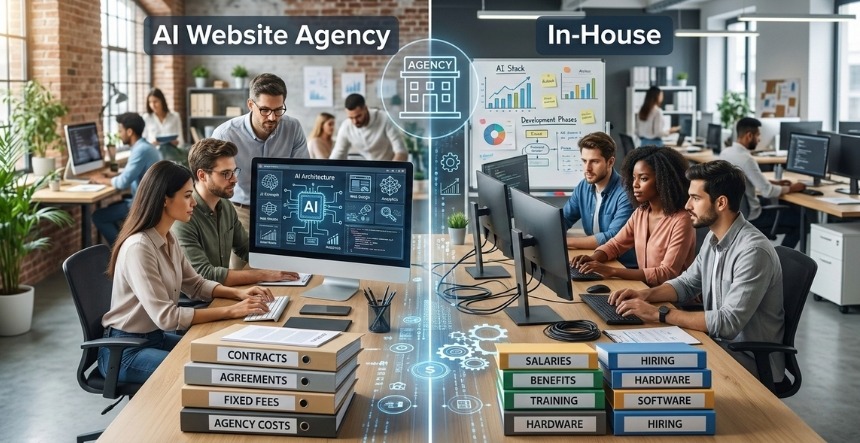
Running the real numbers on agency vs. In-house AI web development reveals a cost gap most founders don’t see until they’re six months into a build. If you’re a CTO or VP of Engineering at a SaaS company, you’ve probably had this conversation with your CEO at least twice this quarter: “Can we build these ourselves, or should we hire out?” The answer lives in the math, not in gut feeling. Let’s break it down.
The Real Question Behind “Agency vs. In-House”
This isn’t really a debate about control vs. convenience. It’s a resource-allocation decision that affects your runway, your product roadmap, and how quickly you get an AI-enhanced website in front of paying customers.
The market has shifted. AI-integrated web experiences, including personalized content delivery, intelligent chatbots, and dynamic UX powered by machine learning, are no longer a competitive edge. They’re table stakes for SaaS companies selling to informed buyers. The question isn’t whether you need AI on your website. It’s who builds it, how fast, and at what total cost.
Most CTOs frame this as a binary choice. It isn’t. But before we get to the nuance, let’s be honest about what each option actually costs.
In-House AI Web Development: The True Cost Nobody Talks About
When leadership says, “Let’s build in-house,” they usually think about salaries. That’s roughly 40% of the real number.
Salary and Fully Loaded Costs
To build and maintain an AI-integrated SaaS website internally, you typically need, at a minimum, this team:
Senior Full-Stack Developer: $130,000 to $170,000/year
AI/ML Engineer: $155,000 to $200,000/year
UX/UI Designer with AI experience: $100,000 to $135,000/year
Project Manager or Technical Lead: $120,000 to $150,000/year
That’s $575,000 to $745,000 in base salaries alone for a small, lean team. Now add the multiplier that most budget conversations ignore.
According to the U.S. Bureau of Labor Statistics, employer costs for employee compensation averaged $46.14 per hour worked in December 2024, with benefits accounting for 29.4% of total compensation costs. (Source: BLS Employer Costs for Employee Compensation, December 2024)
Apply that benefits multiplier and your $575K to $745K base becomes approximately $745,000 to $965,000 in fully loaded annual cost. And that assumes you fill every role on the first try.
Recruiting, Ramp-Up, and Attrition
You won’t fill every role on the first try. The Society for Human Resource Management (SHRM) reports the average cost-per-hire in the U.S. at approximately $4,700. For technical and specialized roles, however, companies frequently report costs of $15,000 to $28,000 per hire, including recruiter fees, lost productivity during the search, and onboarding. (Source: SHRM Benchmarking Report on Recruiting Metrics)
The average time-to-fill for AI/ML roles in the U.S. is 10 to 14 weeks, according to LinkedIn’s Workforce Reports and multiple industry analyses from 2024. (Source: LinkedIn Workforce Insights)
Then there’s ramp-up. Even experienced developers need 2 to 4 months to learn your product, your infrastructure, your coding standards, and your customers. During ramp-up, output is 40-60% of full capacity.
And attrition is real. The tech industry’s voluntary turnover rate hovered around 13.2% in 2023 and 2024, according to data from the Bureau of Labour Statistics. (Source: BLS Job Openings and Labor Turnover, 2024) Every departure resets the clock.
Tooling and Infrastructure
In-house teams need their own stack: AI/ML platforms (OpenAI API credits, cloud compute for model training or fine-tuning, vector databases), design tools (Figma), project management (Jira, Linear), staging environments, CI/CD pipelines and monitoring. A realistic annual tooling budget for a small AI web team runs $25,000 to $60,000, depending on cloud usage intensity.
Why this matters: When you add recruiting, ramp-up delays, attrition risk, and tooling to fully loaded salaries, the real first-year cost of an in-house AI web development team for a mid-market SaaS company ranges from $350,000 for a very minimal setup to $650,000+ for a capable team, and that’s before the site even launches.
AI Agency: What You’re Actually Paying For
An experienced AI website agency doesn’t just sell you hours. You’re buying an assembled, cross-functional team that has already solved the problems your in-house hires will spend months figuring out.
Typical Agency Pricing Models for SaaS
Agency pricing for AI-integrated SaaS websites typically falls into three models:
Fixed-Project Pricing: $40,000 to $150,000 for a complete website build. Scope is defined upfront, covering discovery, UX/UI design, AI feature integration (chatbots, personalization engines, lead-scoring widgets), development, QA, and launch. Best for companies that know what they need.
Monthly Retainer: $8,000 to $25,000/month for ongoing development, optimization, and AI feature iteration. Common after an initial build, or for companies that want continuous improvement without a full-time team.
Dedicated Team Model: $15,000 to $40,000/month for a fractional team (designer, developer, AI specialist, PM) allocated to your project. This mimics in-house capacity at 30-50% of the cost, since you share overhead and tooling.
These ranges are consistent with pricing data reported by Clutch.co across verified agencies in the U.S. and global delivery markets. (Source: Clutch.co, Web Development Pricing Guide)
What’s Included (and What Isn’t)
A strong AI website agency typically bundles UX research and design, front-end and back-end development, AI/ML feature integration (chatbots, recommendation engines, and personalization layers), CMS setup, QA/testing, launch support, and 30 to 90 days of post-launch bug fixes.
What’s usually extra: ongoing content creation, paid ad management, dedicated hosting management (though many agencies offer this as an add-on), and deep custom ML model training. Ask before you sign.
Side-by-Side Cost Comparison: 12-Month View
Here’s what the numbers look like when you line them up for a mid-market SaaS company building an AI-enhanced marketing and product website.
Cost Category
In-House Team
AI Website Agency
Team Salaries (fully loaded)
$400,000 to $650,000
N/A
Recruiting & Onboarding
$30,000 to $70,000
N/A
Tooling & Infrastructure
$25,000 to $60,000
Included
Project/Build Cost
N/A
$60,000 to $150,000
Ongoing Retainer (6 months post-launch)
N/A
$48,000 to $120,000
Ramp-Up Productivity Loss
$40,000 to $80,000 (est.)
N/A
Estimated 12-Month Total
$495,000 to $860,000
$108,000 to $270,000
Even at the high end, the agency model runs roughly one-third of the in-house cost over the same period. And that’s before we talk about speed.
Note: In-house estimates assume a 4- to 5-person team in a U.S. market. Agency estimates assume a capable mid- to senior-tier agency with AI specialization. Your numbers will vary based on scope, location, and team size.
Beyond Dollars: Speed, Quality, and Opportunity Cost
Time-to-Launch Benchmarks
Speed is where the gap gets uncomfortable for in-house advocates.
In-house team: 6 to 9 months from the first hire to the launched website. This includes recruiting (10 to 14 weeks), onboarding and ramp-up (8 to 12 weeks), and actual build (12 to 20 weeks). If any key hire falls through, add 8 to 12 more weeks.
AI agency: 8 to 16 weeks from signed SOW to launched website. An established agency has its team in place, its processes running, and its AI tooling already integrated. There’s no recruiting. No onboarding. No “figuring out how to work together” phase.
Why this matters: For a SaaS company, every month of delay is a month of lost pipeline generation, missed conversions, and competitors gaining ground. If your website generates $50,000/month in pipeline, a 4-month delay costs $200,000 in lost opportunity, which, by itself, exceeds most agency project fees.
Quality and AI Expertise Depth
An AI agency that builds SaaS websites daily brings pattern recognition that a newly assembled team simply can’t match. They’ve implemented AI chatbots across dozens of sites. They know which personalization approaches actually lift conversions and which ones just burn API credits. They’ve solved the performance, accessibility, and SEO problems that come with AI-rendered content before your team even encounters them.
This isn’t a knock on in-house talent. It’s about accumulated reps. A surgeon who performs 200 knee replacements a year will be more efficient than one who does 15, even if both are excellent.
When In-House Makes Sense (Be Honest About It)
Agency isn’t always the answer. In-house development makes more sense when:
Your website IS your product. If you’re building a web application where the AI features are core intellectual property (not marketing-layer enhancements), you need that knowledge in-house.
You already have the team. If you have senior developers and AI engineers on staff who have the bandwidth, the marginal cost of a website project is far lower than building from zero.
Regulatory or security constraints require it. Some industries (fintech and healthcare) have data handling requirements that make external development more complex, though not impossible, with the right agency and SOWs.
You’re building for 3 to 5 years of continuous, heavy iteration. If the website will require daily engineering attention (not just content updates), the long-term math may favor in-house, typically after a year.
When an AI Agency Is the Smarter Bet
For most small to mid-market SaaS companies, the agency model wins when:
You need to launch in under 4 months. No in-house build matches this timeline, starting from scratch.
You’re in a hiring freeze or budget-constrained environment. Agencies convert capex (headcount) into predictable opex (project fees).
AI web development isn’t your core competency. Your engineering team should be building your product, not your marketing website.
You want to test AI features before committing long-term. An agency engagement lets you validate chatbot ROI, personalization lift, or AI-driven UX without a $500K team commitment.
You need cross-disciplinary expertise on day one. Agencies bundle design, dev, AI, and strategy. Hiring all four disciplines in-house takes months.
The Hybrid Model: Best of Both Worlds
The smartest SaaS companies we work with at KrishaWeb often land on a hybrid approach:
Phase 1, Agency Build (Weeks 1 to 12): Engage an AI website agency to handle discovery, design, development, AI feature integration, and launch. This gets a high-quality site live fast.
Phase 2, Handoff and Knowledge Transfer (Weeks 12 to 16): The agency documents the architecture, trains your internal team on the CMS and AI systems, and transitions day-to-day management.
Phase 3, In-House Iteration + Agency Retainer (Ongoing): Your team handles content updates, minor tweaks, and routine optimization. The agency stays on a lightweight retainer ($5,000 to $10,000/month) for quarterly CRO sprints, AI feature upgrades, and performance audits.
This model gives you agency speed and expertise at launch, in-house control for ongoing operations, and a safety net for complex work, all at roughly 40 to 50% of the cost of a full in-house team.
How to Evaluate an AI Agency (Checklist)
Before you sign, run through these:
Do they show AI-integrated projects in their portfolio? Not just standard websites, but actual AI features like chatbots, personalization, dynamic content, and ML-driven UX.
Can they articulate their AI stack? Which LLMs, APIs, and frameworks do they use? Vague answers mean shallow capability.
Do they have SaaS-specific experience? SaaS websites have unique requirements: product-led growth patterns, integration with your app, pricing page optimization, and trial/demo funnels.
What’s their defined process for discovery and scoping? A strong agency won’t quote you before understanding your business. If they throw a number on a first call, be cautious.
How do they handle post-launch? Ask about retainer options, SLAs, and how they measure success after go-live.
Can they provide references from companies of your size? Ask to talk to a current client. Any agency confident in its work will say yes.
Do they offer a CRO or performance audit? Agencies that optimize for outcomes, not just deliverables, are the ones worth partnering with.
The numbers in this article are industry benchmarks. Your situation is specific. Your tech stack, feature requirements, timeline, and team’s current capacity all change the math.
That’s why we built a free audit around it.
Get Your Free AI Website + CRO Audit from KrishaWeb
Here’s what you’ll get, with no commitment required:
A scoped proposal for your AI-integrated website, built around your actual requirements
A side-by-side cost model comparing agency engagement to your in-house build estimates
A CRO assessment of your current site with specific, actionable recommendations
Time-to-launch projections based on your scope
If you’re a CTO or VP of Engineering weighing this decision, this gives you the data to make the case internally, whether you choose us, another agency, or go in-house. The numbers don’t lie, and we’d rather you make the right call with full information.
How much does it cost to hire an AI website agency for a SaaS website?
Typical project costs range from $40,000 to $150,000 for a complete AI-integrated SaaS website, depending on scope, AI feature complexity, and the agency’s location. Monthly retainers for ongoing work run $8,000 to $25,000.
Is it cheaper to build a website in-house or hire an agency?
For most small to mid-market SaaS companies, an agency is 2 to 3x cheaper over 12 months when you factor in fully loaded salaries, recruiting, tooling, and ramp-up time. In-house can become more cost-effective after Year 2 if you need daily engineering work on-site.
How long does an AI website agency take to build a SaaS website?
Experienced agencies typically deliver in 8 to 16 weeks from signed SOW to launch. In-house teams starting from scratch typically take 6 to 9 months, including recruiting and onboarding time.
What features can agencies add to my SaaS with AI?
Some of the more common AI features that an agency can incorporate into its SaaS are intelligent chatbots, content personalization engines, AI-powered search, lead scoring and routing, dynamic pricing displays, automated A/B testing, and UX optimization with machine learning.
When do I choose in-house vs. agency for AI site-building?
In-house is a better option if your website is your core product, if you already have an engineering team with the ability/capacity to handle the AI build-out, or if the regulatory environment in your industry strictly limits how external vendors can handle your company’s data.
Can I work with an agency initially and then move to In-house?
Yes. This hybrid model is typical of most companies building out their software business and is usually the most cost-effective route. The agency will handle the initial build and launch of your site, then transfer its knowledge to your internal team for continued management.
How Do I compare AI website agencies?
To find an AI website agency, review AI-based project-specific portfolios; ask about their technology stack; ask how much experience this agency has in the SaaS industry; obtain client references for similar projects; and ask what level of support they provide after launching a site. Also, an agency, in addition to providing support by answering questions, should provide you with a proposal/audit that defines the scope of work, allowing you to fairly compare agencies.
Parth Pandya
Founder & CEO
Founder & CEO of KrishaWeb, leads an Enterprise Web Agency. With contributions to WordPress and organization of WordCamps, he pioneers innovation and community engagement in the digital realm.




 KrishaLabs
 KrishaStudio
 KrishaStore