Two agencies send the same brief to two white label partners. One gets a quote for $4,500. The other gets a quote for $9,000. Same project, same platform, same rough scope on paper.
They are not actually buying the same thing. One quote includes a fixed deliverable and nothing else. The other includes project management, a staging review cycle, a defined revision policy, and a partner who will still answer the phone if something breaks in month two. The price difference is not about margin greed on one side. It is the price of certainty, capacity, and risk transfer, and most agencies never break that difference down before they sign.
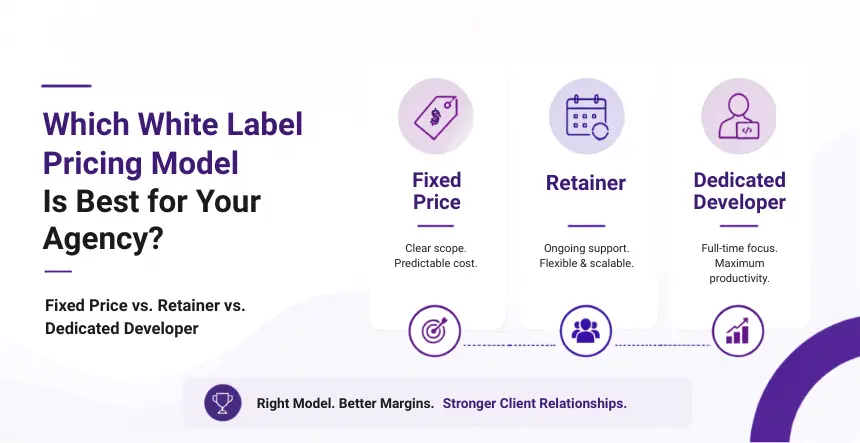
There is no universally best white label pricing model. Fixed pricing is usually right for a clearly scoped one-off build. A retainer is usually right for recurring work with moderate, fairly predictable demand. A dedicated developer is usually right only once your agency can keep a near-full-time resource genuinely busy.
This article compares the three models on the things that actually determine whether a pricing decision protects your margin or quietly erodes it: cost predictability, scope risk, capacity flexibility, utilization, agency margin, client pricing, and how each model behaves operationally once the work is underway.
KrishaWeb’s ownwhite label web development offer runs across all three structures, per-project work from $1,500, monthly retainers from $1,299, and dedicated developer engagements from $3,500 a month, so the comparisons below aren’t abstract. They reflect real commercial choices agencies are making right now.
Table Of Contents
Table Of Contents
What Is a White Label Pricing Model?
A white label pricing model determines how your agency pays an external development partner for work delivered under your own brand. The three common structures are fixed-price projects, monthly retainers, and dedicated developers. Which one fits depends on how clear your scope is, how predictable your workload is, how much capacity you actually need, your cash flow preference, and the margin you’re targeting on the client side.
White label development is really two arrangements stacked on top of each other. There’s the delivery arrangement, the partner does the work, and the brand arrangement, your agency owns the client relationship, the pricing, and the presentation. The client never knows the partner exists. That second part is the whole point of white label, and it’s why the contract terms matter as much as the price.
What you’re actually buying
Whatever pricing model you pick, you’re paying for more than lines of code. You’re paying for:
The deliverables themselves
Development hours or reserved capacity
Project management
QA and a proper staging process
Communication coverage during the engagement
Risk transfer, someone else absorbing the technical risk
Continuity, a partner who remembers your last five projects
Documentation and a clean handover at the end
Price is not the same as cost
The cheapest quote on the table is not automatically the cheapest project. Total delivery cost looks more like this:
Total delivery cost = Partner fee + Agency PM time + QA and rework + Client communication + Idle capacity
A $3,000 fixed quote that generates two extra rounds of rework and eats ten hours of your PM’s week is not a $3,000 project. It’s closer to $4,200 once your own time is counted honestly, and most agencies never count it.
How the Three Models Work
Fixed pricing charges once for a defined project. A retainer reserves recurring monthly capacity. A dedicated developer reserves a substantially larger share, often close to all, of one person’s working time. Fixed pricing gives you maximum flexibility between projects. Retainers balance flexibility against predictability. Dedicated capacity trades flexibility for continuity and control.
In practice, the workflow looks roughly the same regardless of which model you choose:
Your agency receives the client brief
You define scope and delivery requirements
You select the pricing model that fits the situation
The partner scopes capacity and flags exclusions
You confirm the client price and your margin
The partner delivers through your own tools where possible
You review, present to the client, and handle ongoing support
That fifth step matters more than it looks. A partner who can plug into your existing Slack, Asana, Jira, ClickUp, Trello, Monday, or Notion setup removes a layer of coordination friction that otherwise eats into whichever model you’ve chosen. It’s a small operational detail with a real effect on the total-cost formula above.
Trying to figure out which of these three models fits your current pipeline?
A fixed-price white label project works best when the deliverables, technology, acceptance criteria, and timeline can all be nailed down before development starts. It gives you a known delivery cost and makes quoting the client straightforward. What it doesn’t protect you from is scope creep, vague requirements, an unlimited appetite for revisions, or a client who keeps adding “one more thing.”
What’s usually in a fixed-price quote, and what needs confirming
Usually included
Needs confirming before you sign
Agreed deliverables
Number of revision rounds
Defined platform and features
Premium plugin or app licenses
Milestones and timeline
Hosting and deployment
Staging review
Third-party API fees
Basic bug-fix window
Post-launch maintenance
Handover requirements
Content entry and migration volume
Where fixed pricing fits well
One-off brochure sites. Clearly scoped WordPress builds. Design-to-Webflow implementations where the design is already locked. Landing pages with defined sections. Standard Shopify theme work. Migrations where the page list and redirect map already exist.
What you get, and what it costs you
Fixed pricing is predictable and easy to quote to the client. It carries no recurring commitment, which suits an agency with an irregular pipeline. The margin is clean and calculable on a per-project basis.
The tradeoff: scope changes create friction fast. You need tighter upfront scoping discipline than the other two models, because there’s no flexible capacity to absorb ambiguity. And winning the project doesn’t automatically give you capacity for the next one. Every fixed project is its own negotiation.
A worked example
Say the partner fee comes in at $3,000. Your own PM and QA time adds roughly $500. Total delivery cost sits at $3,500. Priced at a 60% gross margin, the client price works out to $8,750.
That’s an illustration, not a market rate, but it shows the mechanics: the client price isn’t the partner fee plus a flat markup. It’s the total delivery cost, including your own time, divided against your target margin.
Monthly White Label Retainers
A retainer earns its keep when you have recurring development work but not quite enough volume to justify a full-time resource. You pay a fixed monthly fee for an agreed block of hours or deliverable capacity. Retainers improve planning and continuity over one-off projects, but they come with a specific failure mode: unused hours and vague service boundaries quietly erode the profitability that made the retainer attractive in the first place.
What a good retainer agreement defines
A retainer worth signing spells out the monthly hours or deliverable capacity, whether unused hours roll over, response and priority rules, which platforms and task types are included, PM and QA coverage, emergency support terms, the revision and change-request policy, what happens to unused hours specifically, and cancellation or scaling terms.
Retainer tiers, roughly
Tier
Typical agency situation
Capacity type
Starter
Occasional updates and overflow work
Small monthly hour block
Growth
Steady work across several clients
Larger block with priority access
Scale
Consistent pipeline, multiple builds
Near-full-time capacity
Dedicated
High-volume, predictable demand
Exclusive developer resource
KrishaWeb’s own retainer plans start at $1,299 a month, with capacity scaling up from there depending on the volume your agency actually needs. Confirm current tier pricing directly before quoting a client, since it changes as capacity and service scope evolve.
The formula that keeps a retainer honest
Retainer utilization = (Hours used ÷ Hours purchased) × 100
A 40-hour retainer where you’re only using 16 hours a month is running at 40% utilization. That’s not a partner problem. That’s a sign to either drop down a tier, build a proper backlog so the hours get used, or move more eligible client work into the allocation. Retainers only save money when the reserved capacity actually gets used.
Dedicated Developer Pricing
A dedicated developer makes sense once your agency can keep that person productively assigned to client work for most of the month. This is the model with the highest continuity, the most context retention, and the tightest scheduling control. It’s also the model with the biggest commitment, and it needs a stronger, steadier pipeline than fixed pricing or a shared retainer to justify.
What you actually get
A named developer, not a rotating pool. Reserved monthly capacity that’s yours. Someone who’s familiar with your agency’s standards and doesn’t need re-briefing every project. Faster context switching between recurring client work. Tighter workflow integration. Often a dedicated PM and reporting layer on top.
When the math actually works
Bring in a dedicated resource when your pipeline is genuinely predictable, when development is a core part of what your agency sells rather than an occasional add-on, when you’re regularly turning away work because you’re at capacity, when you can realistically maintain 70 to 80% productive utilization, when client work needs continuity across several months, and when you’re trying to build a repeatable delivery system rather than handle one-off requests.
Say the partner cost is $3,500 a month, internal PM and QA allocation adds $600, and you’re targeting a 60% gross margin. You’d need $10,250 in monthly client revenue attributable to that resource to hit your margin target.
Compare that against hiring. The U.S. Bureau of Labor Statistics puts the median annual web developer wage at $90,930 as of May 2024, before benefits, recruitment, equipment, management overhead, or the cost of idle capacity between projects. Once you load all of that in, the comparison usually looks closer than the headline salary number suggests, and often favors the white label route for agencies that haven’t yet hit consistent full-time volume.
Not sure whether your pipeline is steady enough to justify dedicated capacity yet?
That’s a common question, and it’s worth answering with real numbers rather than a gut feeling. Talk to our team and we’ll help you run the utilization math against your actual project history.
Fixed Price vs. Retainer vs. Dedicated Developer
Factor
Fixed price
Monthly retainer
Dedicated developer
Payment basis
Per project
Monthly capacity or hours
Monthly reserved resource
Best for
Defined one-off builds
Recurring but variable work
Predictable high-volume work
Cost predictability
High per project
High monthly
High monthly
Flexibility
High between projects
Medium to high
Lower
Scope risk
Higher if brief is weak
Shared through service rules
Managed by agency priorities
Utilization risk
Low
Medium
High
Continuity
Project-specific
Builds over time
Highest
Commitment
Lowest
Moderate
Highest
Margin visibility
Clear per project
Requires utilization tracking
Requires pipeline forecasting
Client response speed
Depends on queue
Better priority access
Best scheduling control
Ideal agency stage
Emerging or irregular pipeline
Growing agency
Established development practice
For most agencies, the honest answer is a hybrid model. Use fixed pricing for clearly scoped builds, a retainer for recurring maintenance and enhancement work, and reserve dedicated capacity only once demand is consistently high enough to keep that resource productive. Treating the three models as mutually exclusive is usually a mistake. Most established agencies end up running two of them side by side without thinking twice about it.
How to Choose the Right Model
Choose fixed pricing when the scope is clear and demand is irregular. Choose a retainer when work recurs but the monthly volume still fluctuates. Choose a dedicated developer when your pipeline is predictable, you can maintain high utilization, and continuity is worth more to you than maximum flexibility. Use a hybrid when different parts of your client base have genuinely different demand patterns, which, honestly, is most agencies.
A quick decision path
Start with whether the deliverable is clearly defined. If yes, fixed price is worth considering first. If not, keep going.
Do you have recurring monthly work? If not, stick with project-based pricing. If yes, keep going.
Is that monthly demand reasonably predictable? If not, a flexible retainer is the safer bet. If yes, keep going.
Can you keep a resource substantially productive month over month? If not, a larger retainer or shared capacity still makes more sense. If yes, a dedicated developer is worth pricing out.
Does the work span multiple clients or platforms? If so, prioritize a partner with broad stack coverage and strong PM support over a narrow specialist. If the work is concentrated on one platform, a specialist resource might actually be more efficient.
Score yourself before you call anyone
Rate each of the following from 1 to 5: scope clarity, monthly demand predictability, how much continuity you actually need, how fast you need responses, your tolerance for commitment, your ability to keep capacity utilized, and how much you need margin predictability up front. Low scores across the board point toward fixed pricing. High scores, especially on demand predictability and utilization ability, point toward dedicated capacity. Most agencies land somewhere in the middle, which is exactly where a retainer belongs.
If you haven’t yet worked through what questions to ask a potential partner regardless of which model you land on, the12-point checklist for evaluating a white label partner is worth reading before this decision, not after.
Margin and Break-Even Math
Evaluate a white label pricing model on gross margin after the partner fee and your own internal delivery time, not on markup alone. Count project management, QA, client communication, rework, software costs, and idle capacity. A model with a higher headline price can still be more profitable than a cheaper one if it cuts rework and improves how much of your reserved capacity actually gets used.
Markup and gross margin are not the same thing
Markup is how much you add on top of cost. Gross margin is the percentage of client revenue left over after direct delivery costs are subtracted.
These figures are illustrative planning examples, not quotes. KrishaWeb’s own pricing framework makes the same point directly: total delivery cost has to include partner fees, account management, client communication, quality review, and delivery risk, not just the invoice line from the partner.
The utilization problem nobody budgets for
One 2026 operating report on professional services put average billable utilization at 66.4% in 2025, well under the 75% level most cost structures are actually built around. That figure aggregates across professional services broadly rather than agencies specifically, so treat it as directional. But the pattern holds in white label work too: a retainer or dedicated resource that isn’t hitting real utilization is quietly the most expensive model on this list, regardless of what the invoice says.
The single most expensive pricing mistake is choosing a model based on the partner’s headline rate alone. Agencies also end up paying for unclear scope, rework, unproductive reserved capacity, slow communication, thin documentation, and client-management overhead that never showed up in the original quote. The right model minimizes total delivery cost while still protecting the client experience you’re promising.
Mistakes worth avoiding
Committing to dedicated capacity before demand is actually predictable. Buying a retainer and never tracking whether the hours are used. Comparing two quotes with different inclusions and treating them as apples to apples. Assuming every client revision request is automatically in scope. Ignoring time-zone overlap and realistic response windows. Leaving code and deliverable ownership undefined in the contract. Pricing purely off the partner’s cost without adding your own internal effort. Choosing a specialist who can’t actually support your agency’s main platforms. Letting a partner communicate directly with your end client without agreed boundaries. And publishing different partner pricing across your own service pages, which creates confusing conversations later.
Four myths worth retiring
“The cheapest partner produces the best margin.” Not necessarily. Rework, missed deadlines, and the PM hours spent chasing status updates can quietly make a cheap quote the most expensive option on the table.
“A retainer always saves money.” Only if you’re actually using the capacity you’re paying for. An underused retainer is worse than no retainer at all.
“Dedicated developers eliminate delivery risk.” They improve continuity, but they don’t replace clear requirements, real QA, active project management, or scope discipline. A dedicated resource with no process around them is still exposed to the same risks as any other model.
“Fixed pricing means unlimited revisions.” Fixed pricing covers the scope and acceptance criteria that were agreed at the start. It was never meant to cover unlimited changes to the brief after the fact.
For a deeper look at how the total cost of a dedicated resource stacks up against building an in-house team, the article onwhite label developer vs in-house cost breaks that comparison down in full.
Best Practices for a Profitable Partnership
A profitable white label partnership starts before pricing ever comes up. It starts with transparent scope, clear ownership, defined communication rules, measurable utilization, and a documented escalation process. Agree on what’s actually delivered, who reviews it, how changes get priced, where the code lives, and how the relationship can scale up, scale down, or end, before you decide which pricing model to use.
Commercial safeguards worth insisting on
Ask for an itemized scope, not a paragraph summary. Confirm inclusions and exclusions in writing. Define acceptance criteria before work starts. Set clear revision limits. Agree on response-time expectations up front. Specify who owns PM, QA, and staging responsibilities. Review the NDA, non-solicitation, and IP terms line by line. Require full code ownership and proper documentation on handover. Confirm explicitly whether unused hours roll over or expire. Set up a quarterly capacity review. Agree on cancellation and handover procedures before you need them.
What to actually track once the relationship starts
Gross margin per project. Retainer utilization. Rework hours. Revision rounds per project. On-time delivery rate. Average response time. Client escalation rate. Revenue per reserved developer hour. Percentage of work that required a scope change after kickoff. And a rolling 90-day capacity forecast so you’re not caught guessing.
KrishaWeb builds these safeguards into every engagement as standard: NDA protection before any brief is shared, code ownership assigned to your agency, staging delivery on every project, full documentation, a dedicated project manager, and tool integration with whatever your team already uses. These are worth presenting to any partner you’re evaluating as a baseline, not a premium add-on.
Ready to compare your current partner setup against a structured pricing and process model?
Book a call with our team and bring your current project volume, platform mix, and target margins. We’ll walk through which model actually fits before recommending anything.
Frequently Asked Questions
What is the best white label pricing model for an agency?
Fixed-price projects usually work best for clearly scoped, one-off jobs. Retainers suit recurring work where volume still fluctuates month to month. Dedicated developers suit agencies with predictable demand and the ability to keep that resource genuinely busy. Most agencies end up running a hybrid rather than picking just one.
Is fixed-price or retainer pricing better for white label development?
Fixed pricing is better when the scope and deliverables are known ahead of time. A retainer is better when you expect ongoing requests but can’t pin down exactly what each one will be. Fixed pricing gives you certainty at the project level. A retainer gives you recurring capacity you can draw on as needed.
When should an agency hire a dedicated white label developer?
When demand is sustained, when you can realistically keep that resource productively assigned most of the time, and when continuity across multiple projects is worth more to you than maximum flexibility. If demand is irregular, a project-based model or a flexible retainer will almost always reduce your exposure to unused capacity.
How much does white label web development cost?
It depends heavily on scope, platform, developer seniority, geography, and what’s included in the fee. Market examples in 2026 range from around $1,500 for smaller project-based work to several thousand dollars a month for retainers or dedicated capacity. KrishaWeb’s own pricing runs from $1,500 for per-project work, $1,299 a month for retainers, and $3,500 a month for dedicated engagements.
How should agencies calculate their white label markup?
Start by working out total delivery cost, the partner fee plus your own internal PM, QA, communication, and rework time. Then divide that number by 1 minus your target gross margin. For example, $2,400 in total delivery cost priced at a 60% margin means a client price of $6,000.
What happens if retainer hours go unused?
That depends entirely on what the agreement says. Some retainers let hours expire, some roll them over, some convert unused hours into another deliverable type. Review utilization monthly and adjust the tier down if usage stays consistently low. An unused retainer is a leak in your margin, not a safety net.
Does white label development include project management?
Not always, and this is worth confirming before you compare prices. Some partners include a dedicated PM in the fee. Others charge for it separately, or expect your agency to manage delivery internally. Get clarity on PM ownership, reporting cadence, client communication responsibilities, and escalation paths before you put two quotes side by side.
Should agencies use a hybrid pricing model?
Yes, in most cases. A common and sensible structure is fixed-price implementation for the initial build, followed by a monthly maintenance or enhancement retainer once the site or product is live. A dedicated developer gets added on top only once recurring demand is consistent enough to justify the commitment.
Conclusion
The best white label pricing model is the one that matches your agency’s actual demand pattern, not the one with the lowest headline number. Choose fixed pricing for defined projects. Choose a retainer for recurring but variable work. Choose a dedicated developer once you have enough predictable demand to keep that capacity genuinely productive. If you’re not sure yet, start with whichever model carries the lowest commitment while still meeting your delivery standard, and move up as your utilization and pipeline visibility actually improve.
KrishaWeb can walk through your typical project types, platforms, monthly volume, and target margins before recommending a specific model, rather than defaulting to whichever one is easiest to sell.
Ready to Scale Your Agency?
Tell us what you are trying to deliver. Schedule a call to talk it through, or contact us with your project.
Pricing examples and worked calculations in this article are illustrative planning figures unless explicitly attributed to a named source. KrishaWeb’s own pricing reflects current published rates at the time of writing and should be confirmed directly before quoting a client. All other figures are for planning purposes only.
Parth Pandya
Founder & CEO
Founder & CEO of KrishaWeb, leads an Enterprise Web Agency. With contributions to WordPress and organization of WordCamps, he pioneers innovation and community engagement in the digital realm.




 KrishaLabs
 KrishaStudio
 KrishaStore