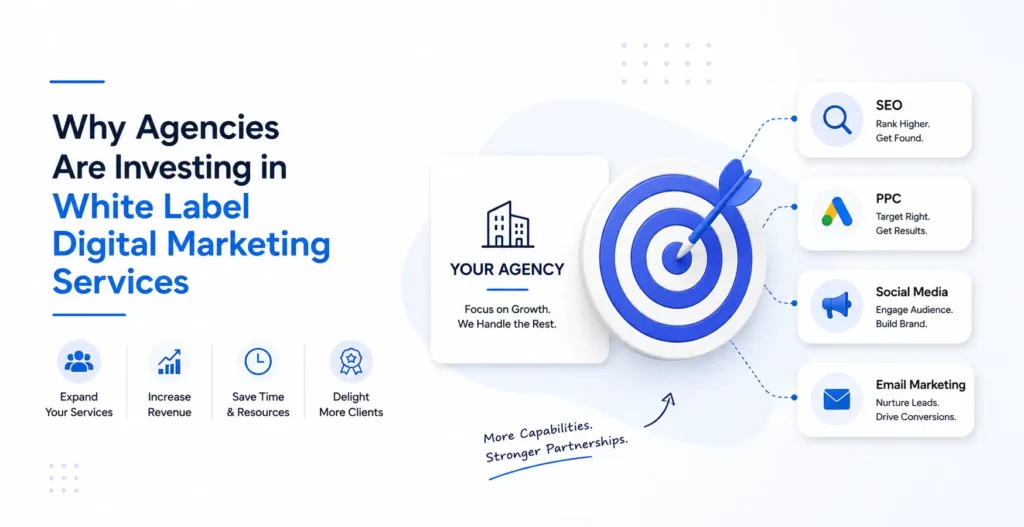
More agencies are buying white label digital marketing because it lets them sell SEO, PPC, social, and content without hiring a single new specialist. The client sees one accountable agency. The delivery happens behind the scenes. The agency keeps the relationship and the margin and adds services it could never have staffed on its own.
That is the short answer. If you run an agency and your clients keep asking for marketing work you cannot deliver in-house, this is the model that solves it. Below is why the shift is happening now, what agencies actually gain, where it goes wrong, and how to decide if it fits your business.
Table Of Contents
Table Of Contents
What White Label Digital Marketing Actually Means
White label digital marketing: one agency delivers the work, another sells it under their brand. Why agencies are investing in it in 2026 and how it works.
It is not referral or outsourcing in the loose sense. In a referral, you hand the client away. In white label, you keep the client, the billing, and the relationship. The partner stays invisible by design. Reports go out on your letterhead. The strategy call is yours. The execution is theirs.
The services covered usually include search engine optimization, paid advertising, social media management, content marketing, and marketing automation setup. Some partners cover all of it. Others specialize.
Why Agencies Are Moving Now
Three things are pushing agencies toward this model in 2026, and they are stacking on top of each other.
First, clients want fewer vendors. A business that trusts you to build its website would rather buy its SEO and ads from you too, instead of managing three separate agencies. Every service you cannot offer is a reason for them to shop around, and sometimes a reason to leave.
Second, hiring is hard and expensive. A skilled SEO specialist, a paid media manager, and a content lead are three separate hires, each with a salary you pay whether the workload is full or not. For an agency with uneven demand, that is a heavy fixed cost placed on an unpredictable pipeline.
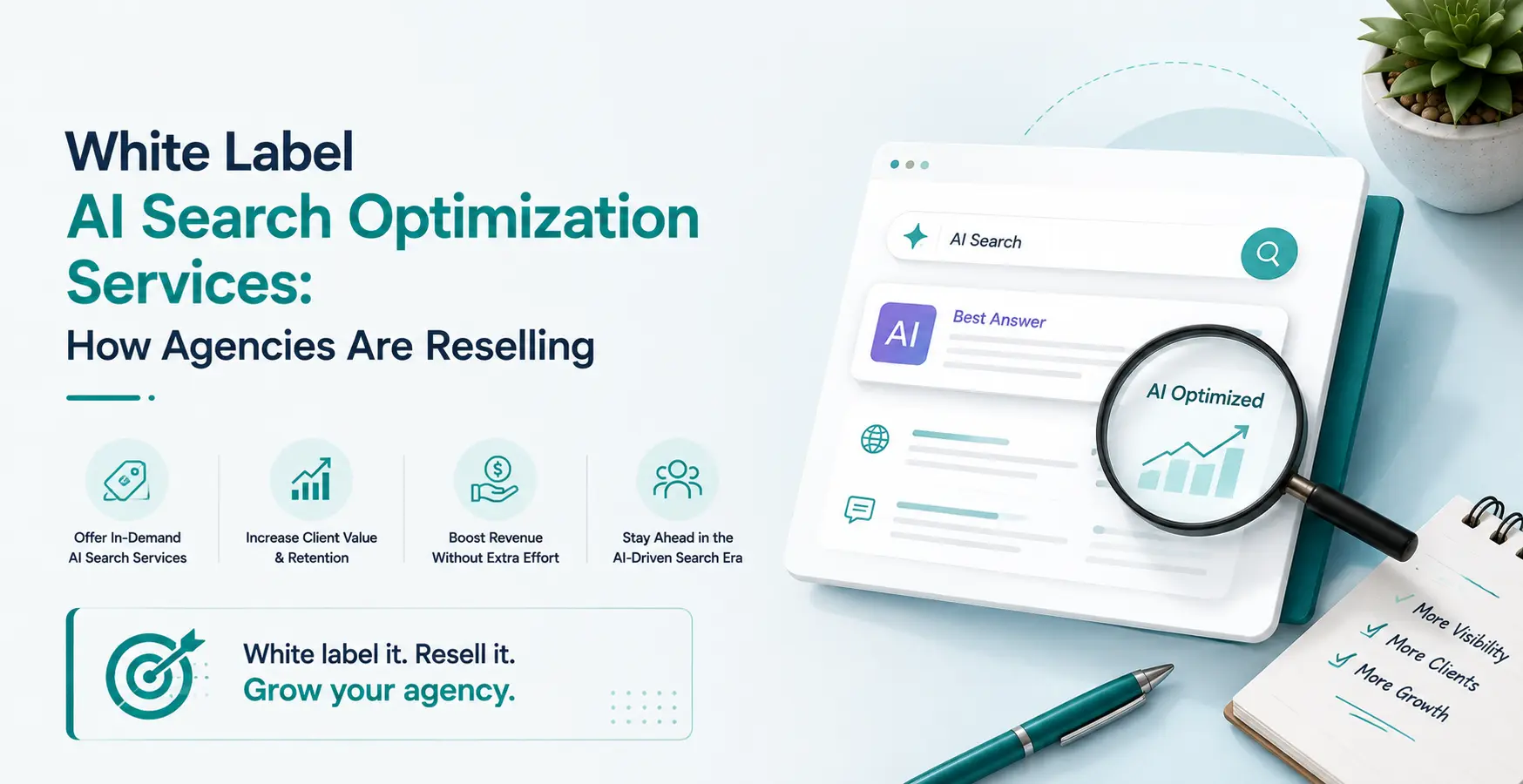
Third, marketing got more technical. Search now includes AI answers and generative engines, not just blue links. Paid platforms change targeting rules constantly. Keeping a team current across all of it is a full-time job on its own. Partnering lets you offer current expertise without having to maintain it.
The service you cannot deliver is the door you leave open for a competitor.
What Agencies Gain
The benefits go beyond simply having more to sell. Here is what actually changes when the model works.
More revenue per client. Marketing is usually recurring, not one-off. A website is a project. SEO and paid media are monthly retainers. Adding them turns a one-time client into an ongoing one, which raises the lifetime value of every account you already have.
Margin without overhead. You mark up the partner’s work and keep the difference, with no salaries, benefits, software licenses, or training to carry. The cost scales with the work instead of sitting fixed on your books.
Faster expansion. You can offer a new service next week instead of next quarter. No recruiting, no ramp-up, no waiting for a new hire to become productive.
One relationship to manage. A good partner covers multiple marketing services, so you are not stitching together five freelancers. One point of contact, one standard of quality, one invoice.
Focus stays on your strength. If your agency is great at design, you keep doing design. The marketing gets delivered by people who do marketing all day, and your brand still gets the credit.
What Agencies Get Wrong
The model works, but it is not automatic. The agencies that struggle usually make one of these mistakes.
They pick a partner on price alone. The cheapest partner who misses a client deadline is not cheap. It is your reputation on the line, because your client does not know the partner exists. Vet on quality, communication, and reporting, not just rate.
They stay hands-off on strategy. White label works best when you still own the client relationship and the strategic direction. Agencies that hand over everything, including the thinking, lose touch with their own clients and become a pass-through. Stay in the room.
They skip the reporting conversation. Your client expects updates in your voice, on your brand. If the partner cannot deliver white-labeled reporting that matches how you communicate, the seams show. Agree on this before the first project.
They resell services they cannot speak to. You do not need to execute SEO to sell it, but you need to understand it well enough to set client expectations and answer basic questions. A partner should help you get fluent, not leave you guessing.
Which Services Resell Best
Not every marketing service is equally easy to white label. Based on what agencies ask for most, here is how the common ones stack up.
Service
Why it resells well
Recurring?
SEO
High demand, clear deliverables, technical enough that clients rarely want to DIY
Yes, monthly
Local SEO
One of the highest-demand requests; clients with physical locations need it constantly
Yes, monthly
Paid advertising (PPC)
Ongoing management, hard to staff, clients want expert hands
Yes, monthly
Content marketing
Steady volume clients cannot produce alone; pairs naturally with SEO
Yes, ongoing
Social media management
Constant output, easy to scope, predictable retainer
Yes, monthly
Marketing automation (HubSpot and similar)
Technical setup clients ask for and cannot self-serve
Often project plus retainer
The pattern to notice: almost all of it is recurring. That is the real prize. White label marketing does not just add a service; it adds monthly revenue to accounts that were previously one-time projects.
Is It Right for Your Agency?
White label digital marketing fits best if several of these are true.
Your clients are already asking for marketing work you do not offer. You have a web, design, or development business and want to add recurring revenue. You do not have the volume to justify full-time marketing hires. You want to grow your service menu faster than hiring allows. And you want to keep your client relationships rather than refer them out.
If most of those describe you, the model is worth a serious look. If you already have a full, busy in-house marketing team and steady demand to keep them booked, you may not need it, though many agencies use a partner for overflow even then.
The honest test is simple. Add up the revenue you have referred out or turned away in the last year because you could not deliver marketing. If that number stings, white label is how you stop leaving it on the table.
Add up what you referred out last year. That number is what the model recovers.
White label digital marketing is when one agency delivers marketing services, such as SEO, paid ads, social, and content, that another agency sells under its own brand. The client sees only the agency they hired. The partner delivering the work stays invisible, so the agency keeps the relationship, the billing, and the credit.
How is white label different from outsourcing or referrals?
With a referral, you hand the client to someone else and usually lose the relationship. With outsourcing in the loose sense, the client often knows a third party is involved. White label keeps you as the single, branded point of contact. You own the client and the billing, and the partner works behind your brand.
What services can agencies white label?
The most common are SEO, local SEO, paid advertising, social media management, content marketing, and marketing automation setup. Most of these are recurring, which is why agencies use white label to add monthly retainer revenue rather than one-off projects.
Does white label digital marketing hurt my agency’s brand?
Not when it is done right. The work ships under your brand, with reporting in your voice, so clients experience it as your service. The risk comes from choosing a low-quality partner or one that cannot deliver white-labeled reporting. Vet for quality and communication, and your brand is protected.
How much can an agency mark up white label marketing?
Markup varies by service and partner, but the model is built to leave you a healthy margin between what you pay the partner and what you bill the client. Because there are no salaries or overhead attached, more of that margin stays with you. Agree on pricing that fits your market and client base.
Do I need marketing expertise to resell these services?
You do not need to execute the work, but you should understand each service well enough to set client expectations and answer basic questions. A good partner helps you get fluent, so you can sell and manage the relationship with confidence.
Where to Go Next
If your clients keep asking for marketing you cannot deliver, the fix is not a hiring spree. It is a partner who lets you offer it under your brand, starting now.
Two related reads go deeper. Our guide onwhite label web development services covers the development side of the same model, and if you are building out your agency, how to grow a web design agency with white label walks through the wider growth strategy.
When you are ready to add marketing to your agency without adding headcount, book a white label partnership call. Tell us what your clients need, and we will show you exactly how we would deliver it under your brand.
Ready to Scale Your Agency?
Tell us what you are trying to deliver. Schedule a call to talk it through, or contact us with your project.
Founder & CEO of KrishaWeb, leads an Enterprise Web Agency. With contributions to WordPress and organization of WordCamps, he pioneers innovation and community engagement in the digital realm.




 KrishaLabs
 KrishaStudio
 KrishaStore