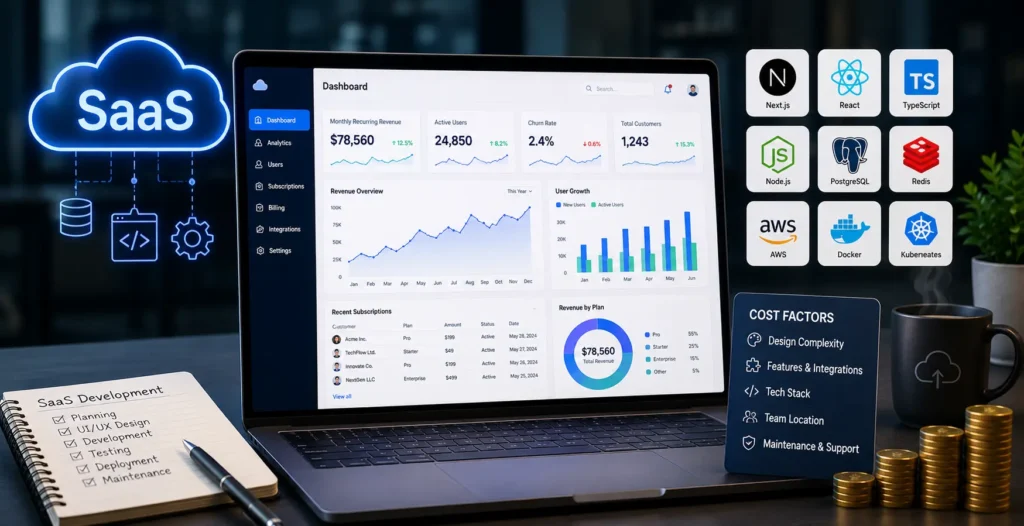
There is no single number for SaaS website development cost in 2026, and any guide that opens with one is not being honest with you. A SaaS MVP costs $15,000 to $60,000. A mid-scale commercial product runs $60,000 to $150,000. An enterprise platform with compliance, complex multi-tenancy, and advanced integrations exceeds $300,000 (Source:SSNTPL). What drives the number is what you are building and in what order, not which development agency you hire. This guide covers what the money actually goes toward, which tech stack decisions matter most at each stage, and where founders consistently spend in the wrong place.
Table Of Contents
Table Of Contents
Two Different Projects That Keep Getting Quoted as One
Most SaaS founders arrive at a budget conversation having conflated two entirely different scopes, and the confusion costs them real money before the first line of code is written.
A SaaS marketing website is what a prospect sees before they sign up. Homepage, features page, pricing, case studies, blog. It is primarily a design and content problem. It needs to load fast, convert visitors, and be updatable by a marketing team that does not know how to code. A SaaS product application is what that same prospect logs into after they sign up. The actual software. It needs authentication, multi-tenancy, a database, an API layer, subscription billing, user permissions, and whatever core functionality the product provides.
Both need to be built. They have completely different technology requirements, different teams, different timelines, and they should have separate line items in any honest budget conversation. A Webflow agency and a full-stack engineering team are solving different problems. When a development shop quotes you $80,000 for “your SaaS,” the right question is which of those two things they think you are asking them to build.
For the marketing site, Webflow is the right choice for most SaaS companies. It is 30% to 50% cheaper than a custom React or Next.js build, and the result is a site the marketing team can own and edit without waiting on engineering (Source:Grid Rebels Studio). React, Next.js, Supabase, Stripe: those belong in the product application. Not in the homepage.
What the Cost Ranges Actually Mean
MVP: $15,000 to $60,000
At this range, you are building enough to validate the product with real users. On the marketing side, that means five to eight pages, a clear value proposition, and a working conversion path to signup or demo. On the product side, it means authentication, basic multi-tenancy, and the one core workflow that proves your hypothesis. Nothing else.
The cost split at MVP stage runs roughly 20% marketing site and 80% product. Do not over-invest in design right now. A well-structured Webflow site on a quality template is enough to find out whether the value proposition resonates. Save the brand investment for after you have talked to fifty paying customers and found out what they actually care about.
One thing that has genuinely changed the economics here: AI-assisted engineering. Teams at MindK report 20% to 30% cost compression on complex applications by accelerating the spec-to-deployment loop (Source:MindK). A team of two or three developers can move at the speed a team of five needed three years ago, which changes how you should think about team size, timeline, and budget at this stage.
Mid-Scale Commercial Product: $60,000 to $150,000
Most funded SaaS companies land here when building their first real version. The marketing site gets a proper investment: full brand expression, a pricing page with multiple tiers, customer case studies, and a blog CMS the content team can operate without filing a developer ticket.
If your product targets integrations, comparison queries, or long-tail use cases, programmatic SEO infrastructure belongs in this build, not as a later retrofit. Adding it later to a Webflow site not originally architected for it adds $8,000 to $30,000 and disrupts the URL and CMS structure the team has been working in for months (Source:Grid Rebels Studio). Build it in from the start if you know you need it.
On the product side, this tier covers advanced multi-tenancy with role-based permissions, subscription billing with upgrade and downgrade flows, two or three integrations with the tools your users already rely on, a reporting or analytics layer, and the API infrastructure that will eventually support a partner ecosystem.
Enterprise Platform: $300,000 and Above
This is not a starting point. It is what you arrive at after building through the earlier tiers and reaching a point where the customer base and product complexity require a different level of engineering investment.
At this scale the product has compliance requirements, a permission model with org-level and team-level hierarchy, custom onboarding per customer segment, and often a dedicated customer portal separate from the core product. The marketing site has multiple ICP-specific sections, localization for at least two or three markets, and ABM infrastructure feeding into the CRM. Every cost that seemed optional at MVP is now operational infrastructure.
The Tech Stack
The right stack for a SaaS product is not the most popular one. It is the one that gives your team the most leverage at your current stage given your hiring market, your budget, and what the product actually needs to do. That said, there are choices that hold up across most situations.
On the frontend, React is still the dominant SaaS framework and Next.js has become the default for product frontends that need SEO performance on public pages alongside the dynamic behavior of a logged-in application. 44.7% of developers use React as their primary frontend framework. TypeScript has replaced plain JavaScript as the starting point for new SaaS projects because the type safety meaningfully reduces runtime errors and makes the codebase maintainable as the team grows. It is now the most contributed-to language on GitHub with 2.63 million contributors (Source:StartuPage). Tailwind CSS has become the default styling layer for most React teams because it keeps styles co-located with components and eliminates the specificity conflicts that accumulate in large shared stylesheets over time.
On the backend, Node.js is still the most common choice, mainly because it lets frontend engineers contribute to backend features without switching languages. It handles high-concurrency I/O well, which is the dominant load pattern for most SaaS products. Python is the right call when AI, machine learning, or data processing is a core product function rather than a feature bolted on later. If the product is analytics software, an AI assistant, or a data pipeline tool, Python’s ecosystem has no real equivalent in Node for that class of problem. The practical question most founders should ask before committing: what language does your strongest early engineer know cold? The productivity advantage of technical fluency in the chosen language is larger than any theoretical performance edge at startup scale.
PostgreSQL is the default database for new SaaS products. 55.6% of developers use it as their primary database. PostgreSQL provides solid support for both structured and semi-structured data, making it an excellent choice for most development projects today. It has a high level of ACID compliance, adds good support for JSON, and will continue to scale without having to change to another database as you grow in size. (Source:StartuPage). Supabase is how most teams run PostgreSQL at MVP and growth stage. It bundles a hosted Postgres instance, row-level security for multi-tenant data isolation, a real-time layer, authentication, and file storage in one platform with a generous free tier. You get the control of a managed PostgreSQL instance without managing a database server yourself. Redis becomes relevant when you have high-frequency reads, session complexity, or rate limiting needs. Not necessary at MVP, but worth planning around architecturally before you need it.
For infrastructure, Vercel for Next.js applications and Webflow’s managed hosting for marketing sites handle most needs at MVP and mid-scale. CDN, edge functions, SSL, zero-configuration deployment. The overhead that used to require a dedicated DevOps hire is largely gone. AWS, Google Cloud, and Azure make sense when compliance requirements need specific data residency, or when scale makes managed platforms meaningfully more expensive than running your own. Most SaaS products reach Series A or later before that transition is worth making.
Stripe is the payment default. Stripe Billing covers subscription management, trial periods, usage-based billing, multi-currency, proration, and tax compliance without building any of that yourself. The one mistake founders consistently make: integrating Stripe Billing after the core product is built rather than from the beginning. Retrofitting subscription billing into an application that was not designed around it is one of the most expensive and disruptive tasks in SaaS development. Put it in on day one.
For authentication, both Auth0 and Clerk are strong and widely used. Both handle social login, MFA, org-level account structures, and role-based access controls without requiring you to build or maintain an auth system. This is the one area where building your own is almost never the right call, regardless of how simple the requirements look at the start.
Where Budgets Break Down
Most SaaS projects that run over budget are not the result of bad estimates. They are the result of decisions made after the estimate that nobody flagged as scope changes.
The clearest one is unclear positioning at project kickoff. Vague positioning does not save money on a SaaS marketing site build. It creates expensive revision cycles. A designer who receives a well-defined ICP, value proposition, and differentiation at the brief stage produces a first draft that needs two rounds of revisions. The same designer working from “we serve businesses that want to work smarter” goes back three or four times before the direction is clear. That extra iteration time costs real money, and it comes entirely from a problem that a positioning workshop before the project starts would have solved.
The other common one is building features the market has not confirmed it wants. The founders who blow their SaaS development budget are not the ones who spend too much. They are the ones who spend in the wrong order. Authentication, billing, and the core workflow first. Validate with real users. Then build the reporting module, the collaboration features, and the API. That sequence is what keeps an MVP budget from quietly becoming a mid-scale budget before the market has said yes.
Scope additions also tend to be underestimated. “Can you also add a changelog CMS while you are in there” sounds minor. It is not. It is a CMS structure decision, content type planning, design work for a new page section, and potentially a publishing workflow to define and document. Every addition to scope after kickoff should go through a formal change request with a cost and timeline impact noted before anyone agrees to do it.
Integration costs follow the same pattern. Each third-party integration (CRM, email platform, analytics, customer success tool) runs $2,000 to $8,000 in development cost depending on the data model complexity and the quality of the external API. “We will just use Zapier for that” is sometimes the right answer and sometimes the beginning of a technical debt spiral that costs more to untangle than a proper integration would have cost to build.
Treating the SaaS marketing site and the SaaS product application as the same project leads to quotes that cannot be meaningfully compared. They are different scopes, different technologies, and should have separate budget conversations.
Webflow works for the marketing site at 90% of SaaS companies. It is cheaper, the marketing team can own it, and it does not require engineering involvement for ongoing updates. Custom code belongs in the product, not the homepage.
According to many entrepreneur advisors, a solid foundational technology stack for your business in the near future (2025-2028) could include: TypeScript, Next.js, Tailwind, PostgreSQL (via Supabase), Vercel/Netlify, Stripe, and a customer-authentication provider (e.g., Clerk, Auth0). Free tiers across the whole stack, runs under $200 per month at $1K MRR, scales without an architectural overhaul.
AI-assisted engineering has genuinely compressed timelines and costs by 20% to 30% at experienced teams. It does not replace good architecture decisions. What it does is let a team of two or three move at the speed a larger team needed a few years ago.
Put Stripe Billing and authentication in on day one. The cost of retrofitting both after the core product is built is significantly higher than building around them from the start.
Vague positioning costs more than it saves. The revision cycles it generates in design and development are more expensive than a positioning exercise before the project starts. Do that work first.
Frequently Asked Questions
How much does it cost to build a SaaS website in 2026?
A SaaS marketing site on Webflow from a boutique agency runs $15,000 to $80,000 depending on scope and design complexity. A lean MVP product build runs $15,000 to $60,000. A mid-scale commercial product covering advanced multi-tenancy, subscription billing, and integrations runs $60,000 to $150,000. Enterprise platforms that require compliance and have complicated permission models generally cost over $300,000. Due to the large scope of work being interpreted differently among vendors, a single piece of work can be quoted for a variety of amounts at each vendor because each vendor interprets the request to be building something entirely different.
What tech stack should a SaaS founder use in 2026?
TypeScript with Next.js on the frontend, Node.js on the backend unless your product has AI or data processing at its core (in which case Python), PostgreSQL via Supabase for the database, Vercel for hosting, Stripe for payments, and Auth0 or Clerk for authentication. Every component has a free tier, the stack runs under $200 per month at $1K MRR, and it scales to significant traffic without requiring architectural changes. The most important single input to that decision is what language your strongest early engineer knows well, not which framework has the most GitHub stars.
Should I use Webflow or custom code for the SaaS marketing site?
Webflow in almost every case. It is 30% to 50% cheaper than a custom React build for a marketing site, the marketing team can update it without engineering involvement, it handles Core Web Vitals well, and it has native A/B testing and personalization through Webflow Optimize. Custom code makes sense only if the marketing site needs to share components with the product application or if your programmatic SEO scale exceeds what Webflow’s CMS can manage without heavy customization.
How long does it take to build a SaaS product?
A lean MVP with clear requirements: 10 to 16 weeks from kickoff to the first real user. A mid-scale commercial product: 16 to 32 weeks. Enterprise platforms: 9 to 18 months. The factor that moves the timeline most is not how many developers you have. It is how quickly your team can make decisions and how clearly the requirements were defined before development started. Well-scoped projects with responsive stakeholders consistently finish faster than larger teams working against unclear briefs.
What should a SaaS founder get right before the build starts?
Positioning. Not in a vague “we need to know our audience” sense but specifically: who is the ICP, what problem is the product solving for them, what is the differentiation from the alternatives they are already using, and what does success look like for a customer in the first 90 days. The clearer that is before the brief goes to a designer or developer, the fewer revision cycles you pay for and the higher the probability that what ships actually converts the customers you are targeting. Founders who start building before that is defined pay to discover it through expensive iteration rather than through a structured conversation that costs a fraction of a sprint.
Conclusion
Building a SaaS product in 2026 is faster and cheaper than it was three years ago. The tooling has matured, AI-assisted engineering has changed what a small team can ship, and the default stack choices are well-established enough that founders are not spending weeks on infrastructure decisions that used to require senior architectural judgment. What has not gotten easier is the discipline of building in the right order, keeping scope contained, and having the positioning conversation before the design brief goes out. The founders who build efficiently are clear on what they are building and why before anyone writes a line of code.
KrishaWeb builds SaaS products and marketing sites for founders at every stage. Webflow marketing sites designed for conversion and SEO, full-stack product applications on modern TypeScript stacks, and the integrations that connect both to your CRM and go-to-market infrastructure. Our web design and development services cover both the marketing layer and the product layer. Our AI consulting team helps SaaS founders integrate AI capabilities into product architecture from the start rather than adding them after launch.
Disclaimer: Cost ranges and technology recommendations reflect market data and third-party research current as of June 2026. Actual costs vary by scope, team structure, and market. All ranges are for planning purposes.
Nisarg Pandya
Project Manager
Experienced Project Manager and Scrum Master at KrishaWeb, delivers expertise in Scrum methodologies, Laravel, React.js, UX design, and project management, ensuring efficient project delivery and agile implementation.




 KrishaLabs
 KrishaStudio
 KrishaStore