Gartner puts the global digital transformation market at $6.8 trillion by 2026. TEKsystems tracked full-scale enterprise AI adoption, which doubled from 12% to 24% in a single year. The direction of travel is not ambiguous.
What is ambiguous is what any individual organization should actually do next. And that gap, between the macro data that says transformation is happening and the practical question of where to start and how to sequence it, is where most enterprise CTOs are sitting right now.
I want to give you the honest version of this. Not a five-pillar framework that looks complete on a slide. The practical sequence that we see working across the enterprise projects KrishaWeb has delivered since 2008, combined with what the 2026 research actually says about where transformation fails and where it compounds.
Table Of Contents
Table Of Contents
Why 2026 is a different conversation than 2023
Three years ago, digital transformation primarily meant cloud migration, workflow digitization, and customer-facing application modernization. AI was a feature category, not an architecture decision.
That changed. Generative AI adoption in enterprise jumped from 33% to 71% in two years, according to the Stanford AI Index. TEKsystems found 37% of organizations have generative AI at scale in 2026. The organizations that invested strategically in 2024 and 2025 are reporting 30-40% efficiency gains, according to EONSR’s 2026 CTO research.
But here is the number that matters more than any of those. Gartner says 60% of agentic AI projects will fail in 2026 due to poor data foundations. And more than 50% of enterprise AI initiatives fail to reach production through 2027 because the foundational architecture was missing.
The companies winning at digital transformation in 2026 are not the ones spending the most.
They are the ones who built the infrastructure correctly before scaling the AI layer. That sequence is the whole conversation.
The mistake most transformation programs make
The most consistent failure pattern I see is treating digital transformation as a technology project rather than a business redesign program with technology as the mechanism.
When the CTO owns the transformation, the tendency is to start with the stack: cloud migration, API modernization, and data platform selection. All of which matters. But when the technology decisions happen before the business outcome decisions, you end up with a beautifully modern architecture that nobody outside engineering can explain the ROI of.
Cybic’s April 2026 enterprise transformation research put a specific number on the alignment problem: transformations lacking close partnership between CFO, CSO, and CTO fail 75% of the time. Close alignment from day one increases success rates by nearly 70%.
This is not a soft observation about collaboration culture. It is a structural point. The business outcome has to be defined before the technology selection. Not because technology does not matter, but because the technology selection is downstream of the outcome you are trying to achieve. The CTO who starts with “We need to modernize our data infrastructure” is running a different program than the CTO who starts with “We need to reduce our customer churn rate by 18%, and here is how better data infrastructure enables that.”
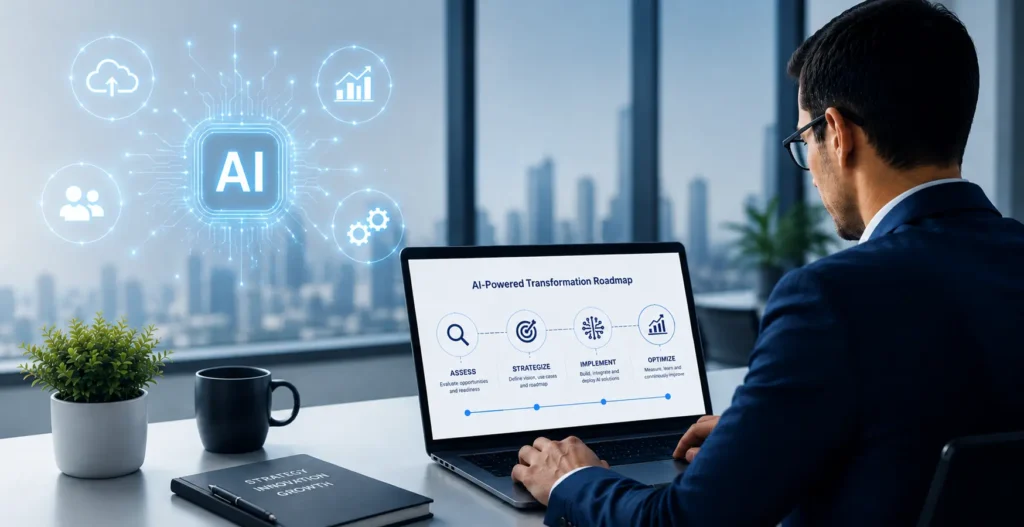
The actual roadmap: five phases in sequence
This is how we structure it. Every enterprise is different. The sequence is not.
Phase 1: Current-state assessment and opportunity mapping
Before any architecture decision, before any vendor evaluation, before any budget approval: an honest assessment of where you are.
Not a SWOT analysis. A specific inventory: which of your core business processes involve the most manual handling, the most data loss between systems, or the most decision latency? Where do your people spend time on tasks that exist only because systems do not talk to each other?
This phase has a deliverable. A prioritised map of transformation opportunities, scored by two things: business value impact and technical feasibility given your current data and infrastructure maturity. High business value and high feasibility is where you start. High business value and low feasibility is where you invest in foundations. Low value in either direction is where you say no.
The assessment phase takes four to eight weeks. Teams that skip it or compress it to a few stakeholder interviews consistently regret it. The decisions made in this phase constrain everything downstream.
Phase 2: Data foundation
Sixty percent of AI projects fail because of poor data foundations. Gartner tracked this in their 2026 research: 60% of AI projects fail because the data underneath them was not ready. Not because the models were wrong. Not because the use case was bad. The data. Because the data is fragmented, inconsistently structured, insufficiently governed, or exists in forms that AI models cannot use effectively.
The data foundation phase is not glamorous. It does not produce visible user-facing outcomes. It is where transformation programs lose momentum when leadership wants to see progress measured in features rather than architecture.
What this phase produces: a governed data architecture, a single source of truth for the datasets that your AI use cases will depend on, data quality standards enforced at the pipeline level rather than the application level, and a clear understanding of what you have, where it lives, and what needs to change before you can build on it.
No AI initiative that skips this phase succeeds at scale. Every organization that has tried to add AI to a data environment that was not ready for it has eventually rebuilt the data layer at a higher cost than if they had started there. This is the investment that CTOs understand in retrospect and struggle to fund politically in advance.
Phase 3: Technology modernisation
With a prioritized opportunity map and a data foundation in place, technology modernization has a defined target. You are not modernizing for its own sake. You are modernizing the specific systems and integrations that enable the highest-priority transformation outcomes.
In 2026 this typically involves three categories of work running in parallel: cloud infrastructure optimization (not necessarily migration, often cost and performance refinement of existing cloud deployments), application modernization (legacy systems that cannot be integrated with modern APIs become transformation blockers and need to be addressed selectively), and API ecosystem development (the connective tissue that allows data to flow between systems in structured ways that AI can consume).
The most common mistake at this phase is scope expansion. The opportunity map from Phase 1 defines what needs to be modernized. Technology decisions outside that scope, however technically motivated, dilute focus and extend timelines without improving business outcomes.
Phase 4: AI integration and intelligent automation
This is where the transformation becomes visible to the business. With clean data and modernized infrastructure, AI integration stops being an experiment and becomes a production capability.
The specific AI use cases your organization should build depend on the opportunity map from Phase 1. But the categories that deliver measurable ROI consistently across enterprise organizations in 2026 are these.
Operational intelligence: AI watching your operational data and surfacing issues, anomalies, and predictions before they require human identification. Supply chain, finance, customer behavior, and production quality. The ROI is in what does not happen: the customer churn that was caught before it spiked, the inventory problem that was visible three weeks before it became a delivery failure.
Intelligent process automation: workflows where decisions are rule-based but currently handled manually because the rules were never codified into software. Document processing, approval routing, compliance checking, and reporting. TEKsystems found 57% of organizations cite improving employee productivity as the primary AI use case in 2026. This is the category they are talking about.
Customer-facing AI: personalization, intelligent search, AI-powered support, and recommendation systems. The 2026 AppVerticals data puts AI-personalized applications at 4x the conversion rate of non-personalized alternatives. The business case is measurable.
Internal knowledge systems: employees querying institutional knowledge through natural language instead of searching through documentation folders. For organizations above a certain size, the productivity gain from this alone justifies a meaningful investment.
Phase 5: Governance, measurement, and iteration
The transformation that has no measurement system has no accountability structure. And AI systems that are not monitored, evaluated, and refined get worse over time relative to the competitive environment around them.
Governance in the AI era covers three things. Model governance: who owns the AI models, and who can approve changes? How are outputs monitored for drift or quality degradation? Data governance: who controls data access? How are privacy and compliance requirements enforced at the infrastructure level rather than the policy level? Change governance: How do you make architecture decisions as AI capabilities evolve without accumulating technical debt or creating security exposure?
The measurement system should connect technology outcomes to business outcomes. Not vanity metrics about API calls or model requests. Business metrics that the board cares about: customer acquisition cost, employee productivity by function, customer satisfaction scores, time-to-market for new products, gross margin improvement. The technology is the mechanism. The business outcome is the measure.
TEKsystems recommends CTOs revisit their roadmap at least quarterly with a deeper annual refresh. That frequency reflects how fast AI capabilities are changing. A roadmap built in January 2026 needs review by Q3 2026 because the tooling available will have changed meaningfully.
What AI enterprise landscape actually looks like
A few realities worth naming before any enterprise CTO approves a transformation budget.
The gap between digital leaders and laggards is real and growing. TEKsystems found 76% of digital leaders will increase AI investment in 2026 versus 61% of laggards. Full-scale AI adoption sits at 38% among digital leaders and 9% among laggards. The leaders are not slowing down to let the laggards catch up. The compounding advantage of two years of production AI experience is not recoverable by simply spending more later.
Cloud migration is table stakes, not the goal. Organizations treating cloud migration as their primary transformation objective in 2026 have misread the competitive landscape. Cloud infrastructure is the environment where transformation happens. It is not the transformation itself.
Build versus buy decisions have changed. Three years ago, building a custom model was the default assumption for serious AI work. That calculus flipped. Calling GPT-4o or Claude through an API gets you to production faster and cheaper than training something from scratch on most use cases. Custom training still makes sense in specific situations: when your domain is too specialized for a foundation model, when data privacy means nothing can touch a hosted API, or when generic output quality genuinely is not good enough after serious prompt engineering. But those situations are the exception, not the starting point. Custom training enters the picture for specific high-value use cases where generic models underperform, and proprietary data creates genuine differentiation.
The AI talent constraint is real. Finding engineers with production AI experience, the kind that have shipped AI features to real users on real enterprise systems and debugged what happens when they fail, is harder than finding engineers who can build with AI in a demo context. How you resource your transformation program matters as much as how you plan it.
The costs: what enterprise digital transformation actually requires
I am going to give you ranges rather than precise numbers because the variance is too wide for precision to be honest.
Assessment and strategy phase: $50,000 to $150,000. Larger organizations have more systems, more stakeholders, and more history to untangle. The assessment reflects that. For a large enterprise, a thorough assessment is closer to the upper end. Skipping or compressing it is a false economy.
Data foundation work: $100,000 to $500,000+. This is the range nobody budgets for correctly. For an enterprise with years of accumulated legacy data across multiple systems, bringing the data foundation to a state where AI can operate reliably on it is a substantial program on its own.
Application modernization: $200,000 to $2,000,000+. Highly dependent on the number and complexity of legacy systems involved, the integration requirements, and whether systems are being wrapped (adding APIs to existing systems), replaced, or rebuilt.
AI integration: AI integration sits between $150,000 and $1,000,000 depending on scope. A few focused features in one business function land at the lower end. Rolling AI across procurement, customer operations, finance, and product simultaneously is a different program entirely.
Total enterprise transformation program: Put it all together across two to four years, and a mid-to-large enterprise is looking at $500,000 to $5,000,000+. That number makes some leadership teams flinch. The more useful question is what the cost of not transforming looks like compounded over the same period, because the 30 to 40% efficiency gains TEKsystems is tracking at digital leaders are not theoretical. Phased funding, with each phase requiring demonstrated business outcomes before the next tranche is approved, is the governance model that keeps these programs on track.
These are not KrishaWeb’s fees. These are what the market looks like for enterprise programs of this scope. The relevant question is not whether the investment is large. It is whether the ROI justification is documented and measurable before the program begins.
The questions to settle before any vendor conversation
Every enterprise CTO should be able to answer these before issuing a briefing to a technology partner.
What are the three business outcomes we are willing to be measured against over the next twenty-four months? Specific outcomes with numbers, not directional statements.
What is the state of our data actually? Not what we assume or aspire to. A realistic view of data quality, completeness, governance, and accessibility as it exists today.
Who has the authority to make technology decisions that affect business processes? In most enterprises, this is a governance question with a political dimension. Getting that authority structure clear before the program starts is cheaper than navigating it after competing stakeholders have invested in different directions.
What is the risk tolerance for the first AI deployment in production? The first production AI system in an enterprise sets the cultural precedent for everything that follows. A successful, visible, measurable first deployment makes the second one easier to fund. A failed first deployment makes the entire program politically vulnerable.
Who will own this after the implementation partner leaves? The capability needs to stay inside the organization. The implementation partner builds and transfers. If the answer to this question is “we will continue to rely on the partner,” that is a dependency, not a transformation.
A digital transformation roadmap in 2026 is a sequenced plan connecting specific business outcomes to the technology, data, and process changes required to achieve them, with AI integration as a primary accelerator rather than an afterthought. It is not a technology migration plan. It is a business redesign program with technology as the mechanism. An effective 2026 roadmap moves through five phases: current-state assessment and opportunity mapping, data foundation, technology modernization, AI integration, and governance and measurement, with each phase building on the previous one rather than running in parallel without dependency management.
Where do these programs actually break down?
Gartner’s 2026 data puts it clearly: 60% of AI projects fail due to poor data foundations. Over 50% of enterprise AI initiatives fail to reach production because foundational architecture was missing. The Cybic research adds that transformation programs without C-suite alignment across technology, finance, and security fail 75% of the time. The pattern is consistent: transformation fails when treated as a technology project rather than a business strategy, when data work is skipped or deferred, and when the governance structure is added after architecture rather than built into it from the start.
How long does enterprise digital transformation take?
A meaningful enterprise digital transformation program runs two to four years for a mid-to-large organization. The first six to twelve months typically covers assessment, data foundation work, and the first production AI deployment. Months twelve through twenty-four are where the program expands. Application modernization broadens. AI starts moving into a second and third business function based on what the first deployment proved. Ongoing iteration and governance run indefinitely. Programs that try to compress the full transformation into twelve months consistently sacrifice data foundation quality for the sake of visible progress, which creates the technical debt that the next CTO inherits.
What is the role of AI in digital transformation in 2026?
AI is no longer a feature you add to a digital product. It is the operating layer that makes transformation economically viable at scale. In 2026, AI accelerates transformation in four ways: operational intelligence that surfaces issues before humans notice them, intelligent automation of manual processes because the rules were never codified, customer-facing personalization and interaction, and internal knowledge accessibility. Enterprise-wide AI adoption doubled from 12% to 24% year over year according to TEKsystems’ 2026 State of Digital Transformation research. The organizations at 38% full-scale adoption are the ones that built data foundations first.
What should an enterprise CTO prioritize in 2026?
Based on TEKsystems’ 2026 research and what we see across enterprise engagements at KrishaWeb: first, complete the assessment work that tells you where business impact and technical feasibility intersect. Second, address data foundations before building any AI capability at scale. Third, start AI deployment in the highest-value, highest-feasibility use case identified in the assessment. The visible success of the first production AI deployment funds politically enables everything that follows. Do not try to transform everything at once. Pick the highest-leverage starting point and execute it completely before expanding scope.
How do you measure digital transformation ROI?
The measurement framework should be defined before the program begins, not after the first phase is delivered. The metrics that matter to enterprise boards: revenue impact attributable to new digital capabilities; cost reduction in specific operational functions with before-and-after measurement; time-to-market improvement for new products or customer experiences; and customer satisfaction scores where AI-powered experiences have been deployed. Technology metrics (API performance, model accuracy, deployment frequency) matter internally. They do not constitute ROI. The translation layer between technical outcomes and business outcomes is where most transformation programs have a measurement gap.
Start Your Digital Transformation with KrishaWeb
KrishaWeb has delivered digital and AI transformation programs for enterprise clients across 42 countries since 2008. Our practice covers the full roadmap: assessment and opportunity mapping, data architecture, application modernization, AI integration across web applications and business systems, and the governance frameworks that keep transformation programs on track after the initial implementation.
If you are at the point where the transformation decision is in front of you and you want a realistic assessment of where to start, what it will cost, and what the first measurable outcome should be, that is the conversation worth having.
TechTimes, Enterprise IT Trends 2026: Top CTO Priorities, February 2026
Parth Pandya
Founder & CEO
Founder & CEO of KrishaWeb, leads an Enterprise Web Agency. With contributions to WordPress and organization of WordCamps, he pioneers innovation and community engagement in the digital realm.




 KrishaLabs
 KrishaStudio
 KrishaStore