Klatsch Mate opened in Ahmedabad with something genuinely unusual: a 160-item menu built around authentic European food, from Neapolitan pizza and Italian pasta to Georgian khachapuri and Vienna-style coffee, in a market that had never seen this kind of offering. The concept was right. The timing was right. And almost nobody in the area knew the place existed.
That gap between what a business actually is and what the internet tells the world about it is one of the most expensive problems in local hospitality. A restaurant can have exceptional food, a genuinely differentiated concept, and a service standard that earns loyal regulars, and still operate at a fraction of its potential because the digital infrastructure is not there to convert nearby intent into footfall.
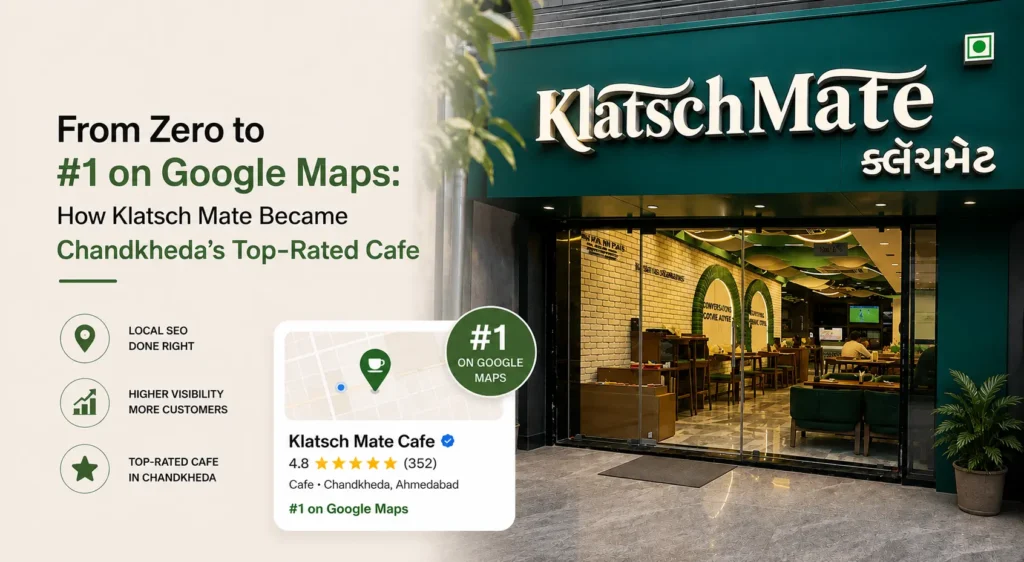
Six months after KrishaWeb started working with Klatsch Mate, that gap had closed completely. The cafe now holds the number one position on Google Maps for “cafe in Chandkheda,” carries a 4.8-star rating across nearly 300 reviews, receives close to 5,000 Google Business Profile interactions per month, and is already showing up in ChatGPT and Gemini results before most of its local competitors have thought about AI search at all.
Here is how that happened, and what it teaches any local business about where digital visibility actually comes from.
Table Of Contents
Table Of Contents
The starting point, and why it mattered
When Klatsch Mate came to KrishaWeb at the start of 2026, the challenges were straightforward to identify and uncomfortable to sit with.
The Google Business Profile was incomplete. Basic information like hours, menu, and photos was missing or outdated, which meant a nearby searcher who found the listing had less confidence in it than they would have had for a competitor with a more polished presence. In local search, an incomplete profile is not neutral. It is a negative signal, both to Google’s ranking algorithm and to the person deciding whether to make a reservation.
The cafe had almost no social presence. The accounts existed but were not being used as discovery or engagement tools, which meant the gap between the actual cafe experience and what a potential customer could see online was significant. Great food that nobody can see might as well not exist when the decision to visit is being made on a phone screen.
There was no paid media history and no conversion data. Starting Google Ads from zero means no cost benchmarks, no keyword performance data, and no evidence of which campaigns drive which outcomes. The first weeks are expensive by design, and that had to be factored into the plan.
And there was no content infrastructure. No library of food photography, no video showing the ambience, no visual assets that reflected what the experience of being in Klatsch Mate actually felt like.
The interesting thing about this situation is that none of it was about the cafe’s quality. The food was good, the concept was differentiated, the experience was worth the visit. The problem was purely digital infrastructure, and digital infrastructure is something you can build systematically.
The strategy: one system, not five separate workstreams
The most important decision KrishaWeb made at the start of this engagement was treating GBP optimization, SEO, paid media, social media, and AEO/GEO as a single connected system rather than as separate channel investments that would be measured independently.
The sequencing within that system was the second important decision. Before any paid media went live, the Google Business Profile had to be complete, accurate, and actively managed. Sending Google Ads traffic to a half-finished listing is budget going directly to waste, because the click happens but the confidence does not follow. Every category, attribute, photo, and post was optimised first. The profile became the foundation everything else was built on.
Local SEO ran alongside the GBP work, targeting the specific searches a hungry, nearby customer actually types. Not broad brand terms with limited commercial intent, but the high-intent queries that map directly to someone deciding where to go right now: “cafe in Chandkheda,” “European cafe near me,” “best brunch near Motera.” The content and technical work connected the cafe’s web presence to those searches.
Paid media launched after the foundation was solid. The campaigns were built around the actions that drive a physical visit (directions requests, phone calls, table reservations) rather than generic impressions or brand awareness. Targeted within the cafe’s actual visit radius, not a city-wide spread. The difference between a campaign designed to be seen and a campaign designed to be acted on is measured in cost per visit, and Klatsch Mate needed visits, not impressions.
The AEO and GEO work was built in from the start, not added as an afterthought later. Content and business information were structured for AI-powered search experiences during the same period as the traditional work. At the time, this was a forward-looking decision. The GA4 data confirmed it was the right one: 19 sessions from chatgpt.com, 12 from a dedicated AI Assistant channel, and 1 from gemini.google.com arrived in a single 30-day window, before most local competitors had any presence in AI-generated answers at all.
Photography, video, and Reels were produced to show the cafe’s food and ambience as they actually are, not in a way that could belong to any restaurant. Influencer content extended reach into audiences the cafe’s own channels could not access directly.
The results, six months later
The clearest single number is the Google Maps position. Klatsch Mate holds number one for “cafe in Chandkheda” with a 4.8-star rating across 297 reviews, ahead of competitors who have been operating in the area for years and carry far larger review volumes.
GBP interactions scaled from near zero in January 2026 to nearly 5,000 per month by May. Direction requests reached approximately 3,800 per month. Website clicks from the profile reached around 300 per month over the same period.
The AI search result is the one that is hardest to manufacture and most forward-looking in its implications. The GA4 data confirming ChatGPT and Gemini referral traffic arriving within the first six months reflects the AEO and GEO sequencing decision. Klatsch Mate is visible in AI-generated restaurant recommendations ahead of competitors who have been operating far longer, because the ground was prepared while it was still open to claim.
The client’s own description of the result is worth quoting: “What surprised us most was the AI search piece. Seeing Klatsch Mate showing up in ChatGPT results felt like something that should not be possible for a cafe that opened recently, but the numbers are right there in our analytics.”
What this teaches any local hospitality business
The Klatsch Mate results are not the product of a large budget or a complicated strategy. They are the product of doing the basic things in the right order, with the right level of attention to each one.
A complete Google Business Profile is still the single highest-leverage asset for a local business. Nearly 5,000 monthly GBP interactions from near zero is not a paid media result. It is the result of an optimised, actively maintained profile that gives nearby searchers enough confidence to act. The businesses that treat GBP as a one-time setup task are leaving this kind of traffic on the table every month.
Sequencing matters as much as the strategy itself. Running paid media before the profile is optimised is the most common waste in local hospitality marketing. The foundation comes first. Everything else amplifies a foundation that is already working.
Rating quality outperforms rating volume. A 4.8-star average across 297 reviews outranked competitors that had accumulated far more reviews. Google’s local ranking algorithm rewards recent, high-quality engagement alongside review count. Consistently good experiences that generate consistently good reviews compound in the ranking over time.
AEO and GEO are not future concerns. They are present-tense competitive advantages for any local business willing to structure content for AI search while the ground is still unclaimed. The businesses that wait until AI search is the obvious channel will find the positions already occupied by whoever did the work earlier.
A connected strategy across channels performs better than any single channel in isolation. The result at Klatsch Mate came from GBP, SEO, paid media, social, content, and AI search working as one system. The whole is measurably more than the sum of the parts.
How long does it take to rank number one on Google Maps for a new restaurant?
Klatsch Mate reached the number one position in its local search area within approximately five months of optimization work beginning, starting from near zero. The timeline depends on competition density in the area, the quality and completeness of the GBP optimization, and the volume and quality of new reviews generated during the period. In less competitive local markets, the timeline can be shorter. In high-competition areas with established competitors holding strong positions, a longer period of consistent work is required. The consistency matters as much as the starting quality.
What is the most important thing a restaurant can do to improve Google Maps ranking?
Complete and actively manage the Google Business Profile. This means accurate categories, full hours including holiday variations, high-quality photos across all categories (food, interior, exterior, team), regular posts, prompt responses to reviews including negative ones, and keeping all business information current. The GBP is the primary signal Google uses for local ranking, and an incomplete or neglected profile directly suppresses position regardless of what other marketing work is being done.
What is AEO and GEO, and why does it matter for a restaurant?
AEO stands for Answer Engine Optimization, which is the work of structuring content so that AI-powered search tools like ChatGPT, Perplexity, and Google’s AI Overviews can accurately represent a business when someone asks a relevant question. GEO stands for Generative Engine Optimization, the broader practice of ensuring business information is available and structured in the formats these tools use to generate responses. For a restaurant, this means being the answer when someone asks “what is the best European cafe in Chandkheda” or “where should I go for brunch near Motera.” The businesses doing this work now are building positions that will be harder to displace as AI search grows.
Is local SEO different for restaurants than for other businesses?
The fundamentals are the same, but the purchase decision cycle is faster and more location-sensitive. A restaurant searcher is usually deciding where to go today, not researching over weeks. The searches are high-intent, time-sensitive, and heavily influenced by proximity and rating. The content that matters most is immediate and specific: what is on the menu, what does the space look and feel like, what do recent customers say about it. For restaurants, the GBP is arguably more important than the website for initial discovery, which inverts the priority order that applies to most other business types.
Can a small restaurant compete with established competitors in local search?
Yes. The Klatsch Mate result demonstrates this directly. A cafe that opened in 2025 with no prior digital presence outranked established competitors in its area within five months through a combination of GBP optimization, targeted content, and consistent review generation. The factors that favour a well-run newer business over a neglected established one include: higher average review ratings when every visit is a chance to earn a positive review, more recent and relevant content, faster response times to reviews and customer questions, and willingness to optimize for new channels like AI search that established competitors may not be actively pursuing.
Conclusion
Most local restaurants are sitting on a version of the same problem Klatsch Mate had at the start of 2026: a quality experience that the internet has not been given the tools to represent accurately. The gap between what the business is and what the digital presence says it is costs real money in footfall that never arrives and customers who choose a competitor that looks better online even if the food does not compare.
The work that closed that gap for Klatsch Mate is the same work available to any local hospitality business: a properly optimised and maintained Google Business Profile, SEO targeting the searches that matter, paid media designed around visits rather than impressions, and forward-looking AEO and GEO work that positions the business in AI search before the competition gets there.
KrishaWeb’sdigital marketing team builds and runs connected local SEO, paid media, and AI search programmes for hospitality businesses and local brands that want results like these. If your business has a concept that deserves more visibility than it currently has, the conversation starts the same way it did with Klatsch Mate: with an honest audit of where the gaps are and what it would take to close them.
Founder & CEO of KrishaWeb, leads an Enterprise Web Agency. With contributions to WordPress and organization of WordCamps, he pioneers innovation and community engagement in the digital realm.




 KrishaLabs
 KrishaStudio
 KrishaStore