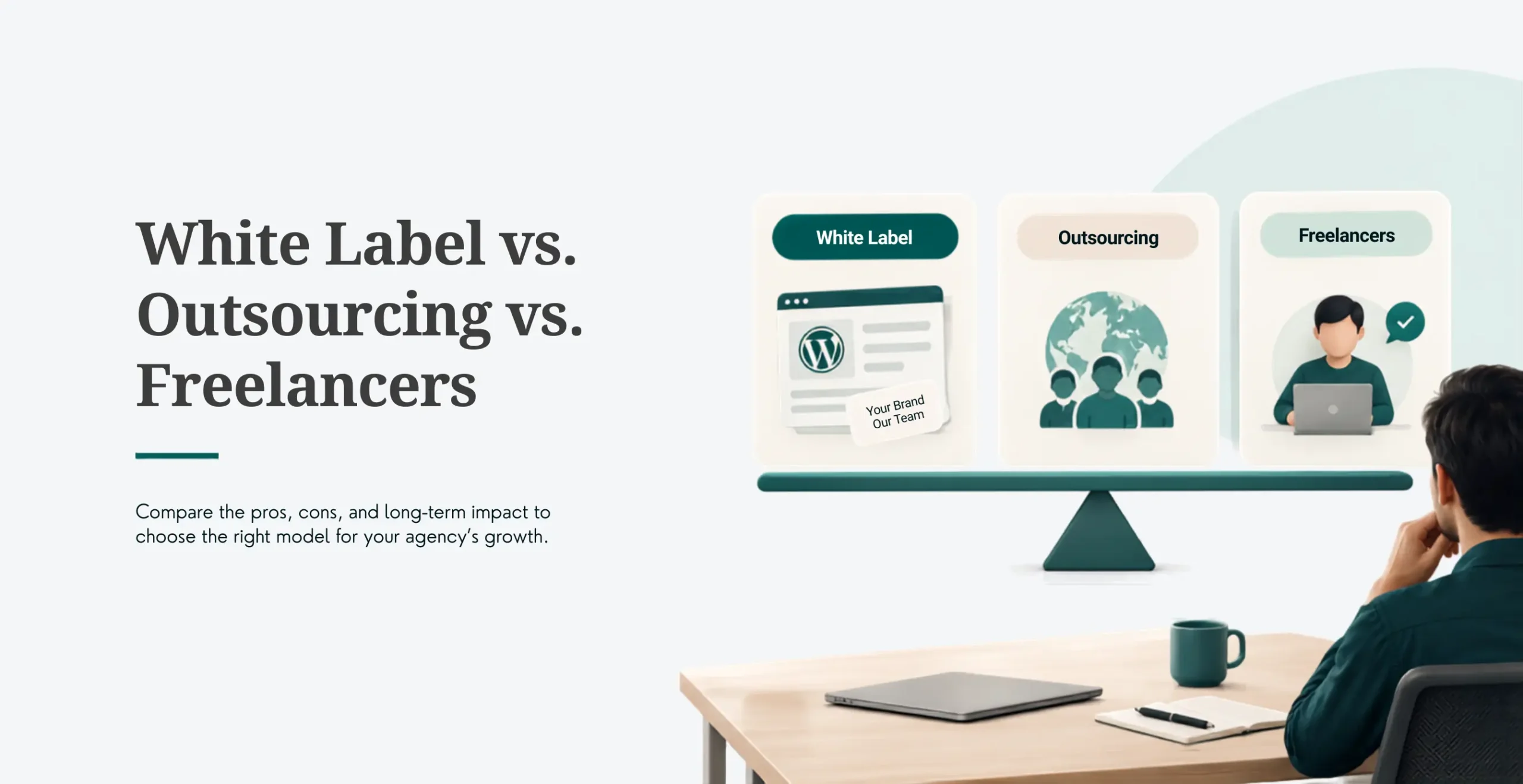
Most agency owners don’t decide to use a white label partner. They stumble into it; usually the week three projects land at once, and two of them are due Friday. If you’ve felt that specific panic, this article is for you.
Here’s what’s worth knowing: agencies that outsource 40 to 60% of their delivery grow 2.3 times faster than those that don’t and report profit margins 18 to 22% higher and client retention 42% higher. White label isn’t the thing you do when you’re failing to cope. It’s the thing the fastest-growing agencies are already doing on purpose.
But you don’t need a market report to know whether it’s time. Your own week tells you. Below are ten clear signs your agency has outgrown doing everything in-house, and, because you’re a business owner and not a philosopher, what each one is quietly costing you. If a handful of these sound like your last month, you already have your answer.
1. You’re turning away good work
This is the most expensive sign and the easiest to ignore because it doesn’t show up as a loss. It shows up as a polite “we’re at capacity right now.”
When a solid project comes in, and you say no because your team is full, you didn’t avoid a problem; you created one. You handed revenue to a competitor and taught a client to call someone else next time. Turning away work isn’t discipline; it’s a leak. A white label partner lets you say yes to the overflow without hiring, so the project you’d have declined becomes margin instead of a missed invoice.
2. Your team is stretched thin and starting to burn out
Watch your best people. When designers and account managers get pulled into development work they don’t love, or everyone’s working late to hit converging deadlines, you’re not being lean. You’re burning your most valuable and hardest-to-replace asset.
Burnout is quiet until it’s a resignation. The senior designers and strategists who make an agency attractive are exactly the ones who leave first when the work turns into a grind. A white label partner absorbs the overflow and the parts your team doesn’t want to do, so your people spend their energy on the work that keeps them.
3. Clients keep asking for things you don’t offer
Every time a client asks, “Do you also do Webflow / Shopify / a web app?” and you say no, you’ve capped that relationship. They’ll find another agency for it, and that agency now has a foot in your account.
You don’t have to build every skill in-house to offer it. A white label partner lets you say yes to services you don’t staff for, delivered under your brand as if you did it yourself. You expand what you sell without expanding your payroll. That’s how a design shop becomes a full-service agency without a hiring spree.
4. Your delivery quality or timelines are slipping
When client feedback starts mentioning bugs, slow load times, or weak mobile performance, or when “we’ll have it Friday” keeps becoming “early next week,” that’s not a motivation problem. It’s a capacity or skills problem, and clients feel it before you admit it.
The moment delivery stops being predictable, your reputation is on the line, and reputation is the whole business. A white label partner with real project managers, QA, and staging brings back the reliability that wins repeat work. Predictable delivery is the quiet thing clients actually pay for.
5. You’re about to hire a senior developer you can’t keep busy year-round
Do the math before you post that job. A senior developer costs $70,000 to $120,000 a year in the US (£50,000 to £85,000 in the UK), before benefits, equipment, software, and management overhead that add another 25 to 35%. And you pay all of it in the slow months too.
That’s the trap: a full-time hire is a fixed cost, but agency work is lumpy. A white label partner converts that fixed salary into a variable cost that flexes with your project flow, you pay for delivery when the work is there, nothing when it isn’t. For most agencies, that math alone is the whole argument.
6. You’re spending more time managing delivery than growing the agency
Notice where your own hours go. If you and your account managers are buried in build logistics, chasing developers, checking files, and managing timelines instead of on strategy, client relationships, and new business, your agency has quietly stopped growing.
The owner stuck in delivery is the single most common reason agencies plateau. A white label partner takes the build logistics off your plate so the people who should be selling and strategizing actually are. This is exactly the shift we cover inhow to grow a web design agency; the growth usually comes from getting out of delivery, not further into it.
7. One specialty now makes up a big share of your incoming work
Look at your pipeline. If Webflow, Shopify, or WordPress builds have quietly grown to 40% or more of what comes in, you’ve crossed a threshold; that’s no longer occasional overflow, it’s a standing demand you’re trying to meet by improvising.
At that volume, improvising is the expensive option. A white label partner who lives in that platform every day delivers it faster and cleaner than a generalist stretching to cover it, and you can mark it up to protect your margin. When a service becomes a steady stream rather than a one-off, a dedicated delivery partner stops being a nice-to-have.
8. Your busy and slow seasons swing hard
If your workload spikes and crashes with the seasons, feasting in Q1 and famine in Q3, you have a structural problem that hiring can’t solve. Staff for the peak and you’re overpaying through the quiet months; staff for the average and you drown during the rush.
This is exactly what variable capacity is for. A white label partner flexes with you: full firepower when three projects land in a week and nothing on the payroll when things go quiet. You stop choosing between overstaffing and turning away peak-season revenue and let capacity follow the work instead of the calendar.
9. You’re saying yes to projects and hoping you’ll figure out delivery
Be honest about this one. If you’re closing work on a capability you don’t quite have yet, then scrambling to find a freelancer who may or may not deliver, you’re betting your client relationship on a gamble every time. It works until the one time it doesn’t, and that one time can cost you the account.
A reliable white label partner turns “I hope we can deliver this” into “I know we can.” You sell with confidence because delivery is already handled by a team with structure behind it, not a freelancer you found last Tuesday. Selling what you can dependably deliver is how you sleep at night and keep clients for years.
10. AI made your team leaner, and now you can produce more than you can staff
Here’s a sign that didn’t exist two years ago. AI tools made your existing team faster and, for many agencies, smaller. That sounds efficient, until demand rises and you realize you have fewer hands to manage more potential output.
This is the counterintuitive part most agencies haven’t worked out yet. A leaner, AI-accelerated team doesn’t make a white label partner less useful. It makes one more valuable, because now you can win and scope more work than your reduced headcount can deliver alone. Pairing your AI-sped internal team with a white label partner for delivery lets you take on far more volume and serve clients faster without rebuilding the headcount AI just let you trim. The agencies pulling ahead in 2026 use AI for speed and a white label partner for scale.
If you’re still unsure, run one simple check we call the Capacity-Not-Sales test. Ask yourself: is my problem that I can’t win enough work, or that I can’t deliver the work I’m already winning?
If it’s the first, you have a sales problem, and a white label partner won’t fix it. But if you’re winning work and then scrambling, declining, or burning out trying to deliver it, that’s a capacity problem, and it’s exactly what white label solves. The quotable version: White label doesn’t get you more clients, it lets you keep the ones your own success is about to cost you.
Most agency owners reading this recognize the second problem. If that’s you, the signs above aren’t warnings; they’re a green light.
What the right partner actually looks like
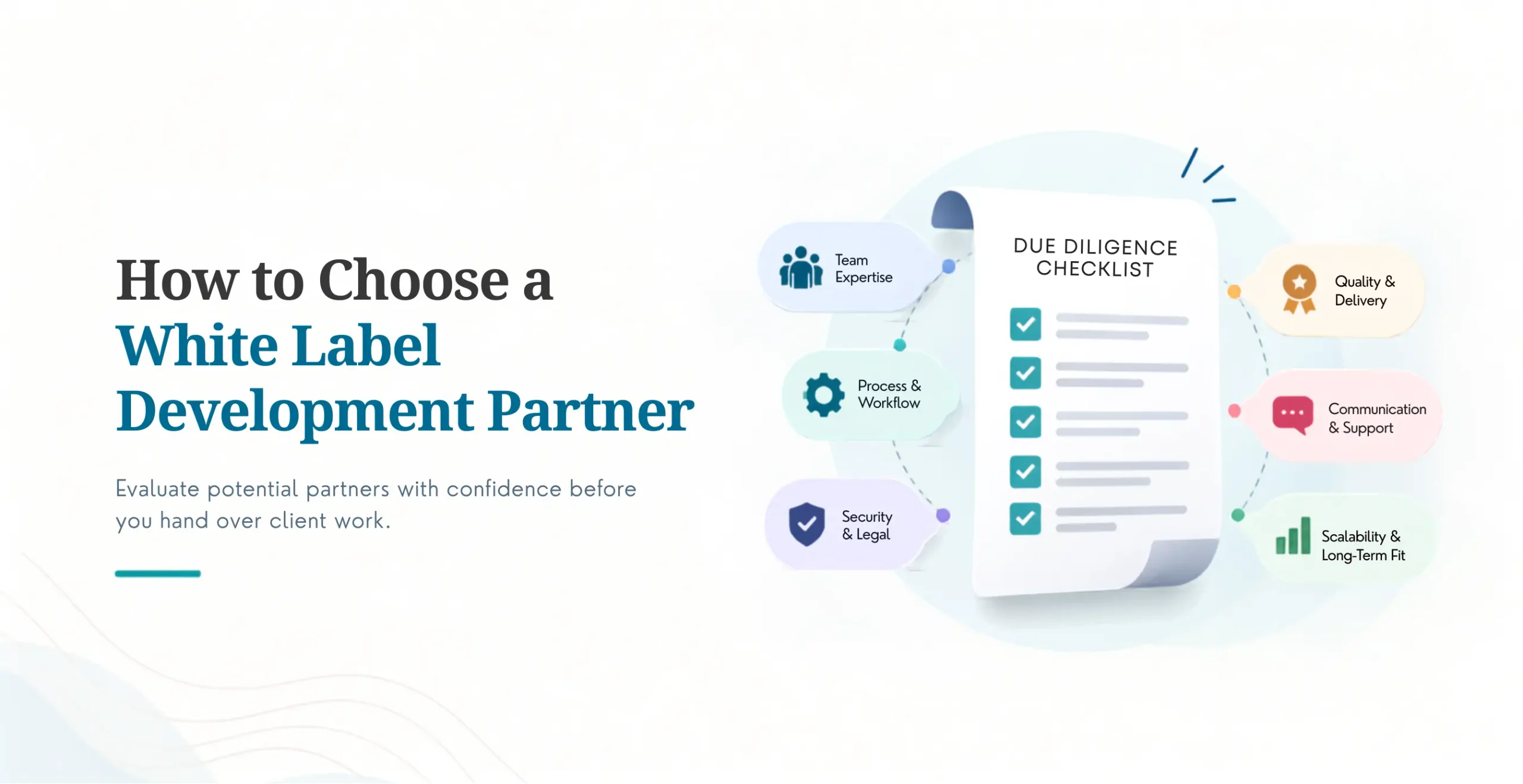
Recognizing the need is step one. Choosing well is step two, because the wrong partner creates more problems than it solves. The right white label partner is genuinely white label (your brand stays front and center, and they stay invisible to your client); has real structure (project managers, QA, staging, not a lone freelancer); is transparent about pricing so you can protect your margin; shows you real work; and welcomes a small paid test project before a big commitment. We go deeper on partnership models in our guide to white label for small agenciesand what we deliver inwhite label web development.
If a handful of these signs describe your last month, the capacity problem won’t fix itself, and it’s costing you more than a partner would. KrishaWeb works as the invisible development team behind agencies like yours: custom, WordPress, Webflow, Shopify, and e-commerce builds delivered under your brand, with real project management and QA, so your clients only ever see you.
Ready to Scale Your Agency?
Let’s talk about how a white label partnership could take the delivery pressure off and let you say yes to more. No pitch, just a straight conversation about whether it fits your agency.
What are the signs an agency needs a white label partner?
The clearest signs are: turning away good projects at capacity, your team stretching thin or burning out, clients asking for services you don’t offer, delivery quality or timelines slipping, considering a full-time senior developer you can’t keep busy, spending more of your own time managing delivery than growing, one specialty making up 40%+ of your work, hard seasonal swings in workload, selling work before you know how you’ll deliver it, and having an AI-leaner team that can win more than it can staff. If a handful of these describe your recent months, it’s usually a capacity problem that white label solves.
When should an agency start using white label web development?
Once delivery, not sales, becomes the bottleneck. If you’re consistently winning work and then scrambling to deliver, declining projects, missing deadlines, or burning out your team, that’s the signal. A useful threshold: when a service like Webflow makes up 40% or more of your incoming work, or when your capacity regularly falls short of demand, outsourcing becomes more efficient than managing it all in-house. The data supports acting early: agencies outsourcing 40 to 60% of delivery grow 2.3 times faster with higher margins and retention.
Does using a white label partner hurt my agency’s brand?
No, done right it’s the opposite. A genuine white label partner works invisibly under your brand, so your client only ever sees you, and delivers reliable, high-quality work that strengthens your reputation. The brand risk actually comes from the alternatives: missing deadlines because you’re overstretched, or delivering weak work because you lack the skill in-house. A structured partner with proper project management and QA protects your brand by making your delivery consistent and professional.
Is a white label partner cheaper than hiring in-house?
For most agencies, yes, especially given uneven project flow. A full-time senior developer costs $70,000 to $120,000 a year in the US (£50,000 to £85,000 in the UK) before benefits, equipment, and overhead that add 25 to 35% more, and you pay it in slow months too. A white label partner converts that fixed salary into a variable cost that scales with your project flow: you pay for delivery when the work is there and nothing when it isn’t. That flexibility is why agencies use white label to protect margins while still saying yes to more work.
Does AI mean agencies need white label partners less?
Counterintuitively, no, many need them more. AI tools made teams faster and often leaner, which means you can now win and scope more work than your reduced headcount can deliver alone. Pairing an AI-accelerated internal team with a white label partner for delivery lets you take on more volume and serve clients faster without rebuilding the headcount AI let you trim. The agencies pulling ahead in 2026 use AI for speed and a white label partner for scale.
How do I choose a good white label web design partner?
Look for five things: genuine white labeling (they stay invisible, your brand stays front and center), real structure (dedicated project managers, QA, and staging, not a lone freelancer), transparent pricing so you can protect your margin, a real portfolio they can show you even if anonymized, and willingness to start with a small paid test project before a large commitment. A partner who dodges pricing or can’t show work is a red flag. The right partner functions as an extension of your team and delivers quality that holds up as your volume grows.
Parth Pandya
Founder & CEO
Founder & CEO of KrishaWeb, leads an Enterprise Web Agency. With contributions to WordPress and organization of WordCamps, he pioneers innovation and community engagement in the digital realm.




 KrishaLabs
 KrishaStudio
 KrishaStore