Agencies that outsource between 40% and 60% of their service delivery grow 2.3 times faster than those that keep everything in-house, and they report profit margins 18 to 22% higher. Among agencies already doing it, 73% have integrated white label services into their offering. The ones that have not are mostly losing work to competitors who can say yes to projects they cannot staff.
The capacity problem in agency web development is not new. The client wants a site built in six weeks. Your developers are already on three active projects. You either turn the client away, rush the existing work, or tell the client eight weeks and hope for the best. None of those options is good. The fourth option, a white label development partner who builds the project under your brand while your team manages the client, is the one most agency owners know exists but have not set up properly.
This guide is written for agency owners and MDs in the US, the UK, and Australia who are actively considering a white label development partnership. It covers what to look for in a partner, how to structure the first handoff, how to protect your client relationship throughout, how to price white label work so the margin makes sense, and the specific red flags that separate a reliable white label partner from one who will create more problems than they solve.
Table Of Contents
Table Of Contents
What White Label Web Development Actually Means in Practice
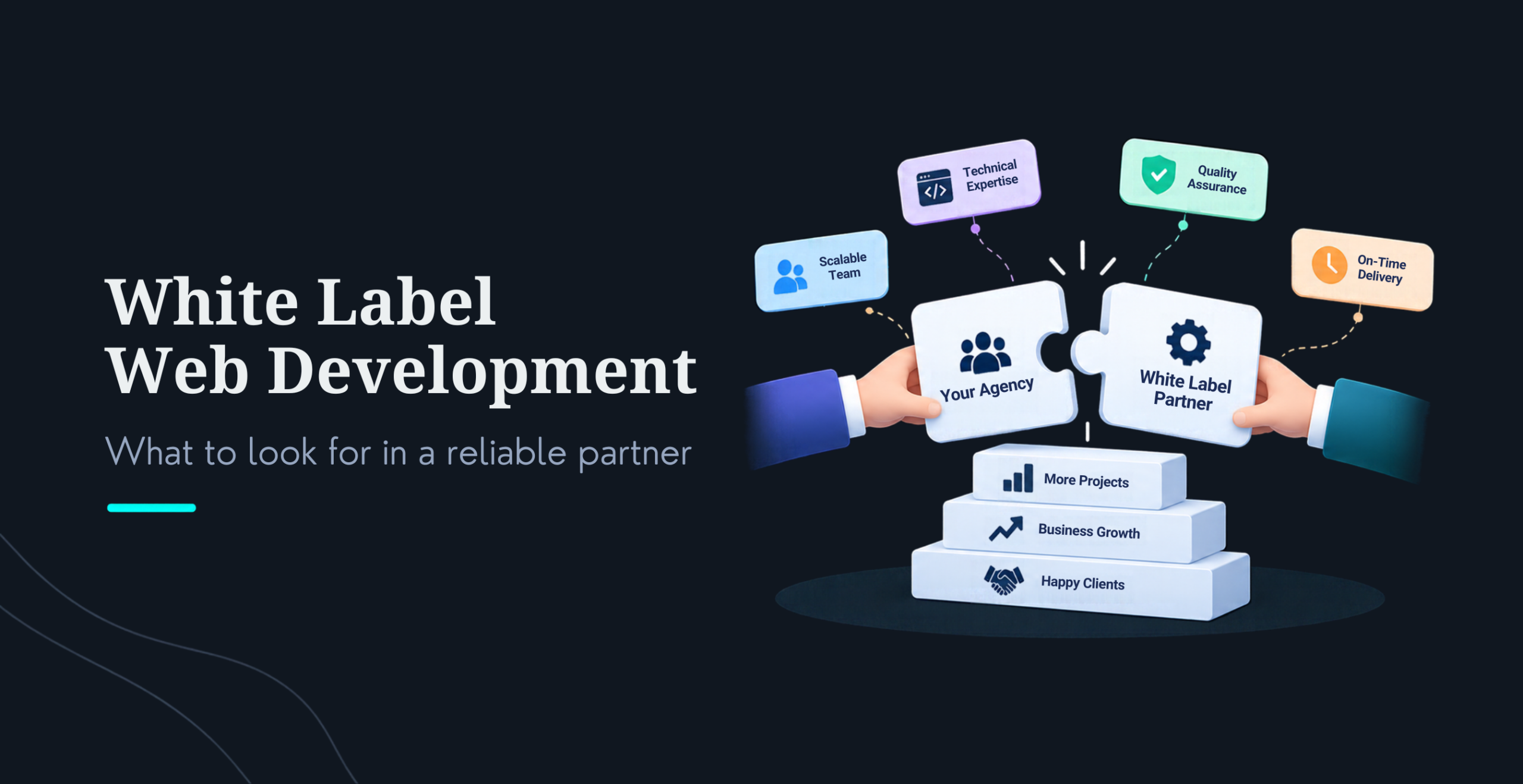
White label web development is straightforward in concept. A third-party development team builds a website or web application for your client. The work is delivered under your agency’s brand. Your client sees it as your work. The development partner stays invisible throughout.
Where agencies often get confused is about the difference between white label development and standard outsourcing. The distinction matters. Standard outsourcing is transactional: you send a brief, they send back a deliverable, and the relationship is one project at a time. White label development is a partnership model: the development team operates as an extension of your agency, follows your processes, communicates in your voice, and is set up specifically to make the arrangement invisible to your clients.
The operational difference shows up in the details. A white label partner signs an NDA before seeing any client materials. They use your branded project management environment or adapt to yours. They deliver work in formats your team can present directly to the client. They do not put their name on anything. When the client asks who built their site, the answer is your agency.
Why Agency Owners Are Moving to White Label Development in 2026
The economics of hiring a developer have shifted. A mid-level web developer in the US costs between $80,000 and $120,000 annually, including benefits, before you factor in recruitment costs, onboarding time, equipment, and the overhead of managing an employee through quiet periods when project volume drops. In the UK and Australia, the numbers are comparable in local currency terms.
The alternative: a white label development partner charges per project or on a retainer. When client work is heavy, you scale up. When it is quiet, you are not carrying fixed headcount costs. The agency gets capacity when it needs it without the overhead that comes with employment.
The four situations where white label development solves a real problem:
The first is overflow. Your team is at capacity. A client wants a project started now. White label gives you a yes instead of a delay or a referral out.
The second is skill gaps. Your team is strong on WordPress, but a client needs a complex Laravel application or a Shopify Plus implementation with custom checkout extensions. Instead of turning the work away or attempting it with a team that will struggle, KrishaWeb’s web development services give you the capability immediately, across WordPress, Shopify, Laravel, React, and custom web applications.
The third is service expansion. A marketing agency wants to offer web development without building a development team. A branding agency wants to add website builds to a rebrand package. White label development is how you add a service line without the infrastructure investment.
The fourth is margin management. White label development at KrishaWeb’s cost base in Ahmedabad versus a US or UK development team at local market rates means the same quality of work delivered at a cost that supports healthy agency margins. An agency billing a client $15,000 for a WordPress site and delivering it through a white label partner at $6,000 is running a 60% gross margin on that project. Try doing that with in-house US developers.
What to Look for in a White Label Web Development Partner
Most white label partnership articles give you a generic checklist. Portfolio, communication, pricing. That is not specific enough to be useful when you are evaluating a partner who will be building work that goes out under your brand. Here is what actually separates reliable white label partners from ones who create problems:
Signed NDA before any client details are shared
This is non-negotiable and should happen before the first brief changes hands. A white label partner who is reluctant to sign an NDA, asks you to use their standard NDA rather than yours, or delays the conversation is not a partner you want to trust with client details. The NDA should cover client identity, project details, any proprietary materials shared, and a non-solicitation clause that prevents the partner from approaching your clients directly.
IP ownership assigned to your agency, not the partner
Every piece of work produced should be assigned to your agency as a work-for-hire arrangement. This means the code, the design files, the database structures, and any custom functionality built for the project belong to your agency and through you to your client. A white-label partner who retains any rights to the work they build for you is not operating a proper white-label model.
A project management process that mirrors yours
The handoff is where white label partnerships break down most often. If your agency uses Linear or Jira and the partner only communicates by email, every update becomes a translation exercise, and things get missed. Ask specifically how they handle project briefs, how they communicate progress, how they flag blockers, and what their revision process looks like. The best white label partners adapt to your tooling rather than requiring you to adopt theirs.
Staging environments and QA before delivery
Work delivered directly to production without a staging review period is work you cannot check before your client sees it. A white-label partner should deliver to a staging environment, provide a review period, address your feedback, and push to production only after you have signed off. If a partner’s standard process skips staging, that is how your client ends up seeing broken layouts on a live site.
Relevant stack experience, not just general development capability
A white label partner who says they can build anything on any platform is not giving you useful information. You want a partner with demonstrable experience in the specific stack your client project requires. WordPress with ACF and custom Gutenberg blocks are a different skill set from a headless Shopify build with Checkout Extensibility. Ask for examples of comparable projects, not a general portfolio.
Communication in your time zone window
A four-hour overlap between your working hours and your partner’s is workable. No overlap is not. When a client asks a question at 2 PM your time and the answer requires input from the development team, a partner who is asleep is a liability. KrishaWeb’s team in Ahmedabad has a meaningful overlap with UK mornings and US East Coast afternoons and operates on extended hours for clients in Australia and the West Coast.
How to Price White Label Development and Protect Your Margin
This is the section most white label guides skip. Pricing your white label work correctly is what determines whether the partnership is profitable or whether you are doing more admin for a thin margin.
The cost-plus model
The simplest approach: take your white label partner’s cost for the project, apply a markup that covers your account management time and your agency margin, and quote that to the client. A project costing $5,000 from KrishaWeb quoted at $9,500 to the client gives you $4,500 gross profit on a project your team did not build. Your time is in scoping, managing the client relationship, and reviewing deliverables, not in development hours.
The value-based model
More sophisticated: price based on the value the project delivers to the client, not on the cost of building it. A WooCommerce store for a client expecting $500,000 in first-year online revenue is not priced at cost-plus. It is priced at what the platform is worth to their business. White label development at a fraction of local developer costs gives you the margin to price on value without squeezing the project.
The retainer model
The most predictable: your client pays a monthly retainer for ongoing development support, you pay your white label partner a lower monthly rate for the hours, and you pocket the difference. The agency retainer model works particularly well for clients with continuous development needs eCommerce stores requiring regular feature builds, WordPress sites needing ongoing customization, SaaS products in active development.
The margin mistake most agencies make with white label development is quoting client projects based on their own hourly rate rather than the white label cost base. If you quote a project at $120/hour because that is what your senior developer costs and then deliver it through a white label partner at a $45/hour equivalent, you have left significant margin on the table. The client does not know your cost structure. Quote based on value and market rate, not your internal cost.
How to Manage Client Communication on a White Label Project
The question agency owners ask most often before starting a white label partnership: “What do I tell my client about who is building their site?” The short answer: nothing that you are not legally required to disclose and nothing that undermines your agency’s value in the relationship.
Your agency’s value to the client is not in the hours your team personally codes. It is in your understanding of their business, your account management, your quality control, your project management, and your strategic input. That value exists whether your team writes every line of code or a white label partner does. The client is paying for the outcome and the relationship, not the delivery mechanism.
What to communicate and what to keep internal
Be clear with your client that your agency uses specialist development teams for specific project requirements. This is accurate and positions the arrangement professionally. You do not need to name KrishaWeb or any specific partner. ‘Our development team is accurate; it is a team that works on development for your agency.
What you never do: let the partner communicate directly with your client without your involvement, share partner contact details with your client, or allow the partner’s branding to appear anywhere in deliverables. The entire client relationship stays with your agency.
The handoff brief that prevents most problems
The quality of your brief to the white label partner determines the quality of what comes back. A good handoff brief includes the client’s business context and what the site needs to accomplish; the technical requirements and platform; the design assets or design direction; the timeline with review stages marked; the acceptance criteria for each deliverable; and the client’s specific sensitivities or concerns. A brief that leaves gaps creates assumptions. Assumptions create revisions. Revisions eat up margin.
What KrishaWeb White Label Development Covers
KrishaWeb has been delivering web projects since 2008. The white label partnership model with agencies in the US, UK, Australia, and Europe is a defined part of how we work. Here is what the partnership covers:
Shopify: Online Store 2.0 custom themes, Shopify Plus with checkout extensibility, Shopify store development, and migrations from WooCommerce and Magento.
Laravel: Custom web applications, SaaS platforms, REST API development, enterprise backends.
React and Next.js: Frontend development, headless CMS implementations, PWA builds. See krishaweb.com/web-application-development/
Staging environment delivery with review period before production deployment
Your-branded project management environment or adaptation to yours
No KrishaWeb branding in any deliverable, communication, or file metadata
Direct communication through your preferred channel during your time zone overlap
Post-launch support window on every project
Plans and Pricing
Three plans. No contracts. Priced around daily development hours so your cost matches your actual workload rather than a fixed retainer you pay regardless of project volume.
Plan
Daily Hours
Monthly
Best For
Starter
1 to 2 hours/day
$729/month
Steady but moderate workflow needing reliable overflow capacity
Pro
3 to 4 hours/day
$1,518/month
Growing agencies with consistent multi-project volume
Every plan includes unlimited tasks across any client or project, a dedicated project manager, flexible scope across all eight platforms, on-call emergency support, and clear escalation processes.
The cost comparison is worth running. The Pro plan gives you 3 to 4 hours of senior development daily, five days a week, at $1,518 per month. Work that out hourly, and you are at $18 to $24 per hour of actual senior development output. A mid-level in-house developer in the US runs $90,000 to $110,000 in salary alone before benefits, equipment, or management overhead. White label is not just cheaper. It is an entirely different cost structure. You pay for what you use and nothing beyond it.
Plans adjust month to month. A slower month, drop to the starter. A large client cohort comes in and moves to the agency. No penalty, no questions.
How to Manage Client Communication on a White Label Project
The question agency owners ask most before starting a white label partnership: “What do I tell my client about who is building their site?” The answer is straightforward: nothing that you are not legally required to disclose, and nothing that undermines your agency’s value in the relationship.
Your agency’s value to the client is not in the hours your team personally codes. It is in your understanding of their business, your account management, your quality control, and your strategic input. That value exists whether your team writes every line of code or a white label partner does.
What to say and what to keep internal
Be clear with your client that your agency uses specialist development teams for specific project requirements. This is accurate and positions the arrangement professionally. You do not need to name KrishaWeb or any specific partner. Your development team is accurate. It is a team that works on development for your agency. What you never do: let the partner communicate directly with your client without your involvement, share partner contact details, or allow partner branding to appear anywhere in deliverables.
The brief that prevents most problems
The quality of your brief to the white label partner determines the quality of what comes back. A good handoff brief includes the client’s business context and what the site needs to accomplish; the technical requirements and platform; the design assets or design direction; the timeline with review stages marked; the acceptance criteria for each deliverable; and the client’s specific sensitivities or concerns. A brief that leaves gaps creates assumptions. Assumptions create revisions. Revisions eat into margin.
How It Actually Works Day to Day
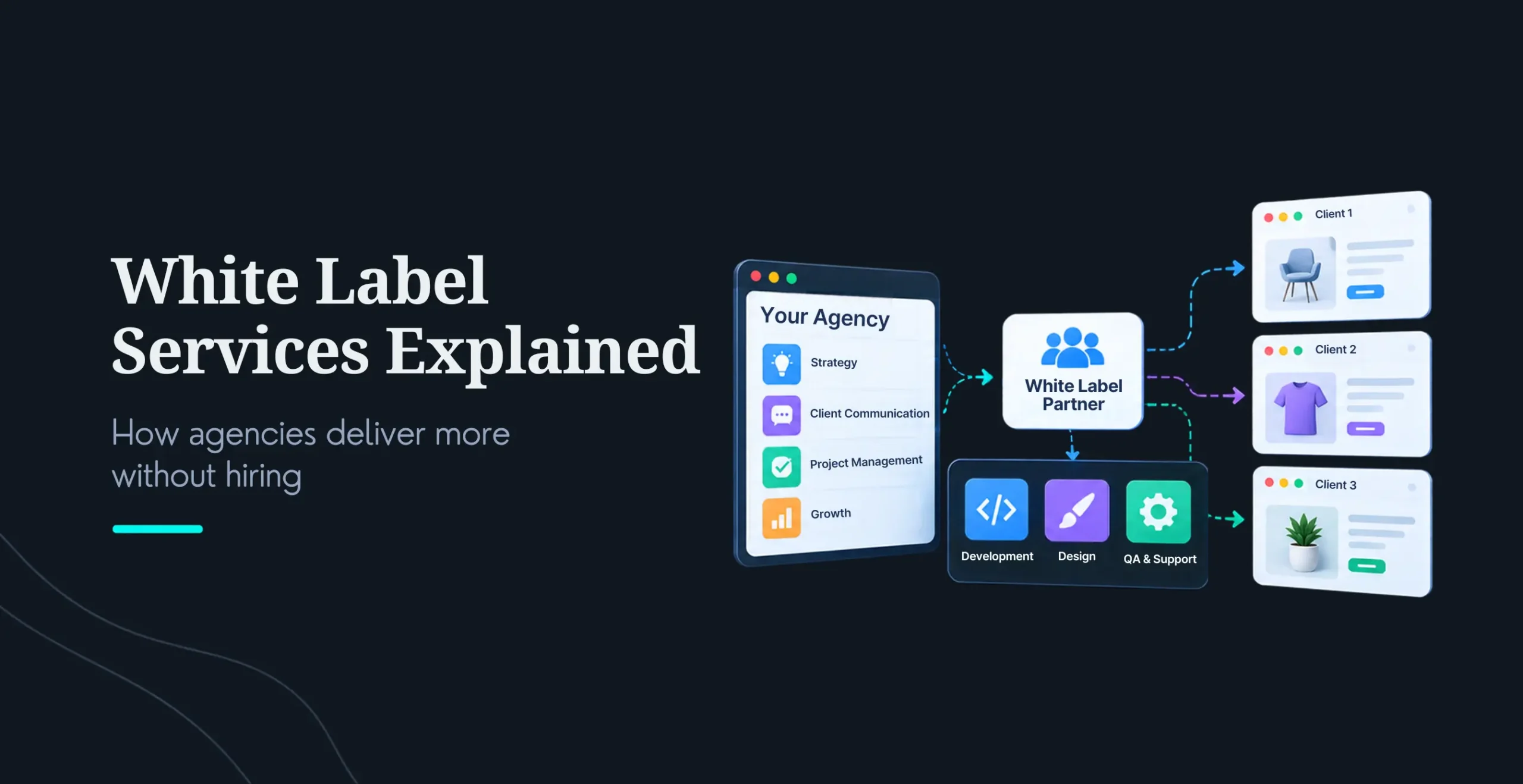
Pick a plan that matches your current workload. Submit tasks through whatever channel you already use. The project manager receives the brief, asks any clarifying questions before development starts, and coordinates delivery. Work comes back to you, reviewed and ready to present to your client. KrishaWeb is never in that chain.
That is genuinely how simple the operational model is. The complexity is on the partner’s side, which is the point.
What One Agency’s First Nine Months Looked Like
A seven-person digital marketing agency in the US had been winning brand strategy and SEO work consistently. Development kept coming up in client conversations, and they kept referring it out or losing the account to a full-service competitor.
They had tried two freelancers before. Both times ended with missed deadlines and the agency cleaning up someone else’s incomplete work on their own time.
They came in on the Pro plan at $1,518 per month. Within 60 days, they had accepted four development projects they would have previously declined. Within six months, web development was their highest-margin service line, billed at agency rates and sourced at white label rates.
By month nine, they were on the agency plan. Their team of seven had effectively become full-service without adding a single technical hire. Clients stopped shopping around for a separate development relationship because there was no longer a reason to. The agency was the single point of contact for everything.
What KrishaWeb Agency Partners Say
Partnering with KrishaWeb transformed our agency from a small consultancy into a full-service marketing company. Their reliability, broad technical expertise, and unwavering support gave us a clear competitive edge. — David Irby, Grove Agency
KrishaWeb enabled us to scale rapidly, expand services across multiple platforms, and compete at a higher level. They deliver consistently, earn complete trust, and operate as a true long-term technology partner. — Phillips Hara, Directory One
KrishaWeb has been a reliable CMS development partner for our UX agency. They translate complex designs into clean, scalable builds with precision, consistency, and clear communication, making collaboration seamless across projects. — Ryan O’Connor, Gobysavvy
Working with KrishaWeb was seamless from start to finish. They understood our requirements, communicated clearly, and delivered a website that perfectly represents our work. A reliable partner for high-quality web development. — Linne Garrett, 829 Design
120 agency partners across solopreneur shops and multinational firms. Verified on Clutch, Google, and GoodFirms.
Frequently Asked Questions
What is white label web development, and how does it work?
White label web development is when a third-party development team builds websites or web applications on behalf of your agency, and all the work is delivered under your agency’s brand. Your client sees it as your work. The development partner operates invisibly throughout the project. The arrangement requires an NDA, IP assignment to your agency, and a delivery process that keeps the partner’s involvement hidden from your client. It is different from standard outsourcing because it is structured specifically to be invisible; the partner does not appear in any deliverable, any communication, or any file.
How do I know if a white label development partner is reliable?
Four things separate reliable partners from unreliable ones. First, they sign an NDA before seeing any client materials without being asked twice. Second, they assign all IP to your agency as standard practice. Third, they deliver to a staging environment and give you a review period before anything goes to production. Fourth, they communicate proactively when something is taking longer than planned rather than going quiet. Partners who are reluctant on any of these four points are telling you something important about how they operate.
Will my client know a third party built their site?
Not unless you tell them or the partner breaks the confidentiality of the arrangement. The work is delivered under your brand. No partner branding appears in any deliverable. KrishaWeb’s white label agreements include a strict non-disclosure covering client identity and project details. Your agency presents the work as your own because it is delivered as your own, under your management and quality standards.
What technologies does KrishaWeb cover for white label development?
WordPress, WooCommerce, Shopify, Shopify Plus, Laravel, React, Next.js, Webflow, Magento, BigCommerce, and custom web application development. If your client project requires a specific stack, confirm it on the partnership call. Most agency overflow and service expansion requirements fall within these platforms.
How is white label development priced?
KrishaWeb quotes white label projects on a fixed-price basis after reviewing the brief. The fixed price gives your agency a known cost to mark up to the client. For ongoing agency retainer arrangements, a monthly rate is agreed based on the hours allocation required. We do not charge discovery call fees or require minimum project sizes for the first engagement. The partnership call is where we understand your agency’s requirements and confirm whether the partnership is the right fit.
How do I manage client communication during a white label project?
You manage the client relationship entirely. The partner communicates only with your agency, never directly with your client. You brief the partner, you review deliverables, you present work to the client, and you relay client feedback to the partner. The client’s understanding is that your agency’s development team is building their site. That is accurate: it is a team that works on development for your agency. The specific members of that team are an internal operational detail, not something you are obligated to disclose.
What is the minimum project size for a white label partnership with KrishaWeb?
There is no formal minimum. Most agency partners start with a single overflow project to validate the partnership before scaling to a regular arrangement. The partnership call covers your agency’s typical project types, volumes, and timelines so we can confirm the fit before any work starts.
Ready to Add Development Capacity Without Adding Headcount?
If your agency is turning down development work, stretching timelines to cover capacity, or quoting projects you do not have the stack to deliver, a white label partnership is the operational solution. The partnership call is 30 minutes. We cover your agency’s typical project requirements, the platforms you need covered, how you manage client communication, and what the first project handoff looks like.
KrishaWeb has been a white label development partner to agencies in the US, UK, Australia, and Europe since 2008. NDAs signed before the first brief. IP assigned to your agency on every project. No KrishaWeb branding in any deliverable. Your client never knows we exist. Book a Free White-Label Partnership Call: Tell us your agency’s typical project types, the platforms you need covered, and how quickly you need capacity. We will confirm the fit on the call.
Parth Pandya
Founder & CEO
Founder & CEO of KrishaWeb, leads an Enterprise Web Agency. With contributions to WordPress and organization of WordCamps, he pioneers innovation and community engagement in the digital realm.




 KrishaLabs
 KrishaStudio
 KrishaStore