Choosing a white label development partner is one of the highest-stakes decisions an agency makes, and it rarely gets treated that way. The reason it matters so much is simple: the partner’s work ships under your brand. Their missed deadline is your missed deadline. Their sloppy code is the bug your client emails you about at 9 pm. Their good week makes you look brilliant, and their bad one lands entirely on you.
So knowing how to choose a white label development partner is not a nice-to-have skill; it is the thing standing between “we scaled smoothly” and “we spent three months cleaning up after a partner and lost a client in the process.” The trouble is that most agencies choose based on a gut feeling from a sales call, which is exactly how the wrong partner gets in.
This is a repeatable, 15-point due-diligence checklist you can run on any white label partner before you sign anything. It is built for agency owners, ops leads, and procurement people who are past “considering” and into “selecting” and who would rather find the problems now than after the first client project is already live. If you want the wider context of how the model works, our white label web development guide covers that; this piece is purely about picking the right partner.
Table Of Contents
Table Of Contents
Why This Decision Matters More Than It Looks
It is worth sitting with the stakes for a moment, because they are easy to underestimate until you have been burned.
The core of it is that the partner’s mistakes become your client’s complaints. You are the named vendor. When something breaks, your client does not know or care that a partner built it; they know your logo was on the proposal. That is the whole deal you sign up for with white label, and it is fine, as long as the partner is good.
A good partner is genuinely transformative for an agency. It lets you take on more work than your team could handle, add capabilities you do not have in-house, and protect your margins, all without carrying the fixed cost of new hires. A bad one does the opposite: it costs you clients, dents your reputation, and burns months of momentum you cannot easily win back.
One thing worth saying plainly, because it trips up a lot of buyers: price is an unreliable signal here. Expensive does not mean excellent, and some of the best value comes from lean, process-driven teams whose rates look almost too reasonable. Judge the process and the protections, not the sticker. (If pricing itself is what you are trying to work out, our white label pricing models piece handles that separately.)
The 15-Point Agency Due Diligence Checklist
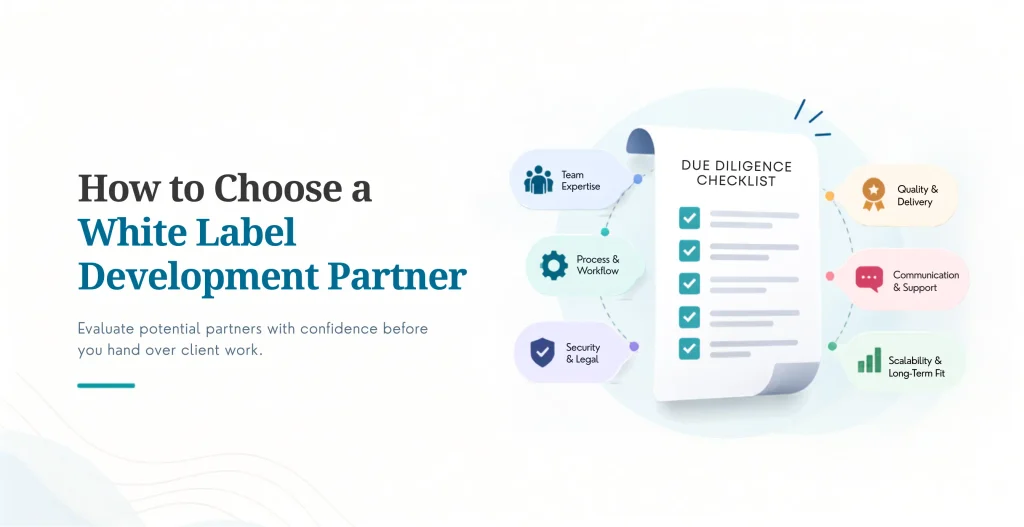
Here is the checklist, grouped into five things that actually matter: how they protect your brand, whether they can build, whether they can communicate, what the commercial terms really are, and whether they understand agencies at all. Run every candidate through all fifteen.
Confidentiality and brand protection
1. NDA and non-solicit terms. Ask directly: will you sign an NDA and a non-solicitation agreement before we share any client details? A good partner offers the NDA proactively, and the non-solicit covers both the engagement and a defined period afterward. Be wary of hesitation, drawn-out negotiation over standard terms, or any refusal to include non-solicit, because that is the clause protecting your client from being approached directly.
2. Client invisibility in deliverables. Ask how they stay invisible across reports, code, staging, and communication. What you want to hear: branded reports, neutral staging with no partner metadata, code repositories under your accounts, and zero direct client contact. What should worry you: partner branding on dashboards, the partner emailing your client, or visible partner domains and footprints anywhere in the deliverable.
3. Who actually does the work. Ask whether delivery is in-house or quietly brokered out to freelancers, and where the team sits. A confident partner names a consistent team, delivers in-house, and is clear about its structure and location. Vague answers, a rotating cast of contractors, or an unwillingness to tell you who will actually touch your projects are all reasons to slow down. (Our white label NDA and IP guide goes deeper on the confidentiality side.)
Technical capability and quality
4. Portfolio relevance and verifiable work. Ask to see live URLs or redacted examples similar to your typical projects. You want multiple live sites, in relevant stacks, from the last 12 to 18 months. Screenshots with no live links, or a portfolio with nothing in your complexity range, tell you little, screenshots are the easiest thing in the world to fake or borrow.
5. QA process in writing. Ask what their QA process actually is: code review, staging, performance, accessibility. A real answer includes documented QA gates, cross-browser testing, an awareness of Core Web Vitals, and a clear rework policy. “We check everything carefully,” with no written process and no examples, is not a QA process; it is a hope. This one matters more than it looks: Boehm and Basili’s peer-reviewed research (IEEE Computer, 2001) found that fixing a software problem after delivery can run up to 100 times more expensive than catching it at the design stage on large projects, closer to 5 times on smaller ones. A partner’s QA gates are you paying to catch problems early instead of on a live client site.
6. Tech stack breadth and currency. Ask which stacks they actively deliver, WordPress, Webflow, React, Laravel, Node, and so on. You want modern, supported stacks that match your common project types, and a partner who can discuss trade-offs between them. A one-framework shop, visibly outdated tech, or an inability to talk through why one stack over another are signs you will outgrow them fast.
Operational fit and communication
7. Timezone overlap and availability. Ask what hours your PM and their team will genuinely be available, not “we’re always on.” You want a defined overlap window and fast response times you can actually plan around. No clear hours, a 24-hour lag on every email, or a vague “we’re always available” with no specifics will quietly wreck your delivery schedule.
8. Single point of contact and a communication SLA. Ask who your named PM is and what their response-time commitments are. A named PM, clear channels (Slack, email, or your PM tool), and same-day responses to queries are what good looks like. Rotating contacts, no SLA, and a fuzzy “we respond quickly” mean you will spend your days chasing.
9. Turnaround times and an on-time track record. Ask for standard turnaround times on common project types, and, crucially, what their on-time rate was last quarter. A partner who tracks this can tell you. Clear timelines for landing pages, brochure sites, and retainers, plus a real on-time percentage, signal a team that measures itself. “A few weeks,” with no milestones and no internal tracking, signals one that does not.
Commercial terms and risk control
10. Pricing transparency and scope clarity. Ask exactly what the price includes and what triggers extra charges. You want clear scope, pages, revisions, content entry, support window, and a written rate card. Vague quotes, frequent change-order surprises, and no written scope are how a healthy-looking margin quietly disappears into disputes.
11. IP ownership and handover. Ask who owns the code, the designs, and the assets, and how handover works. The right answer is unambiguous: 100% IP and code ownership transfers to you on payment, with full repository access, credentials, and documentation. A partner who retains ownership, is vague about handover, or leaves you dependent on their hosting or licenses is one you cannot cleanly leave, which is a problem you only discover when you try.
12. Contract terms, minimums, and exit path. Ask about contract length, notice period, and exit and handover obligations. You want no long lock-ins, a reasonable notice period, and clear handover obligations if the relationship ends. Long minimums, no exit plan, and an unclear answer about what happens when you leave are all ways of trapping you.
Agency-specific experience and growth fit
13. Experience working with agencies. Ask what percentage of their work is white label for agencies versus direct clients. A partner whose majority is agency work understands brand protection, invisibility, and your workflows instinctively. One that mostly serves direct clients will keep forgetting they are supposed to be invisible, because it is not how they usually operate.
14. Reference quality and relevance. Ask to speak with one or two current agency partners doing similar work to yours. A confident partner will provide references, case studies, or redacted reports. No references, only end-client testimonials, or a blanket “we can’t, confidentiality” (the irony) should give you pause, a good white label partner protects confidentiality and can still connect you with a willing reference.
15. Willingness to run a paid pilot. Ask if you can start with a small, paid pilot before committing to anything larger. The right partner encourages it and scopes it clearly. Reluctance to be tested, or a push for a big commitment straight away, tells you they would rather you not see the work before you are locked in.
How to Run the Evaluation in Practice
The checklist gets you a shortlist. A structured bake-off tells you who is actually good.
Start by running the 15 points on paper against two or three candidates and cutting anyone with multiple red flags. Then send the same brief to the survivors, one real, contained piece of work: a landing page, a small module, an audit. Same brief, same deadline, so you are comparing like with like.
Score what comes back against five things: quality measured against your own written standards, whether they hit the deadline, how clearly they communicated along the way, how they handled revisions, and how their wholesale price maps to the retail rate you would charge a client. That last one matters, a partner whose work is great but whose pricing leaves you no margin is not a fit.
Pick one winner, and start with one real client project before you route everything to them. Expand service by service as they earn it. The cost of running a proper bake-off, a few small paid briefs, is trivial next to the cost of a failed partnership discovered three client projects deep. Our white label web development guide has more on structuring the rollout.
Want this checklist in a form you can score?
Download the free White Label Partner Scorecard, run it on your finalists, then book a partnership call.
Red Flags That Should Disqualify a Partner on the Spot
Some warning signs are worth a conversation. These are worth walking away over:
Refusal to sign an NDA or non-solicit. The single fastest disqualifier. If they will not protect your client on paper, nothing else matters.
Guaranteed rankings, ROAS, or outcomes they do not control. Anyone promising results that depend on factors outside their hands is either naive or dishonest, and neither is what you want on a client project.
No verifiable work or references after you have directly asked. One ask can be a scheduling issue. A pattern of dodging is an answer.
Prices dramatically below any plausible cost of competent labor. A rate that seems too good to be true is usually pricing in corners you will discover later, in rework.
Chaotic sales communication. Late replies, changing quotes, unanswered questions. The sales process is the best behavior you will ever see. If it is messy now, delivery will be worse.
No named team members anywhere, on the site, on LinkedIn, in the proposal. Real teams have faces.
An inability to explain their own process step by step. If they cannot describe how they work, they do not have a repeatable way of working.
A partner who never asks about your clients, your positioning, or your standards. A good partner is interviewing you too. Total incuriosity means you are just a ticket to them.
One amber flag is often survivable, and worth a direct conversation. Several red flags together mean keep looking. The whole point of this checklist is that you get to find these out before a client is involved, not after.
How KrishaWeb Handles Each of These 15 Points
Since it would be a bit rich to publish a vetting checklist without answering it ourselves, here is how we do on it.
On confidentiality and brand protection, we offer the NDA and non-solicit as standard before any client details change hands, deliver everything fully branded on neutral staging with no direct client contact, and run delivery through an in-house team with named account leads.
On technical capability and quality, we can show live, verifiable projects across WordPress, Webflow, React, Laravel, and more, we work to a documented QA process with staging reviews and performance checks, and we keep a broad, current stack that maps to the briefs agencies actually bring us.
On operational fit and communication, we commit to a defined timezone overlap and response-time SLAs, give you a named project manager and clear channels, and hold standard turnaround times with internal tracking of on-time delivery.
On commercial terms and risk control, our pricing is transparent with clearly defined scope, IP and code ownership transfer to you fully on payment with a clean handover, and our contract terms are reasonable, with a fair notice period and defined exit obligations.
And on agency fit, the majority of our work is white label for agencies, references are available, and we are happy, in fact we prefer, to start with a paid pilot before any larger commitment. That is exactly what our white label web development services are built around.
How do I choose a white label development partner?
Use a structured checklist covering five areas: confidentiality, technical capability, communication, commercial terms, and agency experience. Score two or three candidates on paper, then run a small paid pilot with the front-runner before committing significant volume. The pilot reveals more than any sales call.
What questions should I ask a white label partner?
Ask about NDA and non-solicit terms, how they stay invisible to your client, who actually does the work, their written QA process, their turnaround times and on-time rate, IP ownership and handover, exactly what their pricing includes, and for references from similar agencies.
Is a paid pilot necessary when choosing a white label partner?
It is highly recommended. A small, real, paid project shows you their true quality, communication, and reliability in a way a portfolio and a sales call cannot. It is the cheapest insurance you can buy against a bad partnership.
What are the biggest red flags in a white label partner?
Refusal to sign an NDA or non-solicit, no verifiable work or references, prices far below plausible cost, chaotic sales communication, and no clear process or named team. Several of these together mean keep looking.
Should I choose a white label partner based on location?
Location matters far less than communication quality, process maturity, and contractual protection around IP, confidentiality, and handover. A well-run team with a defined overlap window and strong process beats a conveniently located one without those things.
Ready to Evaluate Partners With a Real Brief?
If you have a shortlist and want a second opinion, or you would rather just run a real brief and see the work, we are glad to help with either, no pressure. We work with agencies across a wide range of platforms and project types, so we can be straight with you about where we fit and where we might not.
Founder & CEO of KrishaWeb, leads an Enterprise Web Agency. With contributions to WordPress and organization of WordCamps, he pioneers innovation and community engagement in the digital realm.




 KrishaLabs
 KrishaStudio
 KrishaStore