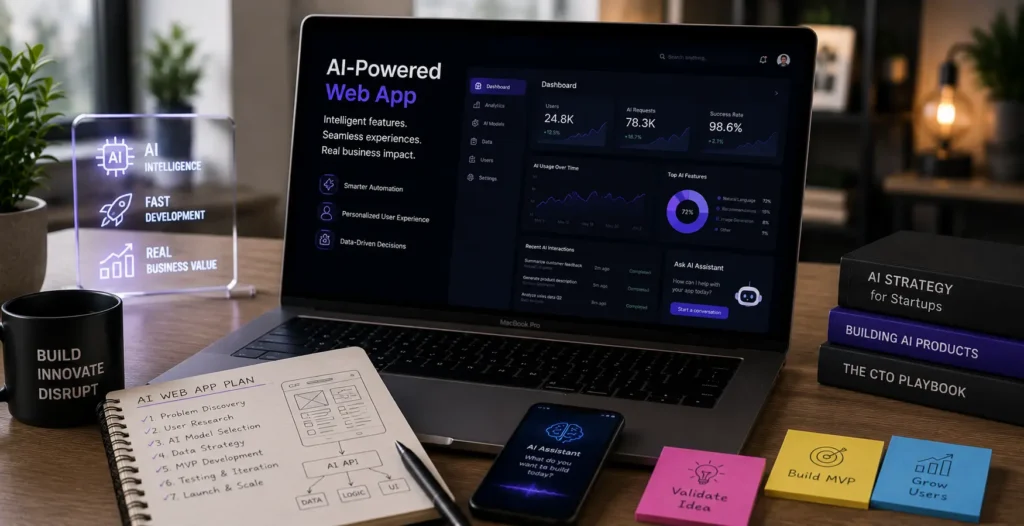
A founder or a CTO sits down with us, says they want to add AI to their product, and then waits for me to be excited. And I am, usually. But my first question is always the same, and it always catches people off guard.
Table Of Contents
Table Of Contents
What, specifically, do you want the AI to do?
About half the time, the answer is some version of “make the app smarter.” That answer has killed more AI budgets than any technical failure ever has. So before we talk stacks, costs, or timelines, I want to walk you through how we actually think about this at KrishaWeb, because we have been building web applications since 2008, and the AI projects that work all start the same way. With a painfully specific answer to that one question.
The money flowing into this space is absurd, by the way. Gartner says worldwide AI spending hits $2.52 trillion in 2026. Stanford’s AI Index tracked enterprise generative AI adoption going from 33% to 71% in two years. I am not quoting those numbers to impress you. I am quoting them because they explain why your competitors are all having this same conversation right now and why getting it wrong is more expensive than it used to be.
Three very different things people mean by “AI app”
When someone says they want an AI-powered web app, they mean one of three things. Often they do not know which one. The confusion between them is where projects die.
The first kind: AI helps users do something faster. A chatbot in the support portal. A dashboard that flags weird numbers before you notice them. A writing tool that suggests the next sentence. The app works fine without the AI. The AI just makes it better. Most businesses should start here, and honestly, most businesses should stop here too.
The second kind: the AI is the product. Take it out, and there is no product left. A legal research tool that reads case law for you. A financial platform that builds scenario models from a plain English prompt. Harder to build. Much more expensive. But when it works, you have something a competitor cannot copy by installing a plugin.
The third kind: the AI acts on its own. It does not wait for a user to click something. It calls APIs, writes to databases, makes a decision, and executes it. These are agents, and the numbers here tell a story worth pausing on. Digital Applied’s 2026 research found 79% of enterprises have adopted AI agents in some form. Production deployments? 11%. Four out of five companies are playing with agents. One in nine has actually shipped one. That gap is not a technology gap. It is a trust and reliability gap, and closing it is genuinely hard.
Figure out which of the three you are building before anyone writes a spec. Everything downstream changes depending on the answer. The budget. The team. The timeline. The risk.
What AI can actually do inside your app
Strip away the marketing language, and there are four jobs.
It can personalize. Different users see different things based on who they are and what they have done. AppVerticals ran the numbers on this in their 2026 analysis: apps with AI personalization convert at four times the rate of apps without it. Four times. That stat sounds inflated until you remember what generic software feels like to use.
It can understand plain language. Your users type “show me late projects over budget” instead of clicking through four filter menus. Every enterprise client underestimates this feature before launch. None of them would give it up after.
It can generate things. Drafts, summaries, reports, product descriptions. The compliance report that took a lawyer three hours now takes twelve minutes plus a review pass. This is the most visible AI capability and the one with the most landmines, because generated output is only as trustworthy as the validation around it.
It can predict and flag. Churn risk. Fraud patterns. The inventory problem that becomes visible in the data three weeks before it becomes visible in the warehouse. Clearest ROI of the four. Also, the hungriest for clean data, which brings me to the thing I actually want to warn you about.
The stack decisions that land on your desk
I will skip the architecture diagrams. Developers have plenty of guides. These are the calls a CTO actually has to make.
Which model?
OpenAI, Anthropic, Google, or open source. OpenAI has the biggest ecosystem. Claude does better on careful reasoning and makes things up less often on analytical work. Gemini makes sense if you live in Google Cloud. Open source models like Llama mean your data never leaves your servers, which for some regulated industries is not a preference; it is the law.
Here is the only advice that matters: test your actual task before committing. We have watched the benchmark-winning model lose to a cheaper one on a client’s specific use case more times than I can count. Benchmarks are someone else’s problem. Your data is your problem.
Backend.
Use what your team knows. I mean it. Laravel 13 with Prism is our default for enterprise builds. Node with the Vercel AI SDK when the project is React-heavy. Python when there is real ML work involved. But the worst decision you can make is rebuilding your foundation to add an AI feature. The AI layer sits on top of your stack. It is not a reason to replace it.
Frontend.
React and Next.js lead because the AI tooling is React-first and streaming interfaces just work. Already on Vue or Angular? Stay there. The gap is smaller than the cost of switching.
Vector database.
If your AI needs to know about your content, your products, or your documents, you need one. Pinecone, Weaviate, or Chroma. This is the difference between a chatbot that knows your actual refund policy and a chatbot that confidently invents one.
What this costs, with real numbers
Most cost guides online are either bait or so vague they are useless. Here is what we actually see.
One AI feature added to an existing app, a chatbot, smart search, or a content generator: $8,000 to $20,000.
A new AI-assisted application built from scratch: $25,000 to $75,000 for an MVP that is a real product, not a demo.
An AI-native application, where the AI is the product: $75,000 to $250,000. The jump is real because the AI quality is the product quality. There is nowhere to hide a mediocre model.
Agents that act autonomously: $150,000 and up. The development is one cost. The monitoring, safety rails, and reliability work that lets you sleep at night while software makes decisions unsupervised is the other cost, and it is not optional.
Now the part nobody puts in the proposal. Running costs. AI workloads push cloud compute bills up 60 to 70% at scale, per AppVerticals. Hosted model APIs charge per token, which means costs scale with success. We have seen teams celebrate adoption numbers in month two and panic at the API invoice in month three. Budget infrastructure separately from development, and model it against your growth projections, not your launch traffic.
McKinsey found companies running AI at scale gained 20 to 40% productivity in certain functions. The return is real. It is just not free, and it is not front-loaded.
Where AI projects actually die
Not in the idea. Not in the demo. The demo always works. They die in production, and they die in one of four places.
Bad data.
This is the big one. An AI-generated product description from your catalog produces garbage if the catalog is inconsistent. We now audit a client’s data before scoping any AI project, because the audit keeps changing the scope. If I could make every founder do one thing before approving an AI budget, it would be this. Look at the data the AI will eat. Honestly. Before you spend anything.
Slow responses.
Users give you about two seconds. An LLM call can take eight. If your AI feature makes someone stare at a spinner, they will stop using it no matter how good the output is. Streaming, async processing, caching. These are architecture decisions made at the start, not optimizations bolted on later.
Hallucinations without a plan.
Every model gets things wrong. In a general chatbot, embarrassing. In a legal tool or a financial product, a liability. Production apps need output validation, confidence thresholds, and human review on anything high-stakes. Put it in the spec on day one. The teams that add it after their first incident pay triple.
No feedback loop.
An AI product that does not learn from its failures stays exactly as good as launch day while everything around it improves. Capture what users correct, what they reject, and where the model fails. Feed it back. This never shows up in a demo, which is exactly why most builds skip it, and it is the single biggest difference between AI products that compound and AI products that rot.
Four questions before anyone writes a spec
What exactly will the AI do?
One sentence. A success number attached. “Cut tier-one support handling from four minutes to thirty seconds” is a spec. “Make the app smarter” is a wish.
What data does that need, and what shape is that data really in?
Not what shape you assume. Go look.
What happens when the AI is wrong? Because it will be. Is the consequence a shrug or a lawsuit?
The answer sets your validation budget.
How will you know it worked?
Pick the metric before you start. If you cannot define success up front, you will not recognize it later, and neither will your board.
Timelines, honestly
A feature on an existing app: four to eight weeks. An AI-assisted MVP: twelve to twenty weeks. AI-native: twenty to forty. Add two to four weeks up front for discovery and the data audit. That feels like a delay. It is insurance.
Some shops advertise 40 to 60% faster delivery with AI-assisted development teams, and on tightly scoped projects, the compression is real. We see it in our own work. But no AI accelerates a project with fuzzy requirements or dirty data. It just produces the wrong thing faster.
What is worth building right now?
Not everything needs to be custom. Plenty of problems are solved by wiring an existing tool into your workflow. But four categories are worth real investment in 2026 because the advantage they create is yours alone.
Internal knowledge tools. Your team asks questions in plain language and gets sourced answers from your own documentation. The company that has this beats the company whose employees are still searching through shared drives. It is not close.
Customer-facing AI trained on your actual business. Your pricing, your policies, your edge cases. A generic chatbot with your logo is a different species from this.
Operational AI watching your data for trouble. Churn signals, delivery exceptions, budget drift. For any business complex enough to generate the data, these pay for themselves embarrassingly fast.
Document intelligence. If your business produces or consumes contracts, specs, or compliance paperwork in volume, this is where the most immediate ROI in the entire AI space currently lives. Ask any law firm that has deployed it.
How much does AI web application development cost in 2026?
A single AI feature on an existing app: $8,000 to $20,000. A new AI-assisted MVP: $25,000 to $75,000. AI-native products start at $75,000. Autonomous agents start at $150,000. Infrastructure and API costs come on top and grow with usage, so model them against your growth, not your launch.
How long does it take?
Four to eight weeks for a feature. Twelve to twenty for an AI-assisted MVP. Twenty to forty for AI-native. The discovery and data audit up front adds a few weeks and removes most of the project risk, which is the best trade in software.
What is the difference between AI-assisted and AI-native?
“AI-assisted” means the app works without the AI; the AI makes it better. “AI-native” means the AI is the product. Remove it, and nothing is left. The second costs more, takes longer, and is far harder to copy.
Do I need to train a custom model?
Probably not. Most enterprise apps need a foundation model connected to your own data through retrieval (RAG), not a custom-trained model. Custom training enters the picture when your domain is too specialized for foundation models, or your data legally cannot touch a hosted API. Exhaust the retrieval approach first. It goes further than people expect.
What is the biggest risk?
Data quality. Teams scope, build, and launch before checking whether the data the AI depends on is clean. Second biggest: shipping generation features into high-stakes contexts with no hallucination plan. Both are cheap to handle in the spec. Both are brutal to fix after launch.
Build a custom tool or buy one?
If an existing tool covers 80% of the problem and the last 20% is not your competitive edge, buy. Build when the AI is the differentiator, when your data cannot leave your walls, or when per-seat SaaS pricing across your whole team starts to cost more than building once.
Build Your AI App with KrishaWeb
We handle the full path: discovery, data audit, architecture, build, launch, and the iteration after launch where AI products actually get good. Building web applications since 2008. Building AI into them since before it was the obvious move.
If the build decision is sitting in front of you, bring us the use case. We will tell you what it really costs, how long it really takes, and whether you should build it at all.
Founder & CEO of KrishaWeb, leads an Enterprise Web Agency. With contributions to WordPress and organization of WordCamps, he pioneers innovation and community engagement in the digital realm.




 KrishaLabs
 KrishaStudio
 KrishaStore