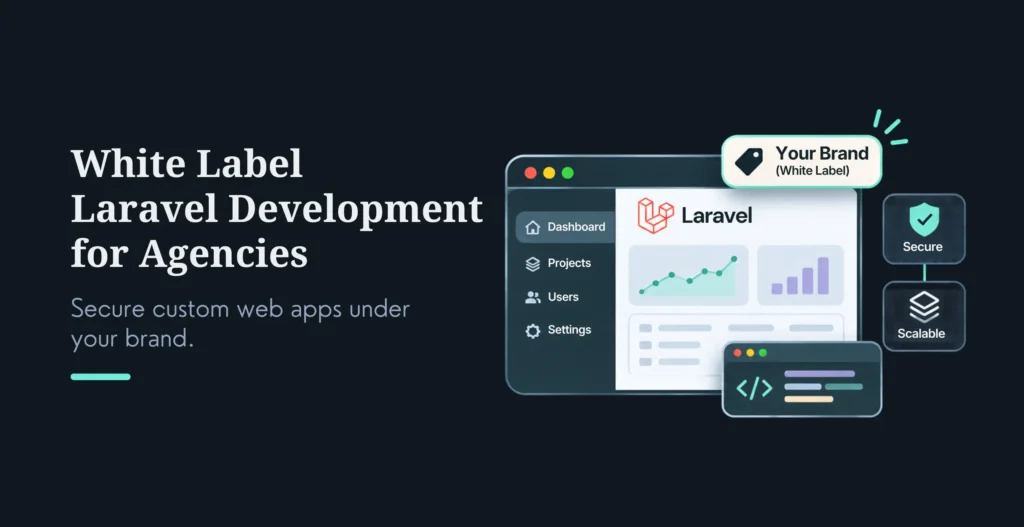
Your client needs a real application, a SaaS platform, a customer portal, a complex integration, not another CMS site, and that means Laravel. But hiring a senior Laravel engineer is expensive, slow, and hard to keep busy between projects, so the work either gets turned away or forced onto a platform it doesn’t fit. White label Laravel development solves that: senior Laravel capacity under your own brand, delivered invisibly, without adding headcount.
White label Laravel development is an arrangement where a specialist engineering team builds custom Laravel web apps, SaaS products, APIs, and integrations under your agency’s brand, contracts and invoices with you rather than your client, and stays invisible to that client for the entire engagement. You own the relationship, the pricing, and the brand; the partner supplies the engineering and the IP transfers to you on delivery. It runs on a repeatable handoff, you scope and sell, the partner builds under NDA with milestone reviews, and you deliver it as your own, with the whole thing protected by an NDA signed before any client detail is shared, full IP assignment, staging access throughout, and a strict no-direct-client-contact rule. As planning ranges, engagements run from monthly retainers (~700–3,500/month for 30-200 hours) to hourly (~20–95 depending on seniority and geography) to fixed-price projects ($2,500 for a focused app up to $150,000+ for custom multi-tenant SaaS).
This is the decision playbook for agency owners and technical leads adding Laravel to their menu: what it is, why agencies use it, exactly how the handoff works, how invisibility and IP are protected, the real 2026 Laravel stack to expect, pricing, and how to vet a partner (including the Laravel Partner Program check most agencies skip). Not being able to take complex application work is one of the bottlenecks that stall agency growth, and this clears it. It’s the model behind our own white label development.
Key Highlights
What it is: A specialist team builds custom Laravel apps, SaaS, APIs, and integrations under your brand, invisible to your client, contracting and invoicing only with you. You keep the client and margin; the IP transfers to you.
Why agencies use it: To take on complex application work (where a CMS is the wrong answer), SaaS and product builds, and overflow, with senior Laravel engineers available in days, not the months a hire takes.
The handoff (4 stages): you scope and sell → hand off to the partner under NDA → the partner builds and QAs against milestones (commonly 25/50/75/100%) on a staging environment you can access → you deliver it as your own.
The invisibility and IP safeguards: NDA before any client detail is shared (covering identity, scope, specs, commercial terms), full IP assignment on delivery, deliverables branded only to you, and the partner never contacting your client.
The real 2026 stack: Laravel 13 (current; released March 17, 2026; requires PHP 8.3 or newer) with PostgreSQL/MySQL, Redis, Horizon, Telescope, Pest, Filament, Inertia + React + TypeScript + Tailwind, Cashier/Stripe, deployed on Forge or Vapor. Laravel 12 gets security fixes only, until February 24, 2027.
Pricing (vendor-reported ranges): retainers ~700–3,500/month, hourly ~20–95, projects 2,500–150,000+. Verify with a scoped quote.
The vetting step most agencies skip: check the partner against the official Laravel Partner Program at laravel.com/partners, it’s vetted by the Laravel team, not a paid listing, and agencies report fewer than ~50 hold it worldwide. Plus: ask them to describe their QA process unprompted.
Table Of Contents
Table Of Contents
What White Label Laravel Development Is
At its core, it’s invisible, branded engineering. A specialist team builds the software under your brand, contracts and invoices with you (not your client), and stays out of sight for the whole engagement, no appearance in any deliverable, communication, or file. That invisibility is what distinguishes it from ordinary outsourcing, where the vendor may be visible to or in contact with the end client. With white label Laravel specifically, the partner builds, your client sees only your agency, and the code and IP become yours on delivery.
The scope is whatever Laravel is genuinely good at, which is custom application work rather than brochure sites: bespoke web applications where a CMS would be a poor fit, backend systems with complex requirements, full SaaS product builds (including multi-tenant architectures), APIs, admin dashboards, third-party integrations, and billing via Laravel Cashier and Stripe. The technical standard to expect from a serious partner in 2026 is specific, and worth knowing so you can judge one: Laravel 13 (the current major version, released March 17, 2026; it requires PHP 8.3 and supports up to 8.5) on PHP 8.3 or newer, with PostgreSQL or MySQL (properly indexed), Redis for cache/queue/session, Laravel Horizon for queue monitoring, Telescope for debugging and Sentry for production error tracking, Pest for tests, Filament for admin panels, Inertia.js with React, TypeScript, and Tailwind for customer-facing SaaS, Laravel Cashier (Stripe) for billing, and deployment on Laravel Forge or Vapor. A partner who can’t speak fluently to that stack isn’t current. Nor is one starting new projects on Laravel 11 or older (Laravel 11 has had no security fixes since March 12, 2026), or on Laravel 12 without a reason such as a PHP 8.2 constraint: Laravel 12’s bug fixes ended August 13, 2026 and its security fixes end February 24, 2027. Laravel 14, expected in Q1 2027, will require PHP 8.4. For what changed in the current release, see our guide to Laravel 13’s key features, and for our own work, our Laravel development page.
Why Agencies Use White Label Laravel Development
The reasons cluster into four, and they’re all about taking on work you otherwise couldn’t. The first is capacity: you’ve won a project you can’t staff, or you need a second team that will deliver without trying to own your client relationship. A white-label partner can supply senior Laravel engineers in days under your brand, with none of the hiring, onboarding, or headcount overhead, so you can say yes to work that would otherwise be declined. The second is complex applications: Laravel is the right tool precisely when a CMS is the wrong answer, and enterprise and serious SaaS clients increasingly won’t accept generalist web builds, so an agency that can deliver real application work wins the business that a WordPress-only shop loses.
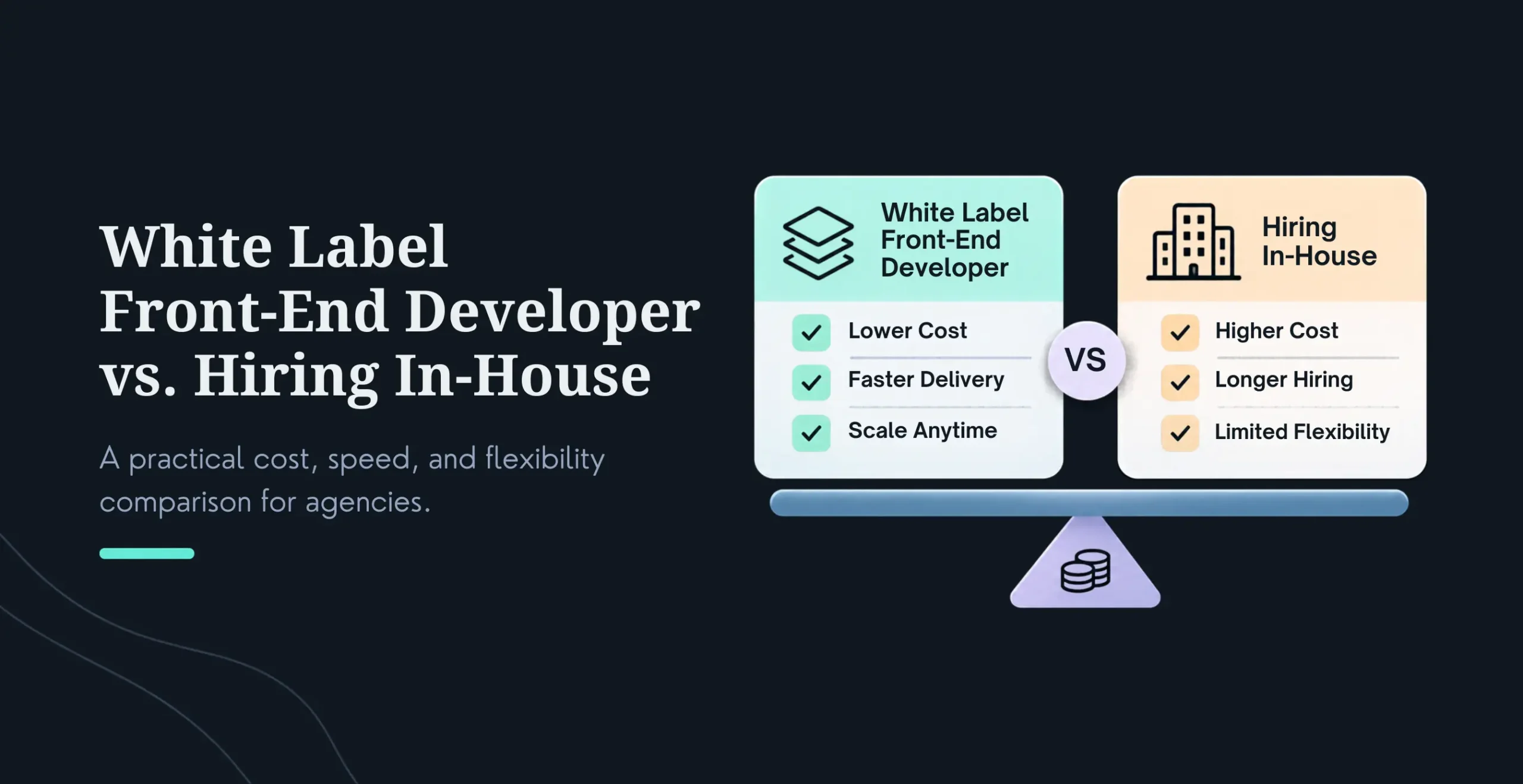
The third is SaaS and product builds: when a client is launching a software product or adding a software layer to their business, that’s custom Laravel work, multi-tenant architecture, subscription billing, API design, and it’s high-value (custom SaaS and multi-tenant builds commonly run into six figures). White label lets you offer that without a product-engineering team on payroll. The fourth is modernization and inherited codebases: the project nobody on your team wants to open, a legacy app that needs rescuing or extending, is exactly the kind of senior work a specialist partner handles well. Across all four, the common thread is the same: white label Laravel turns “we don’t do that” into “yes, we can build that”, under your brand, which is what lets an agency move upmarket. If you’re weighing this against building the capability yourself, our agency vs in-house cost breakdown runs the math, and the mechanics overlap with outsourcing development work generally.
How the Handoff Works
The engagement follows a repeatable four-stage handoff, and understanding it lets you set accurate expectations with your client, which is half your job as the agency of record. Stage one, sales and scoping: you win the client, gather requirements, and define the brief, ideally bringing the partner into the technical scoping early (before the client proposal is final) so the estimate is grounded in reality. Stage two, handoff under NDA: the brief, wireframes, and technical specs pass to the partner, who signs an NDA before receiving any project detail or client name, covering client identity, project scope, technical specifications, and commercial terms. Stage three, build and QA: the partner develops, tests, and refines against milestones (commonly checkpoints at 25%, 50%, 75%, and 100% completion), working in a staging environment you can access throughout, with a documented QA process rather than ad-hoc developer self-review. Stage four, branded delivery: you review, approve, and deliver the finished work to your client, with your branding on every deliverable from code comments to the final invoice, full IP transferred to you (or your client), and the partner never having contacted the client, unless you deliberately bring them onto a call as part of your team.
The discipline that makes this work rather than becoming chaos is the milestone structure and the staging access: because you can see the build at each checkpoint on an environment you control, there are no surprises at handover, and because the IP transfers cleanly on delivery, you own what you sold. A partner who resists milestone visibility or staging access is a partner to avoid.
How It Stays Invisible, and How Your IP Is Protected
Invisibility and IP protection are the two things an agency owner worries about most, and with a professional partner both are contractual, not hopeful. The invisibility: the partner communicates only with your agency, never your client; every deliverable, the code, Artisan outputs, documentation, handover notes, carries your name only; and there’s no trace of the partner in any file or communication. The protection: an NDA signed before any briefing (covering client identity, scope, specs, and commercial terms), full IP assignment transferring to you or your client on delivery, and, from the better partners, operational security details worth asking about, access provisioned per named engineer and revoked when they leave, a commitment that your client’s data is never used to train models, and a documented handover process where access is removed and local copies deleted with written confirmation within a few working days.
Those specifics are how you tell a serious partner from a risky one. “We work white-label” is a claim; an NDA you sign before sharing anything, a clean IP-assignment clause, staging you control, and per-engineer access logging are the mechanisms that make it real. The single most important of these is clean IP transfer, confirm in writing that you own the code and data on delivery, with nothing carved out, because that’s what you’re actually selling your client. The vetting rigor here is the same you’d apply to a client choosing a web design agency.
White Label Laravel Development Pricing
Treat these as vendor-reported 2026 planning ranges that vary with scope, seniority, and geography, and get a scoped quote. There are three common models. Monthly retainers suit ongoing, predictable capacity and run roughly $700/month for ~30 hours up to $3,500/month for 200+ hours, with the tiers typically scaling what’s included: an entry tier covers a Laravel API or small app with tests and handover docs; a mid tier adds full app builds, admin dashboards, integrations, and queues; a higher tier adds multi-tenant SaaS, Stripe billing, Vapor/Forge deployment, a dedicated project manager, and an OWASP security audit; and an enterprise tier adds a dedicated team, parallel capacity, and a custom SLA. Hourly suits variable or sprint-based work and runs roughly 20–45/hour for offshore talent up to 60–95/hour for senior Central/Eastern European engineers. Fixed-price projects suit defined scope: a focused Laravel web app commonly runs 2,500–10,000, while a custom SaaS, multi-tenant build, or AI-integrated product runs 25,000–150,000+, with simpler entry-level builds in the 1,000–5,000 range. For a dedicated resource, see our dedicated developer option.
Which model fits comes down to scope certainty and workload: fixed-price when the scope is well-defined and you want no surprises, hourly when scope is fluid or you’re working sprint to sprint, and a retainer when you have steady, ongoing Laravel demand you want to cap at a predictable monthly cost. Annual or quarterly retainer commitments often carry a 10-15% discount. Whatever the model, your margin is yours to set, and the usual agency markup (on top of the partner’s cost, reflecting the strategy, PM, and client relationship you own) applies.
How to Choose a White Label Laravel DevelopmentPartner, and the Risks to Manage
Vet a Laravel partner on both standard criteria and two that are specific and high-signal. The first specific check, and the one most agencies skip, is the Laravel Partner Program: verify the partner against the official directory at laravel.com/partners. This is Laravel’s own program, operated by Laravel LLC (Taylor Otwell’s company), where agencies are vetted by the Laravel team for technical capability, track record, and ecosystem contribution, it’s not a paid listing, agencies report that fewer than ~50 worldwide hold it, and there are tiers (Community and the more select Premier). A verified partner isn’t the only good option, but it’s third-party-validated capability versus a self-declared marketing claim, so it’s worth checking rather than taking an agency’s word. Two honest notes: Laravel does not publish a total count on its own page (the “fewer than ~50” figure comes from partner agencies; one August 2026 report puts the Premier tier at 13), and the program is also a commercial channel for Laravel Cloud, where partners earn referral commissions, so treat partner status as a strong vetting signal, not a guarantee about any single project. The second specific check: ask the partner to describe their QA process unprompted. A serious Laravel shop can immediately tell you what happens between code completion and deployment (tests, milestone reviews, code review, security checks); one that can’t has no structured QA beyond developer self-review, which is a real risk when the work ships under your name.
The rest of the vetting: demonstrable, recent experience in the stack you sell; references from agency partnerships specifically (more predictive than general client testimonials); a clear, written scope-creep and change-request process (who identifies it, how it’s communicated, how it’s priced); a real discovery or technical-planning phase (ambiguity at the start creates problems at the end); willingness to work inside your tooling and conventions; and the invisibility/IP safeguards above, NDA before briefing, clean IP transfer, staging access, no direct client contact. A strong, low-risk way to evaluate before committing is a small paid discovery task on a real brief, judged against your own quality bar. The risks are the mirror image of these checks, unstructured QA, undefined scope-creep handling, ambiguity at kickoff, and client exposure, and each is mitigated by choosing for the criterion it violates. None should stop you using white label Laravel; all should shape the contract and the partner you pick.
It’s an arrangement where a specialist engineering team builds Laravel web applications, SaaS products, APIs, and integrations under your agency’s brand, contracts and invoices with you rather than your client, and stays invisible to that client for the entire engagement. You own the client relationship, the pricing, and the brand; the partner supplies the engineering, and the code and IP transfer to you on delivery. It’s distinct from ordinary outsourcing because it’s structured specifically to be invisible, the partner appears in no deliverable, communication, or file.
Why would my agency use white label Laravel development?
To take on work you otherwise couldn’t: complex custom applications (where a CMS is the wrong answer), full SaaS and product builds, and overflow capacity, with senior Laravel engineers available in days rather than the months a hire takes, and no headcount overhead. Enterprise and serious SaaS clients increasingly reject generalist web builds, so being able to deliver real Laravel application work wins business a WordPress-only shop loses. It lets a lean agency move upmarket into high-value custom and SaaS work without building a product-engineering team on payroll.
How does white label Laravel development work?
A four-stage handoff. You win the client, gather requirements, and define the brief (ideally involving the partner in technical scoping early). The partner signs an NDA before receiving any project detail or client name, then receives the brief, wireframes, and specs. They build and QA against milestones (commonly 25/50/75/100%) on a staging environment you can access throughout, with a documented QA process. Then you review, approve, and deliver it to your client as your own work, with your branding on every deliverable, full IP transferred to you, and the partner never having contacted the client directly.
How does it stay invisible, and how is my IP protected?
Both are contractual. Invisibility: the partner communicates only with your agency (never your client), and every deliverable, code, documentation, handover notes, carries your name only, with no trace of the partner anywhere. IP: an NDA signed before any briefing (covering client identity, scope, specs, and commercial terms) plus full IP assignment transferring to you or your client on delivery. The better partners add operational safeguards worth asking about: access provisioned per named engineer and revoked on exit, no use of your client’s data to train models, and documented deletion of access and local copies at handover. Confirm clean IP transfer in writing, with nothing carved out.
What Laravel stack should a white label partner use in 2026?
The current standard: Laravel 13 (released March 17, 2026; PHP 8.3 to 8.5) on PHP 8.3 or newer, with PostgreSQL or MySQL (properly indexed), Redis for cache/queue/session, Laravel Horizon for queue monitoring, Telescope for debugging and Sentry for production error tracking, Pest for tests, Filament for admin panels, Inertia.js with React, TypeScript, and Tailwind for customer-facing SaaS, Laravel Cashier (Stripe) for billing, and deployment on Laravel Forge or Vapor. A partner who can’t speak fluently to this stack isn’t current. Starting a new project on Laravel 11 or older (no security fixes since March 12, 2026) is a red flag, and Laravel 12 is now security-fixes-only until February 24, 2027, so it suits only a project with a specific reason, such as a PHP 8.2 constraint. This matters for both security and maintainability.
How much does white label Laravel development cost?
Vendor-reported ranges: monthly retainers roughly 700–3,500/month (for ~30 to 200+ hours); hourly roughly 20–45 offshore up to 60–95 for senior Central/Eastern European engineers; fixed-price projects 2,500–10,000 for a focused Laravel web app, 25,000–150,000+ for custom SaaS, multi-tenant, or AI-integrated builds, and 1,000–5,000 for simpler entry-level work. Annual or quarterly retainers often carry a 10-15% discount. Choose fixed-price for defined scope, hourly for fluid or sprint work, and a retainer for steady ongoing demand. Verify with a scoped quote, complexity and integrations drive the figure.
How do I choose a white label Laravel partner?
Two high-signal checks first: verify them in the official Laravel Partner Program at laravel.com/partners (vetted by the Laravel team, not a paid listing, agencies report fewer than ~50 worldwide), and ask them to describe their QA process unprompted (a serious shop can immediately explain what happens between code completion and deployment). Then: demonstrable recent experience in your stack, references from agency partnerships specifically, a written scope-creep/change process, a real discovery phase, willingness to work in your tooling, and the invisibility/IP safeguards (NDA before briefing, clean IP transfer, staging access, no direct client contact). A small paid discovery task is the best final test before committing.
What is the Laravel Partner Program, and does a partner need to be in it?
It’s Laravel’s official agency directory, operated by Laravel LLC (Taylor Otwell’s company) and founded in 2017, where agencies are researched and vetted by the Laravel team for technical capability, project track record, and ecosystem contribution. It’s not pay-for-play, agencies report fewer than ~50 hold the status, and it has two tiers (Community and the more select Premier, with Premier partners working directly with Laravel’s team). A partner doesn’t have to be in it to be good, but membership is third-party-verified capability rather than a self-declared claim, so it’s a strong trust signal, and checking the directory at laravel.com/partners is a free, quick way to validate an agency’s claim.
What are the risks of white label Laravel development, and how do I avoid them?
Four, each mitigated by a vetting check. Unstructured QA (avoid by asking the partner to describe their QA process unprompted, and requesting a code review of recent work). Undefined scope creep (avoid by agreeing a written change-request process before the first project). Ambiguity at kickoff (avoid by choosing a partner with a real discovery/technical-planning phase). And client exposure, the partner contacting your client or branding appearing in deliverables (avoid with an NDA before briefing, clean IP transfer, staging access, and a contractual no-direct-contact rule). A small paid discovery task surfaces most of these before you commit real work.
Conclusion
White label Laravel development is how an agency says yes to the work that moves it upmarket, the SaaS platforms, the custom portals, the complex integrations, without the cost and risk of building a senior Laravel team it then has to keep busy. A specialist owns the engineering invisibly while you keep the client, the pricing, the brand, and the IP, and the better partners make the invisibility and IP protection contractual rather than a matter of trust.
The model rewards getting two things right. Pick the partner carefully, verify them in the official Laravel Partner Program, make them describe their QA process unprompted, confirm they work on the current stack (Laravel 13, PHP 8.3+, not Laravel 11 or older), and prove it with a small paid task before you commit. And lock the safeguards in the contract, NDA before any briefing, clean IP transfer on delivery, staging access throughout, and no direct client contact. Do that, and you can confidently offer secure, custom Laravel applications under your own brand, winning the high-value work your clients increasingly expect, without hiring a single engineer.
Ready to add senior Laravel capacity under your brand?
Explore our White Label Web Development services to see how we build custom Laravel apps, SaaS, and integrations under your brand, NDA-first, clean IP transfer, current stack, with milestone reviews on staging you control.
Book a consultation to talk through your Laravel project and get a scoped, white-label proposal.
Nirav Panchal
Lead – Custom Development
Lead of the Custom Development team at KrishaWeb, holds AWS certification and excels as a Team Leader. Renowned for his expertise in Laravel and React development. With expertise in cloud solutions, he leads with innovation and technical excellence.




 KrishaStudio
 KrishaStore