Every healthcare CTO who has evaluated PHP frameworks for a patient portal eventually arrives at the same realization: the framework decision is really a compliance risk decision dressed up as a technical one.
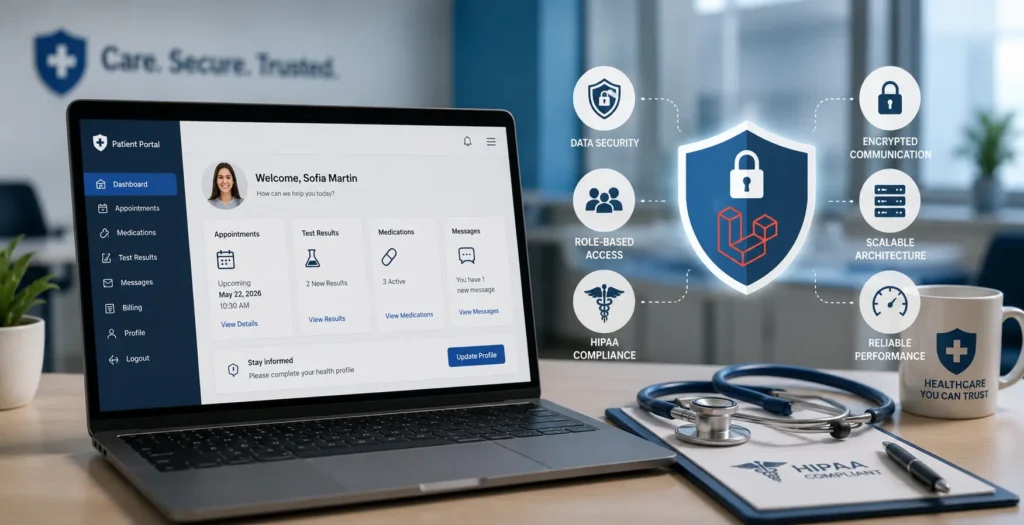
You can build a patient portal in CodeIgniter. You can build one in Symfony or Yii. What you cannot do easily in those frameworks is compose the full stack of security primitives a HIPAA-compliant portal requires without spending significant time and budget on custom infrastructure that Laravel ships with by default. That is the practical reason healthcare organizations keep choosing it, not because it is the trendiest framework, but because it handles the hard parts without fighting you.
Table Of Contents
Table Of Contents
Patient portals are more demanding than most applications
Here is what a patient portal actually needs to do, stated plainly. It stores and serves protected health information. It needs to know, precisely, who is allowed to see which records and enforce that at every access point. It needs an audit trail detailed enough that an OCR investigator can reconstruct what happened to any piece of patient data going back six years. It needs to connect to EHR systems through APIs that are both secure and reliable. And when flu season hits and everyone tries to book an appointment on the same morning, it needs to stay up.
Most PHP frameworks have the primitives to handle these requirements. Laravel is the one where assembling those primitives into a production system does not generate new problems at every step. The authentication layer, the authorization system, the logging infrastructure, the queue management, the API tooling: they were designed to work together. They do.
How encryption actually works in a Laravel healthcare build
HIPAA requires encryption of ePHI at rest and in transit. That sentence is easy to write and harder to implement correctly than it sounds. The failure mode that shows up most often in healthcare applications is inconsistent encryption: some fields protected, others not, with the inconsistency discovered during a security audit rather than before launch.
Laravel’s built-in encryption uses OpenSSL with AES-256-CBC. Every encrypted value gets signed with a message authentication code before it is stored, which means the application catches tampering before decryption rather than after. Calling encrypt() and decrypt() throughout the application is consistently using the same cipher configuration and the same application key, not a different implementation decision made by whoever wrote each model.
For data in transit, Laravel enforces HTTPS through middleware and its HTTP client handles TLS configuration for outbound requests including EHR integrations. The practical upshot is that your team is not making low-level cryptographic implementation decisions on a system where getting them wrong triggers regulatory penalties. They are working within a tested implementation and spending their time on the application logic that actually varies by project.
Authentication on a portal used by stressed, non-technical patients
HIPAA access control requirements cover unique user identification, automatic logoff after inactivity, and emergency access procedures. Laravel’s authentication system covers all of that without custom development.
What is worth thinking through for a patient portal specifically is the user population. Patients accessing their health records are often anxious, sometimes in pain, occasionally elderly or not technically confident. The authentication experience that works for a developer portal does not work for a 68-year-old trying to view their lab results for the first time.
Laravel Sanctum handles API token authentication for mobile and web clients. Fortify and Jetstream provide production-ready MFA using time-based one-time passwords, which satisfies HIPAA’s technical access control requirements. Session timeouts are configurable per role. Clinical staff on shared workstations need short windows, patients on personal devices can reasonably have longer ones. Social OAuth is available for organizations that want to reduce password management burden by federating identity to Google or Apple.
The security protections built into the authentication layer are worth understanding too. Constant-time string comparison prevents timing attacks on password checks. Built-in rate limiting on login endpoints stops credential stuffing. Configurable lockout after failed attempts handles brute force. A healthcare development team should not be implementing any of these from scratch under a compliance deadline.
Role-based access control that holds up under audit
“The user is logged in” is not an access control strategy for an application handling medical records.
A patient portal serving a multi-specialty clinic has multiple user types: patients who can see their own records and nothing else, clinical staff who can access records for patients on their care team, billing staff who need demographic and insurance data but not clinical notes, and administrators who manage the system without necessarily having access to any patient data. Those distinctions need to be enforced at every access point, and the enforcement needs to be visible to an auditor.
Laravel’s Policies and Gates define access rules at the model level. A care team nurse’s permission to view a patient record does not automatically extend to viewing records for patients outside their assignment. That restriction is enforced through a named, testable Policy rather than through a WHERE clause that someone might forget to include. When a compliance auditor asks how the system prevents billing staff from viewing clinical notes, the answer is a specific Policy class you can show them, not a verbal description of how the queries work.
Spatie’s Laravel Permission package sits cleanly on top of this, handling role hierarchies and permission assignment without building custom RBAC infrastructure. Most patient portals need three to five distinct roles. The combination of Laravel’s native policy system and Spatie’s package covers that without reinventing the access control layer.
Audit logging that actually satisfies OCR requirements
The HIPAA audit control standard says systems containing ePHI must have mechanisms to record and examine activity. Every access. Every modification. Every failed login. Every administrative action. Tamper-evident. Retained for six years minimum.
Laravel’s Eloquent ORM fires observer events on every create, update, and delete. For a patient portal, that means every change to a record, appointment status, or access control assignment generates an event with the user identity, timestamp, and the specific data changed. Monolog routes these events to whatever log store the architecture requires, including external aggregation services that the application itself cannot modify after the fact.
The architectural decision that matters here is not which Observer class to write. It is where the logs go and how they are protected from tampering. Laravel gives you the event capture mechanism. Your team decides on the log store, the retention policy, and the access controls that make the audit trail tamper-evident. That is the right division of responsibility. Framework handles the plumbing, your architects handle the compliance design.
Building a patient portal and want to talk through the Laravel architecture before the project scoping starts? Our team has built HIPAA-compliant Laravel applications for healthcare organizations.Schedule a technical consultation and we can discuss your specific access control, audit, and integration requirements.
EHR integration: where most of the actual complexity lives
A patient portal that cannot talk to the organization’s EHR is a standalone database with a nice interface. The integration layer is where most patient portal projects spend most of their time and budget, and where the gap between teams that have done it before and teams that haven’t becomes most visible.
Modern EHR systems like Epic, Cerner, and Athenahealth expose FHIR APIs protected by OAuth 2.0 SMART on FHIR authentication. Laravel’s HTTP client handles that authentication flow. API Resources handle the serialization and deserialization of FHIR-formatted data into and out of the application’s data model. The queue system handles synchronization asynchronously: when a patient updates their contact information in the portal, that update propagates to the EHR without making the patient wait for the external API to respond before they see a confirmation screen.
Older EHR systems that still use HL7 v2 message formats require middleware that transforms those messages into structures Laravel can work with. This is an area where prior EHR integration experience on the development team matters as much as the framework. Laravel doesn’t create obstacles, but it also doesn’t solve the problem of an EHR vendor with incomplete API documentation and a support team that answers tickets in two weeks. That is a project management problem as much as a technical one.
One thing worth knowing about Epic specifically: API access tiers vary. What your application can access depends on whether you are a certified app, a licensed partner, or using Epic’s open access tier. Understanding which tier applies to your project affects the integration design before any code is written.
Performance when 3,000 patients try to book appointments on Monday morning
Healthcare traffic is not flat. A patient portal for a regional health system might handle a few hundred concurrent users on a Tuesday afternoon and several thousand during the window that opens after a public health advisory. A portal that handles average load fine but degrades under spikes is an operational problem for the organization and a patient experience problem at exactly the wrong moment.
Laravel’s queue system moves background processing off the main request thread. Appointment confirmation emails, PDF generation for record summaries, EHR sync operations, bulk administrative tasks: all of these happen in the background without blocking the request cycle. Redis or Memcached handles in-memory caching for reference data that gets queried constantly but changes rarely: provider availability grids, location directories, service type lookups. Database load on read-heavy pages drops significantly with proper cache configuration.
Horizontal scaling is straightforward with Laravel: stateless sessions stored in Redis, cache external, queue workers distributed across multiple processes or servers. The application code doesn’t change when you add capacity. That matters for healthcare organizations that need to plan for growth over a three to five year application lifetime rather than optimizing only for the day of launch.
Why not Symfony? Why not CodeIgniter?
This question comes up in every framework evaluation, so it is worth being direct about it.
Symfony is a mature, well-engineered framework and it is not a wrong choice for healthcare. The practical issue is that Symfony’s ecosystem for RBAC management, audit logging, and API development requires more custom assembly than Laravel’s equivalent. The packages exist, but the defaults are lower-level and the integration work is heavier. For a healthcare organization that wants to move fast without sacrificing compliance architecture, that assembly cost is real.
CodeIgniter is lightweight and has a smaller learning curve, which makes it appealing for teams with limited backend experience. It becomes a problem when the healthcare application grows. The ecosystem depth for the kinds of packages a production patient portal depends on, sophisticated RBAC, production-grade audit logging, queue management, FHIR integration tooling, is simply not there at the same level. Teams end up building custom infrastructure in areas where Laravel has production-tested packages maintained by thousands of developers.
Laravel has the largest active developer community of any PHP framework. When you need to hire a developer two years after launch because someone leaves, Laravel expertise is available. That is not a small thing for an application that will be in production for years and needs ongoing maintenance.
What to expect from a Laravel patient portal project
Before code, architecture. This is not optional and it cannot be compressed. The access control model, audit logging architecture, encryption key management, EHR integration design, hosting environment, and BAA coverage all need to be defined and documented before a line of application code is written. That documentation is the foundation of the compliance program. It is also the thing an OCR investigator would want to see.
After architecture comes the backend API build: data model, business logic, authentication, authorization, audit logging, and EHR integration. This is the compliance-critical layer. It gets the most attention in code review and the most scrutiny in the pre-launch security audit.
Frontend work happens in parallel or sequentially depending on team structure. Laravel works well as an API backend for a React or Vue frontend. For teams that want to stay in the PHP ecosystem, Livewire or Inertia.js keep frontend development close to the backend without the context-switching of a fully separated architecture.
Nothing goes live until a penetration test runs against the production environment and the results are reviewed against the HIPAA technical safeguard requirements. Patient data enters the system after that, not before.
The realistic timeline for a focused MVP, authentication, appointment scheduling, secure messaging, document access, and one EHR integration, is 16 to 24 weeks from architecture kickoff to production launch. Multi-provider access, multiple EHR integrations, or custom clinical workflows extend that.
Ready to scope a Laravel patient portal project? Tell us your EHR system, your expected patient volume, your compliance requirements, and your timeline. We will give you an honest architecture recommendation and project estimate.Contact our team.
Not on its own, but it is the most HIPAA-ready PHP framework available. Laravel gives you AES-256 encryption, configurable MFA, role-based access control, audit-capable event logging, and HTTPS enforcement as standard components. What turns those components into HIPAA compliance is correct implementation at the application layer, a compliant hosting environment, BAAs with every vendor in the stack, and operational policies covering access, incident response, and risk analysis. Laravel handles the hard development parts. The compliance architecture around it is still your team’s responsibility.
What does a Laravel patient portal cost to build?
A focused portal with authentication, appointment scheduling, secure messaging, document access, and one EHR integration runs $60,000 to $120,000 for an initial build. The range reflects real variation: EHR integration complexity differs significantly by system, and a multi-provider organization with role hierarchies across departments is substantially more scope than a single-location clinic. Post-launch maintenance, security patching, and annual penetration testing add ongoing cost that should be in the budget before the project starts.
How does Laravel handle audit logging for HIPAA?
Eloquent model observers fire on every database create, update, and delete, capturing the authenticated user, the timestamp, the model type, and the specific fields that changed. Those events route through Monolog to whatever log store the architecture requires, including external services that the application itself cannot modify after the fact. The event capture mechanism is built in. Where logs go, how they are protected from tampering, and how long they are retained are design decisions your team makes based on the compliance requirements.
Can Laravel integrate with Epic, Cerner, or Athenahealth?
Yes. The HTTP client handles the OAuth 2.0 SMART on FHIR authentication flow those APIs require. The queue system handles asynchronous sync without blocking patient sessions. API Resources handle FHIR data serialization. Integration complexity varies significantly by EHR system and access tier. Epic in particular has different API capabilities depending on whether your application is certified, licensed, or using open access. Sorting out which tier applies to your project affects the integration design before development starts.
How long does a Laravel patient portal build take?
A focused MVP with authentication, scheduling, messaging, document access, and one EHR integration is realistically 16 to 24 weeks from architecture kickoff to production launch. Multi-provider organizations, multiple EHR integrations, or custom clinical workflows extend the timeline. The architecture and compliance scoping at the start is not time that can be traded away. It produces the documentation the compliance program depends on and surfaces design decisions that are far cheaper to make before coding starts than after.
Why Laravel instead of Node.js for a patient portal?
Patient portal data is fundamentally relational. Patient records, appointments, provider relationships, and access permissions all connect to each other in ways that relational databases and Eloquent ORM handle naturally. Node.js has genuine advantages in real-time features and high-throughput scenarios. For a portal where the priorities are data integrity, audit auditability, compliance-grade access control, and long-term maintainability by a team that will change over the application’s lifetime, Laravel’s architecture and its hiring market fit that better than a Node.js stack does for most healthcare organizations.
Conclusion
The framework choice matters less than what the team does with it. But the framework choice determines how hard it is to do the right things under time and compliance pressure. Laravel makes the right things easier: not trivially easy, but meaningfully easier than the alternatives. That is why healthcare organizations with CTOs and IT Directors who have done this before tend to land on it.
KrishaWeb builds Laravel patient portals for healthcare organizations where the compliance architecture is not an afterthought. Our laravel development services include healthcare application builds with HIPAA safeguards designed in from the first architecture conversation, and ourAI consulting team helps integrate AI-powered patient engagement features within the compliance boundary when that is part of the project scope.
If you are scoping a patient portal project and want to talk through the architecture before committing to a development approach, that conversation is free, and there is no proposal until you are ready.
Lead of the Custom Development team at KrishaWeb, holds AWS certification and excels as a Team Leader. Renowned for his expertise in Laravel and React development. With expertise in cloud solutions, he leads with innovation and technical excellence.




 KrishaLabs
 KrishaStudio
 KrishaStore