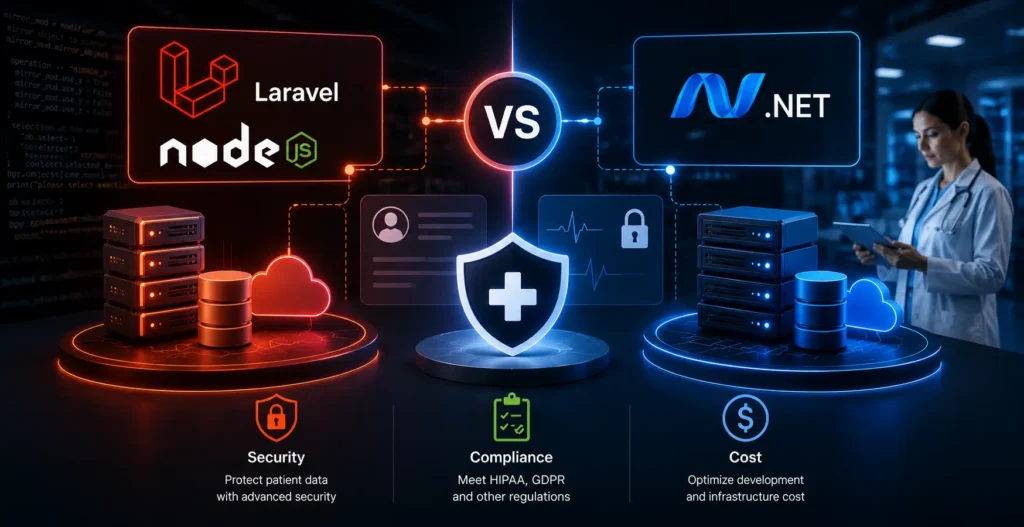
The stack decision for a healthcare application is not a preference conversation. It is a compliance architecture conversation that happens to involve technology choices. The framework that makes one team productive under deadline may be the same framework that makes the compliance program harder to build and harder to audit. Getting that wrong is expensive.
This comparison is written for CTOs and Solution Architects who already know the technical basics and want the honest tradeoffs. Not which framework has more GitHub stars. Which one produces a defensible HIPAA compliance posture, integrates cleanly with your EHR environment, and can be staffed, maintained, and extended three years after the initial build.
Table Of Contents
Table Of Contents
The three stacks and what they actually represent
Laravel, Node.js, and .NET are not interchangeable options occupying the same tier of the technology stack. They make different assumptions about your team, your compliance approach, and what you are building.
Start with what each one actually is, plainly stated. Laravel is a PHP framework. It has opinionated defaults on security, a structured approach to relational data through Eloquent, and the largest active PHP developer community in the world. The security primitives compose into a compliant system without significant custom infrastructure because that is how the framework was designed. It dominates PHP-based healthcare application development for a reason.
Node.js is a JavaScript runtime, not a framework. The distinction matters. It excels at high-concurrency, event-driven workloads: real-time dashboards, notification pipelines, telehealth platforms with live data. It handles 20,000 to 30,000 concurrent requests with low latency (Source: QServices), which is not just a benchmark number but the reason it fits certain healthcare product architectures that PHP and C# handle less naturally. The flip side is that the security stack gets assembled from packages rather than shipped with the runtime, which means your team’s discipline determines your security posture more than the framework’s defaults do.
.NET, specifically ASP.NET Core in 2026, is Microsoft’s cross-platform enterprise framework. Free, open source, and running equally well on Windows, Linux, and macOS. The reason it appears repeatedly in regulated industry conversations is not brand loyalty, it is the depth of the compliance tooling integration with Azure, Microsoft Defender, and Azure Monitor. For healthcare organizations already running their compliance program on Microsoft infrastructure, that integration is a real and practical operational advantage (Source: Faciletechnolab).
Security architecture: what each stack gives you out of the box
This is the question that matters most for a healthcare build, and it is worth being specific about what “out of the box” actually means.
Laravel
Laravel’s security primitives are built into the framework core and are designed to work together. AES-256-CBC encryption through the Encrypter class, CSRF protection on every state-modifying request, XSS filtering through Blade’s output escaping, bcrypt password hashing, and configurable rate limiting on authentication endpoints are all present without package installation.
For HIPAA-specific requirements: the authentication layer handles unique user identification, configurable session timeouts, and MFA through Fortify and Jetstream. Eloquent model observers provide event hooks for audit logging that fire on every database operation, which maps directly to HIPAA’s audit control standard. Spatie’s Laravel Permission package, the de facto RBAC implementation in the ecosystem, handles role hierarchies that cover the multi-user-type requirements of any patient-facing application.
What Laravel does not do is guarantee compliance. It gives you the components to build a compliant application. Whether those components are implemented correctly for a HIPAA use case depends on the development team’s understanding of the requirements, which is a distinction worth maintaining clearly.
Node.js
Node.js’s security story is more fragmented, and that fragmentation is both its strength and its liability in a healthcare context.
The strength is flexibility. Your team can assemble exactly the security stack the application requires, choosing among Passport.js for authentication, Helmet for HTTP security headers, bcrypt for password hashing, and express-rate-limit for rate limiting. When a healthcare-specific need arises that no opinionated framework anticipated, Node.js doesn’t fight you.
The liability is that the responsibility for correct assembly sits entirely with your team. Laravel has opinionated defaults that protect against common vulnerabilities even when a developer doesn’t know to think about them. Node.js does not. A healthcare application built by a Node.js team that does not have deep security experience will have gaps that a Laravel or .NET application with equivalent team experience would not, because the frameworks don’t give them the same protective defaults.
This matters most in the context of hiring. If your team is established and experienced with Node.js security, the flexibility advantage is real. If you are building a new team or relying on developers who are strong in Node.js generally but not specifically in healthcare application security, the lack of opinionated defaults increases risk.
.NET (ASP.NET Core)
.NET’s security architecture is the most integrated of the three, and in a specific type of healthcare organization, that integration is a genuine advantage.
ASP.NET Core’s built-in identity system handles user management, claims-based identity, external OAuth providers, and multi-factor authentication within a single coherent framework that also integrates with Azure Active Directory for enterprise identity federation. The Data Protection API handles encryption with automatic key rotation, which solves a key management problem that many development teams handle poorly. The structured security middleware pipeline makes it easier to trace exactly which security checks apply to which endpoints, which is useful when an auditor asks precisely that question.
For organizations already using Azure or Microsoft 365, the compliance tooling integration is a practical advantage. Azure’s HIPAA compliance configurations, Microsoft Defender for Cloud, and the audit logging infrastructure in Azure Monitor all connect to .NET applications more naturally than to a PHP or Node.js stack on the same cloud. That is not a small operational benefit for a hospital IT team that is already managing its compliance program on Microsoft infrastructure.
The cost is complexity on the development side. ASP.NET Core has a steeper learning curve than Laravel for teams new to it, and the more structured nature of C# means more verbose code for tasks that PHP handles with less ceremony. That verbosity is a feature in large enterprise codebases where explicit structure prevents mistakes. It is overhead in smaller teams building focused applications under tight timelines.
HIPAA compliance mapping: how each stack addresses the Technical Safeguards
HIPAA’s Technical Safeguard requirements under 45 CFR 164.312 cover five areas. Rather than listing them in parallel, it is more useful to talk through where the real differences between the stacks show up, because three of the five are relatively equivalent across frameworks and two are genuinely differentiated.
Access control is where the differences are most practically visible. All three stacks get you to role-based access control, but through different mechanisms. Laravel centralizes authorization logic in named Policy classes, which means when a compliance auditor asks how the system prevents billing staff from viewing clinical notes, you can point to a specific, testable class rather than explaining a set of middleware conditions distributed across the codebase. .NET’s claims-based authorization with Azure AD integration is the stronger path for organizations managing identity at the enterprise level across multiple applications. Node.js handles access control through middleware and packages like CASL, which works well for experienced teams and requires more deliberate governance than the other two.
Audit controls are where Node.js falls furthest behind. Laravel’s model observer pattern fires on every Eloquent database operation and routes through Monolog to whatever log store the architecture requires. .NET’s structured logging through Serilog or NLog connects naturally to Azure Monitor for hospital-adjacent organizations that already run compliance programs on Microsoft infrastructure. Node.js audit logging requires explicit architectural decisions that may not be made consistently across a development team unless a senior architect specifies them clearly and the team enforces them in code review.
On integrity, Laravel’s Encrypter signs every value with an HMAC before storage, catching tampering before decryption rather than after. .NET’s Data Protection API includes the same built-in verification. Node.js requires explicit implementation of message authentication codes through packages, which is not complicated but is an additional decision the team needs to consciously make.
MFA and transmission security are roughly equivalent across all three stacks. Laravel uses Fortify, .NET uses ASP.NET Core Identity, Node.js uses Passport.js with OTP packages. HTTPS enforcement is framework-level in Laravel and .NET, middleware-level in Node.js. All three are capable of satisfying these requirements. How well depends more on the team than the framework.
Working through a stack decision for a healthcare application and want a second opinion before you commit? Our team has built healthcare applications across Laravel and Node.js for organizations with different compliance profiles and EHR environments.Talk to our team about your specific requirements.
EHR integration: where the real complexity lives
No comparison of healthcare application stacks is complete without addressing EHR integration, because it is where most of the actual complexity and most of the project risk concentrates.
FHIR (Fast Healthcare Interoperability Resources) has become the primary API standard for modern EHR integrations. Epic’s FHIR API, Cerner’s Millennium platform, and Athenahealth’s REST API all implement SMART on FHIR authentication, which uses OAuth 2.0 with specific healthcare-profile scopes. Every stack handles this through HTTP client libraries.
The HTTP client of Laravel (which is based on Guzzle) takes care of the OAuth 2.0 SMART on FHIR authentication flow easily. The queuing system manages the process of synchronizing EHR data asynchronously without interfering with patients’ sessions. The API Resources do the FHIR data serialization from and into the domain model of the application.
Node.js FHIR integration typically uses packages like fhir-kit-client alongside Axios or the native fetch API for HTTP operations. The event-driven architecture is a natural fit for the asynchronous nature of EHR data sync, and teams that are doing significant real-time data operations, remote patient monitoring, or streaming clinical data feeds will find Node.js’s non-blocking model genuinely useful here.
.NET has the most mature FHIR integration ecosystem through Microsoft’s FHIR Server for Azure and the Firely SDK, which provides a strongly-typed C# representation of FHIR resources. For organizations building on Azure and targeting enterprise EHR environments, the integration story is more complete and more documented than what’s available in the PHP or Node.js ecosystems. This is the area where .NET’s enterprise tooling advantage is most visible.
Legacy EHR systems using HL7 v2 message formats are another consideration. All three stacks handle HL7 v2 through parser packages or middleware layers. The quality and maintenance status of those packages varies. Teams that expect significant HL7 v2 integration work should evaluate the specific packages they’ll be using as part of the stack decision, not just the framework.
Developer cost and hiring
This is where the comparison often gets oversimplified. Both .NET Core and Node.js are free and open source. There is no licensing cost difference between them at the framework level. The cost difference that matters is in the team (Source: Faciletechnolab).
Senior Node.js backend developers command $80 to $150 per hour in North America, $35 to $70 per hour in Eastern Europe, and $18 to $45 per hour in South Asia for experienced teams with verifiable healthcare project history (Source: HourlyDeveloper). .NET developers in enterprise healthcare markets tend toward the higher end of those ranges in North American and Western European markets due to the seniority profile that .NET enterprise work tends to require. PHP and Laravel developers are broadly available at competitive rates across all regions, with a deep talent pool that makes hiring less constrained than either .NET or Node.js specialists.
The more important cost variable is what comes after the build. Healthcare applications are long-lived. A patient portal or clinical management system that goes live in 2026 needs to be maintained, updated for new compliance requirements, extended with new features, and supported by a team that may not be the original development team in three years. Long-term maintainability costs favor .NET in stable enterprise environments where the predictability of a structured, statically-typed system reduces the risk of maintenance mistakes over time. They favor Laravel in environments with active PHP developer availability. They are most variable in Node.js environments because the JavaScript ecosystem’s rapid evolution can create significant dependency management overhead on long-lived applications that aren’t actively maintained.
When to choose each stack
The feature comparison matters less than this question, so it is worth being direct about it.
Laravel is the right default for most web-facing healthcare application builds where the primary concerns are relational data structure, composable security primitives, and access to a large developer pool that can staff and maintain the project over time. If your team knows PHP, or if you need a development partner who can deploy experienced developers efficiently, Laravel gets you to a working, compliant system faster than the other two. The organization also needs to not have an existing Microsoft infrastructure investment that creates a natural pull toward the .NET ecosystem.
Node.js earns its place when real-time capability is genuinely core to the product’s value, not just a nice-to-have. Remote patient monitoring platforms where clinicians see live vitals, telehealth systems with streaming video and data, patient engagement tools with notification pipelines that need to handle thousands of concurrent connections: these are the use cases where Node.js’s event-driven model is an architectural fit, not just a preference. The caveat is team experience. Node.js in a healthcare context requires security discipline from the team because the framework does not impose it. Strong in Node.js generally is not the same as strong in Node.js healthcare security.
The case for .NET is most compelling when the organization is already in the Microsoft ecosystem. Azure for cloud infrastructure, Microsoft Defender for security monitoring, Azure Monitor for compliance logging: if these are already in place, the integration story for a .NET application is more complete than you can reasonably replicate with Laravel or Node.js on the same cloud. The compliance documentation requirements that come with hospital-adjacent applications also favor .NET’s structured architecture, where the middleware pipeline makes it easier to demonstrate exactly which security controls apply to which endpoints.
There is a fourth option that comes up more often than the clean binary choice: hybrid architectures where a Laravel or .NET API handles data management, authentication, and compliance-critical operations, while a Node.js service layer handles the real-time components. For healthcare platforms with both complex relational data and genuine real-time requirements, this pattern is worth evaluating rather than forcing the whole application onto one runtime.
Not sure which stack fits your specific healthcare build? Walk us through the application, the EHR environment, the compliance requirements, and the team you have. We’ll give you an honest recommendation.Schedule a consultation with our team.
Is Laravel or .NET better for HIPAA-compliant healthcare applications?
Both are capable of producing HIPAA-compliant applications. The honest distinction is that .NET’s structured security architecture and Microsoft compliance ecosystem integration give it a practical advantage in enterprise hospital environments already running on Azure and Microsoft infrastructure. Laravel’s composable security primitives, opinionated defaults, and large developer pool make it the more accessible choice for most web-facing healthcare application builds outside that Microsoft ecosystem. The compliance outcome depends more on the team’s implementation discipline than on the framework choice.
Can Node.js be used for HIPAA-compliant applications?
Yes, but with more architectural discipline required from the development team. Node.js does not have the opinionated security defaults that Laravel and .NET provide. The security stack is assembled from packages rather than provided by the framework, which means a team without strong healthcare security experience can build a Node.js application that handles HIPAA requirements correctly or one that misses significant gaps. For real-time healthcare applications where Node.js’s event-driven model is a genuine fit, teams with appropriate security expertise can build fully compliant systems. For organizations evaluating teams rather than building with established staff, the lack of protective defaults in Node.js is a higher-risk posture.
What is the cost difference between building a healthcare application in Laravel vs .NET?
At the framework level, both are open source and free. The cost difference is in the team. Laravel PHP developers are broadly available across all hiring markets at competitive rates. Senior .NET developers with healthcare experience tend toward the higher end of enterprise development rates, particularly in North American markets. Node.js developers vary widely by experience level and region. Long-term maintenance costs may favor .NET in stable enterprise environments due to C#’s structured typing reducing maintenance risk over time, but this depends heavily on team continuity and the specific application’s change frequency.
Which framework would work best for EHR integration in 2026?
When it comes to FHIR-based integrations with modern EHR systems like Epic and Cerner, all three stacks have their advantages via their own HTTP clients and FHIR package systems. The .NET framework already has mature FHIR tooling with products like Microsoft’s FHIR Server for Azure and the Firely SDK. Hence, this functionality may be the biggest asset for corporate environments that rely on Azure as a platform. Laravel and Node.js also make FHIR integration easy with the help of Guzzle and FHIR-kit-client respectively. If you deal with HL7 v2 legacy integrations, the choice of package used will matter much more than the framework.
Should I use .NET if my organization already uses Microsoft Azure?
If your organization is already running on Azure and using Microsoft’s compliance infrastructure, Microsoft Defender, and Azure Monitor for your compliance program, .NET’s integration with those tools is a practical advantage worth weighing. The audit trail, identity management, and compliance documentation that connects to Azure’s healthcare compliance configurations is more complete for a .NET application than for a Laravel or Node.js application on the same cloud. Outside the Microsoft ecosystem, that advantage disappears.
What healthcare applications are Node.js best suited for?
Real-time patient engagement platforms, telehealth applications with live video and data streams, remote patient monitoring dashboards with live clinical data, and high-concurrency appointment booking systems are the use cases where Node.js’s event-driven model produces a genuine architectural advantage. For these applications, Node.js’s ability to handle 20,000 to 30,000 concurrent connections with low latency is not just a performance number. It is the reason the application can work at the user volumes healthcare platforms at scale actually need.
Conclusion
If there were a universally correct answer to this question, the conversation would not keep coming up in every healthcare CTO evaluation we’re part of. The reason it keeps coming up is that the right stack genuinely depends on things that vary by organization: what the team knows, what cloud infrastructure is already in place, what the EHR environment looks like, and whether the application’s real-time requirements are genuine architectural drivers or features that can be handled by other means.
Most web-facing healthcare application builds land on Laravel. The developer availability, the composable security primitives, and the speed of getting to a working compliant system make it the practical default for teams that aren’t already committed to a Microsoft ecosystem. Real-time platforms are the exception, and Node.js’s event-driven model earns its place there when the team has the security experience to match. .NET’s case rests almost entirely on the Microsoft infrastructure alignment, and for organizations where that alignment exists, it is a genuine advantage worth taking seriously.
The decision KrishaWeb makes with healthcare clients is based on those specific inputs, not a framework preference. We’ve built HIPAA-compliant healthcare applications across Laravel and Node.js for organizations with different team profiles and EHR environments. Ourweb design anddevelopment services include healthcare application development scoped to the compliance architecture first, and ourAI consulting team helps integrate AI-powered clinical and patient engagement features within the compliance boundary when that is part of the project scope.
If you are working through a stack decision for a healthcare build, we are happy to talk through the specifics before you commit to an architecture.
Lead of the Custom Development team at KrishaWeb, holds AWS certification and excels as a Team Leader. Renowned for his expertise in Laravel and React development. With expertise in cloud solutions, he leads with innovation and technical excellence.




 KrishaLabs
 KrishaStudio
 KrishaStore